


I remember staring at the screen in late 2022, watching the GBP/USD chart.

Sarah Collins
Trading Strategist ·  United Kingdom
☕ 12 min read
What you'll learn:
- 1What the Hell is a 'Lot' Anyway?
- 2Why Lot Size is Everything (It's Not What You Think)
- 3How to Calculate Your Lot Size: A UK Worked Example
- 4Lot Size in the Shadow of the FCA
- 5Lot Size Mistakes I've Made (So You Don't Have To)
- 6Beyond the Basics: When to Adjust Your Size
- 7Your Lot Size Checklist Before Hitting 'Buy'
I remember staring at the screen in late 2022, watching the GBP/USD chart. The Bank of England had just made another dovish comment, and cable was dropping like a stone. I was in a 2-lot short, my biggest position that month. Each pip was worth $20. As it fell 50 pips, then 100, the profit was intoxicating. Then it reversed. Hard. That £1,000 paper profit evaporated in minutes, turning into a £400 loss before I could even think. I'd broken my own cardinal rule: I'd let the potential profit dictate my lot size, not my risk tolerance. That's the power - and the danger - of getting your forex trading lot size wrong.
Let's cut through the jargon. A 'lot' is just the standardized batch size for a forex trade. It's the container your trade comes in. Think of it like buying eggs: you can buy a full dozen (a standard lot), a half-dozen (a mini lot), or just a couple (a micro lot). The size of that container directly determines how much each tiny market movement (a pip) is worth in cold, hard cash.
Here’s the breakdown you need memorised:
| Lot Type | Units of Base Currency | Typical Pip Value (USD Quote) | What It Looks Like on MT5 |
|---|---|---|---|
| Standard Lot | 100,000 | $10 | 1.00 |
| Mini Lot | 10,000 | $1 | 0.10 |
| Micro Lot | 1,000 | $0.10 | 0.01 |
| Nano Lot | 100 | $0.01 | 0.001 |
Most UK brokers, like Pepperstone or IG, will let you trade down to 0.01 lots (micro lots). This is a godsend for beginners. Back when I started, many platforms only went down to 0.1 lots. Throwing £500 into an account and opening a 0.1 lot trade on GBP/JPY was a surefire way to see a margin call before your first cup of tea went cold.

Example: You buy 0.05 lots of EUR/USD. That's 5,000 euros (100,000 * 0.05). If EUR/USD moves 1 pip (0.0001), your P&L changes by $0.50 ( $10 standard pip value * 0.05 lots).
The base currency is the first one in the pair. In GBP/USD, it's pounds. So, 1 standard lot is a £100,000 position. Your profit or loss is then converted and shown in your account currency (usually GBP for us). This is where your broker's spread comes in as the immediate cost of doing business.
New traders get obsessed with entries. Where to buy? Where to sell? Veterans get obsessed with position sizing. The entry is just the invitation to the party; the lot size determines whether you have a quiet drink or burn the house down.
The use Trap
This is the big one, especially under FCA rules. The FCA caps use for retail clients at 30:1 on majors. That means with £1,000, you can control a £30,000 position. Your broker lets you select a 1.00 lot trade on EUR/USD (€100,000). That's 100:1 use on your equity if your account is in pounds! The platform might not stop you, because the notional value of the trade is within the 30:1 limit relative to the margin required. But the risk to your account is enormous.
I fell for this early on. I had a £2,000 account with an FCA broker. I saw "30:1 use" and thought, "Great, I can use it all!" I opened a 0.3 lot position on AUD/USD. That was a $30,000 position. A mere 67-pip move against me would wipe out 10% of my account. It happened in one afternoon on a Chinese data release. A £200 lesson learned the hard way.
The Real Goal: Risk Per Trade
Your lot size should be a function of one thing only: how much you are willing to lose on that single trade. Full stop. Not how confident you are, not how big the potential profit is. Your risk.
Most serious traders risk between 0.5% and 2% of their account balance per trade. Let's say you have a £5,000 account and you're comfortable with a 1% risk (£50). You analyse EUR/USD and decide your stop loss needs to be 25 pips away from your entry. Your lot size is now dictated by that math.

Pro Tip: Never calculate lot size in your head. Use a position size calculator. Every. Single. Time. It takes 10 seconds and removes emotion from the most critical part of the trade.
Getting this wrong is why the FCA forces brokers to display those warnings that 68-77% of retail clients lose money. It's not because the markets are rigged (though they're tough). It's because people trade lots that are too big for their account size. They get a few wins, get overconfident, size up, and one loss destroys weeks of gains. I've been that guy.

💡 Winston's Tip
If you feel a thrill of excitement when you see the potential profit on a large lot size, that's your signal to reduce the position by half. Greed is an awful risk manager.
“Your lot size should be a function of one thing only: how much you are willing to lose on that single trade.”
Let's make this concrete. You're trading from Leeds, your account is with an FCA-regulated broker like IC Markets, and your balance is £8,000.
Your Trading Plan Parameters:
- Account Balance: £8,000
- Risk Per Trade: 1.5% (£120)
- Trade Idea: Buy GBP/USD at 1.2600
- Stop Loss: 1.2550 (50 pips risk)
- Account Currency: GBP (This matters for the calculation!)
Step 1: Find the Pip Value in GBP. For GBP/USD, the standard pip value is $10. But your account is in GBP, so we need to convert. At an exchange rate of ~1.2600, $10 is worth about £7.94 (10 / 1.26).
Step 2: Calculate the Maximum Position Size. Your total risk is £120. Your risk in pips is 50. So, your risk per pip must be £120 / 50 = £2.40 per pip.
Step 3: Convert to Lots. If 1 standard lot gives you ~£7.94 per pip, how many lots give you £2.40 per pip? £2.40 / £7.94 ≈ 0.302 lots.
Step 4: Round Down and Execute. You'd enter a position of 0.30 lots. This is not a mini lot (0.10) or a micro lot (0.01) increment, which is fine on most modern platforms.
Now, what if you were trading USD/JPY? The calculation changes because the pip value is in JPY, then converted to USD, then to GBP. This is why using a calculator that knows your account currency is non-negotiable. A mistake here can mean risking £200 when you meant to risk £50.

Warning: If your account is in GBP and you're trading a cross pair like EUR/GBP, the pip value will already be in GBP. Don't double-convert! This is a common error that throws calculations completely off.
Trading in the UK isn't the wild west. The FCA's rules directly shape how you can use lot size and use, and frankly, they've saved a lot of amateurs from themselves.
The headline is the use cap: 30:1 on major pairs like EUR/USD, 20:1 on minors and gold. This isn't a suggestion; it's the law for any FCA-regulated broker serving retail clients. What does this mean practically?
It means the maximum position you can take is limited by your margin. But - and this is a huge 'but' - the use cap does NOT mean you should use all the use available. Using 30:1 use is like driving your car at 150 mph on the M1 because the speed limit allows 70. Technically possible, but utterly suicidal for your financial health.
The FCA also gives you two other critical shields:
- Negative Balance Protection: You can't lose more than you deposit. That 5-lot trade that goes catastrophically wrong? It zeros your account, but the broker can't come after your house. This is not the case in some other jurisdictions.
- Client Money Protection: Your funds are segregated. If the broker goes bust (rare, but it happens), your money isn't part of their assets to be claimed by creditors.
These rules allow you to focus on calculating your lot size based on smart risk management, not on fear of a life-altering debt. You should still treat every trade as if you could lose it all, but the regulatory backstop is there. Brokers like XM or Exness have different offerings for their UK (FCA) entities versus their global ones, precisely because of these rules.
💡 Winston's Tip
Your first calculation should always be 'What can I lose?' Not 'What can I win?' Start with the stop loss, then the lot size. The entry price is the last piece of the puzzle.
“Using 30:1 FCA use is like driving at 150 mph because the limit is 70. Technically possible, but suicidal.”
Let's get personal. Here's where I've blown up, or nearly blown up, by getting the lot size wrong.
Mistake 1: Scaling Into a Loss with the Same Lot Size. EUR/USD was drifting down. I bought 0.5 lots at 1.0950. It dropped to 1.0920. "It's a bargain now," I thought, and bought another 0.5 lots. It dropped to 1.0890. My conviction was stronger than the chart, so I bought a final 0.5 lots. I now had 1.5 lots with an average price of 1.0920, and the market was at 1.0870. A 50-pip move against my average was now a £750 loss on my £15k account. I was no longer trading; I was praying. The market didn't care. I got stopped out for a £900 loss. I'd turned a small, manageable 30-pip loss on a 0.5 lot trade into a catastrophe by adding to a loser with the same size.
Mistake 2: Ignoring Volatility. A 50-pip stop on GBP/USD during the London session is different from a 50-pip stop during a major news event like a US CPI release. I once placed a tight 20-pip stop on a 1-lot GBP/JPY trade just before BoJ news. The spread widened to 15 pips instantly, and I was filled and stopped out in a matter of seconds for a full loss. My lot size was calculated for a 20-pip risk, but the effective risk was far higher due to the volatile environment. Now, I widen my stops or significantly reduce my lot size around high-impact news.
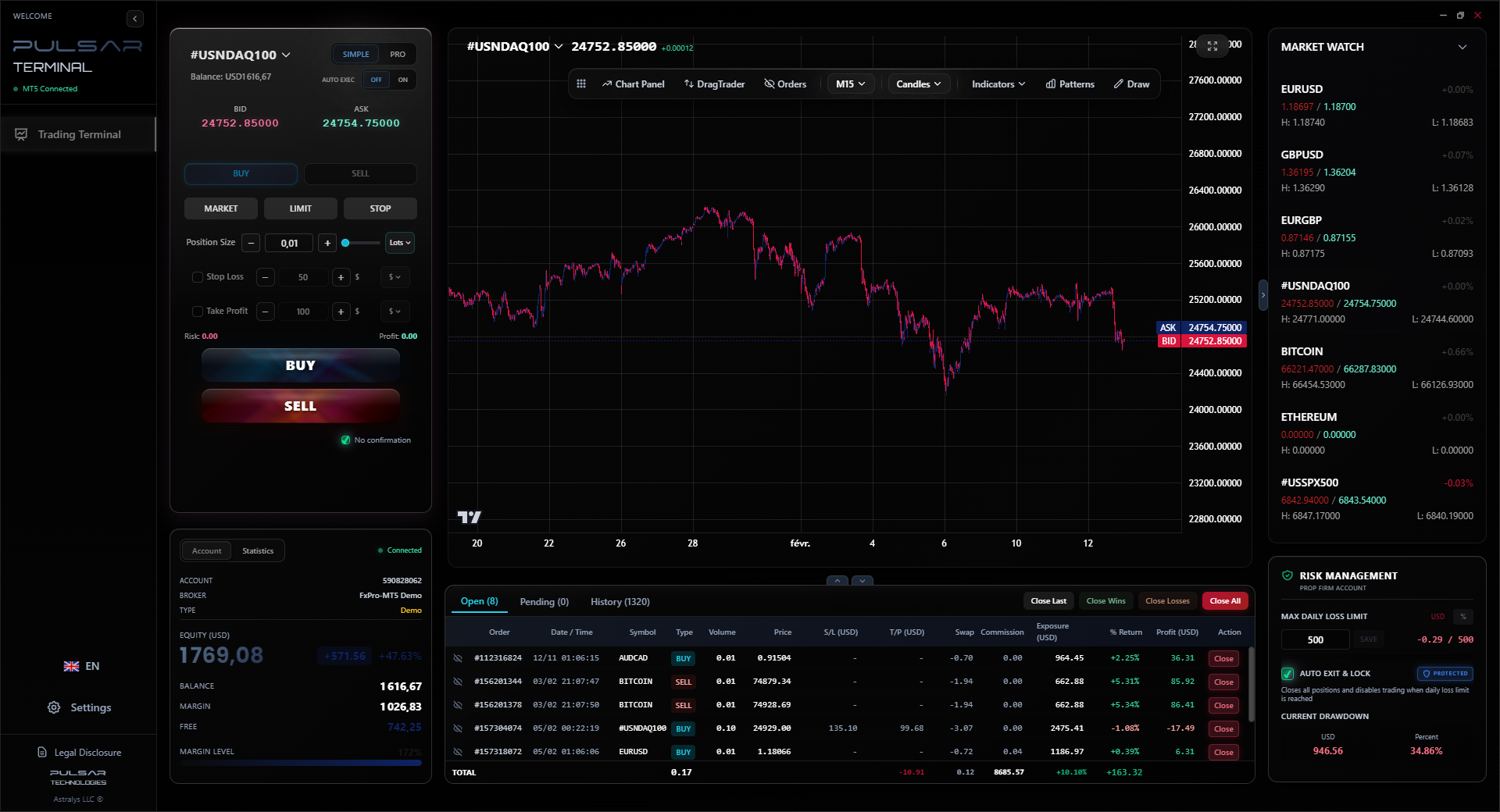
Mistake 3: Letting Winners Turn to Losers. This is the cousin of mistake #1. You're in a 0.2 lot trade on gold (XAU/USD), and it's up $800. You move your stop to breakeven. Then you think, "This is going higher, I'll add another 0.2 lots." The market reverses, hits your breakeven stop on the first lot, and now you're in a new, larger position that's immediately underwater. You've just turned a guaranteed $800 win into a live, risky trade. Managing multiple take-profit levels and trailing stops is a better approach, something tools like Pulsar Terminal can automate directly on MT5.
Once you've mastered the 1%-2% fixed risk model, you can start thinking more dynamically. This isn't for beginners.
Volatility-Based Position Sizing: Instead of a fixed stop in pips, use Average True Range (ATR). If the ATR(14) on EUR/USD is 70 pips, a "normal" day move is 70 pips. Setting a 20-pip stop is likely to get hunted. So, you set your stop at 1.5 x ATR, or 105 pips away. To keep your monetary risk the same (£100), you must trade a smaller lot size. Your risk is more consistent with market reality.
The Kelly Criterion (For the Mathematically Brave): This is a formula that suggests an optimal bet size based on your edge. If you have a historically proven strategy with a 55% win rate and a 1.5:1 reward-to-risk ratio, Kelly might tell you to risk 5% per trade. Most traders halve or quarter the "Kelly number" because it's aggressive. I dabbled with it. It's brilliant in theory but brutal during losing streaks. It can magnify drawdowns. Tread carefully.
Scaling In and Scaling Out: This is where precise lot management pays off. Instead of one 1-lot entry, you might enter with 0.3 lots, add 0.3 at a better price, and a final 0.4 if the trend confirms. Your average entry is better, and your total risk is spread. Similarly, you can take profit in portions: close 0.5 lots at your first target, move stop to breakeven on the rest, and let the final 0.5 lots run with a trailing stop. This turns a binary win/lose into a more nuanced outcome. It requires planning your lot sizes for each leg before you enter the first trade.
Managing complex entries, exits, and partial closures across multiple lot sizes is far simpler with a tool that automates it directly on your MT5 platform.
Pulsar Terminal
The all-in-one MT5 companion: drag-and-drop orders, multi-TP/SL, trailing stop, grid trading, Volume Profile, and prop firm protection. Used by 1,000+ traders daily.
“The traders who last are not the ones with the fanciest indicators. They're the ones with the discipline to get their lot size right.”
Make this a ritual. No exceptions.
- Check Your Account Balance: What's the real, usable equity right now? Ignore open profit.
- Determine Your Risk %: Is this a high-conviction trade (maybe 1.5%) or a speculative punt (0.5%)? Stick to your plan.
- Set Your Stop Loss FIRST: Based on technicals, not on how much you're willing to lose. The chart decides the stop, your risk % decides the lot size.
- Use a Calculator: Input: Account Balance, Risk %, Stop Loss in Pips, Currency Pair, Account Currency. Let it spit out the lot size.
- Check use: Is the required margin more than 5% of your account? If yes, your lot size is probably too big, even if the risk % seems okay. Aim for low effective use.
- Execute and Walk Away: Once the trade is on with the correct size, your job is mostly done. Manage the trade according to your plan, don't micromanage the P&L.
Lot size is the bridge between your analysis and your money. A brilliant trade idea with a reckless lot size is a losing trade. A mediocre idea with a perfectly sized lot can still be a profitable part of your overall edge. After 12 years, I can tell you the traders who last are not the ones with the fanciest indicators. They're the ones who have the discipline to get their forex trading lot size right, trade after trade, regardless of emotion. It's the most boring part of trading, and the most important.
FAQ
Q1What is the minimum lot size I can trade with in the UK?
Most FCA-regulated brokers, like Pepperstone, IG, and XTB, allow a minimum lot size of 0.01 (a micro lot, or 1,000 units of the base currency). Some may even offer 0.001 (nano lots). This allows for very precise position sizing, even with smaller accounts.
Q2How does FCA use affect my lot size choice?
The FCA's 30:1 use cap on major pairs sets a maximum limit on how much you can borrow from your broker. It does NOT mean you should use all of it. Your lot size should be determined by your risk-per-trade percentage (e.g., 1% of your account), not by the maximum use available. Using the full 30:1 is extremely high risk for retail traders.
Q3I have a £1,000 account. What's a safe lot size to start with?
With a £1,000 account, you should be trading almost exclusively in micro lots (0.01). If you risk 1% (£10) on a trade with a 50-pip stop, the math forces you into a tiny position - likely around 0.02 or 0.03 lots on a pair like EUR/USD. This feels small, but it protects your capital while you learn. Trying to trade 0.1 lots or more is a fast track to blowing up.
Q4How do I calculate lot size for pairs where GBP is not the quote currency?
You must convert the pip value to your account currency (GBP). For example, with USD/JPY, the standard pip value is in JPY (approx ¥1000). You convert that to USD, then to GBP at the current rate. This is why using a reliable position size calculator is essential - it handles these conversions automatically and prevents costly errors.
Q5Can I change my lot size for different trades?
Absolutely, and you should. Your lot size should be dynamic, calculated fresh for each trade based on your current account balance and the specific stop-loss distance for that trade. A volatile pair requiring a 100-pip stop needs a smaller lot size than a calm pair with a 20-pip stop, assuming you want to risk the same monetary amount (£) on both.
Q6What's the difference between lot size and position size?
Lot size is the standardized unit (e.g., 0.05 lots). Position size is the total monetary value of the trade. If you buy 0.05 lots of EUR/USD at 1.0800, your position size is €5,000. Lot size is the input; position size and its associated risk are the critical outputs you need to manage.
Prof. Winston's Lesson
Key Takeaways:
- ✓Calculate lot size fresh for every trade using a calculator.
- ✓Risk 1-2% of your account per trade, no exceptions.
- ✓FCA use caps are limits, not targets.
- ✓Micro lots (0.01) are your best friend when starting out.
How useful was this article?
Click a star to rate
Weekly Trading Insights
Free weekly analysis & strategies. No spam.
About the Author
Sarah Collins
Trading Strategist
London-based trading strategist with 12 years in financial markets. Former analyst at a City of London brokerage. Covers GBP pairs, European markets, and FCA-regulated trading.
Comments
Risk Disclaimer
Trading financial instruments carries significant risk and may not be suitable for all investors. Past performance does not guarantee future results. This content is for educational purposes only and should not be considered investment advice. Always conduct your own research before trading.
You Might Also Like

Cara Trading Forex Sukses: 7 Prinsip dari Trader Profesional
Cara trading forex sukses dengan 7 prinsip trader pro: manajemen modal, disiplin, journal trading, backtest. Data nyata, bukan janji profit palsu.
Jam Trading Forex Terbaik untuk Trader Indonesia: Panduan Lengkap dengan Tabel Waktu
Panduan jam trading forex untuk trader Indonesia. Tabel 4 sesi dunia, jam emas 20:00-00:00, sesi mana yang harus dihindari. Data akurat + tips dari trader berpengalaman.
Top 5 Sàn Forex Uy Tín Nhất 2026: Review Jujur dari Trader Indonesia
Top 5 sàn forex uy tín 2026 untuk trader Indonesia. Review jujur: spread, deposit, withdraw, dukungan lokal. Exness, XM, IC Markets & lebih.
Get Pulsar Terminal
All these calculators are built into Pulsar Terminal with real-time data from your MT5 account. One-click position sizing, automatic risk management, and instant calculations.
Get Pulsar Terminal