


You've seen the movies.

David van der Merwe
Emerging Markets Trader ·  South Africa
☕ 11 min read
What you'll learn:
- 1Hollywood Fantasy vs. South African Reality
- 2The Real Costs of Trading in South Africa (The Numbers Don't Lie)
- 3FSCA Rules & use: Your Safety Net, Not a Limitation
- 4Trading ZAR Pairs: The Volatility Nobody Warns You About
- 5Technical Analysis: It's Not Movie Magic
- 6The Real Psychology: Why South African Traders Blow Up
- 7Building a Real Edge (Forget the Montage)
- 8Final Reel: Your Credits Sequence
You've seen the movies. The trader in a slick suit, yelling into a phone, making millions in minutes while the market crashes around him. Here's the truth: that's not forex trading, that's Hollywood fantasy. In South Africa, real trading looks nothing like that. It's quiet, methodical, and if you're not careful with your ZAR, it ends with a margin call, not a mansion. I've been doing this for over a decade, and I've seen more traders blow up from believing movie myths than from bad analysis. Let's set the record straight on what forex trading actually looks like here, from FSCA rules to the real cost of trading USD/ZAR.
Movies like 'The Wolf of Wall Street' or 'Margin Call' are about stockbrokers and investment bankers, not the guy in Cape Town or Joburg trading EUR/USD on his laptop after work. The biggest lie they sell is the speed of wealth. They compress years of work (or luck) into a montage. In reality, consistent profitability is painfully slow.
I remember my first 'big' win. I'd been studying swing trading strategies for months. I took a position on GBP/JPY, managed my risk, and held for three days. The profit was R2,300. Not enough for a sports car, but it proved the process worked. The very next week, I got cocky, ignored my rules trying to replicate that 'movie moment,' and gave back R3,500 in an hour. That's the real montage: patience, discipline, followed by a stupid mistake that costs you.
The South African context adds another layer. You're not battling New York sharks; you're battling load-shedding during a crucial news event, your internet latency to London servers, and the unique volatility of the Rand. Trading USD/ZAR isn't a side thought in the movies, but for us, it's a major pair with its own personality, often influenced by local politics and commodity prices in a way global films completely ignore.
Movies never show the transaction costs. The hero buys low and sells high, full stop. They never calculate the spread, the commission, or the swap fee that eats into his 'genius' trade overnight. This ignorance is why so many new traders start with a handicap.
Let's talk real numbers. You want to trade 1 standard lot (100,000 units) of EUR/USD. Here’s what you’re actually up against:
| Cost Type | Typical Range (ZAR Broker) | What It Means For You |
|---|---|---|
| Spread | 1.5 - 3.0 pips on majors | You're down R150-R300 the moment you enter the trade. That's your first hurdle. |
| Commission | $3-$7 per lot (round turn) | On ECN accounts, add another ~R60-R140 per lot. |
| Swap Fee | Variable, can be ±R200 per lot nightly | Holding a position overnight? You pay or earn interest. It's rarely in your favour for long-term holds. |

Example: You buy 1 lot of EUR/USD at 1.0850 with a 2-pip spread. Your break-even point isn't 1.0850. It's 1.0852. You need the market to move 2 pips in your favour just to get back to zero. That doesn't sound like much, but over hundreds of trades, it's the difference between profit and loss.
I learned this the hard way with gold. I was scalping XAU/USD, in and out for 5-10 pip gains. I felt clever until I reviewed my statement. My average winning trade was R800, but my spreads and commissions were costing me R450 per trade. My edge was razor-thin, and one loss wiped out five wins. I was basically working for the broker. That's when I built my own position size calculator to force myself to account for every cent before hitting buy.
And forget movie-style inactivity. Some brokers, even reputable ones like those reviewed on our site (Exness review, IC Markets review), will charge an inactivity fee if you don't trade for 3-6 months. The market doesn't care if you're on holiday.

💡 Winston's Tip
If your trading story would make a good movie script, you're doing it wrong. The best trading stories are boring to anyone but an accountant.
“The spread is your first enemy. You need the market to move in your favour just to get back to zero.”
In the movies, use is a magic wand. 1:1000! Infinite gains! They never show the other side of the wand: a margin call that wipes you out before you can blink. The Financial Sector Conduct Authority (FSCA) gets this. Their regulations aren't there to spoil your fun; they're a reality check.
South African regulators have pushed for sensible use limits for retail traders. While some offshore brokers might still offer 1:1000, the smart local ones know it's a trap. use amplifies everything: your gains, and your losses. Using 1:500 on a USD/ZAR trade, which can swing 200 pips on a volatile day, is a surefire way to turn a R5,000 account into a R0 account in one bad session.

Warning: If a broker's main selling point is 'highest use!', run. They're targeting your greed, not your long-term success. A good broker, like Pepperstone or XM in their regulated entities, will emphasize risk tools and education.
The FSCA's licensing requirement is your first line of defense. Always, always check the FSP number. Trading with an unregulated offshore entity might seem tempting (higher use, crazy bonuses), but when something goes wrong - a withdrawal issue, a platform glitch - you have exactly zero recourse. Your money is gone, and no amount of yelling like a movie trader will bring it back. I've had clients come to me after these disasters, and it's heartbreaking. The regulation is boring, but it's the foundation everything else is built on.
This is our home turf, and it's a wild one. USD/ZAR, EUR/ZAR, GBP/ZAR - these pairs move with a personality that major pairs like EUR/USD just don't have. The spread is wider (often 50-100 pips on USD/ZAR), the liquidity can dry up, and news hits harder.
A speech by the SARB governor, a change in coal or platinum prices, a local political scandal: these can cause ripples in the Rand that look like tsunamis on your chart. I got caught in one in 2022. I was short USD/ZAR, thinking the Rand was strengthening. Then a major local utility announced worse-than-expected financial results. The pair spiked 400 pips against me in under an hour. My stop-loss was a joke. I lost 15% of my account because I treated ZAR like just another currency. It's not.
The Liquidity Trap
Major forex trading movies show endless liquidity. You can buy or sell millions instantly. With ZAR pairs, especially during off-hours (relative to London/NY), the market can get thin. Your large order might move the price itself (slippage), and getting out in a panic is even more expensive. You need to size your positions accordingly. A 1-lot trade on EUR/USD is standard; a 1-lot trade on USD/ZAR carries significantly more risk due to the pip value and volatility.

Pro Tip: When trading exotics like ZAR pairs, use a fraction of your normal position size. If you'd normally risk 1% on EUR/USD, risk 0.5% or 0.25% on USD/ZAR. The wider stops you need to survive the noise demand it. This isn't a constraint; it's survival arithmetic.
💡 Winston's Tip
The FSCA isn't limiting your potential; it's limiting your potential for stupidity. See regulation as a required course in risk management, not an obstacle.
“use is a magic wand that amplifies your losses just as fast as your gains.”
Here's the classic shot: the camera zooms in on a chart, the trader draws one line, and shouts 'There! It's a reverse head and shoulders! Buy everything!' Cue the money raining down. This creates the illusion that indicators are crystal balls.
Indicators like the RSI indicator or MACD indicator are lagging. They tell you what has already happened, not what will happen. Using them in isolation is like driving while only looking in the rear-view mirror. I spent two years trying to find the 'holy grail' indicator setup. I'd stack RSI, MACD, Stochastic, and Bollinger Bands on my chart until it looked like a rainbow threw up. All it did was give me conflicting signals and paralysis.
The breakthrough came when I simplified. I use price action (support/resistance, candle patterns) for context, and maybe one or two indicators for confirmation. The tool doesn't make the trade; your judgment does. And your judgment is clouded if your chart is a mess.
This is where a clean workflow matters. Having a platform that lets you manage the trade cleanly is half the battle. Manually moving stop-losses or calculating multiple take-profit levels while the market moves is how mistakes happen. The right tools remove friction and let you focus on the decision, not the mechanics.
Movies show emotion: rage, euphoria, panic. What they miss is the slow, grinding psychology that actually destroys accounts. It's not a single bad trade; it's the sequence of decisions that follow.
The South African Pressure Cooker: We have real economic pressure. High unemployment, a volatile currency, inflation. This makes the desire for a 'quick win' from trading incredibly intense. You're not trading for a Lamborghini; you're trading to make rent, to help family, to build a safety net. That pressure leads to overtrading, revenge trading after a loss, and abandoning your plan the second you feel scared or greedy.
I've been there. After a losing month, I doubled my position size on the next trade, trying to 'get back to even.' It was a classic revenge trade. The market moved against me by a measly 15 pips, but because my position was double, the loss was quadruple (thanks to margin and psychological pressure). I closed it in a panic, violating every rule I had. That one trade undid six months of disciplined progress.
The antidote isn't more willpower; it's a system so mechanical that emotion can't touch it. Defined entry, defined stop-loss, defined take-profit. Before you click. No exceptions. Your job is to execute the plan, not judge it in the moment. The judging happens in your preparation, not your execution.
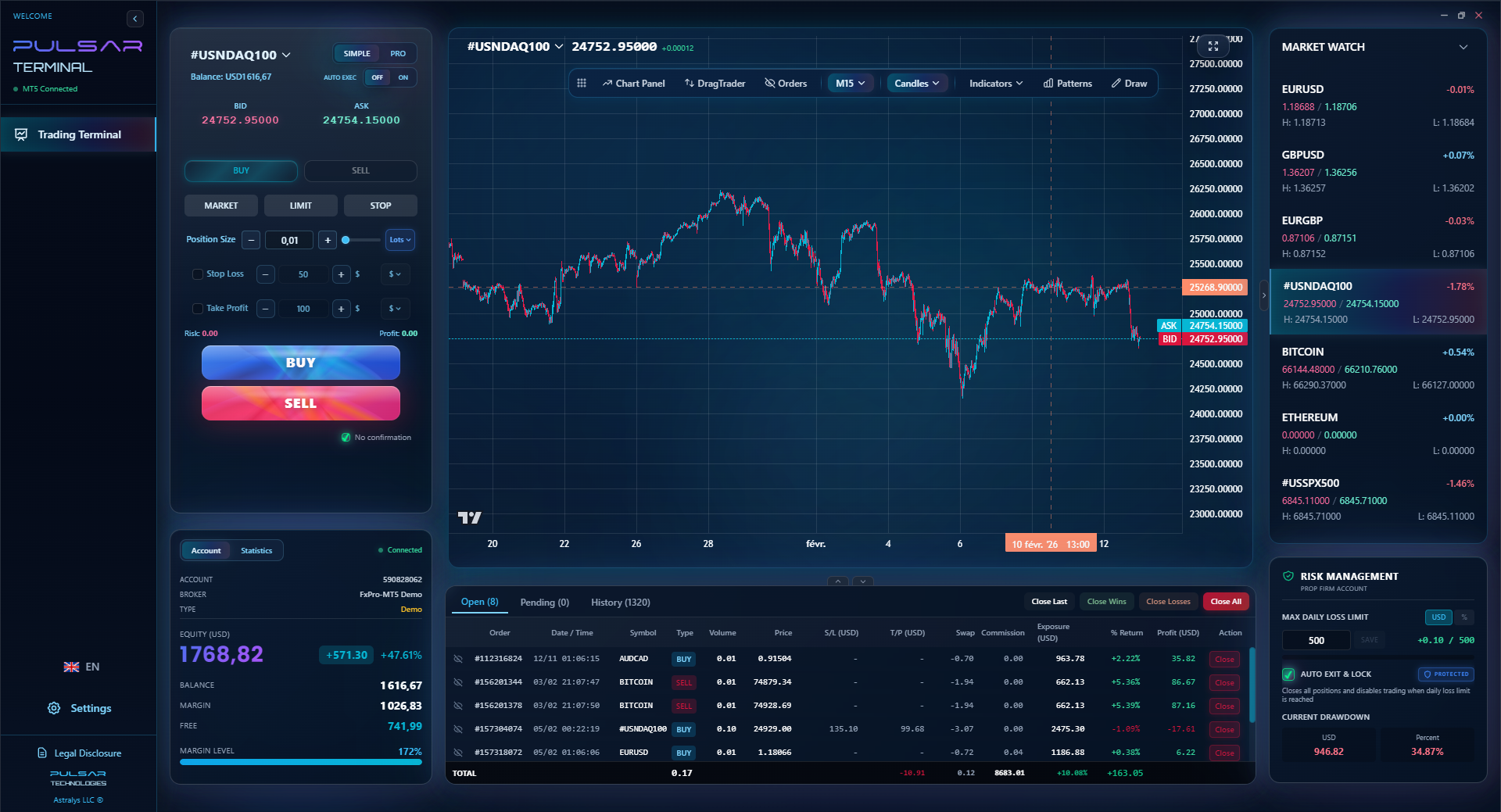
Turning your mechanical trading plan into automatic action is where psychology is beaten, and Pulsar Terminal's drag-and-drop order system and automated trailing stops do exactly that on your MT5 platform.
Pulsar Terminal
The all-in-one MT5 companion: drag-and-drop orders, multi-TP/SL, trailing stop, grid trading, Volume Profile, and prop firm protection. Used by 1,000+ traders daily.
“If a broker's main selling point is 'highest use!', run. They're targeting your greed, not your success.”
So what does work? It's boring. Profoundly, painfully boring. And that's why you never see it in forex trading movies.
- Journal Every Trade. Not just 'bought EUR/USD, won.' Log the setup (what did the chart look like?), your rationale, your emotional state, the outcome. I review my journal every Sunday. The patterns that emerge are your true teachers. You'll see you lose more on Mondays, or when trading before major news. That data is gold.
- Focus on Risk, Not Reward. Decide how much you're willing to lose on a trade before you decide how much you might win. A 1:2 risk-to-reward ratio means you can be wrong half the time and still break even. I aim for 1:3. This single mental shift changed my career.
- Specialise. You don't need to trade everything. Find one or two pairs you understand. For many South Africans, that's EUR/USD for its liquidity and trends, and maybe USD/ZAR because you follow the local news. Learn their rhythm. Read our deep dive on the EUR/USD guide to start.
- Use Technology as a Force Multiplier, Not a Crutch. This means tools that enforce your discipline. A trailing stop that locks in profits automatically. A system that lets you set a breakeven stop the moment a trade goes a certain distance in your favour. Managing multiple partial closures without frantic clicking. This turns your strategic plans into automatic actions, which is where you win the psychological war.
The montage you should imagine is hours of chart review, journaling, and planning. The 'action' is a 10-second click to enter a trade, and then waiting, sometimes for days, managing nothing but your patience. That's the real blockbuster.
💡 Winston's Tip
Your trading journal is the only script that matters. If you didn't write down the plan for a trade, you have no business being in it.
Let's roll the credits on the movie myths.
Starring Role (The Villain): The idea that trading is a quick, emotional thrill ride to riches. Supporting Cast (The Red Herrings): Flashy indicators, ultra-high use, and signals from 'gurus.' Cameo Appearance: The FSCA, mistakenly cast as the fun police.
The Real Lead Actor: You. The trader who treats this as a skilled profession. Who understands that a pip on USD/ZAR is different from a pip on GBP/JPY. Who knows the spread is the first enemy to overcome. Who uses a regulated broker not because they have to, but because they want the safety.
The sequel isn't about making a million. It's about consistency. It's about developing a process that generates small, repeatable gains over years, protecting your capital through South African political cycles and global crises. It's about building a skill that can't be taken from you. That story won't sell movie tickets, but it might just build real wealth. Start with the boring stuff. The journal, the risk calculator, the one reliable pair. The drama can wait.
FAQ
Q1Are there any good movies about forex trading for beginners?
Honestly, no mainstream movie accurately portrays retail forex trading as it exists in South Africa today. Films like 'The Big Short' are about credit default swaps, and 'Wall Street' is about 1980s stock manipulation. For education, you're far better off with documented courses, practicing on a demo account, and reading real trader journals than watching any movie.
Q2What's the biggest mistake new traders make after watching these movies?
They confuse activity with profitability. They think they need to be in constant action, making dozens of trades a day, chasing the 'big score.' In reality, professional traders often make only a handful of high-conviction trades per week or month. The mistake is overtrading, which just generates commissions for your broker and increases your exposure to random market noise.
Q3Is the technology in the movies realistic?
The banks and hedge funds have advanced tech, yes. But for a retail trader in SA, the core technology - a reliable trading platform like MT5, a stable internet connection, and a risk management spreadsheet - is simple. The movie fantasy is the single flashing red button that saves the day. In reality, your success comes from a checklist of boring pre-trade preparations.
Q4How much money do I really need to start trading forex in South Africa?
You can open an account with as little as $10 (roughly R180) at some brokers. But here's the truth: that's not enough to trade safely. With a small account, you're forced to use excessive use to make meaningful gains (in Rand terms), which puts you at extreme risk. A more realistic starter amount that allows for sensible position sizing and survival through a learning curve is closer to R10,000 - R20,000. Never trade with money you can't afford to lose entirely.
Q5Do professional traders really yell and scream like in the movies?
Maybe on a 1980s stock exchange floor. In modern forex trading, especially from your home in Durban or Pretoria, the opposite is true. The most successful traders I know are calm, quiet, and disciplined. Emotional outbursts are a sign of poor risk management. If you're screaming at your screen, your position size is too large and you've lost control.
Q6Can I get rich quick with forex like the movie characters?
The short, evidence-based answer is no. The people who get 'rich quick' are either incredibly lucky (and usually give it all back later) or are running scams. Sustainable wealth from trading is built slowly, through compounded returns over years. Aiming for a consistent 10-20% return per year is a fantastic, professional-level goal. Anyone promising you more is selling a fantasy.
Prof. Winston's Lesson
Key Takeaways:
- ✓Movie trading is fantasy; real trading is a process.
- ✓Your first profit target should always be to preserve capital.
- ✓The FSCA is your ally, not your enemy.
- ✓Trade the Rand with half your normal size.
How useful was this article?
Click a star to rate
Weekly Trading Insights
Free weekly analysis & strategies. No spam.
About the Author
David van der Merwe
Emerging Markets Trader
Johannesburg-based trader with 11 years in emerging market currencies. Specializes in ZAR pairs, FSCA-regulated trading, and South African market analysis.
Comments
Risk Disclaimer
Trading financial instruments carries significant risk and may not be suitable for all investors. Past performance does not guarantee future results. This content is for educational purposes only and should not be considered investment advice. Always conduct your own research before trading.
You Might Also Like

Cara Trading Forex Sukses: 7 Prinsip dari Trader Profesional
Cara trading forex sukses dengan 7 prinsip trader pro: manajemen modal, disiplin, journal trading, backtest. Data nyata, bukan janji profit palsu.
Jam Trading Forex Terbaik untuk Trader Indonesia: Panduan Lengkap dengan Tabel Waktu
Panduan jam trading forex untuk trader Indonesia. Tabel 4 sesi dunia, jam emas 20:00-00:00, sesi mana yang harus dihindari. Data akurat + tips dari trader berpengalaman.
Top 5 Sàn Forex Uy Tín Nhất 2026: Review Jujur dari Trader Indonesia
Top 5 sàn forex uy tín 2026 untuk trader Indonesia. Review jujur: spread, deposit, withdraw, dukungan lokal. Exness, XM, IC Markets & lebih.
Get Pulsar Terminal
All these calculators are built into Pulsar Terminal with real-time data from your MT5 account. One-click position sizing, automatic risk management, and instant calculations.
Get Pulsar Terminal