


Most new traders think the forex market is a 24-hour casino where you can win anytime.
Sarah Collins
Trading Strategist ·  United Kingdom
☕ 9 min read
What you'll learn:
Most new traders think the forex market is a 24-hour casino where you can win anytime. They're wrong. The truth is, 80% of the real, profitable action happens in just a few specific windows each day. If you're trading at the wrong time, you're not just wasting effort - you're actively increasing your risk. I'll show you exactly when to be at your screen and, more importantly, when to walk away, based on the real rhythm of the London market.
Every broker advertises the market as open 24 hours a day, five days a week. Technically, that's true. From Sunday night when Wellington kicks off, to Friday night when New York closes, the price is always moving somewhere.
But here's the trap: liquidity isn't constant. Trading during the dead zones - like the late New York close or the early Asian session - is like trying to sail a boat in a pond. The spreads widen, the price can be pushed around by a single decent-sized order, and your stop-loss becomes a suggestion rather than a guarantee. I learned this the hard way early on, getting stopped out on a GBP/USD trade during the Sydney session by a spike that vanished minutes later. The chart looked volatile, but it was just thin, illiquid noise.
The key isn't that the market is always open; it's that the good market - the deep, liquid, efficient one - has very specific forex trading opening hours. Your job is to sync your watch to it.
“The truth is, 80% of the real, profitable action happens in just a few specific windows each day.”
The market's pulse is set by four major financial centres. Think of them as shifts in a global factory.
Sydney/Tokyo (Asia Session): This kicks off the week. It runs from about 11 PM to 8 AM UK time (GMT). The main players here are Japan, Australia, and China. Pairs like AUD/USD, USD/JPY, and NZD/USD get most of the attention. The action can be range-bound, but it often sets the tone for the day. Don't expect massive breakouts, but pay attention to key levels that hold or break.
London (European Session): This is our home game. The London forex trading opening hours are roughly 8 AM to 5 PM UK time. This is where volume truly explodes. London is still the world's largest FX hub, handling trillions daily. All major pairs are in play, but EUR/USD, GBP/USD, and EUR/GBP are the stars. Economic data from the Eurozone and the UK drops here, causing immediate and often sustained moves.
New York (US Session): This runs from 1 PM to 10 PM UK time. The big US banks, hedge funds, and economic data (like Non-Farm Payrolls) drive the action. The USD is in focus across all pairs. The first hour after the open (1 PM-2 PM UK time) is especially frantic as the US reacts to what London did.
The 'Weekend' Gap: The market officially closes Friday at 10 PM UK time and reopens Sunday at 10 PM. Anything can happen over the weekend - elections, geopolitical events, bank failures. This often causes a "gap" where the price opens at a different level than it closed. It's a major risk for swing trading positions held over the weekend.

💡 Winston's Tip
The market's liquidity is its personality. Trade when it's loud and crowded (overlaps), not when it's quiet and easily spooked (off-hours).
“The London-New York overlap is the superstar. If you only have one hour a day to trade, make it this one.”
This is the most important part of the guide. The magic happens when two sessions are open at once. More banks, more funds, more orders flying around. This means tighter spreads, smoother price action, and stronger, more reliable trends.
The London-New York Overlap (1 PM - 5 PM UK Time)
This is the superstar. For four glorious hours, both the European and American financial capitals are in full swing. This period consistently sees the highest trading volume of the entire day. It's when major trends are confirmed or reversed. If you only have one hour a day to trade, make it this one. I've placed more profitable trades in this window than in all other sessions combined. The momentum is just cleaner.

Example: On a typical Wednesday, EUR/USD might move 30 pips during the quiet Asian session. During the London-New York overlap, it can easily move 70-100 pips on the same day, with much less erratic choppiness.
The Sydney-Tokyo Overlap (12 AM - 7 AM UK Time)
This is the Asian powerhouse session. It's great for trading the Aussie and Yen crosses. The volatility is lower than London, but the trends can be very tradable if you're an early riser (or a night owl).
The London-Tokyo Overlap (8 AM - 9 AM UK Time)
This is a short but sweet one-hour window as London comes online and Tokyo is still open. It's often when we see the first big directional move of the European day, especially if there was Asian news. It's a fantastic time to look for breakouts from the Asian range.

Warning: The period right after New York closes (from 10 PM to 11 PM UK time) and before Asia fully wakes up is notoriously thin. I avoid entering new positions here. Your stop-loss is vulnerable to meaningless price spikes.
“The London-New York overlap is the superstar. If you only have one hour a day to trade, make it this one.”
Let's make this practical. Here’s how I structure my week based on forex trading opening hours:
Early Morning (6 AM - 8 AM): Planning time. I review the overnight moves from Asia, check the economic calendar for London/US news, and mark up my charts with key support and resistance levels. No trading yet.
London Open (8 AM - 1 PM): I'm at my desk. The first hour is about feeling the market's direction. I'll look for trades based on breaks of the Asian range or reactions to European data. I might use the MACD indicator here to confirm momentum shifts.
London-New York Overlap (1 PM - 5 PM): Maximum focus. This is when I execute my best-conceived plans. I'm watching for continuation patterns or reversals fueled by US data. I often set multiple take-profit levels here because trends can run.
Evening (5 PM - 10 PM): I manage any open positions from the overlap. I rarely enter new trades after 5 PM unless there's a very clear setup. I use this time to review trades, update my journal, and plan for tomorrow.
What I Avoid: I almost never initiate a new trade between 10 PM and 6 AM UK time. The cost (in wider spreads and slippage) simply doesn't justify the potential reward. It's not trading; it's gambling on poor liquidity.
💡 Winston's Tip
Your first trade of the London session shouldn't be before 8:30 AM. Let the market wake up and show its hand. The first 30 minutes are often noise.
“Trading during the dead zones is like trying to sail a boat in a pond. Your stop-loss becomes a suggestion.”
Your strategy needs to match the session.
Volatility & Spreads: During the London-New York overlap, the spread on a major like EUR/USD can be as low as 0.1 pips on a good ECN account. That same pair might have a 1.5 pip spread at 3 AM. That difference is your immediate cost. Always know the typical spread definition for your pair at your trading time.
Strategy Fit:
- Scalping: Only really viable during high-liquidity overlaps. You need those tight spreads and fast fills. Trying to scalping strategy in a quiet session is a fast track to losses.
- Swing Trading: You can enter positions during quieter times if you're confident in the longer-term setup, but be aware of the wider spreads on entry/exit. The real risk is the weekend gap.
- News Trading: You must know which session the news is in. UK GDP at 9:30 AM? That's a London session play. US CPI at 1:30 PM? That's right in the overlap sweet spot.
A Personal Mistake: I once tried to trade a breakout strategy on USD/CAD during the Tokyo session. The price punched through a key level on what looked like strong volume. I entered, and it immediately reversed. Why? A single large institutional order in the thin market caused the fake breakout. The loss was small, but the lesson was huge: the market's character is defined by who's in it.
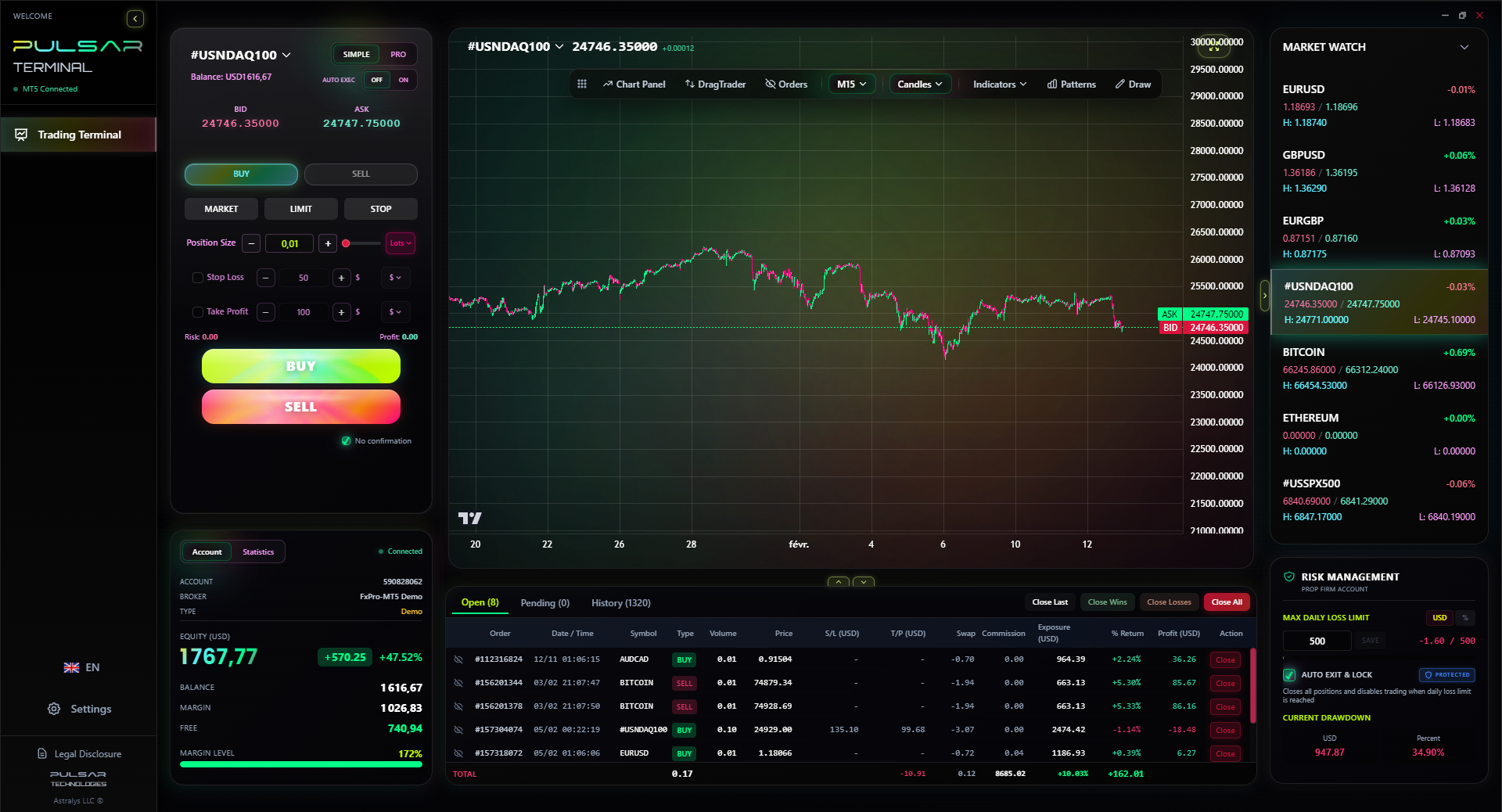
Managing trades across volatile session overlaps is easier with tools that let you set multiple take-profits and trailing stops automatically, like Pulsar Terminal does on MT5.
Pulsar Terminal
The all-in-one MT5 companion: drag-and-drop orders, multi-TP/SL, trailing stop, grid trading, Volume Profile, and prop firm protection. Used by 1,000+ traders daily.
“Trading during the dead zones is like trying to sail a boat in a pond. Your stop-loss becomes a suggestion.”
Your Broker's Clock: Most UK brokers like Pepperstone or IC Markets run on GMT or GMT+1 (BST). Their trading week starts Sunday 10 PM and ends Friday 10 PM. Always double-check their server time against your local time. A mix-up here can mean missing a key open.
Bank Holidays & Reduced Liquidity: When London is closed for a UK bank holiday, the entire European session volume plummets. Trading on a day like Boxing Day is a different, often trickier, market. New York might move, but without London's weight, the moves can be exaggerated and unpredictable. I usually treat major UK holidays as no-trade days.
Daylight Saving Time (DST): This is a classic trap. The UK and US switch to DST on different weekends. For about two weeks in March and October, the session overlaps shift. That 1 PM London-New York overlap might temporarily become 12 PM. Mark these dates in your calendar.

Pro Tip: Use a simple spreadsheet or a trading journal app to log not just your trades, but the time you took them. After 100 trades, you'll see a clear pattern showing which sessions are truly profitable for you. Mine showed 65% of my wins came between 1:30 PM and 4 PM UK time. I adjusted my life to protect that time.
💡 Winston's Tip
If you wouldn't walk into a empty pub expecting a great party, don't log into a thin market expecting a great trade. Patience is a schedule.
“Understanding opening hours isn't about memorising a timetable. It's about understanding the flow of money and risk.”
Understanding forex trading opening hours isn't about memorising a timetable. It's about understanding the flow of money and risk around the planet. You're not just trading a chart; you're trading the collective attention of the world's biggest financial institutions.
Start by focusing purely on the London-New York overlap for two weeks. Watch how the price moves with purpose. Then, contrast it by watching a chart during the dead of night. The difference will become instinctual.
Finally, remember that time is a tool. The market gives you periods of high opportunity (overlaps) and periods of high risk (thin sessions). A disciplined trader uses the first and avoids the second. This single insight - trading with the liquidity tide instead of against it - will do more for your bottom line than any new indicator ever could. Now, go check the clock. Is it time to trade, or time to wait?
FAQ
Q1What are the exact London forex session opening hours?
In the UK, the core London trading session runs from 8:00 AM to 5:00 PM local UK time, year-round. This is when the major UK and European banks are most active. In GMT, this is 8 AM to 5 PM in winter, and 7 AM to 4 PM GMT in summer (when the UK is on BST).
Q2When is the best time of day to trade forex in the UK?
The absolute best time is during the London-New York session overlap, from 1:00 PM to 5:00 PM UK time. This four-hour window has the highest liquidity and volatility, offering the cleanest trends and tightest spreads. It's when the majority of profitable opportunities occur.
Q3Can I trade forex 24 hours a day from the UK?
Technically yes, as brokers offer access 24/5. But practically, it's a bad idea. Trading during low-liquidity hours (like late night or early morning UK time) means wider spreads, higher risk of slippage, and more erratic price action. It's far riskier and less profitable than focusing on the major session overlaps.
Q4How does Daylight Saving Time affect forex trading hours?
It shifts the overlap times relative to GMT. The UK and US change clocks on different dates. For about two weeks in spring and autumn, the London-New York overlap might start an hour earlier or later from a GMT perspective. Always check your broker's server time, which usually stays on GMT, to avoid confusion.
Q5What happens to forex when the London market is closed on a UK bank holiday?
Liquidity drops significantly. The European session becomes very quiet, and price movements are often driven by New York alone, which can lead to exaggerated, less predictable moves. Many experienced UK traders avoid opening new positions on major UK bank holidays due to the increased risk and poor trading conditions.
Q6Is the weekend gap a real risk?
Absolutely. The market closes Friday at 10 PM and opens Sunday at 10 PM UK time. If major news hits over the weekend, prices can 'gap' up or down on the open. This can instantly trigger stop-losses or turn winning positions into losers. It's a key risk management factor for swing trading.
Q7Do all currency pairs move the same during each session?
No. Each session has its 'specialties'. The Asian session sees more action in AUD, JPY, and NZD pairs. The London session dominates EUR and GBP pairs. The New York session focuses on USD pairs. Trading the right pair in its active session increases your odds significantly.
Prof. Winston's Lesson
Key Takeaways:
- ✓Focus 80% of your effort on the 1 PM - 5 PM London-New York overlap.
- ✓Avoid new trades between 10 PM and 6 AM UK time due to poor liquidity.
- ✓Wider spreads in quiet sessions directly eat into your potential profit.
- ✓Always adjust for Daylight Saving Time shifts in March and October.
- ✓Treat major UK bank holidays as reduced-liquidity, higher-risk days.
How useful was this article?
Click a star to rate
Weekly Trading Insights
Free weekly analysis & strategies. No spam.
About the Author
Sarah Collins
Trading Strategist
London-based trading strategist with 12 years in financial markets. Former analyst at a City of London brokerage. Covers GBP pairs, European markets, and FCA-regulated trading.
Comments
Risk Disclaimer
Trading financial instruments carries significant risk and may not be suitable for all investors. Past performance does not guarantee future results. This content is for educational purposes only and should not be considered investment advice. Always conduct your own research before trading.
You Might Also Like

Cara Trading Forex Sukses: 7 Prinsip dari Trader Profesional
Cara trading forex sukses dengan 7 prinsip trader pro: manajemen modal, disiplin, journal trading, backtest. Data nyata, bukan janji profit palsu.
Jam Trading Forex Terbaik untuk Trader Indonesia: Panduan Lengkap dengan Tabel Waktu
Panduan jam trading forex untuk trader Indonesia. Tabel 4 sesi dunia, jam emas 20:00-00:00, sesi mana yang harus dihindari. Data akurat + tips dari trader berpengalaman.
Top 5 Sàn Forex Uy Tín Nhất 2026: Review Jujur dari Trader Indonesia
Top 5 sàn forex uy tín 2026 untuk trader Indonesia. Review jujur: spread, deposit, withdraw, dukungan lokal. Exness, XM, IC Markets & lebih.
Get Pulsar Terminal
All these calculators are built into Pulsar Terminal with real-time data from your MT5 account. One-click position sizing, automatic risk management, and instant calculations.
Get Pulsar Terminal