


If you've spent any time in South African trading circles, you've heard the pitch: 'Partner with us and earn passive income from forex!' It sounds like a golden ticket, doesn't it? The truth is, a forex trading partnership isn't a magic money machine.

David van der Merwe
Emerging Markets Trader ·  South Africa
☕ 12 min read
What you'll learn:
- 1What Exactly Is a Forex Trading Partnership?
- 2The Legal Stuff: FSCA Rules You Can't Ignore
- 3Show Me the Money: IB & Affiliate Commission Structures
- 4The Prop Firm Model: Trading Their Money
- 5How to Choose the Right Partnership for You
- 6The Trap Door: Common Pitfalls to Avoid at All Costs
- 7Your First Steps: A Realistic Action Plan
If you've spent any time in South African trading circles, you've heard the pitch: 'Partner with us and earn passive income from forex!' It sounds like a golden ticket, doesn't it? The truth is, a forex trading partnership isn't a magic money machine. It's a business model, and like any business, it can fail spectacularly if you don't know what you're doing. I've seen guys lose more money chasing referral commissions than they ever did trading. Let's cut through the hype and look at what these partnerships really are, how they work under South African law, and whether they're a smart move for you.
When we talk about a forex trading partnership in South Africa, we're usually talking about one of three things: an Introducing Broker (IB), an affiliate marketer, or a relationship with a proprietary trading firm. They're all ways to make money from the forex market without necessarily placing your own trades every day.
An Introducing Broker (IB) is the most hands-on. You refer clients to a broker, and in return, you get a slice of the revenue they generate (the spread or commissions). Sometimes, you might even provide basic support or education to your referrals. It's a relationship business.
Affiliate marketing is more hands-off. You promote a broker through links on a website, YouTube channel, or social media. You get paid a flat fee per sign-up (a CPA) or a smaller revenue share. It's a numbers game.
Then there are prop firms. This is a different beast. You're not referring clients; you're trading the firm's capital. Pass their evaluation challenge, and you get a funded account. They take a cut of your profits, and you keep the rest. It's a performance-based partnership.

Warning: Many 'partnership' offers are just multi-level marketing schemes in disguise. If the focus is more on recruiting other partners than on the actual trading or client value, run. I got burned early on by one that promised the world but was just a fancy pyramid.
The key thing to remember? All of these are regulated activities under the FAIS Act. If you're giving financial advice as part of your partnership, you need to be licensed. The FSCA doesn't mess around with this.

💡 Winston's Tip
A partnership built on a 50% share of garbage is still garbage. Prioritise the broker's execution quality and your clients' potential success over the headline commission rate.
This is where most aspiring partners trip up. They see the dollar signs and forget this is a regulated financial service. The Financial Sector Conduct Authority (FSCA) is your new best friend and worst enemy, depending on your compliance.
The FAIS Act is Your Bible
The Financial Advisory and Intermediary Services Act is the core law. If your partnership involves any form of advice or intermediary service - like suggesting which broker to use or explaining account types - you likely need to be an authorised Financial Services Provider (FSP) or a representative of one. That means meeting fit and proper requirements, including experience and qualifications.
What You Can and Can't Do
You can share your own experiences and post your broker's referral link. You can't tell someone, 'Based on your financial situation, you should open a Standard Account with Broker X.' That's regulated advice. The line is finer than you think.
Broker Responsibility
Reputable brokers with a real FSCA license (check the FSP number on the register) will have a compliance team. They'll vet their IBs and often provide the legal framework for you to operate under their license as a representative. If a broker doesn't ask any questions about your compliance, that's a massive red flag. They're either ignorant or operating in a grey area, and you'll be left holding the bag if things go south.
The 30:1 use Cap
Remember, since 2021, the FSCA caps use for retail traders at 30:1. Any broker or partner offering you or your clients higher use on an FSCA-licensed entity is breaking the rules. Some brokers offer offshore entities with higher use, but that comes with less regulatory protection. You need to be transparent about this with anyone you refer.
Here’s a quick look at how some major brokers stack up on key local metrics:
| Broker | FSCA License (FSP No.) | Min. Deposit (ZAR approx.) | Typical EUR/USD Spread | Popular Platform |
|---|---|---|---|---|
| AvaTrade | Yes (45984) | R1,500+ | Fixed from 0.9 pips | MT4, MT5, AvaTradeGO |
| Exness | Yes | ~R90 | As low as 0.0 pips | MT4, MT5 |
| HF Markets | Yes | R0 (on some) | As low as 0.1 pips | MT4, MT5 |
| IG | Yes | ~R5,800 | Avg. 0.98 pips | IG Platform, MT4 |
| IC Markets | Via Global Entity | ~R3,700 | As low as 0.0 pips | MT4, MT5, cTrader |
Using a proper position size calculator is non-negotiable, especially with use limits. It keeps you and your clients safe.
“A forex trading partnership isn't a magic money machine. It's a business model, and like any business, it can fail spectacularly.”
Let's talk numbers, because vague promises are worthless. I've been an IB for two different brokers over the years. Here’s the real math.
Revenue Share: This is the most common. You get a percentage of the spread or commission paid by your referred client. It's usually tiered.
- Example: Broker X offers 25% revenue share on the first $10,000 of client revenue, 35% up to $50,000, and 40% beyond that. If your client generates $200 in spread/commission fees in a month, you'd earn $50 at the base tier.
- The Catch: 'Revenue' is what's left after costs. It's not the raw spread. Brokers are very good at calculating this to their advantage. Always ask for a clear, written example of the calculation.
Cost Per Acquisition (CPA): A flat fee for each verified client who deposits. This is simpler but often less lucrative long-term.
- Example: Broker Y pays $400 for every client who deposits over $1,000 and places 5 trades. I once ran a Facebook ad campaign costing $35 per lead. If I converted 1 in 10 leads to a $400 CPA client, I'd just about break. It's tough.
Hybrid Models: Some offer a lower CPA plus a smaller revenue share. This can be a good way to start earning something upfront.

Example: Let's get concrete. In 2021, I referred a small group of 5 active traders to a broker. Their average monthly trading volume was 20 lots each. The broker's revenue per lot was about $8. My revenue share was 30%. My Monthly Commission: 5 traders * 20 lots * $8/ lot * 30% = $240 per month. Not life-changing, but a nice side income. The hard part was keeping them as active traders. Two stopped after 3 months, and my income dropped accordingly.
The top-tier IB programs, like the one from Exness, can offer up to 40% revenue share and CPAs as high as $1,850 for high-value clients. But to get those, you need to bring in serious, consistent volume. It's a grind.
Affiliate marketing for a broker like XM or Pepperstone follows similar principles, but you're often dealing with lower payouts and higher traffic requirements. You need a real audience.
This is the 'partnership' that appeals to traders who just want to trade. You're not marketing; you're proving your skills. The model is simple: pass a challenge, get a funded account, split the profits.
How the Challenge Works: You pay a fee (say, $200) for a $10,000 challenge account. You have to hit a profit target (e.g., 10%) within a month while adhering to strict rules: a daily loss limit (e.g., 5%), a max overall drawdown (e.g., 10%), and sometimes a minimum trading day rule.
The Partnership: If you pass, you get a live funded account. The typical profit split is 80/20 or 75/25 in your favour. So, if you make $2,000 profit, you keep $1,600, and the firm takes $400.
My Experience: I passed a $50,000 challenge in 2023. The fee was $350. My strategy was conservative swing trading on XAU/USD. I hit the 8% target in 12 trading days. The first payout was smooth: $1,920 profit, my cut was $1,536. It felt great.
The Dark Side: The rules are designed for most people to fail. The psychology is brutal. That daily loss limit means if you have a bad morning, you're done for the day. No revenge trading. The pressure can make your RSI indicator signals blurry. Many firms also use 'simulated' accounts, meaning you're not actually moving the market. It's still real money to you, but it's important to know.

Pro Tip: Your number one job in a prop challenge is risk management. The trading strategy is secondary. A 2% risk per trade is too high when you have a 5% daily limit. I risked 0.5% max. It was boring, but it worked. A tool that can automate a hard daily loss stop is useful here.
💡 Winston's Tip
In a prop firm challenge, your primary opponent is not the market. It's the daily loss limit. Structure every trade to ensure you can survive a string of losses without hitting that wall.
“The discipline that got you through the prop challenge is even more critical now. The money feels more real, and greed is a powerful drug.”
This isn't a one-size-fits-all decision. Your personality and skills matter more than the commission percentage.
Ask yourself:
- Are you a people person or a solo operator? If you love networking, teaching, and sales, the IB path could work. If you'd rather stare at charts alone, look at prop firms.
- Do you have an audience? Starting an IB or affiliate business from zero is like opening a shop in the desert. Do you have a YouTube channel, a Twitter following, or a network of aspiring traders? If not, building that is your first job, and it takes years.
- Can you handle compliance? Are you willing to get the necessary FSP rep licensing or work strictly within a broker's compliant marketing guidelines? If legal paperwork gives you a headache, this might not be your path.
- What's your trading track record? For prop firms, you need a statistically proven, rule-based strategy. A few lucky wins on your personal account won't cut it. You need to know your win rate, average risk/reward, and have the discipline of a monk.
My Mistake: I tried the IB route first because the money seemed easier. I'm not a natural salesman. I hated 'closing' people. I spent 6 months and made R4,000. I was miserable. Switching to focus on prop firm trading, where my performance did the talking, was a liberation. Know thyself.
Also, deeply research the broker or prop firm. A flashy website means nothing. How long have they been operating? What do real user reviews say about payouts? For brokers, verify that FSCA FSP number. For prop firms, check their payout proof on independent forums. Don't be the test subject for a new, unproven company.
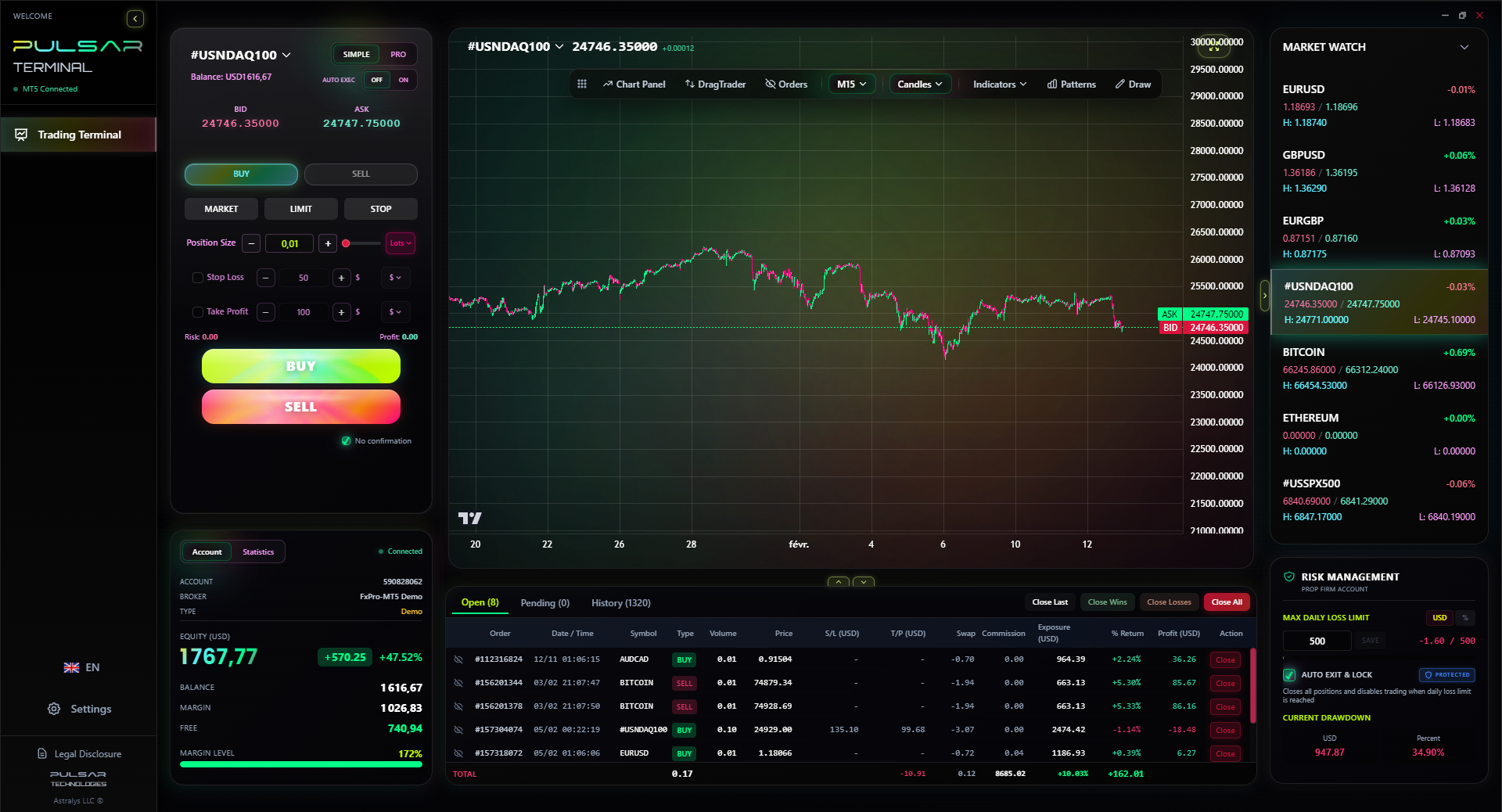
Managing the strict daily loss limits of a prop firm challenge is a huge psychological burden, which is why automating that rule with a trading tool can be the difference between passing and failing.
Pulsar Terminal
The all-in-one MT5 companion: drag-and-drop orders, multi-TP/SL, trailing stop, grid trading, Volume Profile, and prop firm protection. Used by 1,000+ traders daily.
I've fallen into some of these. Learn from my losses.
Pitfall 1: Chasing the Highest Commission Rate. A broker offering 50% revenue share might have terrible execution, wide spreads, or constant requotes. Your clients will lose money, blame you, and leave. You'll make 50% of nothing. A broker with 25% share but great execution like IC Markets will keep clients trading longer, earning you more over time.
Pitfall 2: Neglecting Your Own Trading Education. As an IB or affiliate, you're in the finance advice space. If you don't understand a margin call or how a pip is calculated, you lose all credibility. You don't need to be a master trader, but you need to know the basics cold.
Pitfall 3: Over-leveraging Your Prop Firm Account. You get a $100,000 funded account and think, 'Just a few big trades...' This is the fastest route to a blown account. The discipline that got you through the challenge is even more critical now. The money feels more real, and greed is a powerful drug.
Pitfall 4: Thinking It's Passive Income. It's not. IB work is client service. Affiliate marketing is content creation and SEO. Prop trading is active, high-stress work. There's nothing passive about it until you've built a massive, self-sustaining system, which takes years.
Pitfall 5: Partnering with an Unregulated Entity. This is the biggest risk. If the broker or prop firm isn't properly regulated (especially by the FSCA for SA clients), you have zero recourse if they decide not to pay you. Your commissions, your challenge fee, your funded account profits - all can vanish overnight. I only work with FSCA-licensed brokers or prop firms regulated in jurisdictions I trust (like the UK or Australia). Sleep is important.
💡 Winston's Tip
Your first partnership agreement is a learning document. Negotiate, but don't get stuck. The real value is in the experience and track record you build, not the perfect first deal.
“The guys making real money from this aren't lucky; they're the ones who treated it like a real business from day one.”
Okay, you're still interested. Here's how to start without losing your shirt.
Step 1: Self-Audit. Spend a week honestly answering the questions in the previous section. Write down your answers. Which model genuinely fits your skills and temperament?
Step 2: Education First, Application Second.
- For IB/Affiliate: Study the FAIS Act basics. Understand what constitutes financial advice. Then, pick one broker with a strong local presence and a clear, transparent partnership program. Read every word of their IB agreement.
- For Prop Firms: Master one strategy. Don't jump between scalping and swing trading. Backtest it for at least 100 trades. Then, paper trade it under prop firm rules (daily loss limit, etc.) for a full month. Only if you're profitable and disciplined, consider the smallest challenge account.
Step 3: Start Small and Document Everything.
- Don't quit your job. This is a side hustle until it proves otherwise.
- If going the IB route, refer 2-3 people you know personally first. See how the process works, how support is handled, and how commissions are paid.
- Track every hour spent and every rand earned. Calculate your effective hourly rate. Is it worth it?
Step 4: Build Systems.
- If you're creating content, build an editorial calendar.
- If you're trading a prop account, have a pre-trade checklist and a daily journal. Your trading platform should work for you. Having tools that let you set multiple take-profits or automate a trailing stop can be a huge edge, letting you focus on analysis instead of order management.
A successful forex trading partnership is a marathon, not a sprint. It's built on trust, consistency, and a brutal commitment to doing things properly. The guys making real money from this aren't lucky; they're the ones who treated it like a real business from day one. You can be one of them, but you have to put in the real work. No shortcuts.
FAQ
Q1Do I need a license from the FSCA to be a forex IB or affiliate in South Africa?
It depends on your activities. If you are simply sharing a referral link and sharing your own experiences, you may not need one. However, if you are providing any form of financial advice, recommendations, or intermediary services (like helping someone choose an account type), you likely need to be an authorised Financial Services Provider (FSP) or a representative of one under the FAIS Act. Always check with a compliance professional or the broker you're partnering with.
Q2What's a typical profit split with a prop trading firm?
The industry standard for funded traders is an 80/20 split in your favour, though some firms offer 75/25 or even 90/10 for top performers. This means you keep 80% of the profits you generate, and the firm takes 20%. Always read the terms, as some firms have scaling plans where your split increases as you hit profit milestones.
Q3Can I use a prop firm to bypass the FSCA's 30:1 use limit?
Often, yes. Many proprietary trading firms are based offshore and are not bound by South African retail use rules. It's common to see use of 100:1 or even 200:1 on their evaluation and funded accounts. However, remember that higher use significantly increases risk. The trade-off is that these firms are not regulated by the FSCA, so your legal protections are different.
Q4Which is more profitable: IB commissions or prop firm trading?
There's no single answer. IB income is capped by your ability to attract and retain active clients; it can provide steady, smaller-scale income. Prop firm trading has unlimited profit potential but comes with high risk - you can lose your challenge fee and make nothing. Profitability depends entirely on your skills: sales and relationship-building for IB, and disciplined trading for prop firms. Some traders do both.
Q5What are the tax implications of forex partnership income in SA?
Income from IB commissions or affiliate marketing is generally considered ordinary revenue and is taxable as part of your income. Profits from prop firm trading are also taxable. It's crucial to keep detailed records of all income and expenses related to your partnership activities. You should consult with a South African tax professional who understands financial trading, as the rules can be complex.
Q6How long does it take to start earning from an IB partnership?
It's not instant. After you refer a client, they need to sign up, deposit funds, and start trading actively. Most brokers have a commission payout cycle, often monthly. From your first referral to your first commission payment, you're typically looking at 6-8 weeks minimum, assuming the client is active. Building a meaningful income stream usually takes 6-12 months of consistent effort.
Prof. Winston's Lesson
Key Takeaways:
- ✓Compliance is non-negotiable. Know FAIS Act boundaries.
- ✓IB success hinges on client retention, not just sign-ups.
- ✓Prop firm rules are designed for most traders to fail.
- ✓Start small, document everything, and calculate your real hourly rate.
How useful was this article?
Click a star to rate
Weekly Trading Insights
Free weekly analysis & strategies. No spam.
About the Author
David van der Merwe
Emerging Markets Trader
Johannesburg-based trader with 11 years in emerging market currencies. Specializes in ZAR pairs, FSCA-regulated trading, and South African market analysis.
Comments
Risk Disclaimer
Trading financial instruments carries significant risk and may not be suitable for all investors. Past performance does not guarantee future results. This content is for educational purposes only and should not be considered investment advice. Always conduct your own research before trading.
You Might Also Like

Cara Trading Forex Sukses: 7 Prinsip dari Trader Profesional
Cara trading forex sukses dengan 7 prinsip trader pro: manajemen modal, disiplin, journal trading, backtest. Data nyata, bukan janji profit palsu.
Jam Trading Forex Terbaik untuk Trader Indonesia: Panduan Lengkap dengan Tabel Waktu
Panduan jam trading forex untuk trader Indonesia. Tabel 4 sesi dunia, jam emas 20:00-00:00, sesi mana yang harus dihindari. Data akurat + tips dari trader berpengalaman.
Top 5 Sàn Forex Uy Tín Nhất 2026: Review Jujur dari Trader Indonesia
Top 5 sàn forex uy tín 2026 untuk trader Indonesia. Review jujur: spread, deposit, withdraw, dukungan lokal. Exness, XM, IC Markets & lebih.
Get Pulsar Terminal
All these calculators are built into Pulsar Terminal with real-time data from your MT5 account. One-click position sizing, automatic risk management, and instant calculations.
Get Pulsar Terminal