


Here's the brutal truth most trading 'gurus' in Nigeria won't tell you: your 'trading plan' is probably just a list of indicators and a prayer.

Olumide Adeyemi
West African Trading Pioneer ·  Nigeria
☕ 11 min read
What you'll learn:
- 1Why Your Current 'Plan' is Broken (And How to Fix It)
- 2The Nigerian Legal & Tax Foundation (Your Plan's First Page)
- 3The Core: Your Trading Rules & System
- 4Risk & Money Management for the Nigerian Reality
- 5Broker Logistics & Trade Execution
- 6The Trading Journal & Beating Nigerian Trading Psychology
- 7Putting It All Together: Your One-Page Checklist
Here's the brutal truth most trading 'gurus' in Nigeria won't tell you: your 'trading plan' is probably just a list of indicators and a prayer. You're not planning to trade, you're planning to hope. I've seen it a thousand times. A trader shows me their 'plan' - it's three moving averages and a dream of buying a Range Rover. That's not a plan, that's a wish list. A real forex trading plan is your business blueprint. It accounts for Nigerian regulations, taxes, broker realities, and your own psychology. Let's scrap the nonsense and build one that survives the market, the CBN, and your own worst impulses.
Let me guess. Your trading plan lives in your head or on a single page titled 'My Strategy.' It says something like 'Buy when RSI is oversold on the 1-hour chart.' Where's the rest? Where's the part about how much you'll risk when Naira liquidity dries up at 3 PM? Where's the rule for what happens when your broker's server disconnects during a CBN announcement?
Most Nigerian traders fail because they plan for profits, not for problems. They don't have a plan for the 10% capital gains tax the FIRS will want. They don't have a plan for when their preferred deposit method (like bank transfer) is suddenly delayed for days. A real plan isn't sexy. It's a boring, detailed operations manual.
I learned this the hard way in 2019. I had a 'killer' strategy on GBP/NGN. I was up 40% in three months. Then, the CBN made a major policy shift on a Friday evening. The market gapped open on Sunday, my stop loss was ignored (slippage), and I lost 80% of my account in seconds. My 'plan' had no rule for central bank intervention risk. Yours probably doesn't either. A proper plan forces you to think about these black swan events before they bankrupt you.

Warning: If your plan doesn't have a specific section for 'Regulatory & Technical Failure Procedures,' you are not trading. You are gambling with extra steps.

💡 Winston's Tip
Your first profit target should always be to recover the spread and commission. Aim for breakeven plus costs before you aim for the moon.
“A real forex trading plan is your business blueprint, not a wish list for a Range Rover.”
Before you draw a single trendline, your plan must acknowledge the ground you're standing on. Trading in Nigeria isn't a regulatory free-for-all, and pretending it is will cost you money.
The Regulatory Reality
You are legal. Trading for yourself with an international broker is allowed. But the CBN prohibits Nigerian banks from facilitating transactions for speculative forex trading. This is why funding your broker account can sometimes feel like a covert operation. Your plan must include a reliable, tested funding and withdrawal method. Many use international debit/credit cards or specific e-wallets that still work smoothly.
The bigger recent change is the Investments and Securities Act, 2025 (ISA 2025). This law targets the platforms and educators, not you. It means any company offering forex trading services in Nigeria must register with the SEC. This is good for you long-term - it should weed out some scams. For your plan, it means you should be extra diligent in choosing a broker with solid international regulation, like those we review for Exness or IC Markets.
The Tax Man Cometh
Here’s a number to write at the top of your plan: 10%. That's the capital gains tax the Federal Inland Revenue Service (FIRS) expects on your net annual trading profits. I don't care if your broker is in Cyprus; if you live in Lagos, this applies. Your trading plan must include a profit-logging system. Not just for your ego, but for tax calculation. I set aside 10% of every profitable withdrawal into a separate savings account. It’s not my money; it’s the government's, and I don't touch it. Failure to plan for this is planning for a nasty letter from the FIRS later.
“Most Nigerian traders fail because they plan for profits, not for problems.”
This is the engine room. But we're not just listing indicators. We're defining every single action with the precision of a flight checklist.
Market Selection & Conditions
What do you trade? EUR/USD? GBP/NGN? Gold? You can't trade everything. My rule: I only trade majors (EUR/USD, GBP/USD) and XAU/USD (gold). Why? Reliable liquidity and tighter spreads. I avoid exotic pairs, especially those involving Naira, outside of specific, planned opportunities. The spreads are wider and the moves can be erratic around CBN windows. Define your instruments. Then, define your market 'weather.' I only trade when volatility, measured by the ATR indicator, is above its 50-period average but below its extreme high. This filters out dead markets and panic-driven news spikes.
Entry, Exit, and Risk Rules
This needs to be robotic.
- Entry Signal: It must be unambiguous. Not 'RSI looks low.' It's: 'Buy signal triggers when price touches the 200-period EMA on the 4H chart, and the daily candle closes above it, and the MACD indicator histogram is turning up on the 1H chart.' Three conditions. All must be true.
- Exit Signal (Take Profit): You don't hold for 'more.' You have a predefined target. I use a 1:2 risk-to-reward ratio as a minimum. If I risk 50 pips, my first profit target is at +100 pips. I'll often use a multi-target approach, closing half my position at 1:1 R:R and letting the rest run with a trailing stop.
- Exit Signal (Stop Loss): This is non-negotiable. Your stop loss is placed before you enter the trade, based on technical levels, not on how much money you're willing to lose. A common mistake is placing a stop loss that's 20 pips away just because that's a $100 loss, even though the nearest support is 50 pips away. That's a guaranteed way to get stopped out. Use a position size calculator every time to determine your lot size based on your stop loss distance and risk-per-trade percentage.

Pro Tip: Your risk-per-trade should never exceed 1-2% of your trading capital. On a ₦500,000 account, that's ₦5,000-₦10,000 max risk per trade. This is the single most important rule in your entire plan. It keeps you in the game.
“Most Nigerian traders fail because they plan for profits, not for problems.”
This is where Nigerian traders blow up. The temptation for high use is insane because brokers offer it. I've seen offers for 1:2000 use. That's financial suicide in a nice package.
use is a Tool, Not a Toy
With a ₦200,000 account and 1:100 use, you can control ₦20,000,000 worth of currency. That power is terrifying. My plan caps my effective use (total exposure / account balance) at 1:10. Usually, it's closer to 1:5. This self-imposed limit forces discipline and survives wild volatility.
The Daily & Weekly Loss Limit
You will have losing days. The goal is to prevent a losing day from becoming a losing week that destroys your account. My plan rules:
- Daily Loss Limit: If I lose 3% of my account in a day, I shut down the platform. No 'revenge trading.' I'm done.
- Weekly Loss Limit: If I lose 6% of my account in a week, I stop trading for the rest of the week. I go back to demo or just review my journal.
These rules have saved me more times than I can count. In April 2023, I had three losing trades in a row on EUR/USD, hitting my 3% daily limit. I stopped. The next day, the market crashed in the direction I would have revenge-traded. I saved 10% of my account by following my boring rule.
Managing the Naira Factor
Your capital is in Naira. Your broker account is in USD. Currency risk is real. If you deposit when USD/NGN is 1200 and withdraw when it's 1500, you've made a 25% gain on the exchange rate alone before you've even traded! The reverse is also true. Some brokers, like HFM, offer NGN-denominated accounts to remove this risk. Factor this into your plan - will you hedge this risk, accept it, or use a local account?
💡 Winston's Tip
If you can't explain your trade setup in one simple sentence, it's too complicated. Complexity is the enemy of execution.
“Your risk-per-trade should never exceed 1-2% of your trading capital. This is the single most important rule.”
Your brilliant plan is useless if your broker fails you. Your plan must include your broker selection criteria and how you'll execute.
Choosing Your Broker
Don't just pick the one with the flashiest ads on Instagram. Your plan should list your non-negotiables. Mine are:
- Regulated by a top-tier authority (ASIC, FCA, CySEC – not just a local license).
- Reliable and fast deposit/withdrawal for Nigerian clients (I test with a small amount first).
- Tight spreads on my chosen pairs (I track the average spread on EUR/USD for a week).
- A stable platform (MT4/MT5) with minimal downtime.
Brokers like Pepperstone and XM consistently meet these for me. I have a spreadsheet where I compare their execution speeds and spreads monthly. It's boring admin work, but it's part of the business.
The Execution Protocol
This is your pre-flight routine. Mine takes 5 minutes before any live session:
- Check broker news feed for scheduled high-impact news (CBN announcements, US NFP).
- Test platform connection with a single mini-lot trade on demo.
- Confirm my position size calculator is open and ready.
- Have my trading journal template open to log the trade immediately.
This ritual gets me into the right, disciplined headspace. It turns trading from an emotional reaction into a systematic process.
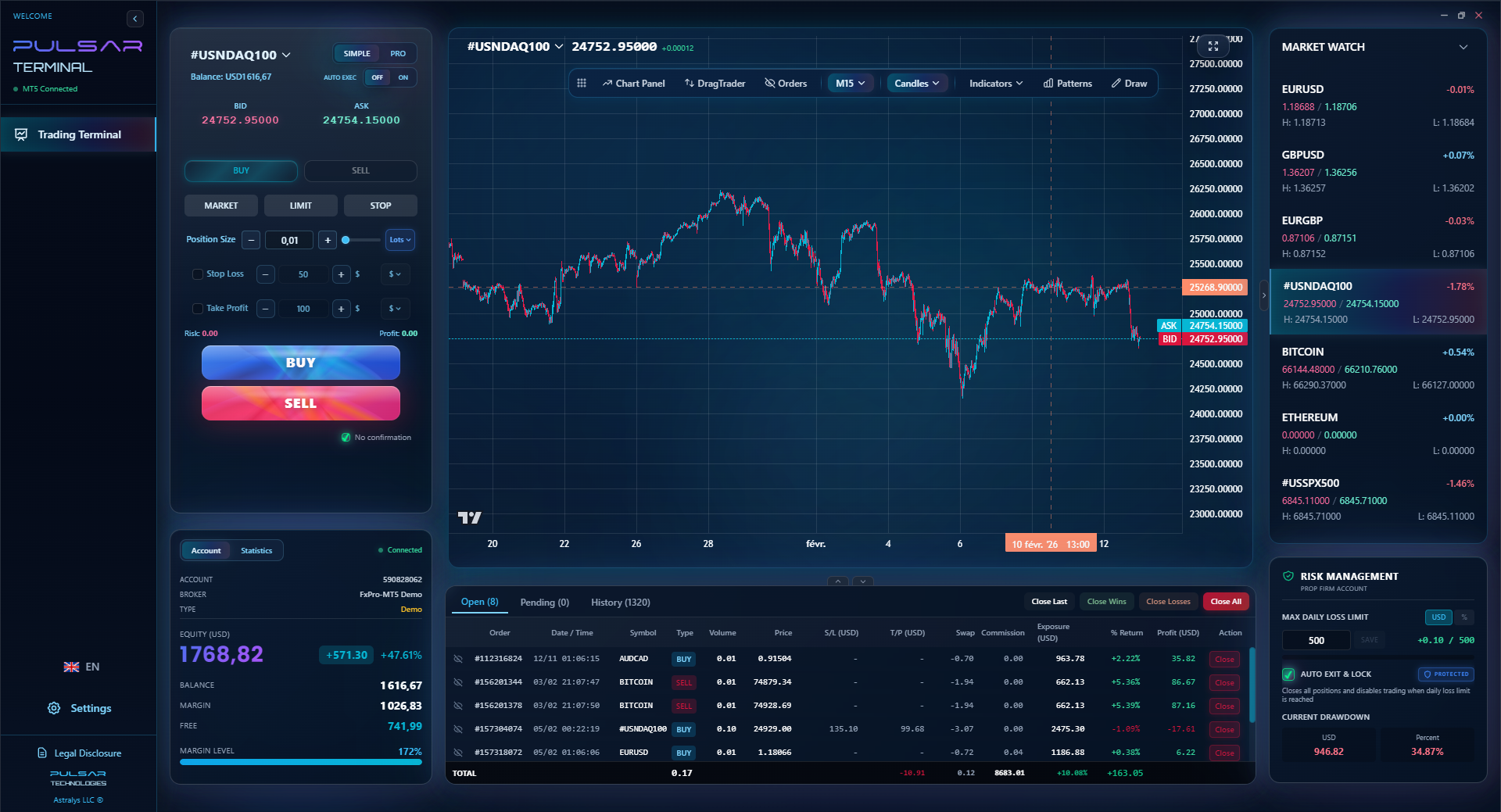
Executing a multi-target trade plan with precise stop management is tedious on standard MT5; Pulsar Terminal lets you drag-and-drop entire bracket orders with partial closures directly onto your chart.
Pulsar Terminal
The all-in-one MT5 companion: drag-and-drop orders, multi-TP/SL, trailing stop, grid trading, Volume Profile, and prop firm protection. Used by 1,000+ traders daily.
“Your risk-per-trade should never exceed 1-2% of your trading capital. This is the single most important rule.”
Your journal isn't a diary of your feelings. It's a forensic logbook to diagnose your performance.
What to Record
Every. Single. Trade.
- Hard Data: Date, Pair, Direction, Entry Price, Stop Loss, Take Profit, Exit Price, Pips P/L, Naira P/L, Risk %.
- Context: Screenshot of the chart at entry. Reason for trade (which rule from Section 3 triggered it?).
- Post-Mortem: After exit, another screenshot. Did price hit my target and reverse? Did I move my stop loss emotionally? (Be brutally honest).
I use a simple Google Sheets template. At the end of the month, I filter for losing trades. Is there a common pattern? Am I always losing on trades entered after 10 PM Lagos time? Maybe I'm tired. That becomes a new rule: 'No trades after 10 PM.'
The Psychology Battle
In Nigeria, there's immense social pressure to 'blow' and show off. Trading from a place of 'I need to make money for show' is a guaranteed failure. Your plan must include psychological rules.
- No Trading After a Loss: Wait 1 hour minimum.
- No Trading When Tired/Emotional: If you just had a fight, close the platform.
- Weekly Review: Every Saturday morning, review your journal before you enjoy your weekend. This separates your self-worth from your P&L.
The biggest psychological shift is accepting that a good trade can lose money, and a bad trade can make money. Your job is to execute good trades according to your plan. The results, over a sample of 100 trades, will take care of themselves. This mindset is the real [game-changer] your plan needs to cultivate. (I broke my own rule there, but you get the point - it's that important).
“The biggest psychological shift is accepting that a good trade can lose money, and a bad trade can make money.”
Your final plan should be a living document, but you need a quick-reference checklist. Here’s a skeleton you can adapt. Print it and have it next to your screen.
Nigerian Forex Trading Plan – Daily Checklist
Pre-Session (5 Mins):
- Check economic calendar for high-impact news (CBN, US, EU).
- Test platform connectivity on demo.
- Confirm daily loss limit is ______ (e.g., 3% of ₦______).
- Open trading journal and position calculator.
Trade Entry (MUST PASS ALL):
- Is the trade within my defined market conditions (Volatility, Session)?
- Does it fit my defined strategy for this instrument? (Refer to Strategy Card #__).
- Is my calculated position size correct for my stop loss? (Risk < 2%).
- Have I entered Stop Loss and Take Profit orders IMMEDIATELY?
Post-Trade (2 Mins):
- Log all trade details in journal with screenshots.
- Have I hit my Daily Loss Limit? If YES, SHUT DOWN.
Weekly Review (Saturday):
- Analyze all trades for the week.
- Calculate weekly P/L. Hit Weekly Loss Limit? If YES, stop until next week.
- Review and update plan if a clear edge or flaw is found.
This checklist turns your 30-page plan into actionable steps. It removes emotion and guesswork. That’s the whole point.
💡 Winston's Tip
The market doesn't know you exist. It doesn't care about your rent or your dreams. Trade the price, not your needs.
FAQ
Q1Is forex trading illegal in Nigeria?
No, it is not illegal for individual Nigerian citizens to trade forex with their own capital using internationally regulated brokers. However, the Central Bank of Nigeria (CBN) restricts local banks from processing transactions for speculative forex trading, and the new ISA 2025 law requires any company offering forex services within Nigeria to be registered with the SEC.
Q2How much tax do I pay on forex profits in Nigeria?
You are subject to a 10% capital gains tax on your net annual trading profits, payable to the Federal Inland Revenue Service (FIRS). You must keep accurate records of all your trades and withdrawals to calculate this correctly.
Q3What's a realistic starting capital for a Nigerian trader?
Realistically, you need enough to survive drawdowns while risking 1-2% per trade. I wouldn't start with less than ₦200,000-₦500,000. Starting with ₦50,000 and using high use to 'grow it fast' is a classic recipe for a margin call and a blown account. Patience is cheaper.
Q4Should I use a high use like 1:1000 offered by some brokers?
Absolutely not. High use is a quick way to amplify losses. A responsible trading plan imposes strict use limits on itself. I recommend never letting your total exposure (effective use) exceed 1:10 of your account balance. Treat high use offers as a warning sign about the broker's client priorities.
Q5How do I choose a reliable broker in Nigeria?
Prioritize international regulation (ASIC, FCA) over flashy marketing. Test their deposit/withdrawal process with a small amount first. Check their average spread on the pairs you trade (like EUR/USD). Read objective reviews from trusted sources, not just sponsored content. We maintain detailed reviews for brokers like Exness and IC Markets for this reason.
Q6Can I combine forex trading with a full-time job in Nigeria?
Yes, but your plan must adapt. You'll likely be a swing trader, not a scalper. Focus on higher timeframes (4-hour, daily charts) where you can analyze in the evening and set orders that last for days. A swing trading approach fits much better with a busy schedule than trying to scalp during your lunch break.
Q7What is the single most important part of a trading plan?
The risk management rules. Specifically, the 1-2% risk-per-trade rule and the daily/weekly loss limits. A mediocre strategy with excellent risk management can survive. A brilliant strategy with poor risk management will always blow up. Protect your capital first, everything else is secondary.
Prof. Winston's Lesson
Key Takeaways:
- ✓Risk a maximum of 2% per trade, no exceptions.
- ✓Define your entry, exit, and stop loss before clicking buy.
- ✓Log every trade with a screenshot and honest review.
- ✓Set a daily loss limit (e.g., 3%) and stop trading when hit.
- ✓Account for the 10% Nigerian capital gains tax on profits.
How useful was this article?
Click a star to rate
Weekly Trading Insights
Free weekly analysis & strategies. No spam.
About the Author
Olumide Adeyemi
West African Trading Pioneer
One of Nigeria's most active forex trading educators. 8 years of experience trading from Lagos. Specializes in low-capital strategies and prop firm challenges for African traders.
Comments
Risk Disclaimer
Trading financial instruments carries significant risk and may not be suitable for all investors. Past performance does not guarantee future results. This content is for educational purposes only and should not be considered investment advice. Always conduct your own research before trading.
You Might Also Like

Cara Trading Forex Sukses: 7 Prinsip dari Trader Profesional
Cara trading forex sukses dengan 7 prinsip trader pro: manajemen modal, disiplin, journal trading, backtest. Data nyata, bukan janji profit palsu.
Jam Trading Forex Terbaik untuk Trader Indonesia: Panduan Lengkap dengan Tabel Waktu
Panduan jam trading forex untuk trader Indonesia. Tabel 4 sesi dunia, jam emas 20:00-00:00, sesi mana yang harus dihindari. Data akurat + tips dari trader berpengalaman.
Top 5 Sàn Forex Uy Tín Nhất 2026: Review Jujur dari Trader Indonesia
Top 5 sàn forex uy tín 2026 untuk trader Indonesia. Review jujur: spread, deposit, withdraw, dukungan lokal. Exness, XM, IC Markets & lebih.
Get Pulsar Terminal
All these calculators are built into Pulsar Terminal with real-time data from your MT5 account. One-click position sizing, automatic risk management, and instant calculations.
Get Pulsar Terminal