


Most Nigerian traders are getting ripped off on every single trade, and they don't even know it.

Olumide Adeyemi
West African Trading Pioneer ·  Nigeria
☕ 11 min read
What you'll learn:
- 1What a Forex Quote Actually Tells You (It's Not Just a Price)
- 2Typical Spreads & Costs for Nigerian Traders in 2026
- 3The Hidden Costs Buried in Your Quote
- 4How to Calculate Your True Cost Per Trade
- 5Choosing a Broker: Impact on Your Quotes & Profit
- 6Using Quotes to Fuel Your Trading Strategy
- 7Common Nigerian Trader Mistakes with Quotes (And How to Avoid Them)
Most Nigerian traders are getting ripped off on every single trade, and they don't even know it. They look at the buy and sell prices on their platform and think that's the whole story. It's not. The real cost of trading - the spread, the commission, the overnight swap - is buried in those forex trading quotes. I've watched traders blow accounts because they didn't understand that a 'zero spread' account still charges you through commissions. This guide will tear apart a typical quote, show you exactly where your money goes, and teach you how to calculate your true break-even point before you even place an order.
A forex trading quote is a two-way price. It shows you the bid (the price you can sell at) and the ask (the price you can buy at). The difference between them is the spread, and that's your immediate cost of entry.
For a pair like EUR/USD, you might see 1.0850 / 1.0852. That's a 2-pip spread. If you buy at 1.0852, the price needs to move up 2 pips just for you to break even on the trade, excluding any other fees. This is the most basic cost, but it's where many new traders get tripped up. They see the price moving and think they're in profit, forgetting they started in a hole.

Warning: A 'tight' spread can be a marketing trick. Some brokers advertise super low spreads but then hit you with a hefty commission per lot. You need to look at the total transaction cost, not just one number. Always check the broker's fee schedule.
Understanding this is the absolute foundation. If you don't know what the spread is costing you on your preferred pairs, you're trading blind. I made this mistake early on, trading a exotic pair with a 15-pip spread. I was ecstatic about a 20-pip win, until I realized my effective profit was only 5 pips after the spread. It was a brutal lesson in reading the fine print.

💡 Winston's Tip
The spread isn't a fee, it's a toll. You pay it to cross the bridge into a trade. Never enter without knowing exactly how much that toll is.
Spreads in Nigeria aren't magically different from the rest of the world, but your broker choice and account type have a massive impact. Due to our regulatory environment, many of us use international brokers like Exness, IC Markets, or XM. Their fee structures directly affect your quotes.
Here’s a rough breakdown of what you can expect on a standard account, trading during London or New York session hours:
| Currency Pair | Typical Spread (Standard Account) | Typical Spread (ECN/Raw Account) |
|---|---|---|
| EUR/USD | 1.0 - 1.5 pips | 0.0 - 0.2 pips + commission |
| GBP/USD | 1.5 - 2.5 pips | 0.2 - 0.5 pips + commission |
| USD/NGN (if offered) | 50 - 200 pips* | Often not available |
| XAU/USD (Gold) | 25 - 50 cents | 10 - 25 cents + commission |
*The USD/NGN spread is notoriously wide on retail platforms because it's an illiquid, controlled market for us. Trading it directly is usually a bad idea.
The big decision is between a standard account (spread-only) and an ECN-type account (raw spread + commission). The commission is usually $3-$7 per standard lot (100k units) round turn. You need to do the math. For example, a 1.3-pip spread on EUR/USD equals $13 cost on a standard lot. On a raw account with a 0.1-pip spread ($1 cost) plus a $7 commission, your total is $8. The raw account is cheaper.

Example: Let's say you trade 2 standard lots of GBP/USD.
- Standard Account: 2.0 pip spread. Cost = 2 pips * $20 per pip = $40
- Raw Account: 0.3 pip spread + $5 commission per lot. Cost = (0.3 pips * $20) + (2 lots * $5 * 2) = $6 + $20 = $26 The raw account saves you $14 on that single trade entry and exit. Over 100 trades, that's $1,400 staying in your pocket.
I personally switched to a raw spread account years ago after running the numbers. My trading costs dropped by about 35% on my main pairs. It's the single most impactful change I made to my scalping strategy, where every pip counts.
“A 'tight' spread can be a marketing trick. You need to look at the total transaction cost, not just one number.”
The spread is the headline act, but the supporting band will steal your wallet. If you're not accounting for these, your profit calculations are fantasy.
Overnight Financing (Swap Rates)
This is the cost or credit for holding a position past 5 PM New York time. Each currency pair has its own swap rate, based on the interest rate differential between the two countries. It can be positive or negative. Holding a sell position on a pair where you're short the high-interest currency can cost you daily. I once held a long AUD/JPY trade for three weeks during a slow trend. I made 85 pips, but the negative swap ate 22 pips of it. I effectively gave back 25% of my profit to the broker for the privilege of holding.
Slippage
This happens during high volatility (like news events). Your order gets filled at a worse price than your requested quote. You set a stop-loss to sell at 1.0800, but the market gaps and your order fills at 1.0790. That's 10 pips of slippage, an extra, unplanned cost. It's not in the static quote you see, but it's a very real part of execution.
Commission Mark-ups
On some account types, the commission isn't transparent. It's baked into a wider spread. You think you're paying no commission, but you're paying a higher, all-in cost. Always, always ask for the complete pricing model.
These hidden costs mean your break-even point is always further away than the spread suggests. A proper position size calculator should factor in an estimate for these, not just the spread. Ignoring them is how you get a margin call on a trade you thought was safe.
Let's get practical. Here's my simple formula for calculating the true cost of a trade before I enter. You need to know this to set realistic profit targets.
True Cost = Spread Cost + Commission Cost + Estimated Swap Cost
- Spread Cost: (Spread in pips) * (Pip Value in your account currency).
- Commission Cost: (Commission per lot) * (Number of lots) * 2 (for entry and exit, if charged both ways).
- Estimated Swap Cost: (Swap rate for 1 lot) * (Number of lots) * (Estimated hold time in days).
Let's use a real trade I took last month. I went long on 1.5 lots of EUR/USD, planning to hold for 5 days.
- Broker: IC Markets Raw Spread Account
- Entry Ask Price: 1.0875
- Spread: 0.1 pips. Pip Value = ~$10 per lot. So Spread Cost = 0.1 * $15 = $1.50
- Commission: $7 per lot round turn. Commission Cost = 1.5 lots * $7 = $10.50
- Swap: Long EUR/USD swap = -$4.80 per lot nightly. Estimated Swap Cost = -$4.80 * 1.5 lots * 5 nights = -$36.00
My Total Estimated Cost = $1.50 + $10.50 + $36.00 = $48.00
That means the trade needed to profit more than $48 (or about 4.8 pips on 1.5 lots) just to cover costs. My target was 50 pips ($750), so it was still valid, but knowing that $48 hole existed changed my risk management. I would never use a 5-pip target on this setup.

Pro Tip: Most platforms show the swap rate if you right-click on a symbol and select 'Specification' or similar. Check it before you plan a swing trading hold. A negative swap can turn a winning setup into a loser if held too long.
💡 Winston's Tip
If you can't instantly calculate the total cost of your planned trade - spread, commission, swap - you have no business placing it. Amateurs guess costs; professionals know them to the cent.
“Ignoring swap rates is how you turn a 200-pip swing trade win into a 50-pip win after costs.”
Your broker is your gateway to the quotes. In Nigeria, we have a unique situation. The CBN doesn't license most international retail brokers, so we rely on their offshore entities. This isn't inherently bad, but it shifts the responsibility to you to vet them.
The broker's liquidity providers, technology, and business model directly affect your quotes. A broker with poor liquidity will have wider spreads, especially during off-hours or news events. A broker that's a market maker (taking the other side of your trade) might have an incentive for your quotes to slip.
Look for:
- Transparent Pricing: Clear disclosure of spreads, commissions, and swap rates. No hidden mark-ups.
- ECN/STP Model: Preferable for direct market access. Brokers like Pepperstone or Exness offer this.
- Local Support & Deposits: Can you fund with Naira via local transfer or cards? What are the conversion fees? This is a hidden cost outside the trading quote but crucial for Nigerians.
- Execution Speed: Slow execution means more slippage, increasing your real cost.
I've tested several. I had a terrible experience with one broker (won't name them) where the spread on gold would balloon from 30 cents to $3.00 the second I placed an order. That's a manipulated quote. I moved to a more reputable ECN broker and never looked back. The consistency in the XAU/USD guide I follow only works with reliable quotes.
Remember, the cheapest spread isn't always the best. Reliability is worth paying a tiny bit more for. A requote or a frozen platform during a volatile move will cost you far more than a 0.2-pip difference in spread.
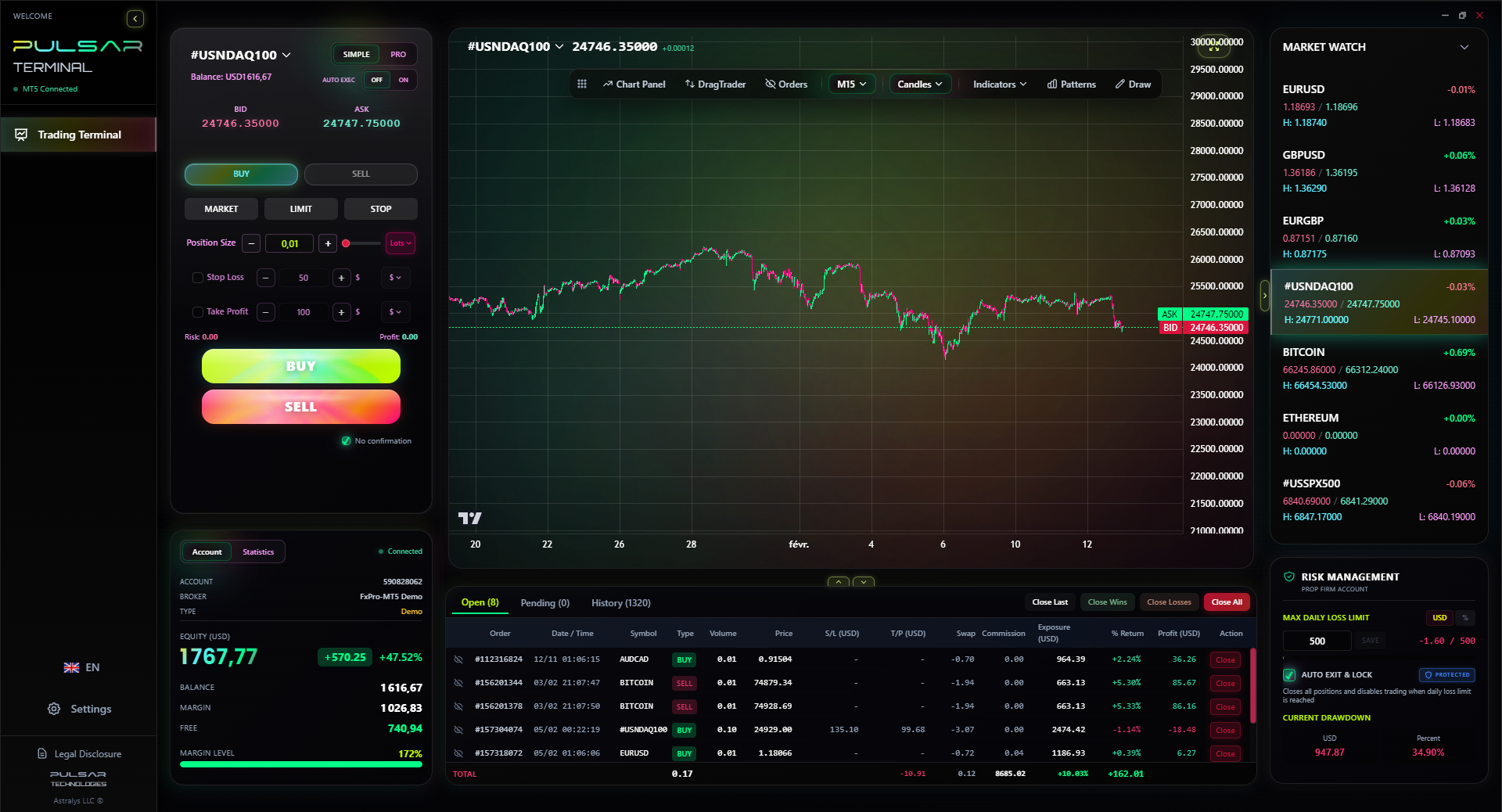
Managing multiple trades with different take-profit levels is complex, but tools like Pulsar Terminal let you set multi-TP orders with partial closures directly on your MT5 chart, automating your exit strategy based on your pre-calculated risk and reward.
Pulsar Terminal
The all-in-one MT5 companion: drag-and-drop orders, multi-TP/SL, trailing stop, grid trading, Volume Profile, and prop firm protection. Used by 1,000+ traders daily.
Forex trading quotes aren't just a ticket to enter a trade. Savvy traders use the information within them.
Spread as a Volatility Gauge: Notice the spread on your favorite pair suddenly doubles or triples for no apparent reason? That's your liquidity providers getting nervous. It often precedes a big move. A widening spread can be a signal to tighten stops or avoid new entries until it settles.
Time Your Trades: Spreads are tightest during the London/New York overlap (1 PM - 4 PM Nigerian time). They widen significantly during the Asian session and right after the New York close. If you're a scalper, trading during peak hours lowers your baseline cost. I schedule my high-frequency sessions for this window.
Pair Selection: Your strategy might not be suitable for all pairs. A scalping strategy that needs 5-pip targets is dead on arrival if you're trading a pair with a 5-pip spread. Your strategy must account for the cost structure implied by the quote. This is why most scalpers stick to major pairs like EUR/USD.
Integrating with Indicators: Don't look at your indicators in a vacuum. A buy signal from your MACD indicator at a price where the spread is abnormally wide is a weaker signal. The market is telling you it's unstable. I combine my RSI indicator readings with spread observations. If RSI shows oversold but the spread is calm and tight, I have more confidence in a reversal play.
, the quote is the raw data. Your job is to interpret not just the price level, but the quality and structure of the quote itself. It's a layer of market information most traders completely ignore.
“Your broker's liquidity providers, technology, and business model directly affect your quotes and your profit.”
I've seen these errors destroy accounts time and again.
Mistake 1: Chasing 'Zero Spread' Accounts Without Understanding Commissions. This is the biggest one. Zero spread sounds like free trading. It's not. The commission on these accounts can be high. You might end up paying more per trade than on a standard account. Always calculate the total cost per lot.
Mistake 2: Trading Exotic or Illiquid Pairs (Like USD/NGN). The spreads are enormous. A 100-pip spread means you need a 100-pip move just to break even. The market can move against you that much before you even have a chance. Stick to majors and a few minors where liquidity is high.
Mistake 3: Ignoring Swap on Long-Term Trades. You find a great swing trading setup and hold for a month. You make 200 pips, but the negative swap was 5 pips a night. Over 30 nights, that's 150 pips gone. Your 200-pip win is actually a 50-pip win after costs. Factor swap into your hold time decision.
Mistake 4: Not Accounting for Slippage in Risk. You risk 2% of your account, calculating your stop-loss based on the current spread. A news event hits, you get 10 pips of slippage, and your actual loss is 40% bigger than planned. This can blow your risk management to pieces. When trading around high-impact news, assume your stop will get slippage and size down accordingly.
Mistake 5: Not Comparing Live Quotes Across Brokers. Don't just trust the advertised spread. Open a demo account with two brokers and watch the live quotes on the same pair for 30 minutes during a quiet period and a volatile period. You'll see the real difference in execution quality. I did this with three brokers before settling on my current one. The differences were eye-opening.
FAQ
Q1Is forex trading legal in Nigeria, and how does that affect the quotes I get?
Yes, individual forex trading is legal. However, the CBN doesn't license most international retail brokers. This means Nigerian traders typically access the global market through brokers regulated offshore (like in Seychelles or Cyprus). This doesn't directly affect the quotes you see - they come from global liquidity pools. The main impact is on funding methods and local support. Your quotes should be the same as a trader in Europe using the same broker, provided your internet connection is stable.
Q2What is a 'pip' in forex trading, and how is it different from the spread?
A pip is the smallest standard price move a currency pair can make, usually the fourth decimal place (e.g., a move from 1.0850 to 1.0851). The spread is the difference between the bid and ask price, measured in pips. If the EUR/USD quote is 1.0850 / 1.0852, the spread is 2 pips. The pip is the unit of movement; the spread is the cost you pay in those units to enter the trade. You can read our full pip definition for more detail.
Q3Why is the spread on USD/NGN so huge on trading platforms?
The official Naira exchange rate is managed by the CBN, and the retail forex market for it is highly illiquid and controlled. Trading platforms don't have direct, deep access to this market. The wide spread (often 50-200 pips) reflects this extreme illiquidity, the broker's risk in offering the pair, and potential conversion fees. For Nigerian traders, it's almost always a terrible instrument to trade directly due to this massive built-in cost.
Q4Should I choose a standard account or a raw spread/ECN account?
It depends on your trading style and size. Standard accounts have no commission but wider spreads. Raw/ECN accounts have tiny spreads but add a commission. As a rule of thumb: if you trade large volumes (multiple lots) or are a scalper, the raw account is almost always cheaper. Use the calculation method in this article to compare the total cost per lot for your typical trade size on your most-traded pairs. For beginners with small lot sizes, a standard account can be simpler.
Q5How do I know if my broker is manipulating the quotes?
Signs of potential manipulation include: consistent and excessive slippage only against you, spreads widening dramatically the moment you click to trade (not during scheduled news), frequent requotes on market orders, and prices that consistently deviate from other major data feeds. To check, compare your platform's live quote with a free, independent feed from a site like Investing.com during a calm market period. If there's a persistent, significant difference, it's a red flag.
Q6Do I pay tax on my forex trading profits in Nigeria?
Yes. Profits from forex trading are generally considered capital gains and are subject to a 10% Capital Gains Tax, payable to the Federal Inland Revenue Service (FIRS). This is a cost you must factor into your overall profitability, separate from the trading costs in the quotes. Keep detailed records of all your trades for tax purposes.
Prof. Winston's Lesson
Key Takeaways:
- ✓Always calculate TOTAL cost: Spread + Commission + Swap.
- ✓A 2-pip spread costs $20 on a standard lot trade.
- ✓Swap can eat 25%+ of profits on long-term holds.
- ✓Compare live quotes, not just advertised spreads.
- ✓Avoid exotic pairs; their spreads are profit killers.
How useful was this article?
Click a star to rate
Weekly Trading Insights
Free weekly analysis & strategies. No spam.
About the Author
Olumide Adeyemi
West African Trading Pioneer
One of Nigeria's most active forex trading educators. 8 years of experience trading from Lagos. Specializes in low-capital strategies and prop firm challenges for African traders.
Comments
Risk Disclaimer
Trading financial instruments carries significant risk and may not be suitable for all investors. Past performance does not guarantee future results. This content is for educational purposes only and should not be considered investment advice. Always conduct your own research before trading.
You Might Also Like

Cara Trading Forex Sukses: 7 Prinsip dari Trader Profesional
Cara trading forex sukses dengan 7 prinsip trader pro: manajemen modal, disiplin, journal trading, backtest. Data nyata, bukan janji profit palsu.
Jam Trading Forex Terbaik untuk Trader Indonesia: Panduan Lengkap dengan Tabel Waktu
Panduan jam trading forex untuk trader Indonesia. Tabel 4 sesi dunia, jam emas 20:00-00:00, sesi mana yang harus dihindari. Data akurat + tips dari trader berpengalaman.
Top 5 Sàn Forex Uy Tín Nhất 2026: Review Jujur dari Trader Indonesia
Top 5 sàn forex uy tín 2026 untuk trader Indonesia. Review jujur: spread, deposit, withdraw, dukungan lokal. Exness, XM, IC Markets & lebih.
Get Pulsar Terminal
All these calculators are built into Pulsar Terminal with real-time data from your MT5 account. One-click position sizing, automatic risk management, and instant calculations.
Get Pulsar Terminal