


You're sitting in Sandton or Fourways, watching the USD/ZAR chart, wondering if this is finally your ticket out of the 9-to-5.

David van der Merwe
Emerging Markets Trader ·  South Africa
☕ 10 min read
What you'll learn:

You're sitting in Sandton or Fourways, watching the USD/ZAR chart, wondering if this is finally your ticket out of the 9-to-5. I get it. The promise of trading dollars and euros from your laptop in Johannesburg is intoxicating. But let me ask you this: are you prepared for how uniquely difficult it is to trade forex from South Africa? The rand's volatility isn't a feature, it's a trap. The global market opens when you're asleep. And the local brokers? Let's just say you need to know exactly what you're getting into. I've traded from Jo'burg, and I've seen the carnage. This isn't a motivational speech. It's a risk assessment.
Trading from Johannesburg feels like you're playing a different game. Your base currency is the ZAR, one of the most volatile emerging market currencies out there. This isn't a minor detail, it's the core of your risk. When you fund a ZAR-denominated trading account, every profit and loss is first calculated in USD, EUR, or GBP, and then converted back to rand. A 5% win on EUR/USD can be wiped out by a 2% move in EUR/ZAR the other way. You're effectively trading two markets at once.
Then there's the time zone. The most liquid sessions - London and New York overlap - happen from 3 PM to 10 PM SAST. If you have a day job, you're trading at the end of your day when you're tired. The Asian session, which is quieter, is when you're supposed to be sleeping. This structural disadvantage forces many into bad habits, like scalping strategy during low-liquidity hours where spreads are wide, or holding swings overnight with massive gap risk.

Warning: Your biggest silent cost isn't the spread; it's the currency conversion on every single trade. If your broker uses a poor conversion rate, you're bleeding money before you even start.
I learned this the hard way in 2018. I made a clean $1,200 profit on a XAU/USD guide swing trade. I was thrilled. But between the trade closing and the profit hitting my ZAR account, the rand strengthened dramatically. That $1,200 translated to about R14,800 instead of the R16,200 it would have been a week earlier. I 'won' the trade but lost R1,400 to my own currency. That's the Johannesburg forex trading experience in a nutshell.

💡 Winston's Tip
Your first calculation before any trade should be: 'If I lose this, what percentage of my account is gone?' If it's more than 1-2%, don't take the trade. Survival is your only priority for the first year.
“Trading from Johannesburg feels like you're playing a different game.”
The Financial Sector Conduct Authority (FSCA) is your main watchdog. A broker licensed by the FSCA is non-negotiable. It means they have to keep client funds in segregated accounts and adhere to some basic standards. But here's the critical part: an FSCA license does NOT guarantee they offer good trading conditions. I've seen local brokers with FSCA approval offering spreads on EUR/USD as high as 2.5 pips. For context, a global broker like IC Markets review or Pepperstone review offers the same pair around 0.1 pips on a raw account.
The Local vs. International Broker Dilemma
Many Jo'burg traders go with a local broker for the ease of ZAR deposits and FSCA comfort. You pay for that convenience through wider spreads and often higher commissions. International brokers often offer far better pricing and technology (like MetaTrader 5, which is superior to MT4). The catch? Funding. You'll need to do an international wire transfer, which your bank will charge for, and you'll be subject to the Reserve Bank's annual foreign capital allowance (currently R11 million for individuals, but your bank will scrutinize frequent small transfers for trading).
| Consideration | Local FSCA Broker | Top-Tier International Broker |
|---|---|---|
| Spread on EUR/USD | 1.8 - 3.0 pips | 0.0 - 0.3 pips (Raw/ECN) |
| Deposit Method | Instant EFT, ZAR | Int'l Wire, Credit Card (USD) |
| Regulation | FSCA (South Africa) | ASIC (Aus), FCA (UK), CySEC (EU) |
| Platform | Often MT4 only | MT5, cTrader, Proprietary |
| Currency Risk | On broker (ZAR account) | On you (USD/EUR account) |
My advice? Start by comparing the real cost. Use a position size calculator and input the spreads. For a 1-lot trade, a 2-pip spread costs you $20 before you're even breakeven. A 0.2-pip spread costs $2. That $18 difference is your money, gone. Over 100 trades, that's R30,000+ at current rates. That pays for a lot of wire transfer fees.

Pro Tip: Don't just check for an FSCA license. Get the broker's FSP number and verify it on the FSCA's website yourself. There have been cases of 'clone firms' pretending to be regulated.

“Your biggest silent cost isn't the spread; it's the currency conversion on every single trade.”
USD/ZAR isn't just a pair you might trade. It's the lens through which you see all your profits and losses. This creates psychological havoc. When the rand is weak, you feel richer. Your USD profits blow up into huge ZAR sums on your screen. This leads to overconfidence. You think you're a genius, but really, you're just riding a weak rand trend. You take bigger risks.
The reverse is a confidence killer. You execute a perfect swing trading plan on the EUR/USD guide, make 4%, but the rand has strengthened by 5%. Your screen shows a loss in rands. You start questioning a perfectly good strategy because your P&L in 'home currency' is misleading you. This is why the most serious traders I know in Johannesburg eventually switch their account base currency to USD. It removes the emotional noise. You measure your skill purely in the market you're trading, not the currency you live with.

Example: You trade GBP/USD. Your account is in ZAR.
- Trade Entry: GBP/USD = 1.2600, USD/ZAR = 18.50
- You buy 1 lot (100,000 units). Your margin (in ZAR) is roughly R18,500.
- Trade Exit: GBP/USD rises to 1.2700 (100 pip win = $1,000).
- BUT, USD/ZAR has fallen to 17.50 (rand strengthened).
- Your $1,000 profit is now worth R17,500.
- In USD terms: +$1,000. In ZAR terms: Your equity went from R18,500 to R17,500? Wait, that's a loss! The math is messy and destroys your performance tracking.
“Your biggest silent cost isn't the spread; it's the currency conversion on every single trade.”
Given our time zone and currency challenges, some strategies are almost designed to fail here.
Avoid (or be extremely careful with):
- High-Frequency Scalping: The latency to international servers from SA is measurable. You're competing against algos in London with a 5-10ms ping. Yours is 150-200ms. You will lose the race on every entry and exit.
- News Trading on USD/ZAR: Trading local CPI or SARB announcements on the rand pairs is a minefield. The spreads widen to 50+ pips instantly, and the volatility is insane. It's a lottery ticket, not a trade.
- Overnight Carry Trading: Holding positions with a swap (interest rate differential) might seem smart, but a rand gap move at 2 AM can trigger your stop and reverse any swap gain ten times over.
Focus On:
- End-of-Day Swing Trading: This aligns with our active hours. Analyze during your day, place orders ahead of the London open (3 PM SAST), and manage in the evening. Your stops are wider, your holding period is 1-5 days. This suits the MACD indicator or other trend-confirmation tools. It respects the time zone.
- Weekly/Monthly Chart Analysis: The higher the time frame, the less your slight latency and rand volatility matter. A trendline break on a weekly chart is significant regardless of where you sit. This is where you can use tools like the RSI indicator to spot longer-term divergences.
- Systematic, Rule-Based Trading: This is the antidote to rand-induced emotional trading. Write down every rule: entry, position size calculator, stop loss, take profit. Follow it. Judge your system's performance in USD over 100 trades, not in ZAR over 2 trades.
💡 Winston's Tip
The rand's mood is not your trading signal. Isolate your analysis. If you wouldn't take the trade on a USD-denominated account, don't take it on your ZAR one.
“Discipline isn't about motivation; it's about designing a routine that removes your worst impulses.”
Here's where most online guides get vague. Let's be specific. In South Africa, forex trading profits are generally considered revenue from a business (if you trade regularly) or capital gains. SARS will look at your intention. Are you speculating for short-term gains (revenue)? Or investing for the long term (capital)? For 99% of active traders, it's revenue.
That means your net profit (after deducting ALL expenses) is added to your other income and taxed at your marginal rate. What counts as an expense? Spreads, commissions, data subscription fees, a portion of your internet bill, even the cost of this education. You must keep careful records of every trade. Every. Single. One.
I made a costly assumption early on. I traded through an international broker and thought, 'SARS will never know.' That's naive. When you eventually withdraw a large sum back to your South African bank account, the bank asks for the source of funds. No legitimate paperwork, no money. And if you're audited, you'll need to explain every deposit. The penalty for tax evasion isn't worth it. Pay the tax. It means you actually made money, which is the goal. Consider it a success fee.
Pro Tip: Open a separate bank account solely for trading. Feed it with your starting capital. All withdrawals and deposits go through it. This makes tracking your P&L for tax purposes infinitely easier. Your accountant will thank you.

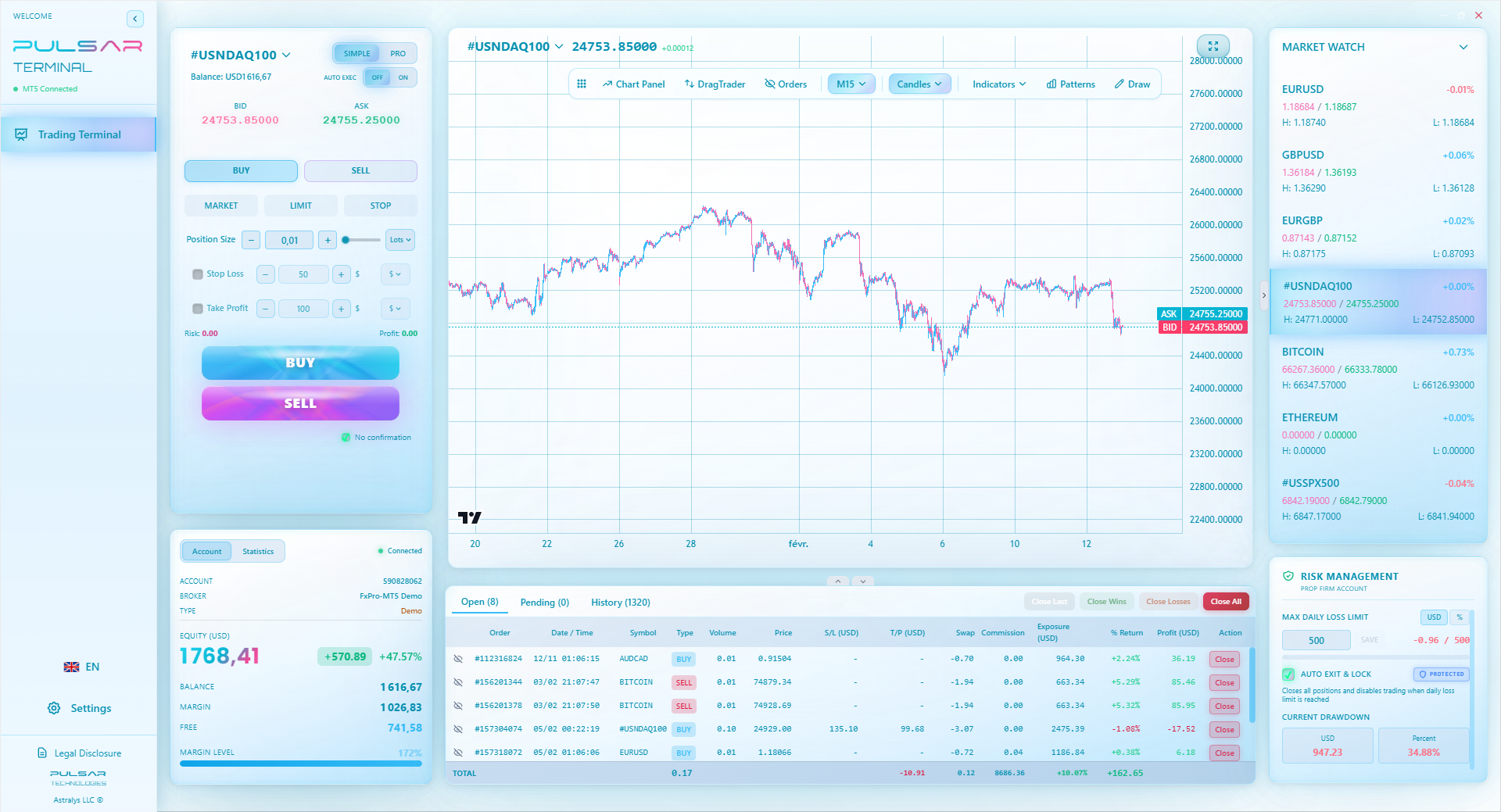
Managing the psychological stress of trading from isolation is easier when your trade management is automated, letting you focus on analysis instead of emotions.
Pulsar Terminal
The all-in-one MT5 companion: drag-and-drop orders, multi-TP/SL, trailing stop, grid trading, Volume Profile, and prop firm protection. Used by 1,000+ traders daily.
“Discipline isn't about motivation; it's about designing a routine that removes your worst impulses.”
Trading can be lonely in London or New York. In Johannesburg, it's isolating. You don't have a local community of pros to bounce ideas off. You're on forums with people in different time zones and realities. This isolation breeds doubt and makes you susceptible to gurus selling 'secret indicators' on Instagram.
Your biggest psychological battle will be FOMO (Fear Of Missing Out) on moves that happen while you're at work or asleep. You'll see a perfect setup that triggered at 11 PM and closed at 7 AM. You'll be tempted to start trading without stops, or to trade bigger to 'catch up.' This is the direct path to a margin call.
You have to build your own structure. Set strict trading hours. Mine were 2 PM to 9 PM SAST, max. No checking charts outside of that. Have a life outside of trading. The markets will be there tomorrow. The rand's volatility will make you feel like you're on a rollercoaster. You need to be the stable track, not another cart. I failed at this for years, constantly glued to screens, until I blew up an account because I overtraded a Sunday night gap purely out of boredom. Discipline isn't about motivation; it's about designing a routine that removes your worst impulses.
“Forget about making money. Your goal for the first 100 trades is to not destroy your capital while learning.”
Forget about making money. Your goal for the first 100 trades is to not destroy your capital while learning. Here's a Johannesburg-specific starter plan:
- Choose a Broker: Compare Exness review, XM review, and IC Markets review for international options, and one top local FSCA broker. Start a demo with each and test execution during the London open (3 PM SAST).
- Base Currency: Open your live account in USD if you can handle the funding hassle. It simplifies everything.
- Capital: Start with money you can afford to lose completely. R5,000 is a common start, but it's very small. R20,000 allows for more realistic position size calculator outcomes.
- Instrument: Trade one major pair only. EUR/USD guide is the most liquid and has the tightest spreads. Ignore USD/ZAR, gold, crypto for now.
- Strategy: Test a simple end-of-day strategy. Example: Price above 200-period moving average on the 4-hour chart, wait for a pullback to the 50-period MA, enter on a 1-hour candle close back in the trend direction. Use a 2:1 risk/reward ratio. Document every trade in a journal - why you took it, your emotion, the result.
- Review: After 100 trades, analyze your journal. Are you net positive in USD? Did you follow your rules? If not, go back to demo. If yes, you might have the beginnings of an edge.
This process will take 4-6 months. That's the reality. Forex trading in South Africa Johannesburg isn't a side hustle you learn in a weekend. It's a professional skill built in the most distracting environment possible. Build slowly, protect your capital, and always, always respect the rand.
💡 Winston's Tip
Keep two journals: one for your trades (entries, exits, reasoning), and one for your emotions and external events (e.g., 'SARB announcement today, felt nervous, closed trade early'). The second one will teach you more about yourself.
FAQ
Q1Is forex trading legal in South Africa?
Yes, absolutely. It is legal for individuals to trade forex through brokers regulated by the Financial Sector Conduct Authority (FSCA). You are responsible for declaring any profits to SARS for tax purposes.
Q2What is the best broker for forex trading in Johannesburg?
There's no single 'best' broker. It's a trade-off. For the lowest costs and best platforms, top-tier international brokers like IC Markets or Pepperstone are superior. For easier ZAR deposits and local regulation comfort, a reputable FSCA-licensed broker is better. You must compare spreads, commissions, and deposit methods yourself based on your needs.
Q3How much money do I need to start forex trading in South Africa?
You can technically start with R500 at some brokers, but it's not advisable. With a small amount, your position size will be tiny, and fees/spreads will eat a large percentage of your capital. A more realistic starting point to properly learn and manage risk is between R10,000 and R20,000. Always use capital you can afford to lose 100% of.
Q4How are forex trading profits taxed in South Africa?
For active traders, profits are typically treated as revenue (trading income) and added to your total taxable income, taxed at your marginal rate. You can deduct legitimate trading expenses (spreads, data, etc.). It's crucial to keep detailed records of all trades and consult with a tax professional familiar with trading.
Q5Why is trading USD/ZAR so risky?
USD/ZAR is an emerging market currency pair with high volatility, lower liquidity compared to majors, and is highly sensitive to local political news, commodity prices, and global risk sentiment. Spreads can widen dramatically around news events, and price gaps are common. It's a difficult pair for beginners to manage risk on.
Q6Can I trade forex successfully with a full-time job in SA?
It's challenging but possible if you adapt. The London/New York session is in your late afternoon and evening. Strategies like end-of-day swing trading that require analysis after work and order placement for the next day are more suitable than intraday scalping. You must have extreme discipline to not check and trade during work hours.
Q7What is the biggest mistake new traders in Johannesburg make?
Ignoring the dual-currency risk. They see a profit in USD on their MT4 screen and immediately convert it to rand in their head at the current rate, not understanding that the final conversion to ZAR in their bank account can be very different. This leads to misjudging real performance and taking on inappropriate risk.
Prof. Winston's Lesson
Key Takeaways:
- ✓The ZAR is a second, hidden market you're always trading.
- ✓FSCA regulation is a safety net, not a seal of quality.
- ✓Time zone dictates viable strategy: swing over scalp.
- ✓Tax your profits as revenue; keep every receipt.
- ✓Isolation is your enemy; structure is your weapon.
How useful was this article?
Click a star to rate
Weekly Trading Insights
Free weekly analysis & strategies. No spam.
About the Author
David van der Merwe
Emerging Markets Trader
Johannesburg-based trader with 11 years in emerging market currencies. Specializes in ZAR pairs, FSCA-regulated trading, and South African market analysis.
Comments
Risk Disclaimer
Trading financial instruments carries significant risk and may not be suitable for all investors. Past performance does not guarantee future results. This content is for educational purposes only and should not be considered investment advice. Always conduct your own research before trading.
You Might Also Like

Cara Trading Forex Sukses: 7 Prinsip dari Trader Profesional
Cara trading forex sukses dengan 7 prinsip trader pro: manajemen modal, disiplin, journal trading, backtest. Data nyata, bukan janji profit palsu.
Jam Trading Forex Terbaik untuk Trader Indonesia: Panduan Lengkap dengan Tabel Waktu
Panduan jam trading forex untuk trader Indonesia. Tabel 4 sesi dunia, jam emas 20:00-00:00, sesi mana yang harus dihindari. Data akurat + tips dari trader berpengalaman.
Top 5 Sàn Forex Uy Tín Nhất 2026: Review Jujur dari Trader Indonesia
Top 5 sàn forex uy tín 2026 untuk trader Indonesia. Review jujur: spread, deposit, withdraw, dukungan lokal. Exness, XM, IC Markets & lebih.
Get Pulsar Terminal
All these calculators are built into Pulsar Terminal with real-time data from your MT5 account. One-click position sizing, automatic risk management, and instant calculations.
Get Pulsar Terminal