


Most Nigerian traders think technical analysis is about finding a magic indicator.

Olumide Adeyemi
West African Trading Pioneer ·  Nigeria
☕ 11 min read
What you'll learn:
- 1What Technical Analysis Really Is (And Isn't)
- 2Core Concepts: Price Charts, Trends, and Support/Resistance
- 3Essential Indicators & Oscillators for Nigerian Traders
- 4Chart Patterns & Price Action Setups
- 5Building a Technical Trading Plan (The Nigerian Reality)
- 6Common Mistakes Nigerian Traders Make with Technical Analysis
- 7Putting It All Together: A Live Walkthrough
Most Nigerian traders think technical analysis is about finding a magic indicator. They're wrong, and that's why they lose money. The truth is, technical analysis is just a structured way to read the story price is telling you, and if you ignore the plot, you'll get burned. I've watched traders in Lagos and Port Harcourt blow accounts chasing 'signals' without understanding the foundation. This guide will strip away the nonsense and show you the core principles of forex trading technical analysis that work with our market's unique volatility, from the Naira's swings to finding a decent broker.
Let's clear this up first. Technical analysis isn't a crystal ball. It's the study of past market data, primarily price and volume, to identify probabilities about future direction. It assumes all known information is reflected in the price, and that history tends to repeat itself in terms of market psychology.
For us in Nigeria, this is crucial. When the CBN makes a policy announcement, you see the immediate panic or euphoria in the USD/NGN pair. Technical analysis helps you measure that reaction, not predict the announcement itself. The biggest mistake I see? New traders treat indicators like holy scripture. An RSI reading of 70 doesn't mean 'sell now.' It means the asset is in a condition where it has historically been overbought. Context is everything.

Warning: No indicator will save you from poor risk management. A perfect entry signal means nothing if your position size is reckless. Always use a position size calculator before you click buy or sell.
The foundation is price action - the raw movement of the candles or bars on your chart. Everything else (moving averages, MACD, etc.) is just a derivative of price. If you don't learn to read price action first, you're building a house on sand.
“Technical analysis isn't a crystal ball. It's a structured way to read the story price is telling you.”
Reading the Price Chart
You have three main chart types: Line, Bar, and Candlestick. For forex trading technical analysis, candlestick charts are the standard. Each candle shows the open, high, low, and close for a period (like 1 hour or 1 day). The body and wicks tell you who won the battle between buyers and sellers in that timeframe. A long green candle closing near its high shows strong buying pressure. A candle with long wicks at both ends shows indecision.
The Trend is Your Friend (Until It Ends)
This old saying holds true. A trend is simply the general direction the market is moving. An uptrend is a series of higher highs and higher lows. A downtrend is a series of lower highs and lower lows. Your first job on any chart is to identify the trend. Trading with the trend increases your probability of success. I learned this the hard way in 2020, trying to short a raging bull trend in EUR/USD. I was right about a pullback, but the trend was so strong it wiped my stop-loss before reversing. I lost $420 on that stubborn trade.
Support and Resistance: The Market's Floor and Ceiling
Support is a price level where buying interest is strong enough to overcome selling pressure, causing the price to bounce back up. Resistance is the opposite - a level where selling pressure overcomes buying, pushing the price down. These aren't magic lines; think of them as zones where price has reacted before. The more times price tests a level without breaking it, the stronger that level becomes. When price finally breaks through, that old resistance often becomes new support, and vice versa. This is key for planning entries and exits.

💡 Winston's Tip
The trend on the daily chart is the boss. Never let a 15-minute chart employee tell the boss they're wrong.
“A plan without execution is a wish.”
Indicators are tools, not trading systems. Pick a few and learn them deeply. Here are the workhorses for forex trading technical analysis in our fast-moving market.
Trend-Following Indicators:
- Moving Averages (MA): Smooth out price data to show the trend direction. The 50-period and 200-period Simple Moving Averages (SMA) are widely watched. When the 50 crosses above the 200, it's a 'Golden Cross' (bullish). When it crosses below, it's a 'Death Cross' (bearish). I use the 20-period Exponential Moving Average (EMA) on the 1-hour chart for scalping strategy entries.
- MACD (Moving Average Convergence Divergence): Shows the relationship between two moving averages. It has a signal line and a histogram. Look for crossovers of the MACD line and the signal line, and for divergence (when price makes a new high but MACD doesn't). The MACD indicator page breaks down the settings I use.
Momentum Oscillators:
- RSI (Relative Strength Index): Measures the speed and change of price movements on a scale of 0 to 100. Readings above 70 suggest overbought, below 30 oversold. In a strong trend, RSI can stay overbought/oversold for a long time. Don't just sell because RSI hits 71. I look for RSI divergence as a stronger signal for a potential reversal.
- Stochastic Oscillator: Similar to RSI, it compares a closing price to its price range over time. It's more sensitive, which can be good for catching turns but also generates more false signals.
| Indicator | Best For | Biggest Pitfall |
|---|---|---|
| Moving Averages | Defining trend direction, dynamic support/resistance | Lagging. Price moves first, MA follows. |
| MACD | Spotting trend changes & momentum shifts | Whipsaws in sideways (ranging) markets. |
| RSI | Identifying overbought/oversold conditions & divergences | Can stay extreme during strong trends, leading to early exits. |

Pro Tip: Don't clutter your chart. Start with one trend indicator (like a 20 EMA) and one oscillator (like RSI). More lines just create confusion and conflict. I made this mistake for my first year, my chart looked like a rainbow spaghetti monster.
“A plan without execution is a wish.”
This is where the story gets clear. Patterns are recurring formations that suggest what might happen next.
Reversal Patterns: Signal a potential change in trend.
- Head and Shoulders: Looks like a head with two lower shoulders. A completed pattern (break of the 'neckline') suggests the uptrend is reversing. I caught a beautiful one on GBP/USD in late 2023. Entry on the neckline break at 1.2620, target based on the pattern height, exit at 1.2450. That was a clean 170-pip gain.
- Double Top/Bottom: 'M' shape (top) or 'W' shape (bottom). After two failed attempts to break a level, price often reverses.
Continuation Patterns: Suggest the trend will resume after a pause.
- Triangles (Ascending, Descending, Symmetrical): Price coils into a tighter range before a breakout, usually in the direction of the prior trend.
- Flags and Pennants: Small, tight consolidations after a sharp move (the 'flagpole').
Candlestick Patterns: These are your quick-read signals. A bullish engulfing pattern (a large green candle completely 'engulfing' the previous red candle) shows buyers aggressively stepping in. A doji (where open and close are nearly equal) shows indecision, often at a top or bottom. Learn to spot these. They won't work in isolation, but combined with a key support level, they're powerful. For more on holding these moves, check out swing trading tactics.
💡 Winston's Tip
Your first profit target should always be to move your stop-loss to breakeven. A trade that can't turn a profit should never turn into a loss.
“Your stop-loss is NOT a suggestion. It's your lifeline.”
A plan without execution is a wish. Here’s how to build one that accounts for our reality: power cuts, internet issues, and Naira volatility.
- Market Selection: Don't trade 28 pairs. Start with one or two majors with good liquidity and lower spreads, like EUR/USD or GBP/USD. These are less prone to wild, broker-driven spikes. Once comfortable, you can look at others. I have a separate EUR/USD guide for this pair.
- Timeframe Alignment: Use multiple timeframes. I use the Daily chart to identify the primary trend (Am I a buyer or seller today?). The 4-Hour chart to find key support/resistance and the trade bias. The 1-Hour or 15-Minute chart for precise entry timing. Never take a buy signal on the 15-minute chart if the daily chart is screaming downtrend.
- Entry Trigger: This is your specific rule. It could be: "Buy when price pulls back to the 20 EMA in an uptrend and forms a bullish engulfing candle." Or: "Sell when RSI shows bearish divergence at a key resistance level." Be specific.
- Stop-Loss Placement: Your stop-loss is NOT a suggestion. It's your lifeline. Place it logically, beyond the recent swing low (for a buy) or high (for a sell), or beyond the pattern boundary. If your stop is farther away, reduce your position size to keep the risk in Naira terms the same. Never move your stop-loss further away because you're wrong.
- Take-Profit Target: Have a target based on something real: a measured move from a pattern, the next resistance level, or a risk-reward ratio. I aim for a minimum 1:1.5 risk-reward. If I risk ₦5,000, I want a potential profit of at least ₦7,500.
- Broker & Platform: Your tools matter. You need a reliable broker with fast execution. Slippage on volatile Naira pairs can kill a good trade. Look for brokers with local support and good withdrawal processes. I've used Exness for its Naira accounts and IC Markets for raw spreads on majors. Test their demo accounts first.
Warning: Nigerian traders, beware of the 'spread trap' on exotic pairs involving NGN. Spreads can be 50 pips or more. That means the price has to move 50 pips just for you to break even. Stick to majors where the spread definition is tight, often under 1 pip.
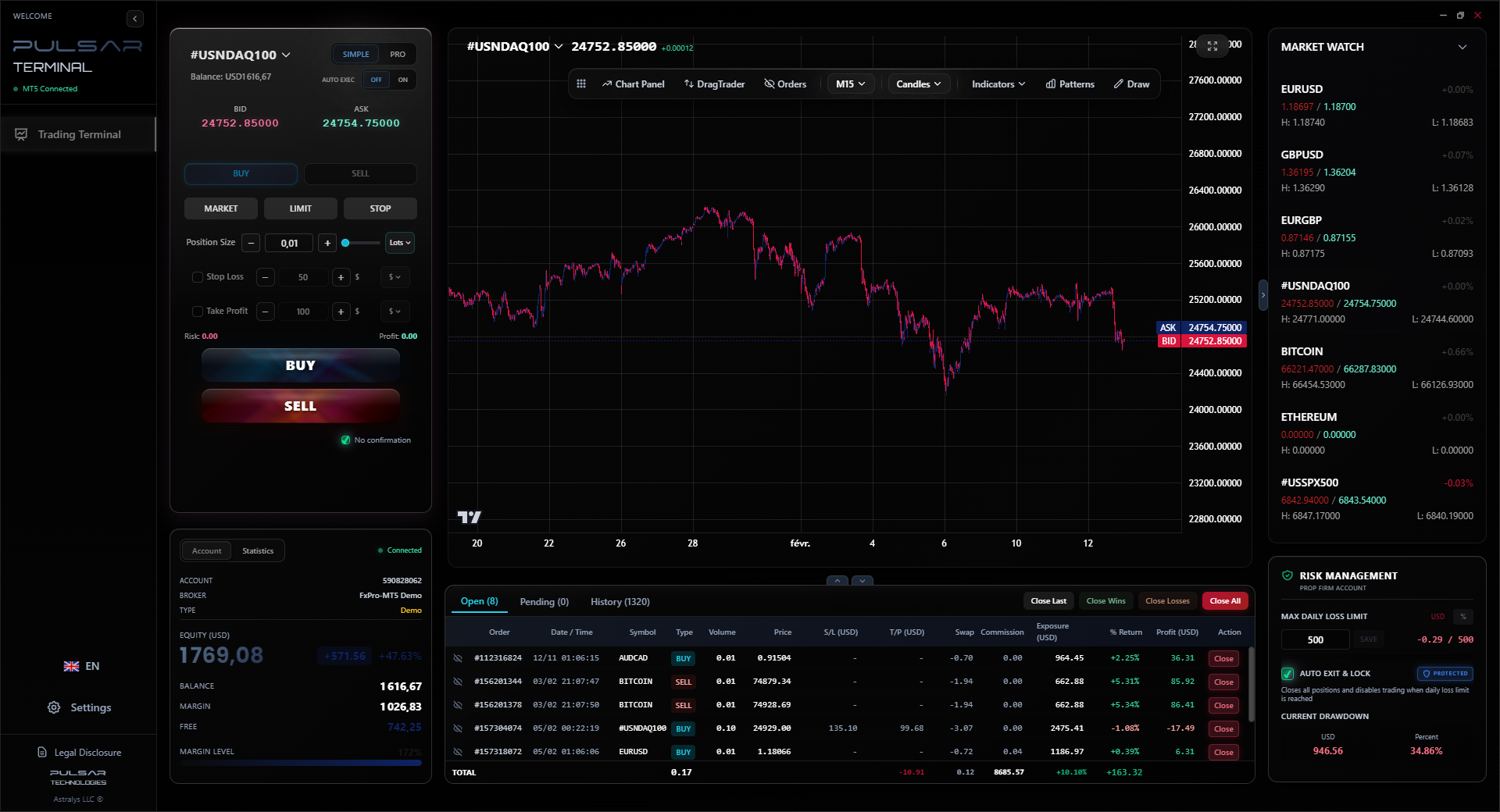
Executing a multi-target trade plan manually on MT5 is clunky, but Pulsar Terminal lets you drag-and-drop orders with partial closures directly on your chart.
Pulsar Terminal
The all-in-one MT5 companion: drag-and-drop orders, multi-TP/SL, trailing stop, grid trading, Volume Profile, and prop firm protection. Used by 1,000+ traders daily.
“Your stop-loss is NOT a suggestion. It's your lifeline.”
I've made most of these. Let's save you the pain and lost capital.
- Overcomplicating the Chart: Ten indicators saying ten different things. You get paralyzed. Keep it simple.
- Ignoring the Higher Timeframe Trend: This is the #1 reason for blowouts. Chasing a 5-minute chart signal against the daily trend is financial suicide.
- No Stop-Loss: "It'll come back." Famous last words. The market doesn't care about your hope. A margin call is a brutal teacher.
- Revenge Trading: After a loss, you jump right back in to 'make it back.' Emotion is now driving, not your analysis. Step away.
- Trading During Low Liquidity or Major News: Trading the NGN pair right before or after a CBN announcement is gambling, not analysis. The spreads widen, and price can gap violently.
- Confusing a Strategy with a Single Trade: A good strategy wins over 20+ trades, not every single one. You will have losing trades. If your analysis was sound and you kept your risk small, it was a good trade that happened to lose.
My most expensive lesson was in early 2022. I was up ₦280,000 for the month. Got greedy on a gold short, ignored clear bullish price action on the 4-hour chart because my 15-minute indicator said 'sell.' I didn't use a stop-loss, convinced I was right. A geopolitical headline hit, gold ripped higher, and I watched in horror as my profit vanished and turned into a ₦150,000 loss. I broke every rule in my plan. It took me three months to emotionally recover.
💡 Winston's Tip
If you look at a chart and your immediate thought is 'What's it going to do?', you're not ready to trade it. You should be thinking 'What does it need to do for me to act?'
“Learning to do your own analysis is the only path to true independence.”
Let's look at a recent example on XAU/USD (Gold).
- Context (Late March 2026): The daily chart for gold was in a clear uptrend - making higher highs and higher lows.
- Setup on 4-Hour: Price pulled back to a previous resistance level (which should now act as support) around $2180. This level also aligned with the rising 50-period EMA.
- Entry Trigger on 1-Hour: At the $2180 zone, price formed a bullish hammer candlestick, followed by a strong green candle. The RSI indicator had dipped near 40 (bullish in an uptrend) but was turning up.
- Trade Execution:
- Entry: Buy at $2183.
- Stop-Loss: Placed at $2172, just below the recent swing low and the support zone. Risk = $11 per ounce.
- Take-Profit 1: Set at $2195 (previous minor high).
- Take-Profit 2: Set at $2210 (next resistance zone). This gave a risk-reward of over 1:2.5 on the first target.
- Result: Price moved up, hit TP1, and continued to TP2 over the next day. A textbook trend-following pullback trade.
The key wasn't a magic signal. It was aligning the trend (Daily), finding a logical area for action (4H S/R & EMA), and waiting for a clear price action confirmation (1H candle). This disciplined approach is what separates consistent traders from gamblers. For more on trading gold specifically, see the XAU/USD guide.
FAQ
Q1Is technical analysis enough for forex trading in Nigeria?
It's the core skill for entry and exit timing, but it's not enough alone. You must combine it with solid risk management (position sizing, stop-losses) and an awareness of fundamental catalysts, especially from the CBN. A technical setup can be obliterated by a surprise interest rate decision.
Q2What is the best timeframe for beginners in Nigeria?
Start with the 4-hour chart. It's slow enough to filter out market noise and avoid the stress of scalping, but fast enough to see setups develop within days. Avoid the 1-minute and 5-minute charts when starting; they are a fast track to emotional burnout and poor decisions.
Q3Which technical indicator is the most accurate?
None of them are 'accurate' in a predictive sense. They show conditions. Price action itself is the most direct indicator. After that, moving averages and RSI are among the most reliable because they are simple and widely followed, which can create self-fulfilling reactions at key levels.
Q4How much money do I need to start forex trading using technical analysis in Nigeria?
You can open an account with as little as $10 or ₦5,000 with some brokers. However, to trade properly with sensible risk management (e.g., risking 1-2% per trade), a more realistic starting capital is around $500 or ₦400,000. This allows you to withstand a few losses without a margin call and trade sensible position sizes.
Q5Can I use technical analysis on the USD/NGN pair?
You can, but be extremely cautious. The pair is highly sensitive to CBN policy and can experience large gaps and wildly widening spreads. Technical levels can break without warning. If you do trade it, use much wider stop-losses and smaller position sizes than you would on a major like EUR/USD.
Q6How long does it take to learn forex technical analysis?
You can learn the basics in a few weeks. But to become proficient - where you instinctively see patterns, respect trends, and control your emotions - takes at least 1-2 years of consistent screen time and journaling your trades. There are no shortcuts.
Q7Are free technical analysis signals on WhatsApp and Telegram reliable?
Almost never. If someone had a reliably profitable signal, they would trade it themselves, not sell it for ₦5000 a month. These services often show past wins (cherry-picked) and ignore losses. Learning to do your own analysis is the only path to true independence.
Prof. Winston's Lesson
Key Takeaways:
- ✓Price action is the foundation; indicators are just derivatives.
- ✓Always define the higher timeframe trend first.
- ✓Risk a maximum of 1-2% of your capital per trade.
- ✓A good strategy wins over 20+ trades, not every single one.
How useful was this article?
Click a star to rate
Weekly Trading Insights
Free weekly analysis & strategies. No spam.
About the Author
Olumide Adeyemi
West African Trading Pioneer
One of Nigeria's most active forex trading educators. 8 years of experience trading from Lagos. Specializes in low-capital strategies and prop firm challenges for African traders.
Comments
Risk Disclaimer
Trading financial instruments carries significant risk and may not be suitable for all investors. Past performance does not guarantee future results. This content is for educational purposes only and should not be considered investment advice. Always conduct your own research before trading.
You Might Also Like

Cara Trading Forex Sukses: 7 Prinsip dari Trader Profesional
Cara trading forex sukses dengan 7 prinsip trader pro: manajemen modal, disiplin, journal trading, backtest. Data nyata, bukan janji profit palsu.
Jam Trading Forex Terbaik untuk Trader Indonesia: Panduan Lengkap dengan Tabel Waktu
Panduan jam trading forex untuk trader Indonesia. Tabel 4 sesi dunia, jam emas 20:00-00:00, sesi mana yang harus dihindari. Data akurat + tips dari trader berpengalaman.
Top 5 Sàn Forex Uy Tín Nhất 2026: Review Jujur dari Trader Indonesia
Top 5 sàn forex uy tín 2026 untuk trader Indonesia. Review jujur: spread, deposit, withdraw, dukungan lokal. Exness, XM, IC Markets & lebih.
Get Pulsar Terminal
All these calculators are built into Pulsar Terminal with real-time data from your MT5 account. One-click position sizing, automatic risk management, and instant calculations.
Get Pulsar Terminal