


Let's be honest, most 'beginner' guides to forex trading are written by people who've never placed a real trade.

Olumide Adeyemi
West African Trading Pioneer ·  Nigeria
☕ 9 min read
What you'll learn:
- 1What is Forex, Really? Forget the Textbook
- 2The Core Concepts (Without the Jargon)
- 3How to Actually Read a Chart (It's Not a Magic 8-Ball)
- 4Placing Your First Trade: A Step-by-Step Walkthrough
- 5Brokers and Platforms: The Nigerian Reality
- 6Psychology: The Real Game is in Your Head
- 7Pitfalls Every Nigerian Beginner Falls Into (And How to Avoid Them)
- 8Your First 30 Days: A Realistic Action Plan
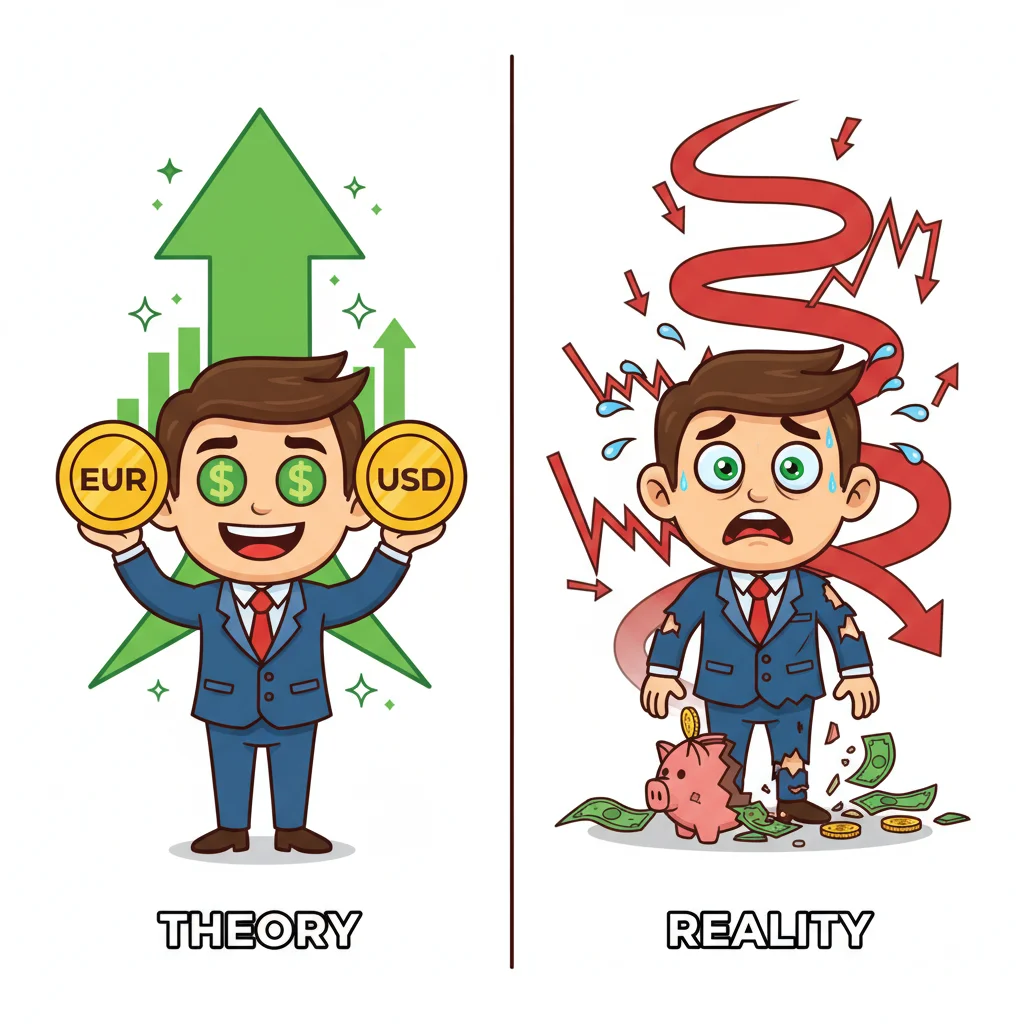
Let's be honest, most 'beginner' guides to forex trading are written by people who've never placed a real trade. They make it sound like a mystical art. It's not. Forex trading the basics explained in simple terms is just about swapping one currency for another and hoping its value changes in your favour. That's it. The complexity comes from managing your own greed and fear, not from understanding the market. I've traded through bull markets, crashes, and everything in between for over a decade, and I'm going to prove to you that the core of this game is brutally simple. The hard part is you.
You know how you check the rate for dollars on AbokiFX or Binance? That's the forex market in its purest form. You're checking the price of the Naira (NGN) against the US Dollar (USD). The global forex market is just that, but on a massive scale where banks, governments, and guys like us try to profit from those price movements.
It's an over-the-counter (OTC) market, which means there's no single physical exchange like the Nigerian Stock Exchange. It's a network of computers. The main thing you're trading is currency pairs, like EUR/USD or GBP/JPY. The first currency is the 'base', the second is the 'quote'. If you buy EUR/USD, you're buying Euros and selling Dollars, betting the Euro will get stronger.

Pro Tip: Start by watching just one or two pairs. Trying to track them all is a sure way to get confused and miss what's actually happening. I made my first consistent profits only after I stopped looking at 10 charts and focused solely on EUR/USD. You can learn a lot from our dedicated EUR/USD guide.
The market is open 24 hours a day, five days a week, because as one financial center closes (like London), another opens (like New York). For us in Nigeria, this means you can trade in the evening after work when both the European and US sessions are active, which is often when things get volatile.

Let's break down the terms you actually need to know.
Pips and Lots
A pip is usually the smallest price move a currency pair can make. For most pairs, it's 0.0001. If EUR/USD moves from 1.0850 to 1.0851, that's a 1-pip move. It's how we measure profit and loss. A lot is the trade size. A standard lot is 100,000 units of the base currency. Thankfully, brokers offer mini (10,000) and micro (1,000) lots, so you don't need millions of Naira to start. If you're unsure how this affects your risk, always use a position size calculator before you enter a trade.
Bid, Ask, and Spread
This is the broker's cut. The bid is the price you can sell at. The ask is the price you can buy at. The spread is the difference between them. If EUR/USD is quoted as 1.0850 / 1.0852, the spread is 2 pips. You start your trade in a 2-pip hole. This is why a low, stable spread is a key feature of a good broker like IC Markets or Pepperstone.
use and Margin
This is the double-edged sword. use lets you control a large position with a small amount of your own money (your margin). If your broker offers 100:1 use, you can control $10,000 with just $100 in your account. It magnifies both gains AND losses. I learned this the hard way early on. I put $500 on a 'sure thing' trade with high use. The market moved 30 pips against me, and I got a margin call. My entire $500 was gone in minutes. use is a tool, not a magic wand. Use it sparingly.
“use is a tool, not a magic wand. Use it sparingly.”
Charts show you the history of a currency pair's price. The most common type is the candlestick chart. Each 'candle' shows the open, high, low, and close price for a specific time period (like 1 hour or 1 day).
A green (or white) candle means the price closed higher than it opened (bullish). A red (or black) candle means it closed lower (bearish). The wicks show the highest and lowest prices reached during that period.
You don't need 20 fancy lines to start. Pick one or two indicators to help you understand momentum and trend. The RSI indicator can show if a market is overbought or oversold. The MACD indicator can help identify trend changes. But remember, indicators are based on past price. They are lagging. Price action itself - where the candles form support (a floor) or resistance (a ceiling) - is often more telling.

Warning: A common mistake is seeing a pattern you like and ignoring everything else on the chart. I once saw a perfect 'double bottom' on GBP/USD and went all in, completely ignoring a massive resistance level just 20 pips above my entry. The price hit that resistance and dropped like a stone. The pattern failed because of the bigger context.

💡 Winston's Tip
Your first profitable system will be boring. The exciting, complex strategies are usually a distraction from the fundamentals of price action.
Let's make this concrete. Imagine you're using a demo account on a platform like MetaTrader 5.
- Analysis: You look at USD/NGN (or more commonly for international brokers, you'd look at USD/ZAR or another liquid African pair proxy) and see the Naira has been weakening steadily. You think a bounce is due. You check the RSI, and it's in oversold territory.
- Decision: You decide to BUY USD/NGN (betting the Naira will weaken further, or SELL if you think it will strengthen).
- Order Entry: You right-click on the chart, select 'New Order'. A ticket pops up.
- Details:
- Symbol: USDNGN
- Volume: You choose 0.10 (a mini lot). Never risk more than 1-2% of your account on a single trade.
- Stop Loss (SL): You MUST set this. You place it 50 pips below your entry price. This is your automatic exit if you're wrong. It's your life insurance.
- Take Profit (TP): You place it 100 pips above your entry, aiming for a 2:1 reward-to-risk ratio.
- Click 'Buy' or 'Sell'.
Now, you wait. Don't stare at it. The trade will either hit your stop loss (you lose a predetermined, small amount) or your take profit. This discipline is what separates gamblers from traders. For strategies on quick in-and-out trades, you can explore scalping strategy, and for longer holds, check out swing trading.
“Understanding a chart is 20% of the work. Managing your emotions is the other 80%.”
This is a minefield. The 'basics' include knowing who you're giving your money to. Many flashy brokers advertising on social media are not properly regulated. You want a broker regulated by a reputable authority like the FCA (UK), ASIC (Australia), or CySEC (Cyprus).
Depositing and withdrawing in Naira is a key concern. Look for brokers that offer local bank transfers or partnerships with Nigerian payment processors. Spreads on major pairs should be tight and commissions clear. Some brokers popular with experienced Nigerian traders for their reliability and fair conditions include Exness, which has a strong local presence, and XM.
The trading platform is your cockpit. MetaTrader 4 (MT4) and MetaTrader 5 (MT5) are the industry standards. They might look dated, but they're stable and have every tool you'll ever need. All the brokers mentioned above offer them. Don't get sucked in by a broker's 'proprietary' platform that looks like a video game unless it offers a clear, proven advantage.

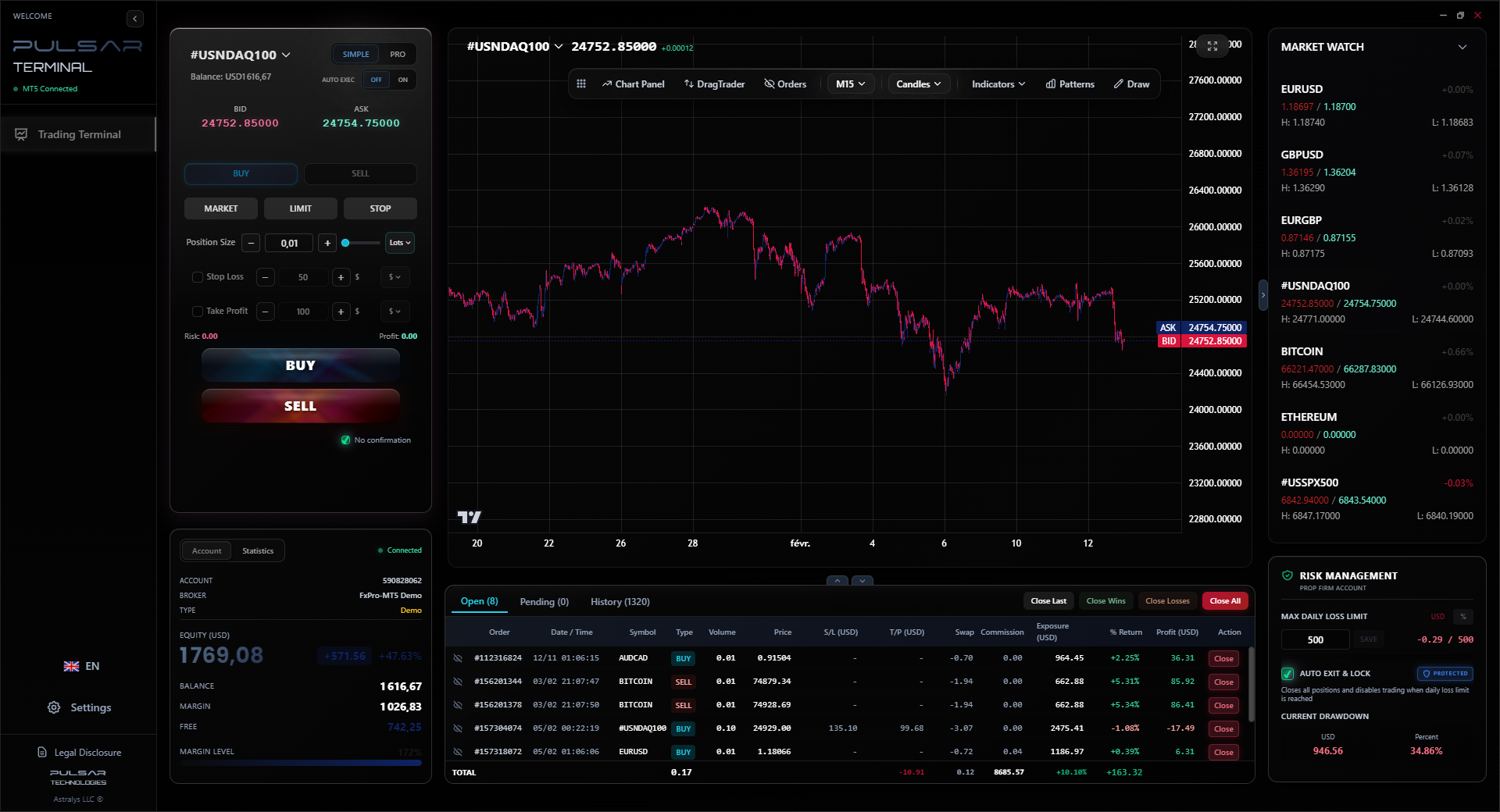
Sticking to your trading plan requires tools that remove emotion, like Pulsar Terminal's automated order management for MT5, which can set your stop loss and take profit the moment you enter a trade.
Pulsar Terminal
The all-in-one MT5 companion: drag-and-drop orders, multi-TP/SL, trailing stop, grid trading, Volume Profile, and prop firm protection. Used by 1,000+ traders daily.
Here's the secret no one tells you in the 'basics': Understanding a chart is 20% of the work. Managing your emotions is the other 80%. You will feel the urge to move your stop loss further away when a trade goes against you ('hoping' it will come back). You will feel the greed to take profit too early on a winning trade. You will feel the fear of missing out (FOMO) and jump into a trade without a plan.
I have a journal entry from 2018 that reads: "Sold GBP/USD at 1.3010. TP at 1.2950. SL at 1.3050. Got scared at 1.2980, closed for +30 pips. Price then fell to 1.2945 without me." I left 65 pips on the table because of fear. The system worked; I didn't.
You need a trading plan and you must stick to it. Your plan should answer: What pairs do I trade? What's my daily loss limit? What's my strategy for entering and exiting? Write it down. This is your rulebook. When emotions run high, you follow the rulebook, not your gut.
💡 Winston's Tip
If you can't explain your trade setup in one simple sentence, you don't understand it well enough to risk money on it.
“Sometimes, the best trade is no trade. Patience is a currency.”
Let's call these out so you can sidestep them.
- Trading With 'Alero' Money: Never trade with money meant for rent, school fees, or your 'aso ebi'. Only use risk capital you can afford to lose completely. The stress will destroy your judgment.
- Changing Strategies Weekly: You see a strategy on YouTube, try it for two days, lose, then jump to another. Master one simple approach. A basic support/resistance strategy executed perfectly is better than 10 fancy ones executed poorly.
- Overtrading: Feeling like you must be in a trade all the time to make money. Sometimes, the best trade is no trade. Wait for your setup. Patience is a currency.
- Ignoring Global News: The Naira reacts to US Federal Reserve announcements, oil prices, and local CBN policies. Use an economic calendar. A trade placed right before a major news event is a coin toss.

Example: Let's say you have a 100,000 Naira account. A sane risk per trade is 1%, or 1,000 Naira. If your stop loss is 50 pips away on USD/NGN, you can only afford a position size where a 50-pip loss equals 1,000 Naira. This math keeps you in the game.
- Week 1-2: Demo Account Only. Open a demo account with a broker like Pepperstone. Don't even think about real money. Practice placing trades, setting stops, and using the platform. Get comfortable with the mechanics of a pip definition and the spread definition.
- Week 3: Develop a Simple Plan. Based on your demo experience, write down a one-page trading plan. "I will only trade EUR/USD during the London session. I will use the 1-hour chart and look for price to bounce off a clear support level with RSI below 30. I will risk 1% per trade."
- Week 4: Execute on Demo. Follow your plan to the letter for a full week. Review every trade. Did you follow the rules? Was the rule good? Tweak the plan, not your discipline.
- Only then, consider a small live account. Fund it with an amount so small that losing it wouldn't make you flinch. The goal of this first live account is not to get rich. The goal is to learn to execute your plan with real money on the line. That emotional lesson is priceless.
FAQ
Q1How much money do I need to start forex trading in Nigeria?
Technically, you can start with as little as $10 (about 15,000 Naira) on a micro account. But realistically, start with a demo account (free). When you go live, use an amount you are 100% comfortable losing, like 50,000 Naira, to learn the emotional side without panic.
Q2Is forex trading haram or halal?
This is a deeply personal religious question. Some Islamic scholars consider spot forex trading (instant currency exchange) permissible, while many consider leveraged trading with swaps (overnight interest) to be impermissible (haram) as it involves riba (interest). You must consult with a scholar you trust for guidance based on your faith and the specific broker's account types (some offer swap-free 'Islamic' accounts).
Q3Can I make a living from forex trading in Nigeria?
A small percentage do, but it's incredibly tough and takes years of consistent, disciplined practice. Do not quit your job to trade. Treat it as a serious skill-based side hustle first. The vast majority of people who try to go full-time too quickly blow up their accounts. Build your skill and track record over years, not months.
Q4Why do most Nigerian forex traders fail?
The main reasons are lack of a tested plan, poor risk management (using too much use, not using stop losses), emotional trading, and constantly switching strategies. They treat it like gambling or a quick-rich scheme instead of a professional skill requiring patience and discipline.
Q5What's the best time to trade forex in Nigeria?
The most volatile (and opportunity-filled) sessions for major pairs like EUR/USD are during the London session (1 PM - 10 PM Nigerian Time) and the overlap with the New York session (3 PM - 5 PM Nigerian Time). This is when liquidity and volume are highest.
Q6How do I avoid forex scams in Nigeria?
Avoid any 'mentor' or 'signal seller' who guarantees profits or asks for direct control of your money. Only use internationally regulated brokers (check their license on their website). If an offer sounds too good to be true (e.g., 'double your money in a week'), it is a scam.
Prof. Winston's Lesson
Key Takeaways:
- ✓Never risk more than 1-2% of your capital on a single trade.
- ✓A 2:1 reward-to-risk ratio should be your minimum target.
- ✓Master one currency pair before adding another.
- ✓A trading plan is useless without the discipline to follow it.
How useful was this article?
Click a star to rate
Weekly Trading Insights
Free weekly analysis & strategies. No spam.
About the Author
Olumide Adeyemi
West African Trading Pioneer
One of Nigeria's most active forex trading educators. 8 years of experience trading from Lagos. Specializes in low-capital strategies and prop firm challenges for African traders.
Comments
Risk Disclaimer
Trading financial instruments carries significant risk and may not be suitable for all investors. Past performance does not guarantee future results. This content is for educational purposes only and should not be considered investment advice. Always conduct your own research before trading.
You Might Also Like

Cara Trading Forex Sukses: 7 Prinsip dari Trader Profesional
Cara trading forex sukses dengan 7 prinsip trader pro: manajemen modal, disiplin, journal trading, backtest. Data nyata, bukan janji profit palsu.
Jam Trading Forex Terbaik untuk Trader Indonesia: Panduan Lengkap dengan Tabel Waktu
Panduan jam trading forex untuk trader Indonesia. Tabel 4 sesi dunia, jam emas 20:00-00:00, sesi mana yang harus dihindari. Data akurat + tips dari trader berpengalaman.
Top 5 Sàn Forex Uy Tín Nhất 2026: Review Jujur dari Trader Indonesia
Top 5 sàn forex uy tín 2026 untuk trader Indonesia. Review jujur: spread, deposit, withdraw, dukungan lokal. Exness, XM, IC Markets & lebih.
Get Pulsar Terminal
All these calculators are built into Pulsar Terminal with real-time data from your MT5 account. One-click position sizing, automatic risk management, and instant calculations.
Get Pulsar Terminal