


I lost ₹42,000 in a single night trying to trade the AUD/USD during the Sydney session.

Rajesh Sharma
Senior Forex Analyst ·  India
India
☕ 10 min read
What you'll learn:
- 1Why Time is Your Secret Weapon (or Your Worst Enemy)
- 2The Forex Market Sessions (Translated to IST)
- 3The Best Time to Trade Forex in India (By Strategy)
- 4Practical Tools: Managing Time-Based Risk
- 5Classic Time-Related Mistakes (I've Made Them All)
- 6A Sample Weekday Schedule for an Indian Trader
- 7Weekends, Indian Holidays & Black Swan Events

I lost ₹42,000 in a single night trying to trade the AUD/USD during the Sydney session. The chart was dead, the spread was 5 pips, and my market order just sat there, slowly getting eaten by fees. That was my expensive lesson: if you're trading from India, you can't just follow some generic 'best time to trade' guide. You need to understand the clock from an Indian Standard Time (IST) perspective. Your profitability isn't just about your strategy, it's about when you choose to deploy it. Getting the timing right is half the battle won, and getting it wrong is a surefire way to bleed your account dry.
Think of the forex market as a 24-hour party. But the party has different vibes in different rooms at different times. The London session is the packed, energetic main hall. The New York session is where the big money shows up. The Asian session is more of a chill lounge. If you walk into the chill lounge expecting a mosh pit, you're going to be disappointed and probably lose your shirt.
For us in India, sitting at GMT+5:30, this is critical. Our most active personal trading hours often don't line up perfectly with the market's most liquid hours. You might have time to trade after your day job at 7 PM IST, which is great. But if you try to trade at 2 PM IST, you're in a different world entirely. Liquidity dictates everything: the spread you pay, the speed of your order fills, and the likelihood of a clean, predictable price move. A thin market will whip-saw you for no reason. I learned this the hard way with that AUD/USD trade; the lack of volume made my stop-loss a magnet.

Warning: Trading during low-liquidity sessions (like the late US or early Asian session) is like driving on a foggy highway. Your technical signals are less reliable, and a single large order can cause a spike that takes you out. It's not a matter of if it will happen, but when.
The goal isn't to trade 24 hours a day. It's to identify the 4-8 hour window where your edge is strongest and focus all your energy there. For most Indian traders, that window is a specific overlap. Let's map it out.

“If you're trading from India, your profitability isn't just about your strategy, it's about when you choose to deploy it.”
Forget GMT. We live by IST. Here’s the global forex schedule on Indian time.
| Session | Major Financial Center | IST Time (No DST) | Key Characteristics |
|---|---|---|---|
| Sydney / Asia | Sydney, Tokyo | 5:30 AM - 2:30 PM | Often range-bound. Focus on AUD, JPY, NZD pairs. Lower volatility. |
| Tokyo | Tokyo | 6:30 AM - 3:30 PM | Overlaps with Sydney. Asian liquidity peak. Good for JPY crosses. |
| London | London | 12:30 PM - 9:30 PM | The main event. Highest liquidity. All majors move. Volatility kicks in. |
| New York | New York | 7:00 PM - 4:00 AM (next day) | Massive volume. Overlaps with London for 3.5 hours. Major news releases. |
The Magic Window: London-New York Overlap
Look at that table. From 7:00 PM to 9:30 PM IST, both London and New York are open. This 2.5-hour window is the golden hour for Indian retail traders. Why? Because you're home from work, the market is at its most liquid, and volatility provides real opportunities. The EUR/USD and GBP/USD actually wake up and start moving with purpose. This is when I've made my most consistent profits. For instance, a clean EUR/USD breakout trade during this overlap once netted me 85 pips in under 90 minutes.
The Quiet Time: Late Night IST
From about 11:30 PM IST onwards, New York winds down and only the late-night algo desks are active. Liquidity dries up. This is the worst time to enter new trades. I treat this period as admin time: reviewing trades, planning for tomorrow, and absolutely not chasing price action on a sleepy chart. This discipline alone saved me from countless revenge trades.

💡 Winston's Tip
Your most powerful tool is your watch. If you can't name the current trading session and its liquidity profile without looking, you have no business being in a trade.

“The 2.5-hour London-New York overlap is the golden hour for Indian retail traders. This is when the market pays attention.”
Your trading style should dictate your clock. Here’s my breakdown.
For Scalpers: You need tight spreads and fast moves. Your only real window is the London-New York overlap (7 PM - 9:30 PM IST). This is when 1-minute and 5-minute charts have clean momentum. Outside this, spreads widen and price action gets choppy. A scalping strategy relies on precision; you can't scalp in mud.
For Swing Traders & Day Traders: You have more flexibility. The London session open (12:30 PM IST) often provides a reliable directional bias for the day. Entering in the early afternoon (IST) allows you to capture the full London move and potentially the New York follow-through. This is perfect for 1-hour and 4-hour chart strategies. I've had great success with a simple MACD indicator and trendline breakout strategy on the GBP/USD, entering between 1 PM - 3 PM IST and holding for 100-150 pip swing trading targets.
What About the Early Bird? If you're up at 5:30 AM IST, the Sydney/Tokyo session can work for AUD/JPY or NZD/JPY crosses. But be honest with yourself: are you truly alert, or are you trading in a pre-coffee haze? I've placed terrible trades at 6 AM that I would never have taken at 7 PM. The mind matters as much as the market.

Pro Tip: Don't fight your lifestyle. If you have a 9-6 job, embrace the 7 PM - 10 PM IST window. It's your strategic advantage. Build a routine around it. If you're a student or have flexible hours, the London open (12:30 PM IST) is a fantastic starting point.

“The 2.5-hour London-New York overlap is the golden hour for Indian retail traders. This is when the market pays attention.”
Knowing the times isn't enough. You need systems to protect yourself from the wrong times.
1. The Economic Calendar is Non-Negotiable. Major news events (US Non-Farm Payrolls, ECB rate decisions) create volatility spikes that don't care about your technical analysis. These often hit during the New York session (around 7:30 PM IST for US data). If you're in a trade, know when news is due. I got stopped out of a perfectly good gold trade because I forgot the FOMC minutes were releasing at 11:30 PM IST. A $500 lesson in calendar management.
2. Use a Broker with Reliable Execution. During high volatility, some brokers struggle. You need a broker known for solid execution during the London and New York opens. I've used IC Markets and Pepperstone for years because their spreads stay relatively tight when the market gets busy. Slippage can kill a good entry.
3. Adjust Your Position Size. Lower liquidity = higher risk. If you must trade outside the prime windows (please don't), use a smaller position size. That position size calculator isn't just for your account balance, it's for the market environment. A 1% risk during the London overlap might need to be 0.5% risk at 3 AM IST.
4. Set Alarms, Not Just Orders. Use phone alarms for session opens. A simple 'London Open' alarm at 12:25 PM IST gets me to my charts to observe the first 15 minutes of price action, which is often telling.
💡 Winston's Tip
The market pays you for patience, not for participation. Waiting for the London open is not missing out, it's stacking the odds in your favour.
“Trading the 'Dead Zone' between 2 AM - 5 AM IST is like paying the broker to lose your money. Just walk away.”
Let me save you some money by sharing my stupidity.
Mistake 1: Trading the 'Dead Zone'. The period between 2 AM - 5 AM IST is a ghost town. I once tried to catch a 'sure thing' reversal on the EUR/USD at 3:30 AM. The price moved 4 pips in an hour, the spread was 3 pips, and I paid swap fees. I literally paid the broker to lose money. Just walk away.
Mistake 2: Overtrading Before the London Open. From 9:30 AM to 12:30 PM IST, the market is in a pre-London lull. It's easy to see fakeouts and get chopped up. I'd enter trades out of boredom, only to see them reverse as soon as London came in. Now, I use that time for analysis, not execution.
Mistake 3: Ignoring the Daily Close (5 PM EST / 3:30 AM IST). The daily candle closes at 3:30 AM IST. Many institutional books are squared around this time, which can cause sudden, sharp moves. If you're holding a swing trade, be aware of this. I've seen a 20-pip profit turn into a 15-pip loss in the 10 minutes before the daily close. Consider moving your stop to breakeven before this window if you're in profit.
Mistake 4: Not Accounting for Daylight Saving Time (DST). The US and Europe spring forward/fall back on different dates than India. For about two weeks in March and October, the London open shifts to 1:30 PM IST and the New York open to 8:00 PM IST. Mark these dates on your calendar. I've missed the first hour of London volatility because I forgot DST had started.
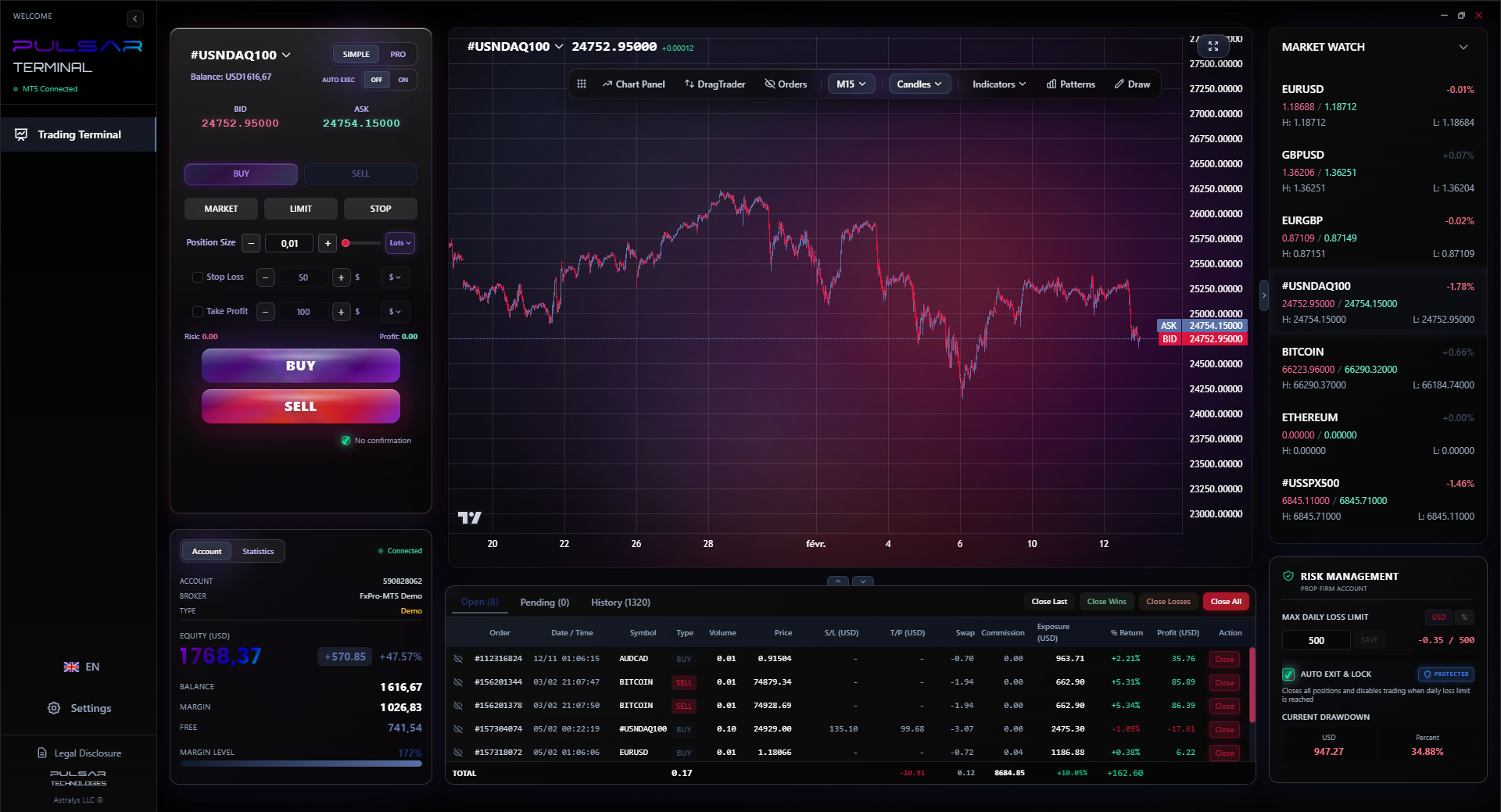
Managing trades across volatile session overlaps is stressful, but tools like Pulsar Terminal automate trailing stops and partial closures directly on your MT5 chart, so you can focus on the next setup.
Pulsar Terminal
The all-in-one MT5 companion: drag-and-drop orders, multi-TP/SL, trailing stop, grid trading, Volume Profile, and prop firm protection. Used by 1,000+ traders daily.
“Trading the 'Dead Zone' between 2 AM - 5 AM IST is like paying the broker to lose your money. Just walk away.”
Here’s a realistic schedule that balances market hours with a life. This assumes a professional with a day job.
- 5:30 AM - 8:00 AM IST (Before Work): Analysis, Not Trading. Check overnight price action on higher timeframes (4H, Daily). Did the US session close with a clear bias? Update your watchlist. Set potential alert levels for the day. No new trades.
- 12:25 PM IST (Lunch Break): London Open Watch. Alarm goes off. Spend 10 minutes watching the initial reaction to the London open. Does price respect the key levels you identified? This confirms or denies your morning bias.
- 6:30 PM - 7:00 PM IST (Post-Work): Final Prep. Review the economic calendar for the next few hours. Check your charts. Finalize your plan for the golden overlap window. Use a position size calculator.
- 7:00 PM - 9:30 PM IST (Prime Time): Execution Window. This is when you trade your plan. Focus is key. Monitor open positions. Look for set-ups aligning with the day's liquidity.
- 9:30 PM Onwards: Wind Down & Manage. No new entries after the London close. Manage existing trades (trailing stops, partial closes). Journal your trades. By 11:00 PM, be done. The New York afternoon is not your friend.
This schedule gives you structure. It forces you to be a sniper, not a machine gunner. The market will always be there tomorrow.
💡 Winston's Tip
Build your life around the 7 PM - 9:30 PM IST window. Protect that time like a meeting with your most important client. Because it is.

“Your most powerful tool is your watch. If you can't name the current trading session, you have no business being in a trade.”
The market closes on Friday at 3:30 AM IST (for the 5 PM EST close) and reopens Sunday at 9:30 AM IST (for the 5 PM EST open). That Sunday open can be gappy, especially if there was big news over the weekend. I never hold highly leveraged positions over the weekend unless it's a core, long-term swing trade. The risk of a gap opening against you is real.
Indian holidays like Diwali or Eid don't affect the global forex market. Your broker might have reduced support staff, but the charts are moving. However, liquidity can be slightly thinner on major US holidays like Thanksgiving or Christmas Day.
Black swan events (e.g., a surprise SNB decision in 2015) can happen anytime. They often occur during European or US hours. Your only defense is strict risk management - never risk more than 1-2% of your account on any single trade. A margin call doesn't care what time it is in Mumbai.

FAQ
Q1What is the best forex pair to trade from India?
For alignment with IST active hours, focus on EUR/USD, GBP/USD, and USD/JPY. They have the tightest spreads and highest liquidity during the London and New York overlaps (12:30 PM - 4:00 AM IST). Avoid exotic pairs with wide spreads unless you have a specific edge.
Q2Can I trade forex in India at night?
You can, but you shouldn't actively trade late night (post 11:30 PM IST). Liquidity is low, spreads widen, and price action is erratic. It's a great way to lose money to noise. Use that time for analysis and trade management, not new entries.
Q3Is the London session or New York session better for Indian traders?
The overlap is best. But if you must choose one, the London session open (12:30 PM IST) is superior for setting the day's trend. The New York session (7:00 PM IST onwards) provides the follow-through and reaction to US news. Most Indian traders get their best results in the first few hours of London.
Q4How does Daylight Saving Time affect forex trading time in India?
It shifts sessions by 1 hour for about 6-7 months of the year. When the US/UK are on DST, London opens at 1:30 PM IST and New York at 8:00 PM IST. Always Google 'DST start date [year]' and mark your calendar. Forgetting this is a classic rookie error.
Q5What time does the forex market open on Monday in India?
The market reopens for the new week on Sunday at 9:30 AM IST (for the 5 PM EST Sunday open). However, liquidity is thin until the Asian banks come in fully around 5:30 AM IST Monday. I avoid trading the Sunday/Monday open session.
Q6Is scalping possible with forex trading time in India?
Yes, but only during the high-liquidity windows. The only viable scalping time for an Indian trader is the 2.5-hour London-New York overlap (7:00 PM - 9:30 PM IST). Outside of that, spreads are too wide and moves are too slow for a typical scalping strategy.
Prof. Winston's Lesson
Key Takeaways:
- ✓Prime trading window: 7:00 PM - 9:30 PM IST (London-NY overlap).
- ✓Avoid new trades between 11:30 PM - 5:30 AM IST.
- ✓Use the London open (12:30 PM IST) to set your daily bias.
- ✓Always adjust for Daylight Saving Time shifts.
- ✓Risk max 1% per trade; time volatility demands it.
How useful was this article?
Click a star to rate
Weekly Trading Insights
Free weekly analysis & strategies. No spam.
About the Author
Rajesh Sharma
Senior Forex Analyst
Trading Indian and South Asian markets for over 10 years. Started with NSE currency derivatives before moving to international forex. Specializes in USD/INR and emerging market pairs.
Comments
Risk Disclaimer
Trading financial instruments carries significant risk and may not be suitable for all investors. Past performance does not guarantee future results. This content is for educational purposes only and should not be considered investment advice. Always conduct your own research before trading.
You Might Also Like

Cara Trading Forex Sukses: 7 Prinsip dari Trader Profesional
Cara trading forex sukses dengan 7 prinsip trader pro: manajemen modal, disiplin, journal trading, backtest. Data nyata, bukan janji profit palsu.
Jam Trading Forex Terbaik untuk Trader Indonesia: Panduan Lengkap dengan Tabel Waktu
Panduan jam trading forex untuk trader Indonesia. Tabel 4 sesi dunia, jam emas 20:00-00:00, sesi mana yang harus dihindari. Data akurat + tips dari trader berpengalaman.
Top 5 Sàn Forex Uy Tín Nhất 2026: Review Jujur dari Trader Indonesia
Top 5 sàn forex uy tín 2026 untuk trader Indonesia. Review jujur: spread, deposit, withdraw, dukungan lokal. Exness, XM, IC Markets & lebih.
Get Pulsar Terminal
All these calculators are built into Pulsar Terminal with real-time data from your MT5 account. One-click position sizing, automatic risk management, and instant calculations.
Get Pulsar Terminal