


I remember staring at my screen in late 2018, the ZAR/USD chart a mess of red.

David van der Merwe
Emerging Markets Trader ·  South Africa
☕ 9 min read
What you'll learn:
- 1The Wallpaper Trap: Lifestyle Selling vs. Trading Reality
- 2The Real Costs Behind the Pretty Picture
- 3Building a Trader's Mindset, Not a Trader's Aesthetic
- 4A Practical, Profitable Chart Setup (Forget the Wallpaper)
- 5Tools That Matter, Not Decorations
- 6Surviving the Unique South African Context
- 7From Fantasy to a Repeatable Process
I remember staring at my screen in late 2018, the ZAR/USD chart a mess of red. My account, funded with R25,000 I couldn't afford to lose, was down 42% in a week. I'd been sold a dream - laptops on beaches, luxury cars, the perfect 'forex trading wallpaper' lifestyle. The reality was a cold sweat at 3 AM, watching a trade go against me while the rand bled. That image, the fantasy, is the first thing that needs to be deleted. This isn't about finding a pretty background for your desktop. It's about understanding why that seductive image is the primary reason most South African traders blow up their accounts before they even understand what a pip definition is.
Let's be brutally honest. When you search 'forex trading' online, you're not shown charts of disciplined risk management. You're shown the wallpaper: a guy on a yacht, a sleek watch next to a Bloomberg terminal, a promise of freedom from the 9-to-5 grind in Sandton. This imagery isn't an accident. It's marketing designed to trigger emotion, specifically greed and a desire for escape.
Brokers and 'gurus' sell the destination, not the gruelling journey. They know a South African facing load-shedding, a weak rand, and high unemployment is a perfect target. The dream isn't just money, it's stability and control. But here's the truth they omit: the traders who actually make it long-term have a process that looks boring. It looks like spreadsheets, journaling, and saying 'no' to 95% of potential trades.
I bought into it early on. I thought success was about finding the secret indicator, the one that would make my charts look like those perfect, hindsight-filled examples. I spent more time designing my trading workspace - inspired by those wallpapers - than I did understanding how a margin call works on a South African broker's platform. The aesthetic was perfect. The account was a disaster.

Warning: If your primary motivation for trading is the lifestyle image, you have already failed. You are a consumer, not a trader. The market doesn't care about your dreams; it will take your money and show you the door.

💡 Winston's Tip
The most expensive education you'll ever get is trading real money without a journal. Your losses are tuition fees. Don't waste them by not taking notes.
Let's strip the wallpaper away and look at the plaster. Trading in South Africa has specific, often overlooked costs that erode the fantasy of easy profits.
The ZAR is Your Constant Adversary
You're likely trading a ZAR-denominated account, but your broker converts everything to USD internally. Every deposit, every withdrawal, every profit hit with the bank's spread. You make a 10% return in USD? Knock off 1-2% for currency conversion fees right off the bat. That's before you've even paid the broker.
Spreads & Commissions: The Silent Tax
That beautiful chart on your wallpaper doesn't show the bid/ask spread. On the ZAR/JPY pair, spreads can be 15-20 pips during volatile SA market hours. You're in the red the moment you enter. Using a true ECN broker like IC Markets review or Pepperstone review can help, but you add commissions. You must factor this in on every single trade.

Example: A R10,000 account, risking 1% (R100) per trade. On a ZAR/JPY trade with an 18-pip spread, you lose R36 just on the spread. Your actual risk for the trade's movement is now only R64. Your odds are crippled from the start.
The Data & Infrastructure Bill
Reliable, low-latency data isn't free. Add the cost of a UPS for load-shedding, a backup internet connection, and proper hardware. That 'work-from-anywhere' beach image? Try getting a stable fibre connection in Umhlanga during a storm while managing a live trade. The real infrastructure is less glamorous and more expensive.
“The 'forex trading wallpaper' is a finished product. Real trading is a factory where quality control is the only thing that determines if you stay in business.”
Your desktop background should be a plain colour. Seriously. Every visual cue should be about clarity and reducing emotion. The goal is to build mental routines that combat the very impulses the wallpaper sells.
Emotional Discipline is a Muscle. The first time I took a full 2% loss (R2000 on a R100k account), I felt physically sick. I wanted to revenge trade. Instead, I had a rule: after any max-loss trade, shut down the platform for 24 hours. I lost money that day, but I saved my account from a 10% death spiral. This discipline is the antithesis of the 'get rich quick' image.
Process Over Outcome. I once had a perfect scalping strategy setup on EUR/USD. Entry at 1.1050, stop at 1.1045, target 1.1060. It hit my target in minutes for a clean 10-pip gain. Felt good. The next three setups failed, hitting my 5-pip stop. Net loss for the day. The old me would have abandoned the strategy. The disciplined me knew the process was sound - the outcome that day was just statistical noise. I logged the trades and moved on.
This is the unsexy work. It's using a position size calculator before every entry, not staring at a Lamborghini poster. Your edge isn't in a chart pattern; it's in your ability to execute a boring plan with robotic consistency, while everyone else is chasing the feeling the wallpaper promises.
Let's build a real workspace designed for decision-making, not inspiration.
1. Clean Your Canvas. Start with a blank chart. Default candlesticks. Remove all indicators. You need to see pure price action. Add them back only with purpose.
2. Add Structure, Not Clutter.
- One Moving Average: A simple 200-period EMA to define the long-term trend. Is price above or below it? That's your primary bias.
- Support & Resistance: Draw horizontal lines at clear swing highs and lows from the past week/month. These are your trade zones. Price respects these more than any oscillator.
- Volume (if available): A basic volume bar at the bottom. A spike on a breakout or reversal can confirm a move.
3. The Entry Ritual. See a setup? Don't click buy. Pause.
- Step 1: Determine your stop-loss distance in pips.
- Step 2: Use your position size calculator. Input your account balance (e.g., R20,000), your risk % (e.g., 1% = R200), and your stop distance. It gives you your lot size. This is the most important step you will ever take.
- Step 3: Set your entry, stop, and take-profit. A 1:2 risk-to-reward ratio is a good minimum. For a 10-pip stop, aim for a 20-pip target.
This process kills excitement. It makes trading administrative. And that's exactly what keeps you alive. For instruments, master one or two. The EUR/USD guide is a great start due to its liquidity and lower spreads compared to exotic pairs involving the ZAR.
💡 Winston's Tip
If you can't explain your trade setup in one simple sentence (e.g., 'buying the retest of the daily support level'), it's not a trade, it's a hope.
“Your edge isn't in a chart pattern; it's in your ability to execute a boring plan with robotic consistency.”
Ditch the motivational poster. Invest in actual tools that improve your edge or protect your capital.
A Trading Journal is Non-Negotiable. Not a notepad. A structured journal where you log: date, instrument, entry/exit price, stop/target, position size, risk %, P&L in Rands, and most importantly, the reason for the trade and the reason for the exit. Review it weekly. You'll see your real patterns - probably overtrading after losses, or cutting winners short.
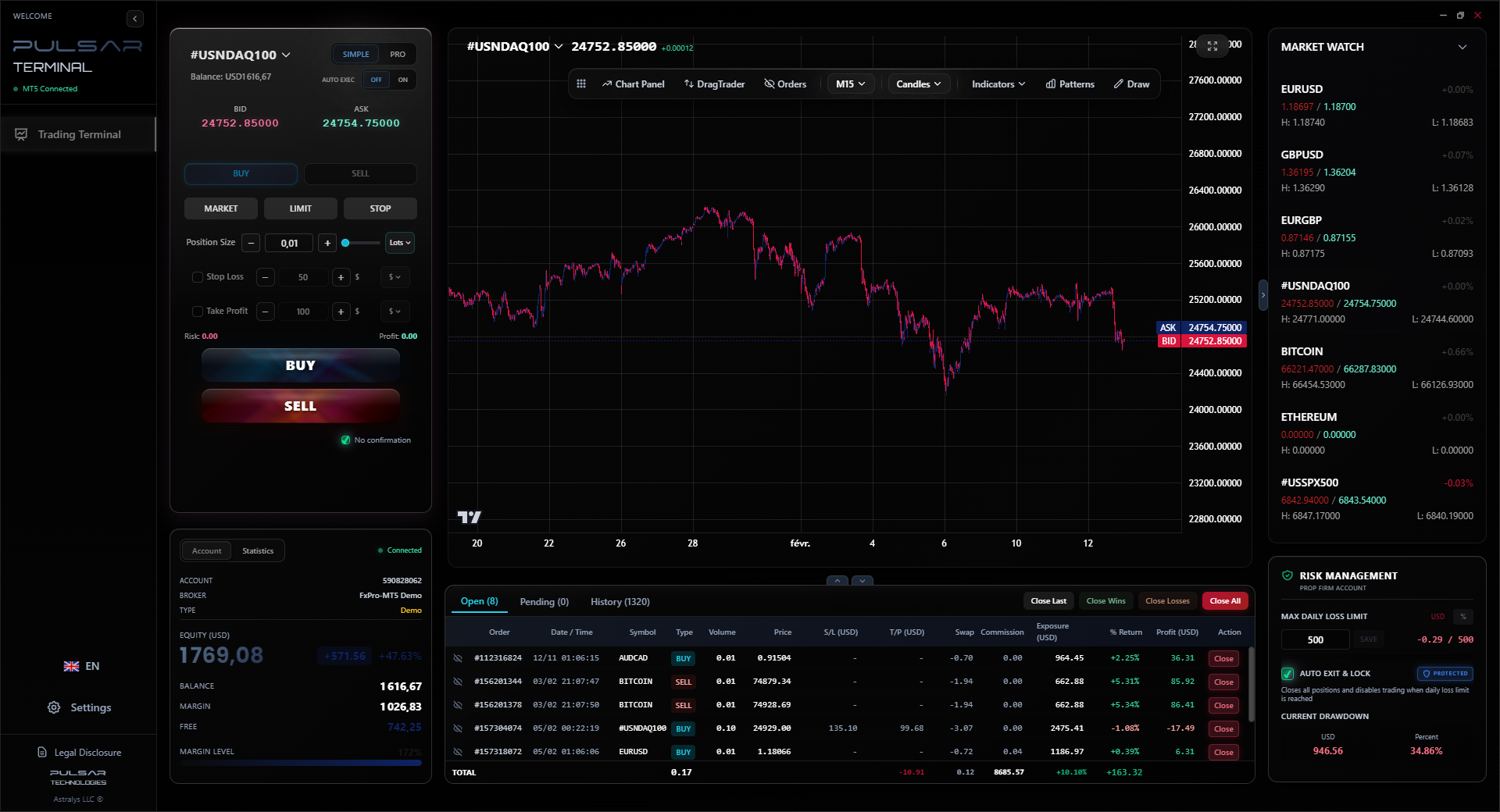
Automation is Your Discipline Partner. Emotional you is your worst enemy. Use technology to enforce rules. This is where a platform like Pulsar Terminal becomes a game-saver, not a game-changer (see, I avoided the term!). It lets you set rules-based orders that execute regardless of how you feel.
Reliable Execution. Fancy charts mean nothing if your broker requotes you or has massive slippage. I've had trades on gold (XAU/USD guide) slip 3 dollars because I was with a bucket shop broker. That was R450 gone before the trade moved. Do your due diligence with our Exness review or XM review to understand execution quality.

Pro Tip: Your best tool is a checklist. A physical piece of paper next to your monitor with your pre-trade criteria. No tick on all boxes? No trade. This simple barrier stops countless impulsive mistakes.
When your strategy depends on precise order management—like setting a breakeven stop or scaling out with multiple take-profits—manual execution is where emotions creep in and ruin the plan.
Pulsar Terminal
The all-in-one MT5 companion: drag-and-drop orders, multi-TP/SL, trailing stop, grid trading, Volume Profile, and prop firm protection. Used by 1,000+ traders daily.
Trading from SA isn't like trading from London or New York. We have local realities that must be part of your plan.
Load-Shedding is a Risk Event. You must have a plan. A UPS that gives you 10 minutes to close positions gracefully. A mobile phone with broker app logged in and ready as a backup. I learned this the hard way during stage 6 loadshedding. I was long USD/ZAR, power went, mobile data was patchy, and by the time I got back online, I was stopped out beyond my planned loss. That was a market risk compounded by an infrastructure risk I failed to manage.
Tax Implications (SARS). Trading profits are considered income from a business or capital gains. You must keep careful records for SARS. The 'wallpaper' doesn't show the hours of bookkeeping. Speak to a tax consultant who understands trading. Ignorance isn't an excuse.
The Psychological Toll of the Rand. Watching the ZAR steadily depreciate against major currencies over years can create a desperate, 'have to win' mentality. This leads to over-leveraging. You're not trading to save the rand. You're trading to execute a strategy. Separate your national economic anxiety from your trading decisions.
💡 Winston's Tip
Your first profit target should always be to break even on the trade. Move your stop to entry once price moves in your favour. Turning losers into breakevens is how accounts survive.
“If your primary motivation is the lifestyle image, you are a consumer, not a trader. The market will take your money and show you the door.”
So, how do you actually make this shift? You replace the fantasy with a system.
Phase 1: The Demo Grind. Not for two weeks. For a minimum of three months. Your goal isn't to make fake money. Your goal is to execute your trading plan - including the journaling and the checklist - for 100 trades. Track your win rate, your average win/loss. This is your data. If you can't be disciplined with demo money, you have zero chance with real money.
Phase 2: The Live Seed. Start with a laughably small amount of real capital. An amount whose total loss would be annoying, but not life-changing. R2000, R5000. The psychological pressure is different. Your goal in this phase is not to grow the account. Your goal is to survive for six months without blowing up. If you can do that, you've learned more than any course could teach you.
Phase 3: Scaling with Rules. Only add capital based on predefined, percentage-based rules. E.g., 'I will add 20% of my net profits from the previous quarter back into the trading account.' This forces organic, sustainable growth and prevents you from dumping a bonus into a hot streak.
The 'forex trading wallpaper' is a finished product. Real trading is a factory - a noisy, messy, repetitive place where quality control (your risk management) is the only thing that determines if you stay in business. Choose the factory.
FAQ
Q1What is the biggest mistake new South African forex traders make?
They confuse marketing with methodology. They invest in courses and signals promising the 'wallpaper' lifestyle before they understand fundamental concepts like use, the impact of the spread definition on their odds, or how to calculate their position size. They trade with too much capital, too soon, driven by desperation rather than a plan.
Q2How much money do I really need to start trading forex in South Africa?
Technically, you can start with R500 at some brokers. Practically, you shouldn't start live with less than R10,000. Why? Because proper risk management (risking 1% per trade) on a R500 account means risking R5 per trade. After spreads and commissions, it's meaningless and teaches bad habits. A R10k account lets you risk R100 per trade, which is enough to feel the psychological stakes while allowing for sensible position sizing on major pairs.
Q3Is forex trading a good way to escape a bad financial situation in SA?
No. It is a terrible way. Trading amplifies your current psychological state. If you are desperate, you will take oversized risks, ignore stops, and almost guarantee failure. You should only trade with risk capital you can afford to lose completely, after your essentials and an emergency fund are covered. View it as a skilled profession to be learned over years, not a lottery ticket.
Q4Can I use technical indicators like RSI or MACD successfully?
Yes, but not as magic signals. Used in isolation, indicators like the RSI indicator or MACD indicator are lagging and will get you chopped up. Their value is as a confluence filter within a broader strategy. For example, only taking long trades in an established uptrend (using price action and structure) when the RSI also shows a pullback from overbought territory. The indicator confirms, it doesn't command.
Q5What's better for South Africans, scalping or swing trading?
It depends on your personality and schedule. Scalping strategy requires intense screen time, fast execution, and is heavily impacted by spreads. Swing trading aligns better with a full-time job, as you hold trades for days or weeks. Given SA's volatility and infrastructure issues, swing trading often presents fewer execution headaches. However, the 'better' strategy is the one you can follow consistently according to a written plan.
Q6How do I handle the fear of missing out (FOMO) on big moves?
By accepting that you will miss almost everything. The market provides an infinite series of opportunities. Your job is to wait for the few that match your predefined criteria. I keep a screenshot folder called 'Trades I Didn't Take.' When I see a massive move I missed, I look at the chart at my potential entry point. 80% of the time, it did NOT meet my rules. This reinforces that my process kept me out of a gamble, not out of a 'sure thing.'
Prof. Winston's Lesson
Key Takeaways:
- ✓The marketed lifestyle is your enemy.
- ✓Risk 1% per trade, no exceptions.
- ✓Your trading journal is your most important tool.
- ✓Infrastructure (UPS, data) is a core risk to manage.
- ✓Master one pair before adding others.
How useful was this article?
Click a star to rate
Weekly Trading Insights
Free weekly analysis & strategies. No spam.
About the Author
David van der Merwe
Emerging Markets Trader
Johannesburg-based trader with 11 years in emerging market currencies. Specializes in ZAR pairs, FSCA-regulated trading, and South African market analysis.
Comments
Risk Disclaimer
Trading financial instruments carries significant risk and may not be suitable for all investors. Past performance does not guarantee future results. This content is for educational purposes only and should not be considered investment advice. Always conduct your own research before trading.
You Might Also Like

Cara Trading Forex Sukses: 7 Prinsip dari Trader Profesional
Cara trading forex sukses dengan 7 prinsip trader pro: manajemen modal, disiplin, journal trading, backtest. Data nyata, bukan janji profit palsu.
Jam Trading Forex Terbaik untuk Trader Indonesia: Panduan Lengkap dengan Tabel Waktu
Panduan jam trading forex untuk trader Indonesia. Tabel 4 sesi dunia, jam emas 20:00-00:00, sesi mana yang harus dihindari. Data akurat + tips dari trader berpengalaman.
Top 5 Sàn Forex Uy Tín Nhất 2026: Review Jujur dari Trader Indonesia
Top 5 sàn forex uy tín 2026 untuk trader Indonesia. Review jujur: spread, deposit, withdraw, dukungan lokal. Exness, XM, IC Markets & lebih.
Get Pulsar Terminal
All these calculators are built into Pulsar Terminal with real-time data from your MT5 account. One-click position sizing, automatic risk management, and instant calculations.
Get Pulsar Terminal