


I remember the screen vividly.

David van der Merwe
Emerging Markets Trader ·  South Africa
☕ 9 min read
What you'll learn:
I remember the screen vividly. It was late 2022, and a WhatsApp group I'd joined was blowing up with 'BUY USD/ZAR NOW!' signals. The admin, 'Big Mike', was posting screenshots of a supposed R50,000 profit from a single trade. The group chat was a frenzy of emojis and FOMO. I hesitated, checked the actual chart, and saw price was smack against a major weekly resistance. I didn't take the trade. An hour later, the pair had dumped 200 pips. Dozens in the group posted crying-face emojis and 'margin call' screenshots. That moment crystalized the entire problem with chasing a forex trading WhatsApp group link. Let's talk about what these groups really are, the very real dangers, and what you should be doing instead.
Here's the uncomfortable truth most 'gurus' won't tell you: a genuine, profitable trader has zero incentive to run a massive, free WhatsApp group. Think about it. If their strategy prints money, why would they spend hours a day managing hundreds of strangers, dealing with questions, and giving away their edge for free? The math doesn't add up.
These groups typically follow a lifecycle. They start with a slick Instagram or Facebook ad promising 'daily signals' or 'secret strategies'. You click the forex trading WhatsApp group link, join, and see a few 'verified' payout screenshots (easily faked with Photoshop or a demo account). The initial signals might even be winners to build trust - this is called 'baiting'. I fell for this early on. A group gave two decent EUR/USD scalps. Feeling confident, I doubled my usual position size calculator input on the third signal. It was a disaster, a classic fake breakout that wiped out my previous gains and then some.
The endgame is usually one of three things: a 'premium' VIP group upsell (R500-R5000 per month), a push to use a specific (often unregulated) broker where the admin gets a kickback, or the outright pump-and-dump where the admin takes the opposite side of the trade they signal to the group.

Warning: The FSCA has been screaming from the rooftops about this. In just the first half of 2025, they issued over a hundred warnings about social media trading scams, many operating through WhatsApp and Telegram. If a group's main offering is 'signals', your alarm bells should be deafening.

💡 Winston's Tip
A signal is just someone else's opinion. An edge is your own tested understanding. Spend 100 hours building the latter, and you'll never pay for the former again.
Trading forex itself is 100% legal here, but it operates in a box with clear lines drawn by the Financial Sector Conduct Authority (FSCA). Understanding these rules shows you exactly why most WhatsApp groups are skating on thin ice.
First, any entity giving financial advice or dealing in forex needs an FSCA license. Is 'Big Mike from the WhatsApp group' a licensed Financial Services Provider (FSP)? Almost certainly not. That means you have zero legal recourse if he vanishes with your 'VIP fee'.
Second, the South African Reserve Bank (SARB) has strict rules on moving money for trading. You have allowances: R1 million per year under the Single Discretionary Allowance (no tax clearance needed) and up to R10 million under the Foreign Investment Allowance (which needs a SARS Tax Compliance pin). Here's the kicker: many WhatsApp groups that promise to 'manage your account' or use 'pooled funds' are likely facilitating currency exchange outside these authorized channels. That's not just sketchy, it's illegal.
Finally, since 2021, use for retail traders like you and me is capped at 30:1 by the FSCA. Be very wary of any group or broker link that promises you 100:1, 500:1, or even 1000:1 use. They are either operating illegally, offshore beyond the FSCA's reach (which is a whole other risk), or are outright lying.
Stick to brokers you can verify. I use and trust IC Markets for their raw spreads and Pepperstone for their razor account, both of which have proper international regulation and offer FSCA-compliant use. It's boring, but it's safe.
“The business model of a profitable trader running a large free group doesn't make sense.”
Let's replace hype with hard numbers. When you trade, you're not just battling the market, you're battling costs. WhatsApp groups love to ignore this because it ruins the 'get rich quick' fantasy.
Your main costs are the spread and commissions. The spread is the difference between the buy and sell price. On a major pair like EUR/USD, a good broker might offer a spread of 0.1 pips on a raw account, but you'll pay a commission, say $7 per standard lot (100,000 units). A standard account might have no commission but a spread of 1.0-1.3 pips. That spread is a cost you pay the moment you enter the trade.

Example: You buy 1 standard lot of EUR/USD at a 1.2 pip spread. Each pip on that trade is worth about $10. So, your opening cost is 1.2 pips * $10 = $12. You are $12 in the red before the market even moves. To just break even, price needs to move 1.2 pips in your favor.
Then there's the swap, or overnight financing fee. If you hold a trade past 10pm SA time (when the trading day rolls over), you pay or receive interest based on the difference between the two currencies' central bank rates. Holding a ZAR pair overnight can have significant swap costs.
Compare this to the promise of a WhatsApp group: "Make 50 pips daily!" They don't subtract the 5-10 pips in total costs (spread + swap) you might incur to chase those 50 pips. Suddenly, that 500-pip monthly target becomes 100 pips, or a loss. I learned this the hard way trying to follow a scalping strategy from a group. The signals aimed for 5-pip profits, but with a 1-pip spread and commission, my risk-reward was destroyed. I was basically working for the broker.
So if random forex trading WhatsApp group links are a dead end, where should you focus? I'll give you the same advice my mentor gave me, which saved me thousands.
Build Your Own Foundation
You need to understand price action. Not indicators slapped on a chart by a guy in a WhatsApp group, but how price actually moves. Start with just support and resistance. Learn what a trend really looks like on a higher time frame. This is boring, foundational work. No one sells a course on it because it's not sexy, but it's everything. I spent three months just watching the XAU/USD daily chart, drawing my lines, and noting where price reacted. It taught me more than any signal ever did.
Use Technology the Right Way
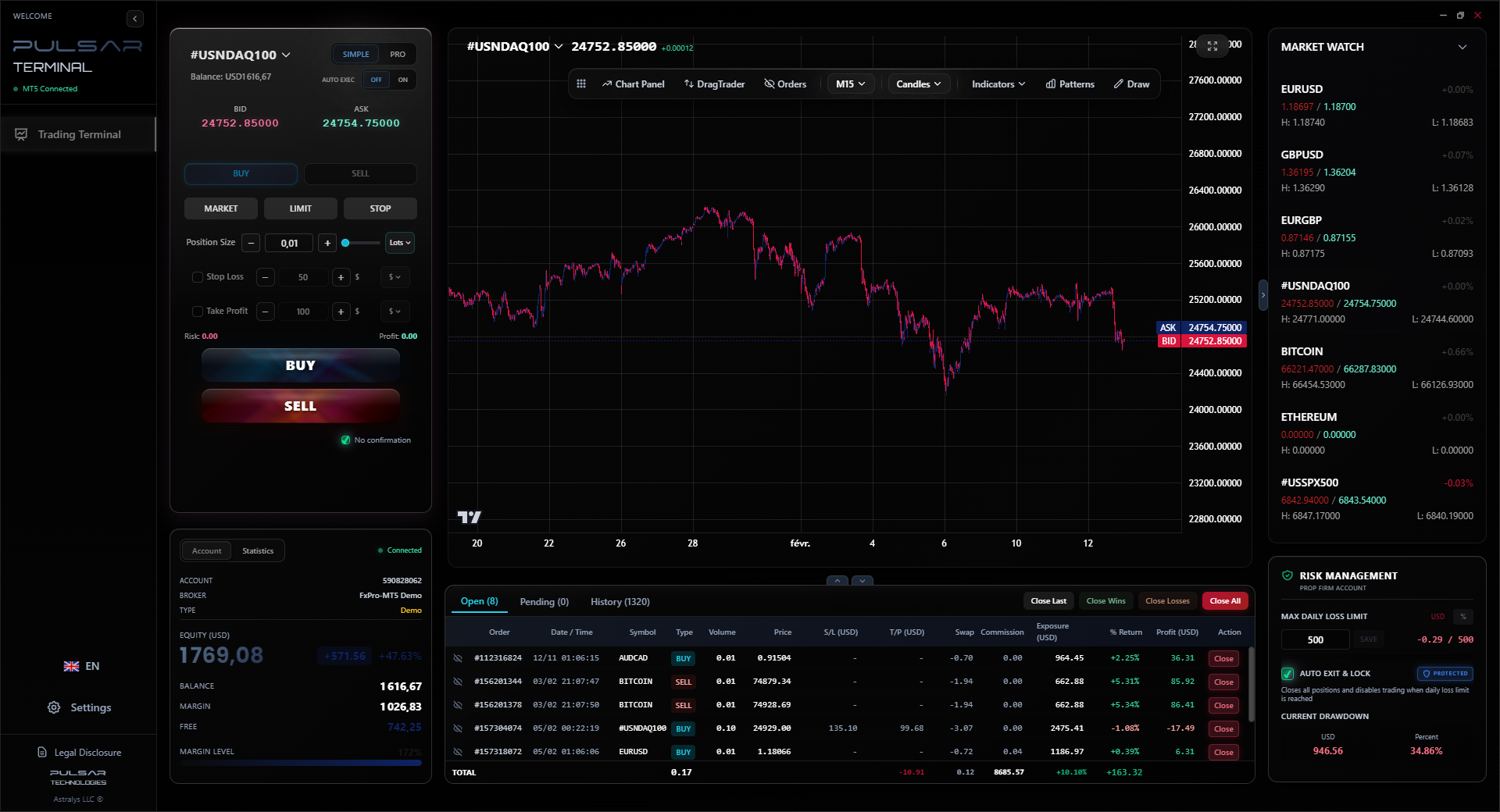
Instead of relying on someone else's signals, use tools that enhance your own analysis. A proper trading platform is your best friend. This is where a tool like Pulsar Terminal shines - it's not a signal generator, it's a power-up for your MT5. Having clean charts, easy order management, and tools like Volume Profile lets you do your own detective work.
Find Quality, Focused Communities
I'm not saying all communities are bad. But look for small, focused groups or forums where the discussion is about why a trade might work, not just "BUY NOW." Places where people post charts with their analysis and ask for feedback. The difference is the mindset: learning vs. blind following. Sometimes, explaining your trade idea to someone else is the best way to find its flaws.

Pro Tip: Paper trade your own ideas for a minimum of three months. Keep a journal. Note your emotional state, your reasoning, and the outcome. This data is worth more than 100 VIP group subscriptions. It's your personal trading DNA.
💡 Winston's Tip
The most expensive education in trading is the one you get from a stranger promising easy money. The cheapest is the one you give yourself with a demo account and historical charts.
“The goal isn't to find a shortcut. The goal is to become the person who doesn't need the shortcut.”
Let's make you a scam detector. If you're ever tempted by a link, run through this checklist.
- Guaranteed Profits: If they promise weekly returns or 'no loss' guarantees, run. The market guarantees nothing. I once saw a group guarantee 20% monthly. That's a 240% annual return. If they could do that, they'd be managing hedge funds, not WhatsApp chats.
- No Verification of Results: Real traders have verified track records (like Myfxbook) that show drawdowns, win rates, and longevity. WhatsApp admins have screenshot folders. Big difference.
- Pressure to Deposit More: "Your R2000 account is too small to follow our signals! Deposit R20,000 to join the real winners." This is a classic tactic to get more of your capital locked in before they disappear.
- Vague or Complex Strategies: If they can't explain the core idea simply (e.g., "we trade breakouts of the London high") and instead hide behind jargon or a 'secret algorithm', it's a smokescreen.
- The Broker Push: Be extremely suspicious if the group is tightly linked to one specific, obscure broker you've never heard of. That's often a white-label broker where the group owner gets a massive rebate on your losses. They profit when you lose.
Remember, a margin call is a quiet, personal event. It's not a badge of honor posted in a group chat with crying emojis. Groups that normalize blowing up accounts are teaching you to be a perpetual loser.
Instead of scrambling for signals in a chaotic chat, tools like Pulsar Terminal let you build and manage your own clear trade plans directly on your MT5 charts.
Pulsar Terminal
The all-in-one MT5 companion: drag-and-drop orders, multi-TP/SL, trailing stop, grid trading, Volume Profile, and prop firm protection. Used by 1,000+ traders daily.
South Africa has a unique advantage: the Rand (ZAR). It's a liquid emerging market currency, accounting for about 1% of global forex volume. That means it moves, and it moves with character. Instead of trying to trade everything from a WhatsApp group, consider specializing.
Pairs like USD/ZAR, EUR/ZAR, and GBP/ZAR are sensitive to local politics, commodity prices (like platinum and gold), and SARB policy. Learning to read South African economic news, understanding load-shedding's impact on sentiment, and watching the USD/ZAR correlation with global risk appetite is a tangible edge you can build yourself. You won't get that from a generic signal group run from another continent.
Start by swing trading these pairs on the 4-hour or daily charts. The volatility means you need wider stops, so your position size calculator is your most important tool. A 200-pip stop on USD/ZAR is normal; you need to trade small to survive the swings.
I built my first consistently profitable year trading almost exclusively GBP/ZAR. I used a simple MACD indicator divergence on the daily chart combined with key support/resistance levels. It wasn't fancy, but I understood the logic behind every trade. No WhatsApp group could have given me the patience to sit through the false moves that strategy required.
The goal isn't to find a shortcut. The goal is to become the person who doesn't need the shortcut. That journey starts by closing the WhatsApp tab and opening a chart.
FAQ
Q1Are all forex trading WhatsApp groups in South Africa scams?
Not all, but the vast majority that focus on providing 'signals' for free or a fee are problematic. The business model of a profitable trader running a large free group doesn't make sense. Some small, study-focused groups exist, but they are rare. The FSCA warns constantly about the scam groups, so extreme caution is the default position.
Q2What should I look for in a legitimate trading community?
Look for communities that discuss analysis, risk management, and psychology - not just trade signals. Legitimate educators provide frameworks, not just entries and exits. They should be transparent about their losses as well as wins, and they should never pressure you to deposit money with a specific broker or into a managed account.
Q3I joined a group and paid for signals. They lost me money. What can I do?
Realistically, very little. If the group admin is not a licensed FSP (which they almost certainly aren't), you have no formal recourse with the FSCA. You can report the scheme to the FSCA's scam alert service to help warn others, but recovering funds is unlikely. This is why the 'premium signal' model is so popular with scammers: low risk for them, high risk for you.
Q4Is copy trading from a WhatsApp group leader safe?
It's one of the riskiest things you can do. You are handing over control of your risk to an unverified, unlicensed stranger with zero oversight. They have no fiduciary duty to you. Even on regulated copy-trading platforms, past performance is no guarantee, but doing it via WhatsApp removes the last shred of platform safety and transparency.
Q5What's the biggest risk with these groups besides losing money?
The biggest risk is stunting your development as a trader. Relying on signals teaches you nothing about market structure or self-reliance. It creates a dependency. When the signals stop (or the scammer vanishes), you're left with an empty account and zero skills. The lost time and missed learning opportunity is a huge, hidden cost.
Q6Can I get in legal trouble for using these groups?
If you're simply following signals in your own regulated brokerage account, you're unlikely to face legal trouble (just financial loss). However, if you participate in a 'pooled fund' or send money directly to the group admin for 'management,' you may be violating SARB exchange control regulations, which is illegal.
Prof. Winston's Lesson
Key Takeaways:
- ✓WhatsApp signal groups are a business model, not an education.
- ✓Verify FSCA licensing before following any financial advice.
- ✓Real trading costs (spread, commission) destroy most signal profits.
- ✓Your edge must come from your own analysis, not a chat notification.
How useful was this article?
Click a star to rate
Weekly Trading Insights
Free weekly analysis & strategies. No spam.
About the Author
David van der Merwe
Emerging Markets Trader
Johannesburg-based trader with 11 years in emerging market currencies. Specializes in ZAR pairs, FSCA-regulated trading, and South African market analysis.
Comments
Risk Disclaimer
Trading financial instruments carries significant risk and may not be suitable for all investors. Past performance does not guarantee future results. This content is for educational purposes only and should not be considered investment advice. Always conduct your own research before trading.
You Might Also Like

Cara Trading Forex Sukses: 7 Prinsip dari Trader Profesional
Cara trading forex sukses dengan 7 prinsip trader pro: manajemen modal, disiplin, journal trading, backtest. Data nyata, bukan janji profit palsu.
Jam Trading Forex Terbaik untuk Trader Indonesia: Panduan Lengkap dengan Tabel Waktu
Panduan jam trading forex untuk trader Indonesia. Tabel 4 sesi dunia, jam emas 20:00-00:00, sesi mana yang harus dihindari. Data akurat + tips dari trader berpengalaman.
Top 5 Sàn Forex Uy Tín Nhất 2026: Review Jujur dari Trader Indonesia
Top 5 sàn forex uy tín 2026 untuk trader Indonesia. Review jujur: spread, deposit, withdraw, dukungan lokal. Exness, XM, IC Markets & lebih.
Get Pulsar Terminal
All these calculators are built into Pulsar Terminal with real-time data from your MT5 account. One-click position sizing, automatic risk management, and instant calculations.
Get Pulsar Terminal