


If you've been searching for 'forex trading wikipedia' hoping for a simple guide, I've got news for you.

Olumide Adeyemi
West African Trading Pioneer ·  Nigeria
☕ 9 min read
What you'll learn:
- 1Is Forex Trading Legal in Nigeria? (The Real Answer)
- 2The Real Costs: Taxes, Spreads, and Starting Capital
- 3Brokers That Actually Work for Nigerian Traders
- 4Trading Strategies That Fit the Nigerian Reality
- 5Risk Management: Your Only Ticket to Survival
- 6The Future of Forex Trading in Nigeria (2026 and Beyond)
If you've been searching for 'forex trading wikipedia' hoping for a simple guide, I've got news for you. The real story for Nigerian traders is way more complex and interesting than any encyclopedia entry. Wikipedia might give you the global basics, but it won't tell you about the 10% capital gains tax you owe the FIRS, the CBN's latest policy flip-flops, or which brokers actually accept your Naira deposits without hassle. Let's set the record straight with a guide written for us, by someone who's been in the trenches here.
This is the first question everyone asks, and the answer is yes, but with a massive 'it depends' attached. Forex trading is legal for Nigerian residents using personal funds. The Central Bank of Nigeria (CBN) and the Securities and Exchange Commission (SEC) are the main watchdogs.
Here's the critical part most 'forex trading wikipedia' pages miss: the online retail space is poorly regulated. There's no strong local framework specifically for you and me trading EUR/USD from our phones. This creates a grey area. While local entities need CBN approval, nothing stops you from signing up with an international broker like Exness or IC Markets. Your protection then depends on their foreign regulator (like CySEC or FSCA), not the CBN.

Warning: This regulatory gap is why due diligence is non-negotiable. You're importing financial regulation. Always verify a broker's overseas license before depositing a single kobo.
The landscape is shifting, though. In late 2024, the CBN rolled out new guidelines for the Nigerian Foreign Exchange Market (NFEM) and an electronic matching system to tidy up the interbank market. Then, in a surprise move in February 2026, they let Bureau de Change (BDCs) back into the official market. This shows the CBN is actively trying to manage liquidity and curb speculation, which indirectly affects the environment we trade in.

💡 Winston's Tip
The market doesn't care about your rent. Trade the chart in front of you, not the bill on your table. That emotional pressure is a sure path to bad decisions.
“Wikipedia might give you the global basics, but it won't tell you about the 10% capital gains tax you owe the FIRS.”
Let's talk numbers, because this is where dreams meet reality. Forget the 'get rich quick' stories; sustainable trading is about managing costs.
The 10% Rule You Can't Ignore
First, the taxman. The Federal Inland Revenue Service (FIRS) expects a 10% capital gains tax on your gross forex trading profits. It doesn't matter if your broker is in Cyprus or your money is in a Mauritius account. If you're a Nigerian resident, the profit is taxable. I learned this the hard way after a good quarter in 2023; setting aside 10% of every withdrawal for tax is now a non-negotiable part of my process.
What You Pay to Trade
Your trading costs are mainly the spread (the difference between buy and sell price) and sometimes a commission. For a staple pair like EUR/USD, expect this:
| Account Type | Typical EUR/USD Spread | Commission | Best For... |
|---|---|---|---|
| Standard | 0.8 - 1.4 pips | None | Beginners, higher-volume scalping |
| Raw/ECN | 0.0 - 0.3 pips | $3 - $7 per lot | High-volume traders, arbitrage |
A pip might seem tiny, but it adds up fast. On a standard account with a 1.2-pip spread, you're down $12 on a single standard lot ($100,000) trade before it even moves.
How Much Do You Really Need to Start?
You'll see brokers advertising accounts for $5 or even $0. Technically true, but practically useless. With $10 and even 1:500 use, your risk management is shot. You'll be one bad trade from a margin call.
From my experience and watching others burn out, a realistic starting point is $500 to $1000. This allows you to trade sensible micro-lots (0.01), withstand normal market noise, and practice proper risk management without sweating every single pip. It's not about getting rich from that amount; it's about buying yourself enough runway to learn.
“A realistic starting point is $500 to $1000. This isn't for getting rich; it's for buying enough runway to learn.”
Choosing a broker isn't just about who has the tightest spreads. For us, it's about deposit methods, customer support in our timezone, and whether they'll actually answer the phone. Here’s a breakdown of the major players, based on the 2026 landscape.
Exness is hugely popular here for a reason. Their verification is relatively straightforward, they offer local bank transfer options, and their use can be eye-wateringly high (up to 1:2000). I used them when I first started. The upside? You can start small. The downside? That high use is a double-edged sword that has wiped out many a novice account. You can read a full deep dive in our Exness review.
XM and HFM (HotForex) also have strong local footprints. HFM often offers Naira as a base account currency, which simplifies things mentally, even though you're still trading USD pairs. XM is known for its educational resources and that tempting $30 no-deposit bonus (treat it as a learning tool, not a goldmine).
For the more serious trader, IC Markets and Pepperstone are top-tier. Their spreads are razor-thin on Raw/ECN accounts, and their execution is solid. The minimum deposit is higher ($200 for IC Markets), but you're paying for professional-grade infrastructure. I switched to a broker like this after my first two years, and the difference in slippage during news events alone was worth it.

Pro Tip: Always test a broker's withdrawal process with a small amount first. The true test of any broker isn't how easy it is to put money in, but how easy and fast it is to get it out.
💡 Winston's Tip
Your first profitable strategy should be your withdrawal strategy. Regularly taking profits out reinforces success and protects capital from yourself.
“High use is a double-edged sword that has wiped out many a novice account.”
Your strategy needs to account for more than just charts. It needs to fit your internet stability, your day job, and the unique volatility of the markets when Lagos is awake.
The Time Zone Advantage (and Disadvantage)
Our GMT+1 timezone is a mixed bag. The London session (8 AM - 5 PM our time) is our sweet spot. Liquidity is high, moves are clean. The New York session overlap (1 PM - 5 PM our time) is often the most volatile period. This is perfect for swing trading setups or catching end-of-day moves.
The Asian session (midnight to 9 AM) is usually quieter. I used to try and force trades then, watching paint-dry charts. It was a waste of sleep. Now, I use that time for analysis and planning.
Picking Your Style
Swing Trading is, in my opinion, the most sustainable approach for most Nigerians. You hold trades for days or weeks, catching larger trends. It doesn't require glued-to-screen attention, which is ideal if you have a 9-5. You can use the MACD indicator on the 4-hour or daily charts to spot trend shifts.
Scalping is seductive but brutal. It requires lightning-fast internet, zero distractions, and intense discipline. The spread costs will eat you alive if you're not on a premium account. If you go this route, you need a rock-solid edge and a broker with execution speeds under 50ms.
A Personal Trade Example (The Good and The Bad)
The Good: In early 2025, I spotted a classic bullish divergence on the RSI indicator for USD/NGN (yes, some brokers offer it as a CFD). Price was making a lower low on the daily chart, but RSI was making a higher low. I bought at 1450. I set a tight stop and rode it for two weeks to 1520. A 700-pip move. The key? Patience and a multi-day horizon.
The Bad: Later that year, I got greedy on a XAU/USD (Gold) news scalp. The Fed announcement came, volatility spiked, and my 1-minute chart strategy fell apart. I broke my own rule and moved my stop-loss, hoping for a reversal. It didn't come. I turned a planned 15-pip loss into a 50-pip disaster. The lesson? Your strategy is useless without the discipline to follow it.
“High use is a double-edged sword that has wiped out many a novice account.”
This is the chapter most people skip, and it's why over 70% of traders fail. In Nigeria, where the temptation to 'try and get quick money' is high, risk management is your holy grail.
The 1% Rule is Not a Suggestion
Never, ever risk more than 1% of your account balance on a single trade. On a $1,000 account, that's $10. Use a position size calculator every single time. This one rule has saved my account more times than I can count. It means you can survive a string of 10 losses and still have 90% of your capital to fight another day.
use: Your Tool or Your Executioner
use amplifies both gains and losses. A broker offering 1:1000 use is offering you a rope. It's up to you whether to use it to climb or to hang yourself. I never use more than 1:50 of the use available to me. On a volatile pair, I might drop to 1:20. High use makes your 1% risk rule impossible to maintain on small accounts - it forces you to use stop-losses that are way too tight.
Psychology and Community Pressure
There's a huge social media culture around trading here. You'll see screenshots of massive wins. Remember, you're seeing the highlight reel, not the countless blown accounts. The pressure to 'perform' can make you overtrade. Your job isn't to be a hero on Twitter; your job is to be consistently profitable over the next 20 years. That means sitting on your hands 80% of the time.
💡 Winston's Tip
If you wouldn't show your trade history to a respected mentor, you're not trading with integrity. Be your own strictest regulator.
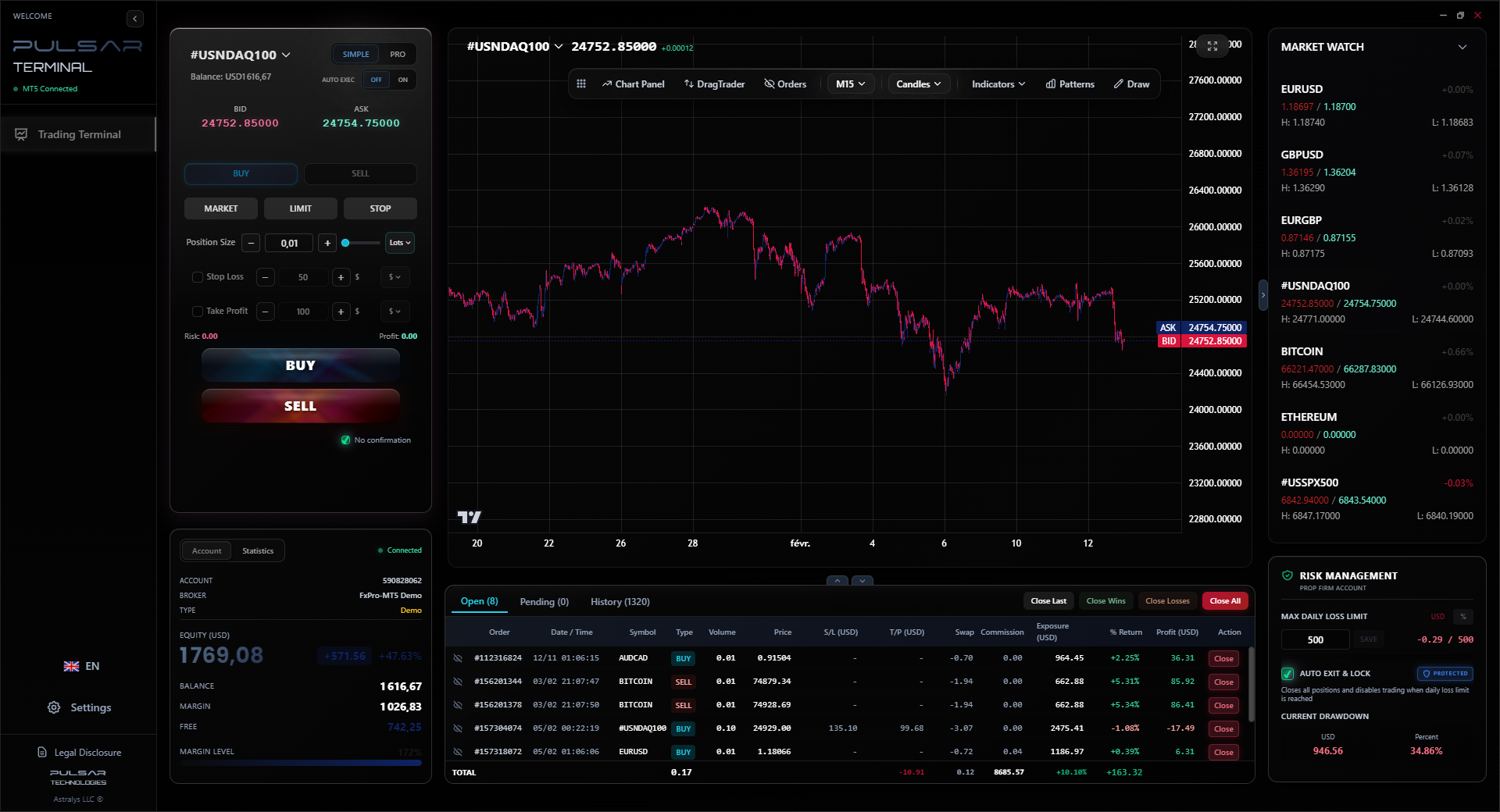
Sticking to the 1% risk rule requires precise order management, which is where tools like Pulsar Terminal's drag-and-drop order system on MT5 become indispensable for fast, accurate trade placement.
Pulsar Terminal
The all-in-one MT5 companion: drag-and-drop orders, multi-TP/SL, trailing stop, grid trading, Volume Profile, and prop firm protection. Used by 1,000+ traders daily.
“Your job isn't to be a hero on Twitter; your job is to be consistently profitable over the next 20 years.”
So, where is all this heading? The trajectory is towards more formalization, whether we like it or not.
The CBN's recent actions - the new NFEM guidelines, the electronic EFEMS system, bringing BDCs back in - signal a desire for more transparency and control in the broader FX market. It's only a matter of time before some of this scrutiny trickles down to the retail space. We might see clearer regulations for local brokerages, which could raise standards but also potentially restrict access to some international firms.
Technologically, we're already ahead. Mobile penetration is massive, and apps are getting better. The barrier to entry will keep getting lower, which means more new traders flooding in. This makes a solid education (like understanding what you're reading beyond a 'forex trading wikipedia' page) and a disciplined edge more valuable than ever.
The bottom line? The opportunity is real and growing. Market turnover shot up by 56.4% to $8.6 billion in 2025. But the path to success is the same as anywhere else in the world: education, discipline, and ruthless risk management. The Nigerian market just adds its own unique layers of complexity on top. Master those, and you're in the game.
FAQ
Q1Do I need to pay tax on my forex trading profits in Nigeria?
Yes, absolutely. The FIRS requires a 10% Capital Gains Tax on your gross profits from forex trading. This applies regardless of whether you use an international broker. You are responsible for declaring this income.
Q2What is the minimum amount I need to start forex trading in Nigeria?
While you can technically open an account with $5 or $10, it's not practical for learning real risk management. A realistic starting amount that allows you to trade micro-lots and withstand normal losses is between $500 and $1000. This gives you room to breathe and learn.
Q3Which is the best broker for beginners in Nigeria?
For absolute beginners, brokers like XM or Exness are common starting points due to low minimum deposits, local deposit options, and extensive educational materials. However, 'best' depends on your goals. Always prioritize proper regulation above all else.
Q4Is forex trading a scam in Nigeria?
Forex trading as a global financial market is not a scam. However, the space is rife with scams: fake investment schemes (Ponzi), unregulated 'brokers' that disappear with deposits, and 'gurus' selling fake success. The activity is legal, but you must do extreme due diligence on who you trade with and who you learn from.
Q5What is the most important thing for a new Nigerian trader to learn?
Risk management. Before you learn a single strategy, learn how to use a stop-loss, calculate your position size (never risk more than 1% per trade), and understand how use can destroy your account. Survival comes first, profits come second.
Q6Can I trade with my phone in Nigeria?
Yes, absolutely. Most brokers offer full-featured mobile apps for MT4 or MT5. In fact, many Nigerian traders primarily use mobile phones. Ensure you have a stable internet connection, as disconnections during a trade can be costly.
Prof. Winston's Lesson
Key Takeaways:
- ✓Risk a maximum of 1% of your account per trade. No exceptions.
- ✓Set aside 10% of every withdrawal for Capital Gains Tax immediately.
- ✓Test a broker's withdrawal process before making a large deposit.
- ✓The London/New York session overlap (1-5 PM WAT) is your prime trading window.
How useful was this article?
Click a star to rate
Weekly Trading Insights
Free weekly analysis & strategies. No spam.
About the Author
Olumide Adeyemi
West African Trading Pioneer
One of Nigeria's most active forex trading educators. 8 years of experience trading from Lagos. Specializes in low-capital strategies and prop firm challenges for African traders.
Comments
Risk Disclaimer
Trading financial instruments carries significant risk and may not be suitable for all investors. Past performance does not guarantee future results. This content is for educational purposes only and should not be considered investment advice. Always conduct your own research before trading.
You Might Also Like

Cara Trading Forex Sukses: 7 Prinsip dari Trader Profesional
Cara trading forex sukses dengan 7 prinsip trader pro: manajemen modal, disiplin, journal trading, backtest. Data nyata, bukan janji profit palsu.
Jam Trading Forex Terbaik untuk Trader Indonesia: Panduan Lengkap dengan Tabel Waktu
Panduan jam trading forex untuk trader Indonesia. Tabel 4 sesi dunia, jam emas 20:00-00:00, sesi mana yang harus dihindari. Data akurat + tips dari trader berpengalaman.
Top 5 Sàn Forex Uy Tín Nhất 2026: Review Jujur dari Trader Indonesia
Top 5 sàn forex uy tín 2026 untuk trader Indonesia. Review jujur: spread, deposit, withdraw, dukungan lokal. Exness, XM, IC Markets & lebih.
Get Pulsar Terminal
All these calculators are built into Pulsar Terminal with real-time data from your MT5 account. One-click position sizing, automatic risk management, and instant calculations.
Get Pulsar Terminal