


You've probably seen the ads or heard the whispers in trading groups: 'Cut out the middleman!' 'Trade forex directly!' It sounds tempting, right? More control, no broker fees, just you and the market.

David van der Merwe
Emerging Markets Trader ·  South Africa
☕ 9 min read
What you'll learn:
You've probably seen the ads or heard the whispers in trading groups: 'Cut out the middleman!' 'Trade forex directly!' It sounds tempting, right? More control, no broker fees, just you and the market. But here's the hard truth I had to learn early on: for a retail trader in South Africa, trying to trade forex without a broker isn't just difficult, it's a fast track to losing your money or breaking the law. Let's unpack what this really means, why the 'direct access' dream is a mirage for most of us, and how to trade currencies the right way from Mzansi.
The idea of trading without a broker is built on a misunderstanding of how the forex market actually works. Think of it like this: you can't just walk into the JSE and start buying shares off the floor. You need a licensed stockbroker. The forex market is similar, but bigger and more fragmented.
The real interbank market, where billions are swapped between major banks and institutions, has a velvet rope. You and I aren't on the guest list. The minimum trade sizes are in the millions, and the credit requirements are insane. A broker acts as your gateway, pooling the trades of thousands of retail traders to access that liquidity. When you place a trade on MT5 with a broker like IC Markets, you're not trading 'with' them in a casino sense; you're using their regulated infrastructure to access the global market.
I made this mistake early. I chased a 'direct ECN' setup I found online, which turned out to be an unregulated bucket shop operating out of a tax haven. The spreads looked amazing on paper, but the platform mysteriously froze every time volatility spiked. I lost R8,000 in two trades because my stops simply didn't get filled. That was my tuition fee for learning that the gatekeeper, when properly regulated, is your protector.

Warning: Any individual or group promising you 'direct' interbank access with a small deposit is almost certainly running a scam. The FSCA has a long list of these operations they warn against weekly.

💡 Winston's Tip
A broker's true test isn't the deposit, it's the withdrawal. Do a small one first. If it's smooth, you've likely found a real business. If it's a fight, you've found a hobby for their compliance department.
“For a retail trader in South Africa, trying to trade forex without a broker is a fast track to losing your money or breaking the law.”
This isn't just about practicality; it's about legality. South Africa has two big watchdogs you need to know: the Financial Sector Conduct Authority (FSCA) and the South African Reserve Bank (SARB).
FSCA: Your Financial Bodyguard
The FSCA licenses all legitimate financial services providers. A forex broker operating here must be an FSP. This license means they have to follow strict rules: they must keep your money in segregated accounts (so they can't use it for their own bills), provide clear risk disclosures, and offer a complaints process. If you trade with an unlicensed entity, you have zero protection. The FSCA can't help you if they vanish with your deposit.
SARB Exchange Control: The Great Wall of Rand
This is the big one everyone forgets. SARB's Exchange Control Regulations strictly manage the flow of money in and out of South Africa. It is illegal to buy or sell foreign currency outside of authorised channels (like banks or licensed brokers).
Let's say you find some offshore platform that lets you deposit ZAR. You're likely violating exchange controls. SARB has cracked down on people using SA credit cards to fund foreign trading accounts without approval. The consequence? Your bank could freeze your account, and you could face penalties. Trading forex CFDs through a licensed broker gets around this because you're not physically moving currency overseas; you're trading a derivative contract settled in Rands.

Example: In 2023 alone, the FSCA reported over 1,200 complaints related to forex scams, with total losses exceeding R500 million. That's half a billion Rand gone, mostly to unlicensed 'brokerless' schemes.
“The FSCA reported over 1,200 complaints related to forex scams in 2023, with total losses exceeding R500 million.”
When someone tells you to skip the broker, what are they really selling? Let's look at the common setups, all of which I've seen trap local traders.
The 'Prop Firm' Illusion: Some fake prop firms claim to give you a 'direct' account with their liquidity. You pass a challenge, get 'funded', and trade. Except the platform is fake, and when you try to withdraw your profits, they invent rules or vanish. The FSCA warned against 'Forex Ghost Trader' in late 2025 for exactly this, promising 10-15% monthly returns via Telegram.
The P2P/WhatsApp Group Trap: This is huge in SA. A 'guru' on Instagram or WhatsApp runs a signal group. You're told to open an account on a specific obscure platform (the guru gets a kickback). The trades are 'copied' directly. This isn't brokerless trading; it's you sending money to an unregulated entity while following bad advice. Groups like 'EFX Trades' and 'Twelve Whales' were specifically flagged by the FSCA in 2026 for this.
The Decentralised Exchange (DEX) Pitfall: Tech-savvy traders ask, "What about crypto DEXs like Uniswap?" Sure, you can swap crypto pairs without a central broker. But you still need to get ZAR into crypto first (through a regulated exchange, i.e., a broker). The DEX itself offers no support, the interfaces are complex, and slippage can be brutal. It's not a viable path for forex trading, just crypto speculation.
The pattern is always the same: avoid the regulated middleman to avoid 'fees,' and you step straight into the arms of a fraudster. The R3,000 'setup fee' I once paid to a Telegram 'funding manager' for 'direct platform access' taught me that lesson the hard way. I never saw that platform, or my money, again.
“Your job isn't to eliminate the broker; it's to choose the best one for your style.”
Okay, so you can't go brokerless. What can you do legally and safely? Plenty. You just work with the right kind of middleman.
1. FSCA-Licensed Brokers: This is your first and best port of call. Brokers like Pepperstone or XM have local offices and FSP licenses. You get local support, ZAR accounts, and the peace of mind that the regulator has your back. They offer the MT4/MT5 platforms you want, with use capped at a safe 30:1 by the FSCA.
2. Top-Tier International Brokers: Many South Africans use major global brokers regulated in jurisdictions like Australia (ASIC) or Cyprus (CySEC). While the FSCA can't directly intervene if you have a dispute, these brokers have strong reputations to uphold. I've used an ASIC-regulated broker for years for my main swing trading account. The key is doing your due diligence.
3. P2P Currency Exchange for Transfers: This is a cool, legal development. Apps like Be Mobile Africa now offer P2P marketplaces to swap currencies at good rates for travel or business, staying within your annual discretionary allowance. This is for currency exchange, not speculative trading, and it's a fantastic way to save on bank fees.
4. JSE Forex Derivatives: You can trade rand-based forex futures and CFDs directly on the Johannesburg Stock Exchange. This is as 'direct' as it gets in a regulated sense, but it's still through a licensed stockbroker.
The fee argument falls apart here too. A good broker's cost is tiny compared to the risk of fraud. The average spread on EUR/USD with a raw account broker can be under 0.1 pips. That's a R10 cost on a R100,000 position. A scam takes 100% of your capital.
💡 Winston's Tip
The 30:1 use limit isn't a cage, it's a seatbelt. I've blown accounts with higher use. This limit forces position sizing that lets you survive the inevitable bad streaks.
“Your job isn't to eliminate the broker; it's to choose the best one for your style.”
So, let's get practical. How do you set up a legitimate trading operation from South Africa?
- Choose Your Regulated Path: Decide between a local FSCA broker or a top-tier international one. Check the FSCA's website for their warning list first to know who to avoid.
- Open Your Account: Have your FICA docs ready (ID, proof of address). The process is fully online. Minimum deposits can be low – some brokers start at $50 (roughly R900).
- Fund It: Use the broker's approved methods. EFT to their local South African bank account (if they have one), or use a credit/debit card. Avoid being asked to do a direct EFT to a personal account.
- Trade Derivatives, Not Spot Forex: Understand you'll be trading CFDs or futures. This gives you the exposure you want without breaking exchange controls. Use a position size calculator to manage your risk, especially with the 30:1 use limit.
- Withdraw Profits: Profits come back to your South African bank account in Rands. There may be a small conversion fee, but it's all above board and reported where necessary.
I keep two accounts: one with a local FSCA broker for quick ZAR deposits and a larger one with an international broker for better overall conditions. This split strategy gives me flexibility and security.

Pro Tip: When testing a new broker, always make a small withdrawal first, before you've even placed a trade. If you can deposit R1,000 and smoothly withdraw R900, you've passed the first major test of legitimacy.
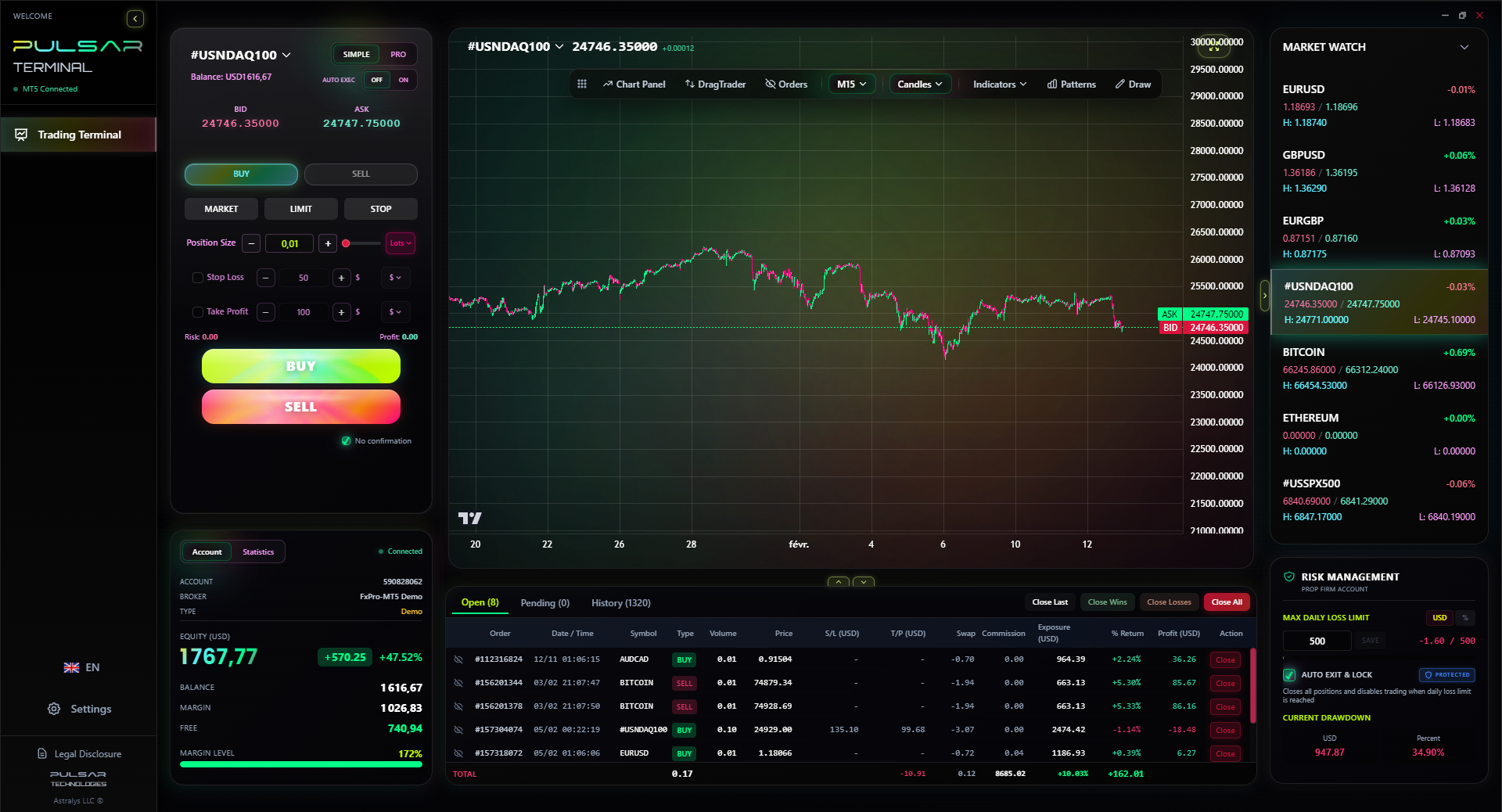
Once you're trading safely with a regulated broker, managing complex trades efficiently is key, and Pulsar Terminal's drag-and-drop orders and multi-TP/SL tools on MT5 make that process seamless.
Pulsar Terminal
The all-in-one MT5 companion: drag-and-drop orders, multi-TP/SL, trailing stop, grid trading, Volume Profile, and prop firm protection. Used by 1,000+ traders daily.
“The dream of forex trading without a broker is a siren song. It leads to rocky shores littered with lost savings.”
After 12 years in this game, my view has flipped completely. I don't see a good broker as a fee-charging obstacle. I see them as a vital service provider, like a reliable internet connection. They provide the secure platform (MT5), the market data, the liquidity bridge, the risk management tools, and the legal framework that makes trading possible.
Your job isn't to eliminate them; it's to choose the best one for your style. Are you a scalping fiend who needs ultra-tight spreads on EUR/USD? Or a macro trader who needs reliable execution on XAU/USD? Your broker choice matters more than any fantasy of going solo.
Focus your energy on what you can control: your strategy, your psychology, and your risk management. Let a regulated professional handle the plumbing. It's the only way to build a sustainable trading career from South Africa without looking over your shoulder at the FSCA or SARB.
The dream of forex trading without a broker is a siren song. It leads to rocky shores littered with lost savings. The real path to success is finding a broker you can trust, and then getting very, very good at the trading part. That's where the real work - and the real opportunity - lies.
FAQ
Q1Is it illegal for a South African to trade forex with an international broker?
No, it's not illegal. Many South Africans use reputable international brokers regulated by bodies like ASIC or FCA. However, the FSCA cannot assist you if you have a dispute with that broker. The key is ensuring the broker is properly regulated elsewhere and that you fund the account using legal methods that comply with SARB's exchange controls, not by using your SA credit card on unapproved platforms.
Q2What's the difference between a forex scam and a regulated broker?
A regulated broker (FSCA licensed) must segregate client funds, provide transparent pricing, and have a clear complaints process. A scam will often promise guaranteed returns, pressure you to deposit quickly, operate mainly on social media, and have no legitimate regulatory license. The FSCA publishes frequent warnings naming specific scams, which is your first resource for checking.
Q3Can I use a VPN to sign up with a broker that doesn't accept South Africans?
You could technically, but you absolutely shouldn't. This violates the broker's terms of service. If they find out, they can freeze your account and keep any profits. More importantly, you'd be lying about your residency, which complicates tax and financial reporting. It's a high-risk move that offers zero legal protection.
Q4What is the maximum legal use I can get in South Africa?
For retail traders, the FSCA has capped use at 30:1 for major forex pairs. This is a protective measure. Some unlicensed entities might offer 500:1 or even 1000:1 to lure you in - this is a major red flag indicating they are not complying with local regulations.
Q5I was scammed by an unlicensed forex operation. What can I do?
First, report it to the South African Police Service (SAPS) and the FSCA. Provide all details: communication, account numbers, website links. However, you must be realistic. The FSCA reported that in 2023, only about 12% of the R547 million lost to forex scams was recovered. Prevention - by only using licensed providers - is infinitely more effective than cure.
Q6Are there any 'brokerless' options that are actually legal?
For speculative trading, no. For simple currency exchange, yes. Peer-to-peer (P2P) apps that let you swap your Rands for another currency within your annual discretionary allowance (like for travel) are legal and can save you money compared to banks. But this is for converting currency you need to use, not for opening and closing leveraged trading positions.
Prof. Winston's Lesson
Key Takeaways:
- ✓The interbank market is institution-only; brokers are your necessary gateway.
- ✓Trading with an unlicensed entity offers zero FSCA protection.
- ✓SARB Exchange Control makes direct offshore currency trading illegal.
- ✓Scams promising 'direct access' stole over R500m from South Africans in 2023.
- ✓Legal trading uses regulated brokers or JSE derivatives, not spot forex.
How useful was this article?
Click a star to rate
Weekly Trading Insights
Free weekly analysis & strategies. No spam.
About the Author
David van der Merwe
Emerging Markets Trader
Johannesburg-based trader with 11 years in emerging market currencies. Specializes in ZAR pairs, FSCA-regulated trading, and South African market analysis.
Comments
Risk Disclaimer
Trading financial instruments carries significant risk and may not be suitable for all investors. Past performance does not guarantee future results. This content is for educational purposes only and should not be considered investment advice. Always conduct your own research before trading.
You Might Also Like

Cara Trading Forex Sukses: 7 Prinsip dari Trader Profesional
Cara trading forex sukses dengan 7 prinsip trader pro: manajemen modal, disiplin, journal trading, backtest. Data nyata, bukan janji profit palsu.
Jam Trading Forex Terbaik untuk Trader Indonesia: Panduan Lengkap dengan Tabel Waktu
Panduan jam trading forex untuk trader Indonesia. Tabel 4 sesi dunia, jam emas 20:00-00:00, sesi mana yang harus dihindari. Data akurat + tips dari trader berpengalaman.
Top 5 Sàn Forex Uy Tín Nhất 2026: Review Jujur dari Trader Indonesia
Top 5 sàn forex uy tín 2026 untuk trader Indonesia. Review jujur: spread, deposit, withdraw, dukungan lokal. Exness, XM, IC Markets & lebih.
Get Pulsar Terminal
All these calculators are built into Pulsar Terminal with real-time data from your MT5 account. One-click position sizing, automatic risk management, and instant calculations.
Get Pulsar Terminal