


Let me be blunt: if you're a new trader in South Africa and you're using use, you're basically asking to get wiped out.

David van der Merwe
Emerging Markets Trader ·  South Africa
☕ 11 min read
What you'll learn:
- 1What Does 'No use' Actually Mean?
- 2Why This is a Game-Saver for South Africans
- 3The Real Costs & The Brutal Math
- 4Finding the Right Broker & Setting Up
- 5Strategies That Make Sense at 1:1
- 6Risk Management When You Can't Blow Up
- 7The Long, Slow Path to Building Capital
- 8Mistakes I Made (So You Don't Have To)
Let me be blunt: if you're a new trader in South Africa and you're using use, you're basically asking to get wiped out. The FSCA's 1:30 limit on majors? Still too high for most. The real secret, the one that brokers hate talking about, is forex trading without use. It sounds boring. It sounds slow. I thought the same thing when I started. I was wrong. Trading at 1:1 isn't for cowards; it's for people who want to actually keep their money while they learn this brutal game. In this guide, I'll show you exactly how to do it, why it's the only sane approach for a beginner, and how you can build real capital without the constant threat of a margin call.
Forget the fancy terms. Trading without use means one simple thing: you only trade with the cash you actually have in your account. If you deposit R10,000, your maximum position size is R10,000. There's no broker loan amplifying your wins (or, more importantly, your losses).
This is called 1:1 use. You put up 100% of the margin for every trade. It's the opposite of the typical CFD or forex derivative account where you might control R300,000 worth of currency with that same R10,000 (that's 1:30 use).
Why does this matter? Psychology. When you're not leveraged, a 50-pip move against you hurts, but it doesn't obliterate your account. It gives you room to breathe, to think, to actually learn price action instead of just panicking. Most brokers offer this simply by setting your account use to 1:1 in the settings, or by trading 'spot' currency conversion. It's perfectly legal and regulated by the FSCA as a standard financial activity.

Warning: Don't confuse 'no use' with 'no risk'. You can still lose your entire deposit if you make terrible, oversized trades. Risk management is still king, it just operates on a more human scale.
Our market has unique pressures that make no-use trading particularly wise. First, the ZAR pairs we often look at - USD/ZAR, EUR/ZAR - are volatile. I mean, properly jumpy. A bit of political news or a SARB announcement can send them moving 200 pips in a blink. Throw 1:30 use on that and a small move wipes you out.
Second, let's talk capital. The average South African retail trader isn't starting with R500,000. They're starting with R5,000, R10,000, maybe R20,000. Using high use with that small base is a recipe for blowing up fast. Trading without use forces you to respect that capital.
The Psychological Edge
I learned this the hard way. Early on, I put R15,000 into an account, used 1:50 use on GBP/JPY (a notoriously volatile pair), and watched a 90-pip swing against me trigger a margin call. Poof. R4,500 gone in an afternoon. I was sick. When I switched to a 1:1 approach with my remaining capital, the stress vanished. I could actually analyze the trade instead of staring at the P&L in a cold sweat. A 90-pip loss on a sensible position size calculator was manageable, a setback, not a catastrophe.
Aligning with FSCA Spirit
Think about it: the FSCA capped use for a reason. They've seen the data that 70-80% of retail clients lose money. Trading at 1:1 is you going a step further in protecting yourself. It shows discipline before you even place an order. This mindset is what separates the 20% who might eventually make it from the 80% who fund the brokers' bonuses.

💡 Winston's Tip
Treat your first R10,000 like a university tuition fee, not an investment. If you learn without blowing it up, you've passed the first and hardest exam.
“A 90-pip loss on a sensible position size is manageable, a setback, not a catastrophe.”
Here's where brokers make their money on 1:1 traders: the spread. Without use, commissions and spreads eat a larger relative chunk of your potential profit. You need to understand this cold.
Let's say you trade EUR/USD with a 1.0 pip spread (common on standard accounts).
- With 1:1 use: You buy 1,000 euros (a 0.01 micro lot) for roughly R20,000 (assuming EUR/ZAR ~20). The spread cost is 1 pip. 1 pip on EUR/USD for a 0.01 lot is about $0.10, or roughly R1.80. To break even, the market needs to move 1 pip in your favor. Your potential profit per pip is also R1.80.
- With 1:30 use: You could buy 30,000 euros (a 0.3 lot) with that same R20,000 margin. The spread cost is now 1 pip * 30 = $3.00, or ~R54. Your profit per pip is also R54.
See the difference? The leveraged trade has higher absolute costs and returns. The non-leveraged trade has tiny costs, but you need bigger percentage moves to see meaningful gains.

Example: On a R10,000 account at 1:1, a fantastic 5% monthly return is R500. After spreads, maybe R450. That's a good dinner out. At 1:30, a 5% move on your margin could be 150% return... or a 100% loss. Which outcome do you think is more likely for a beginner?
For ZAR pairs, it's worse. USD/ZAR might have a 5-pip spread. On a 1:1 trade for $1,000 (R18,500), that 5-pip spread is a much bigger hill to climb right out the gate. You must factor this in. This is why choosing a broker with tight spreads, like Pepperstone or IC Markets, becomes critical - their Raw/ECN accounts offer spreads under 0.1 on majors for a small commission.
Not all brokers are thrilled if you only want 1:1 use. Their business model prefers you to trade big and churn. You need a regulated, transparent broker.
Rule #1: FSCA Regulation is Non-Negotiable. This protects your funds under South African law. Always check the FSP number on the FSCA website.
Local vs. International Brokers with FSCA Licenses:
- Khwezi Trade: A solid local option. They get our market. You can open a ZAR-denominated account with a R500 minimum. Just call them and insist on setting your account to maximum 1:1 use.
- International Brokers (FSCA Licensed): Exness, XM, HFM, and FP Markets all have FSCA entities. They often have more advanced platforms (MT4/MT5) and tighter spreads on major pairs.
The Account Setup Trick: When you open an account, you'll often be asked for 'use preference'. Choose the lowest possible, usually 1:1 or 1:5. If it's not an option, open a ticket with support immediately after funding and demand they lower your use to 1:1. Be persistent. Frame it as a 'risk management requirement'.
Consider a 'Cent' or 'Micro' Account: These allow you to trade in cent lots (0.01 of a micro lot). This is perfect for no-use trading with smaller capital. You can trade a position worth $10 instead of $100,000, making the pip value negligible and the learning experience safe. XM and Exness offer these well.
💡 Winston's Tip
The spread is your real opponent in no-use trading. Choose your broker and your pairs like you're choosing a battlefield.
“You will not turn R5,000 into R500,000 in a year trading forex without use. It's mathematically impossible without lottery-winning luck.”
Forget scalping. Trying to grab 5-pip profits with wide spreads at 1:1 is a fast track to the poorhouse. Your strategies must adapt to the higher relative cost of trading.
Swing Trading is Your Best Friend
This is the natural home for the no-use trader. Swing trading aims for moves of 100-300 pips over days or weeks. That 1-5 pip spread? It becomes noise. You're trading the bigger picture. Use daily and 4-hour charts. Look for key support/resistance levels and macroeconomic trends affecting pairs like EUR/USD or GBP/USD.
I had a great no-use swing trade in 2022. I bought USD/JPY at 114.50 on the daily chart, based on a clear breakout and divergence on the weekly MACD indicator. I held it for three weeks, exiting at 118.20 for a 370-pip gain. On my R20,000 position (1:1), that was a profit of about R1,200 after spreads. Not life-changing, but a solid, stress-free 6% return.
Position Trading Fundamentals
This is even longer-term. You're holding for months, banking on major interest rate differentials or economic shifts. This requires serious patience and a deep understanding of fundamentals. The spread cost is utterly irrelevant here.
The Indicator Shift
At 1:1, you can ignore the ultra-fast noise. Focus on higher-timeframe indicators. The RSI indicator on a daily chart showing overbought/oversold is far more reliable than the 1-minute RSI. Moving averages (like the 50 and 200 EMA) become powerful trend filters.

Pro Tip: Use a trading journal. At 1:1, you might only take 2-3 trades a month. Document every one: your rationale, chart screenshot, entry/exit. This slow pace forces quality over quantity and accelerates your learning like nothing else.
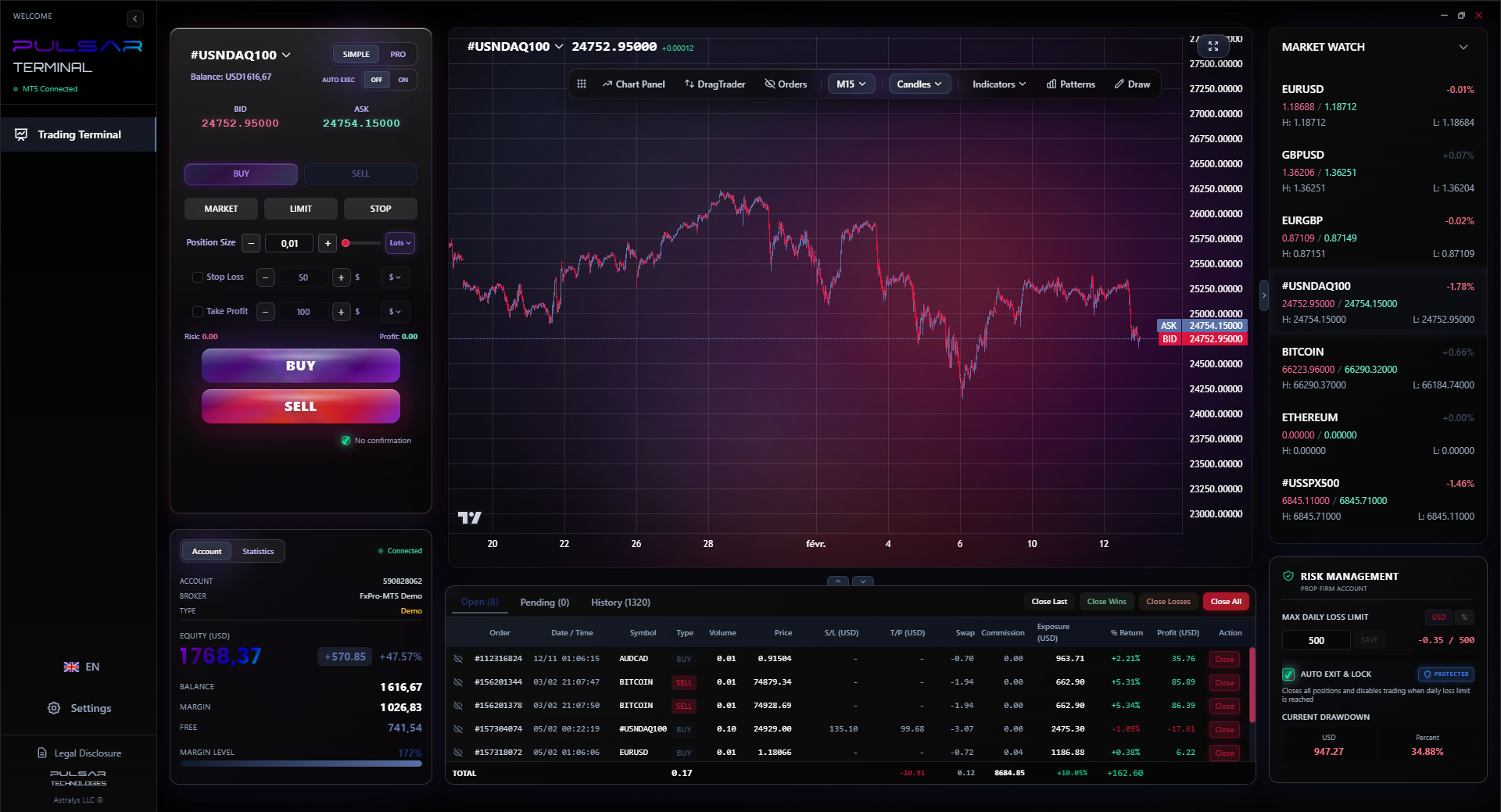
Managing multiple take-profit levels or moving a stop to breakeven on a long-term swing trade is crucial. Doing this manually on MT5 is a pain. A tool like Pulsar Terminal automates trailing stops and partial closures directly on your platform, letting you lock in profits while you sleep, which is essential for a patient strategy.
Just because you can't get margin called in 30 seconds doesn't mean risk management goes out the window. It just changes shape.
The 1% Rule Still Applies (Sort Of): The old adage is to risk 1% of your account per trade. On a R10,000 account at 1:1, 1% is R100. That's a tiny stop-loss distance on any meaningful position. You might need to adjust this to 2-3% to give your trade room to breathe, but never, ever go above 5% of your capital on a single idea.
Your Biggest Risk is Boredom & Overtrading: This is the silent killer of the no-use trader. You'll have weeks with no valid setups. The temptation to force a trade, to lower your standards just to 'do something', will be immense. This is how you slowly bleed capital through spread costs and bad entries.
Portfolio Concentration: With limited capital, you might only be able to hold one or two positions at a time. That's okay. Don't diversify for the sake of it. One well-researched trade is better than three mediocre ones. If you're trading USD/ZAR, maybe that's the only pair you focus on for months until you truly understand its rhythms.
The Emotional Test: The first time you make R500 on a trade that took six weeks to develop, and your friend brags about making R5,000 in a day on leveraged crypto, you'll feel foolish. Stick to your plan. His results are not repeatable; yours are built on a sustainable process.
Managing multiple take-profit levels or moving a stop to breakeven on a long-term swing trade is crucial. Doing this manually on MT5 is a pain. A tool like Pulsar Terminal automates trailing stops and partial closures directly on your platform, letting you lock in profits while you sleep, which is essential for a patient strategy.
Pulsar Terminal
The all-in-one MT5 companion: drag-and-drop orders, multi-TP/SL, trailing stop, grid trading, Volume Profile, and prop firm protection. Used by 1,000+ traders daily.
“Your biggest risk is boredom & overtrading. This is the silent killer of the no-use trader.”
Let's kill the fantasy right now. You will not turn R5,000 into R500,000 in a year trading forex without use. It's mathematically impossible without lottery-winning luck. What you can do is build a track record of consistent, small gains.
Realistic Returns: A truly excellent, professional no-use trader might average 10-15% per year. Outstanding ones might hit 20%. Aim for 1-2% per month consistently. On a R20,000 account, that's R200-R400 per month. It's not quitting-your-job money. It's 'proof-of-concept' money.
The Scaling Plan:
- Phase 1 (Months 1-6): Don't withdraw a cent. Reinforce your account with your profits and, if possible, small additional deposits from your salary. Your goal is to grow the account size to reduce the impact of percentage-based spreads.
- Phase 2 (Months 7-18): Once your account is larger (say, R50,000+) and you have 12+ months of profitable statements, you have options. You could apply to a prop firm using this verified track record. They might give you capital to trade with their rules (which include use). Your 1:1 experience will make their risk limits feel roomy.
- Phase 3 (The Long Game): Continue compounding. R50,000 at 15% per year is R7,500. Do that for five years with some additions, and you're talking about a significant secondary income stream built on a rock-solid foundation.
The key is shifting your mindset from 'get rich quick' to 'become a competent professional slowly'. This is the only approach that has a chance of long-term survival in South Africa's volatile financial landscape.
💡 Winston's Tip
Your trading journal is more important than your trading strategy. At 1:1, you have the time to write in it. Use that time.
I've walked this path. Here's where I stumbled.
Pitfall 1: Getting Greedy After a Win. I had three winning swing trades in a row, making about 8% total. I felt like a genius. So, on the next trade, I broke my own rules and doubled my position size, convinced I'd found the 'secret'. A predictable news spike went against me, and I gave back all three months' profits in one week. At 1:1, it was a painful lesson. At 1:30, it would have been a deposit.
Pitfall 2: Chasing ZAR Pairs for 'Excitement'. USD/ZAR moves are huge. It's tempting. But the wide spreads are a tax on your account. I traded USD/ZAR for a month, had 4 trades with a 50/50 win rate, and still ended down 2% overall because the 5-8 pip spreads on entry and exit killed my profitability. Stick to majors like EUR/USD or XAU/USD when starting.
Pitfall 3: Ignoring Swap Rates. Holding a position for weeks? The overnight swap/rollover fee matters. Sometimes it's a small credit, sometimes a debit. On a long-term trade, it can add up to a meaningful amount. Check your broker's swap calculator before entering a swing trade that you plan to hold for more than a few days.
Pitfall 4: Not Accounting for Taxes. SARS wants its share. Your net profit from trading is taxable income. Keep careful records of every trade from day one. That R400 profit you made in month 3? Log it. When your account grows, you'll be thankful for the clean paper trail. A good trading journal isn't just for learning; it's for your accountant.
FAQ
Q1Is forex trading without use legal in South Africa?
Absolutely. It's a completely legal activity regulated by the FSCA as spot currency conversion or non-leveraged trading. You must use an FSCA-licensed broker, but trading with your own capital at 1:1 is perfectly above board.
Q2How much money do I need to start forex trading without use?
Technically, you can start with as little as R500 on some local brokers. But realistically, to make the effort worthwhile and absorb costs, I'd recommend a minimum of R5,000. A more comfortable starting point for proper swing trading is R10,000 to R20,000.
Q3Can I make a living trading forex without use?
Not with a typical starting capital. If you start with R20,000, even a stellar 20% annual return is only R4,000. The goal of no-use trading for beginners is to preserve capital and learn consistently, not to generate immediate income. To trade for a living, you need significant capital (hundreds of thousands) or to eventually trade with a prop firm's capital after proving your skills.
Q4What's the main disadvantage of trading without use?
The relative cost. Spreads and commissions eat a larger percentage of your potential profit on each trade. This means you need to be more selective, aim for larger moves (swing/position trading), and have exceptional patience. The returns, in Rand terms, will feel very small at first.
Q5Should I use a ZAR-denominated account?
Yes, if you're funding with Rands. It saves you the hidden currency conversion fees your bank or broker might charge to change your ZAR to USD or EUR for trading. Brokers like Khwezi Trade, Exness, and HFM offer ZAR accounts for this reason.
Q6If I'm successful at 1:1, should I ever increase my use?
Maybe, but only after a long, proven track record (at least 12-18 months of consistent profits). And even then, increase it gradually - from 1:1 to 1:3, then maybe to 1:5. Never jump to the FSCA maximum of 1:30. That's for institutions and professionals with risk management systems you don't have. The use that got you profitable is usually the use you should stick with.
Prof. Winston's Lesson
Key Takeaways:
- ✓Start at 1:1 use. Always. No exceptions.
- ✓Swing trade majors. Avoid ZAR pairs until you're experienced.
- ✓Risk max 5% per trade, but aim for 2-3%.
- ✓Target 1-2% monthly returns, not 100% yearly.
- ✓Choose an FSCA broker with tight spreads.
How useful was this article?
Click a star to rate
Weekly Trading Insights
Free weekly analysis & strategies. No spam.
About the Author
David van der Merwe
Emerging Markets Trader
Johannesburg-based trader with 11 years in emerging market currencies. Specializes in ZAR pairs, FSCA-regulated trading, and South African market analysis.
Comments
Risk Disclaimer
Trading financial instruments carries significant risk and may not be suitable for all investors. Past performance does not guarantee future results. This content is for educational purposes only and should not be considered investment advice. Always conduct your own research before trading.
You Might Also Like

Cara Trading Forex Sukses: 7 Prinsip dari Trader Profesional
Cara trading forex sukses dengan 7 prinsip trader pro: manajemen modal, disiplin, journal trading, backtest. Data nyata, bukan janji profit palsu.
Jam Trading Forex Terbaik untuk Trader Indonesia: Panduan Lengkap dengan Tabel Waktu
Panduan jam trading forex untuk trader Indonesia. Tabel 4 sesi dunia, jam emas 20:00-00:00, sesi mana yang harus dihindari. Data akurat + tips dari trader berpengalaman.
Top 5 Sàn Forex Uy Tín Nhất 2026: Review Jujur dari Trader Indonesia
Top 5 sàn forex uy tín 2026 untuk trader Indonesia. Review jujur: spread, deposit, withdraw, dukungan lokal. Exness, XM, IC Markets & lebih.
Get Pulsar Terminal
All these calculators are built into Pulsar Terminal with real-time data from your MT5 account. One-click position sizing, automatic risk management, and instant calculations.
Get Pulsar Terminal