


It was October 2022, and I was watching a GBP/JPY short trade go against me.

Olumide Adeyemi
West African Trading Pioneer ·  Nigeria
☕ 11 min read
What you'll learn:
- 1The Nigerian Forex Course Landscape: From ₦10k to ₦1 Million Dreams
- 2What a Real Forex Training Course Must Teach (The Boring Stuff)
- 3Analysis vs. Execution: The Gap Where Money Dies
- 4Specialization is Key: Don't Try to Master Everything
- 5The Mentor Trap: When Guidance Becomes Dependency
- 6The Regulatory Reality: Trading Legally in Nigeria
- 7Building Your Own Curriculum (The Free & Paid Mix)
- 8The Final Exam: Demo, Then Live Small
It was October 2022, and I was watching a GBP/JPY short trade go against me. I’d entered at 164.50, convinced the pair was topping out. My 'mentor' from a popular ₦250,000 forex training course had taught me this 'surefire' reversal pattern. By the time I finally cut the loss, it was at 167.80. That was a 330-pip loss, which on my 0.5-lot position wiped out over $1,650. The course taught me setups, but it never once mentioned what to do when you’re dead wrong. That’s the gap between most Nigerian forex training courses and actual trading survival. Let's talk about what you really need to learn.
The first thing you need to understand is the market you're buying into. In Nigeria, a forex training course isn't just education, it's a full-blown industry fueled by the desperation for financial escape. You'll see the full spectrum.
At the bottom, you have the basic online courses for ₦10,000 to ₦50,000. These are often PDFs and pre-recorded videos that explain what a pip is and how to draw a trendline. They're information dumps, not training. Then you move into the intermediate zone: ₦50,000 to ₦300,000 for in-person or 'live class' experiences. This is where the personality-driven guru model thrives. The price tag implies exclusivity and 'secret strategies'.
The real money is in mentorship. One-on-one programs range from ₦50,000 to over ₦500,000. I've seen 'exclusive mentorship' packages advertised for ₦975,000. For context, that's more than the annual minimum wage. The promise is always the same: access to the mentor's personal trades, direct WhatsApp support, and the 'real' strategies they don't teach the masses.
Here's the brutal truth I learned the hard way: the cost of a course has zero correlation with its ability to make you a profitable trader. A ₦300,000 course can be just as useless as a free YouTube playlist if it only focuses on entries and ignores risk management. The most expensive lesson I ever bought was that confidence without competence is a recipe for a margin call.

Warning: Be extremely wary of any course or mentor who guarantees profits, shows only winning trades, or pressures you with 'limited slots.' This is salesmanship, not education. A real educator talks about losses, drawdowns, and psychological struggle.

💡 Winston's Tip
The cost of a trading course should be viewed as a tuition fee for an education that may or may not pay off. Never view it as an 'investment' with a guaranteed return. The only guaranteed outcome is that you'll learn something; whether it's how to trade or how to be scammed is up to your discernment.
If you're going to spend money, it needs to be on a curriculum that builds a trader, not a gambler. Most courses fail here. They're 80% entry signals and 20% everything else. It should be the opposite.
The Foundation: Risk Management is Not Optional
This is non-negotiable. A proper course must drill into you how to calculate your position size for every single trade. It's not glamorous, but it's what keeps you in the game. You need to learn how to use a position size calculator religiously. The rule is simple: never risk more than 1-2% of your trading capital on any one trade. My catastrophic GBP/JPY loss happened because I risked nearly 5%. I broke my own rule, convinced the 'signal' was too good. A good course makes this rule sacred.
The Psychology of Losing
Anyone can hold a winning trade. The test is what you do with a loser. A real course spends significant time on trading psychology: dealing with fear, greed, revenge trading, and the boredom of waiting for a setup. It should teach you to have a trading plan that includes your maximum daily loss limit (e.g., stop trading if you lose 3% of your account in a day).
Market Mechanics & Broker Reality
You need to understand the environment. This includes how your broker makes money (through the spread), what time major sessions open, and how economic news causes volatility. In Nigeria, you must also learn about funding and withdrawing from international brokers like Exness or IC Markets, and the 10% Capital Gains Tax on your profits. A course that doesn't cover this is leaving you unprepared for reality.

Example: Let's say you have a ₦500,000 trading account (about $330 at N1,500/$). A 2% risk per trade is ₦10,000. If your stop-loss on a EUR/USD trade is 20 pips, you can only afford a position size where 20 pips = ₦10,000 loss. That dictates your lot size. Ignore this math, and you're just guessing.
“Execution is a skill. If your course is just a guy drawing on charts after the fact, you're not learning to trade.”
This is the core failure of 90% of courses. They teach you how to analyze a chart. They don't teach you how to execute a trade in real-time, under pressure, when your heart is pounding.
I remember learning a beautiful MACD indicator divergence strategy. On historical charts, it looked flawless. My first live trade with it was on USD/CAD. I saw the divergence, entered, and price immediately spiked against me. The course didn't cover what to do. Do I add to the position? Do I widen my stop? I froze, watched my loss grow, and eventually panicked and closed. Of course, price then reversed and hit my original target. I was right on the analysis, but I lost money on the execution.
A worthwhile forex training course must include live trading simulations or detailed breakdowns of real, executed trades - winners and losers. It should cover:
- Order placement: Limit vs. Market orders.
- Setting stop-loss and take-profit levels BEFORE entering.
- What to do when news breaks mid-trade.
- How to manage a trade that's in profit (this is harder than it sounds).
- The emotional checklist to run through before clicking 'buy' or 'sell.'
Execution is a skill. It's like a footballer practicing penalties; you have to simulate the pressure. If your course is just a guy drawing on charts after the fact, you're not learning to trade, you're learning to be a Monday-morning quarterback.
A major red flag is a course that claims to teach you 'everything': forex, crypto, stocks, commodities, and scalping, day trading, and swing trading all in one package. That's impossible. It's a marketing tactic to make the course seem like higher value.
You need to find a course that specializes in one style and one or two markets. For example, a course focused on swing trading XAU/USD (Gold) using daily and 4-hour charts is infinitely more valuable than a generic 'forex mastery' course. The instructor should be able to show you a multi-year track record of applying that specific methodology.
Why does this matter? Because the psychology and techniques for a 5-minute scalp are completely different from a 5-day swing trade. The scalper needs to absorb constant noise and make quick decisions. The swing trader needs immense patience to sit through drawdowns. Mixing the teachings confuses your brain and destroys your discipline.
When I finally found success, it was after I abandoned the 'do everything' approach. I picked one strategy (price action swing trading on major forex pairs) and one mentor who only did that. I stopped looking at other timeframes and other instruments. My focus went from 'catching moves' to 'executing my plan perfectly.' That shift came from specialized training, not a general one.
💡 Winston's Tip
If a course doesn't make you feel uncomfortable by forcing you to confront your psychological weaknesses and past losses, it's not preparing you for real trading. The market is a ruthless examiner of character.
“Your survival depends on controlling losses, not on picking winners.”
The most dangerous phase of any forex training course is the post-course 'mentorship' or signal service. This is where they really get you.
You finish the course, you're unsure, and the offer comes: "Join my private Telegram group for live signals for just ₦20,000 a month." Or, "Book a one-on-one review session each week." This creates a crippling dependency. You stop learning to read the market yourself and start waiting for the guru's text. Your confidence becomes tied to their voice, not your own analysis.
I fell into this. After my initial losses, I paid for a signal service from a different 'mentor.' For two months, I blindly followed. I made some money, but I had no idea why. Then, one week, he gave three bad signals in a row. I lost a month's profits because I had never developed the skill to question or filter the signals. I was an order-follower, not a trader.
A good course's goal should be to make you independent. The mentor should wean you off, not hook you on. Be suspicious of any program where the 'real value' is in ongoing, paid access. True mentorship teaches you to fish, then pushes you out of the nest. It gives you a framework to develop your own trading journal, review your own mistakes, and build your own conviction. The tool should be your brain, not your phone's notification screen.

Pro Tip: Before buying a course, ask the instructor this: "What is your policy on students contacting you after the course ends?" If the answer is an immediate upsell to a paid ongoing group, walk away. If the answer is 'I provide a framework for self-review and host occasional free Q&A webinars,' that's a better sign.
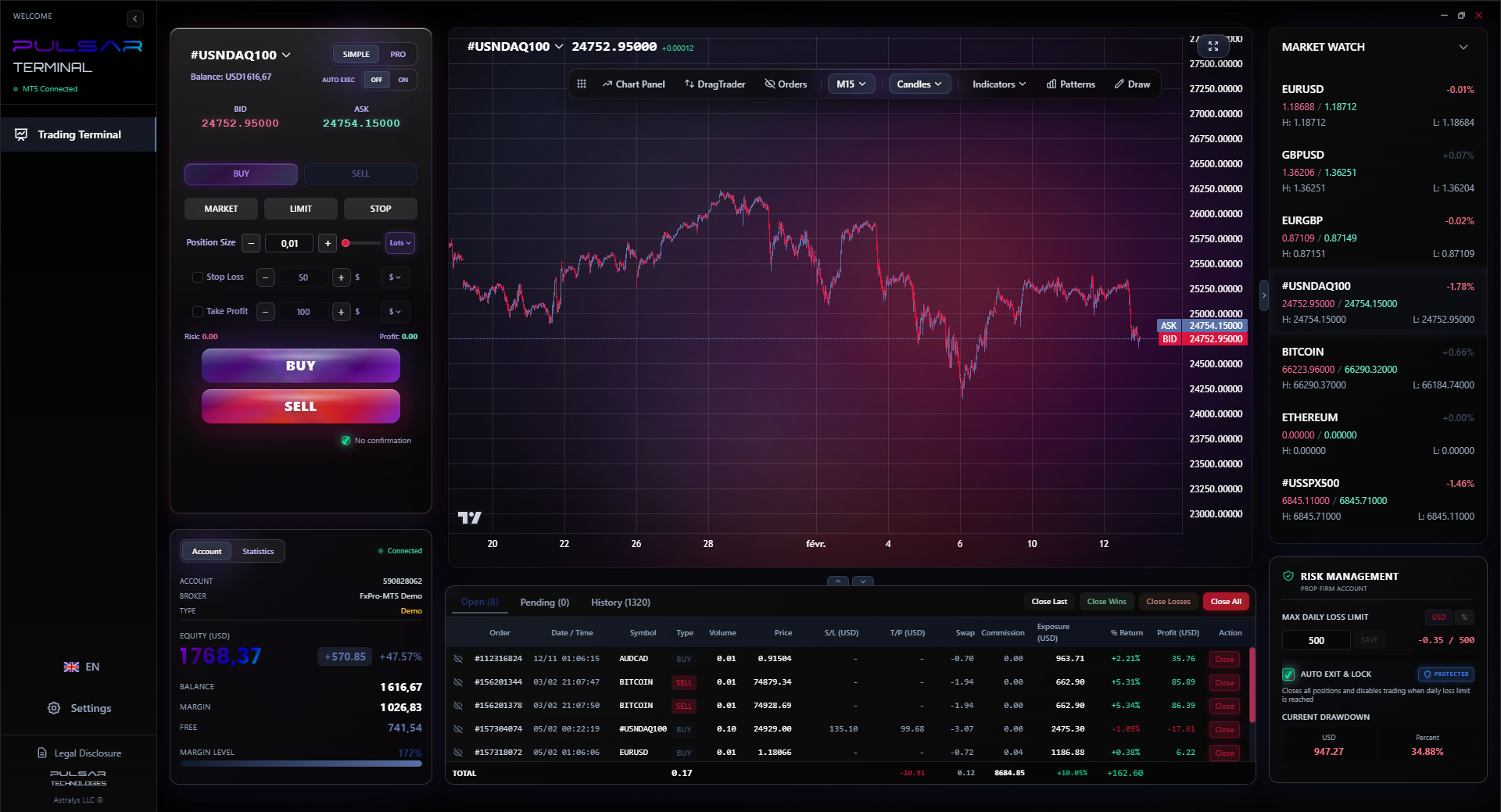
When you're ready to move from theory to disciplined execution, a tool like Pulsar Terminal can enforce your trade management rules directly on MT5, automating stops and taking the emotion out of the process.
Pulsar Terminal
The all-in-one MT5 companion: drag-and-drop orders, multi-TP/SL, trailing stop, grid trading, Volume Profile, and prop firm protection. Used by 1,000+ traders daily.
Any credible forex training course in Nigeria must address the legal and tax environment. Ignorance here can cost you more than a bad trade.
Forex trading is legal with your personal funds. However, the local regulatory scene is messy. The Central Bank of Nigeria (CBN) and the Securities and Exchange Commission (SEC) are the main bodies, but their focus isn't on protecting retail traders like you and me. The CBN cares about currency flows, and the SEC is mainly trying to shut down Ponzi schemes.
Because of this weak local framework, most serious Nigerian traders use international brokers regulated abroad - think XM (CySEC), Pepperstone (ASIC/FCA), or IC Markets (ASIC). A good course will explain the importance of choosing a broker with strong international regulation, not just a fancy website.
Then there's the taxman. This is critical: you are liable to pay a 10% Capital Gains Tax on your gross trading profits in Nigeria. It doesn't matter if your broker is in Cyprus or the Seychelles. If you make ₦1,000,000 in profit this year, you owe FIRS ₦100,000. A course that doesn't hammer this home is setting you up for a future headache. Profiting in the markets is hard enough, you don't need a surprise tax bill making it harder.
“The goal of your first live account is not to make money. The goal is to not blow up.”
You don't necessarily have to spend ₦300,000 to learn. You can assemble a powerful education for much less by being strategic. Here’s how I’d do it if I started today.
Phase 1: The Free Foundation (1-2 Months)
- Books: Read 'Trading in the Zone' by Mark Douglas (psychology) and 'The Daily Trading Coach' by Brett Steenbarger. These are cheaper than any course module and more valuable.
- Broker Education: Use the free webinars and articles from major brokers. They have quality material on basics.
- Chart Time: Open a free demo account and just watch price move. Don't trade. Just observe for hours. This builds 'screen time' no course can give you.
Phase 2: Targeted Paid Education (Your Strategic Investment) This is where you spend money. Don't buy a generic 'forex course.' Identify your biggest weakness and buy a course that fixes ONLY that.
- Weakness: I can't manage trades. Buy: A short course or book specifically on trade management and trailing stops.
- Weakness: I don't understand market structure. Buy: A course focused solely on price action and support/resistance.
- Weakness: My psychology is terrible. Invest in: A trading psychology coaching session or a dedicated workshop.
This approach costs less and is more effective because you're actively solving problems, not passively consuming information. It turns you into your own head of education.
Phase 3: The Paid Tool (Optional but Powerful) Once you have a strategy, consider investing in a tool that automates the tedious parts and enforces discipline. This is where something like a trading terminal can be a game-saver, not a game-changer.
💡 Winston's Tip
Your trading journal is your real forex training course. The market teaches you lessons every day. The journal is where you write down the syllabus. A course that doesn't mandate rigorous journaling is selling you a ticket to a play, not a seat in a classroom.
No forex training course is complete until you've passed its final exam: consistent profitability on a demo account, followed by survival on a tiny live account.
The rule is simple, and non-negotiable: You are not allowed to fund a live account until you can make a net profit over at least 50 trades on demo, using your full strategy and strict risk management. Not 10 trades. Fifty. This filters out luck.
When you go live, start with an amount you can afford to lose completely. I'm talking ₦50,000 or ₦100,000. The goal of this first live account is not to make money. The goal is to not blow up. Your success metric is whether you can follow your rules for 100 trades without self-destructing. Can you take every stop-loss without hesitation? Can you avoid revenge trading? This is the real test of your education.
I blew my first three live accounts because I skipped this step. I took a course, felt enlightened, and jumped in with 'serious money.' The pressure was immense, and I folded immediately. The fourth time, I traded a $100 account (about ₦150k at the time) for six months. I treated it like my life depended on it. I lost 30% of it, learned why, and slowly grinded back. That was the most valuable forex training course I ever took, and it cost me $100 and my ego. The course you pay for gives you the map. Trading your own small money teaches you how to walk the path.
FAQ
Q1How much should a legitimate forex training course cost in Nigeria?
Price isn't a reliable indicator of quality. You can find valuable focused courses for ₦50,000-₦150,000. Be very skeptical of courses over ₦300,000 that promise 'secret strategies' or guaranteed results. Often, the higher price is for the guru's celebrity, not superior content. Remember, the most expensive part of your education will be the losses you take applying bad lessons.
Q2Can I learn forex trading for free in Nigeria?
You can learn the basics for free through broker resources, books from online libraries, and observing demo charts. However, developing a structured, disciplined approach often requires guided learning. A better strategy is a hybrid: use free resources for 80% of the knowledge, then pay for a targeted course or mentorship to solve your specific remaining 20% problem (e.g., psychology or trade execution).
Q3What is the #1 thing a good forex course must teach?
Risk management and position sizing. Any course that spends more time on fancy entry indicators than on teaching you how to use a position size calculator and set a strict stop-loss is dangerous. Your survival depends on controlling losses, not on picking winners. This is the boring foundation most courses skip because it doesn't sell dreams.
Q4Are forex trading profits taxable in Nigeria?
Yes. You are required to pay a 10% Capital Gains Tax on your gross trading profits. This applies whether you use a local or international broker. A responsible course or mentor must inform you of this obligation. Keep detailed records of your trades for tax purposes.
Q5How long does it take to become profitable after taking a course?
A course gives you information, not skill. The skill comes from practice. A realistic timeline is 6-18 months of dedicated demo and small-live trading after a course before you see consistent profitability. If a course suggests you'll be making money in a few weeks, they are lying. This is a professional skill set, and it takes time to develop the required discipline and judgment.
Q6Should I join my course instructor's Telegram signal group?
Almost never. This creates dependency and stunts your growth. The goal is to learn to analyze the market yourself. If you must, use a signal service only as a learning tool for a limited time - compare the signals to your own analysis and try to understand the reasoning. Never trade them blindly with real money. True mastery means you no longer need the signals.
Prof. Winston's Lesson
Key Takeaways:
- ✓Risk 1-2% max per trade. Always.
- ✓Master position sizing before any indicator.
- ✓Pay your 10% Capital Gains Tax.
- ✓50 demo trades in profit before going live.
- ✓Specialize in one market, one timeframe.
How useful was this article?
Click a star to rate
Weekly Trading Insights
Free weekly analysis & strategies. No spam.
About the Author
Olumide Adeyemi
West African Trading Pioneer
One of Nigeria's most active forex trading educators. 8 years of experience trading from Lagos. Specializes in low-capital strategies and prop firm challenges for African traders.
Comments
Risk Disclaimer
Trading financial instruments carries significant risk and may not be suitable for all investors. Past performance does not guarantee future results. This content is for educational purposes only and should not be considered investment advice. Always conduct your own research before trading.
You Might Also Like

Cara Trading Forex Sukses: 7 Prinsip dari Trader Profesional
Cara trading forex sukses dengan 7 prinsip trader pro: manajemen modal, disiplin, journal trading, backtest. Data nyata, bukan janji profit palsu.
Jam Trading Forex Terbaik untuk Trader Indonesia: Panduan Lengkap dengan Tabel Waktu
Panduan jam trading forex untuk trader Indonesia. Tabel 4 sesi dunia, jam emas 20:00-00:00, sesi mana yang harus dihindari. Data akurat + tips dari trader berpengalaman.
Top 5 Sàn Forex Uy Tín Nhất 2026: Review Jujur dari Trader Indonesia
Top 5 sàn forex uy tín 2026 untuk trader Indonesia. Review jujur: spread, deposit, withdraw, dukungan lokal. Exness, XM, IC Markets & lebih.
Get Pulsar Terminal
All these calculators are built into Pulsar Terminal with real-time data from your MT5 account. One-click position sizing, automatic risk management, and instant calculations.
Get Pulsar Terminal