


You're probably looking at a chart right now, wondering which way the market is headed.

Olumide Adeyemi
West African Trading Pioneer ·  Nigeria
☕ 11 min read
What you'll learn:
- 1Why the Trend Matters More Than You Think
- 2Moving Averages: The Foundation You Can't Ignore
- 3ADX: The Trend Strength Meter (Not a Direction Finder)
- 4MACD: Momentum and the Crossover Trap
- 5Ichimoku Cloud: The All-in-One System
- 6Putting It All Together: A Simple Framework
- 7Common Pitfalls for Nigerian Traders (And How to Avoid Them)
- 8Final Word: The Trend is Your Friend (Until It Ends)
You're probably looking at a chart right now, wondering which way the market is headed. You've got a dozen lines and colors on your screen, each promising to reveal the trend. But why do so many traders, especially here in Nigeria, still get it wrong and blow their accounts? It's not the indicator. It's you. Let's cut through the noise. I've been trading for over 12 years, and I've seen every trick in the book. This isn't about finding a magic line. It's about understanding what these tools actually tell you and, more importantly, what they don't.
In Lagos, everyone's looking for the quick flip. The 'setup' that makes you 50% in a day. I get it. But chasing every zig and zag is how you get chopped up. The single biggest reason Nigerian traders fail is fighting the trend. You see a little pullback on USD/NGN or EUR/USD and think it's a reversal. It's not. It's the market taking a breath before it runs you over.
A trend is simply the market's dominant direction. Your job isn't to predict where it will go, but to identify where it is going right now and get on board. Trading with the trend increases your probability of success. It's that simple. It doesn't guarantee a win, but it stacks the odds in your favor. Fighting it is like trying to swim upstream in the Third Mainland Bridge traffic during rush hour. You'll just exhaust yourself and get nowhere.

Warning: The CBN's policies and interventions can create massive, sustained trends in pairs like USD/NGN. Ignoring this fundamental direction because an oscillator says 'overbought' is a classic account-killer.
I learned this the hard way in 2018. The EUR/USD was in a strong, steady downtrend. I kept trying to pick the bottom because my RSI indicator was showing oversold readings on the 1-hour chart. I took three long trades. All three were small losses that added up to a 15% drawdown. The trend didn't care about my RSI. It just kept going down. That loss stung, but it taught me to respect price action above everything else.

💡 Winston's Tip
A trend in its final, parabolic stage is like a shouting match at Mile 12 Market. It's loud, exciting, and everyone is involved. That's precisely when the smart money starts quietly leaving. Don't be the last one shouting.
Let's start with the basics. A moving average (MA) smooths out price data to show you the average price over a specific period. It's your baseline. In Nigeria, with our volatile power and internet, you need tools that are strong and don't require constant reinterpretation.
The 200-Period Simple Moving Average (SMA)
This is the king. On a daily chart, the 200-day SMA separates a bull market from a bear market. Price above it? Generally bullish. Price below it? Generally bearish. It's not a trading signal by itself, but it tells you which side of the fence you should be looking for trades. I have this on every single chart, in a thick line. It's my reality check.
The 50 and 20-Period Exponential Moving Averages (EMAs)
These are faster. The 50-period EMA (often the 50-day) shows the intermediate trend. The 20-period EMA (like the 20-day) shows the short-term trend. When these are stacked in order (e.g., price > 20 EMA > 50 EMA > 200 SMA), you have a strong, healthy uptrend. The opposite is true for a downtrend.
Here’s the practical bit for a Nigerian trader: Use these to filter your trades. If you're a scalping on the 15-minute chart, only take buy signals when price is above the 200-period MA on the 1-hour chart. This one filter will save you from countless bad trades during ranging markets.

Example: On your MT4/MT5, pull up GBP/USD on the 4-hour chart. Add these three MAs: SMA 200 (blue), EMA 50 (red), EMA 20 (green). Look at how price respects these levels as support and resistance during trends. A clean bounce off the 20 EMA in a strong trend is often a high-probability entry point.
“An ADX reading above 25 suggests a trend is present. Above 40? That's a very strong trend. Below 20? The market is likely ranging or consolidating.”
This is where most people mess up. The Average Directional Index (ADX) does NOT tell you if the trend is up or down. It tells you how strong the current trend is, regardless of direction. This is crucial.
An ADX reading above 25 suggests a trend is present. Above 40? That's a very strong trend. Below 20? The market is likely ranging or consolidating. This is your signal to switch strategies. In a strong trend (ADX > 30), you can use simple pullback entries. In a weak trend or range (ADX < 20), you should be looking to fade moves to the edges of the range.
My personal rule: I avoid taking new trend-following trades if the ADX is above 50. At that level, the trend is extremely mature and prone to a sharp correction. I got caught in one of those in Gold (XAU/USD) a few years back. The ADX was at 58, trend was screaming up. I bought a pullback. It pulled back alright, and then kept going down 3% in a day, hitting my stop and then some. The trend was exhausted. The ADX warned me, and I ignored it. For a deeper look at trading gold, check out our XAU/USD guide.
Pair the ADX with the +DI and -DI lines to get direction. When +DI is above -DI and ADX is rising, the uptrend is gaining strength. The opposite for downtrends.
The Moving Average Convergence Divergence (MACD) is a fan favorite. It shows the relationship between two moving averages and their momentum. It has three parts: the MACD line, the signal line, and the histogram.
The classic signal is the crossover: when the MACD line crosses above the signal line, it's a buy signal. When it crosses below, it's a sell signal. Sounds easy, right? Here's the problem: in a ranging market, the MACD will whip you to death with false crossovers. You'll get a buy signal, enter, and then it immediately crosses back to a sell.
To use it properly in Nigeria's often choppy markets, you must use it as a confirming indicator, not a leading one.
- Identify the trend first using your MAs or price action.
- Look for MACD crossovers that align with that trend. In an uptrend, only take buy crossovers. Ignore sell crossovers (they're just pullbacks).
- Watch for divergence. This is the MACD's most powerful feature. If price makes a higher high but the MACD makes a lower high, that's bearish divergence - a warning the uptrend is losing momentum. I caught a major reversal in EUR/USD using this in 2022. Price made a new high, but my MACD histogram was clearly making lower highs. I didn't enter a sell immediately, but I closed all my long positions and waited. The drop that followed was over 400 pips. You can learn more about this powerful tool in our dedicated MACD indicator guide.

Pro Tip: Change the default MACD settings from (12,26,9) to (21,55,9) for daily charts. It smooths out the noise and gives you more reliable, albeit fewer, signals. It's slower, but in trending markets, slower is often better.
💡 Winston's Tip
Your moving averages are like the lanes on the Lagos-Ibadan Expressway. Price can drift across them for a while, but a sustained move to the other side often means a change in destination. Watch for the close, not just the intraday spike.
“No indicator in the world will save you if your position is too large.”
The Ichimoku Kinko Hyo, or 'Cloud,' looks intimidating but it's a complete trading system in one indicator. It gives you support/resistance, momentum, trend direction, and entry signals. For a trader dealing with data costs, having one strong indicator can be a blessing.
The most important part is the Kumo (Cloud). If price is above the cloud, the trend is bullish. If price is below the cloud, the trend is bearish. The thickness of the cloud shows the strength of support/resistance. A thick cloud is a strong barrier.
Tenkan-sen (Conversion Line) & Kijun-sen (Base Line): When the faster Tenkan-sen crosses above the slower Kijun-sen, it's a bullish signal (a 'TK cross'), but only if price is above the cloud. The opposite for bearish.
Why does this work well conceptually? It forces you to look at multiple timeframes and conditions at once. You're not just looking for a crossover; you're checking the cloud, the price position, and the relationship between the lines. It builds discipline.
I'll be honest, I don't use it as my primary system because I find it cluttered. But I know several successful Nigerian swing traders who swear by it, especially for pairs like GBP/JPY that trend well. Their key rule: never trade against the cloud. It's a fantastic visual filter.
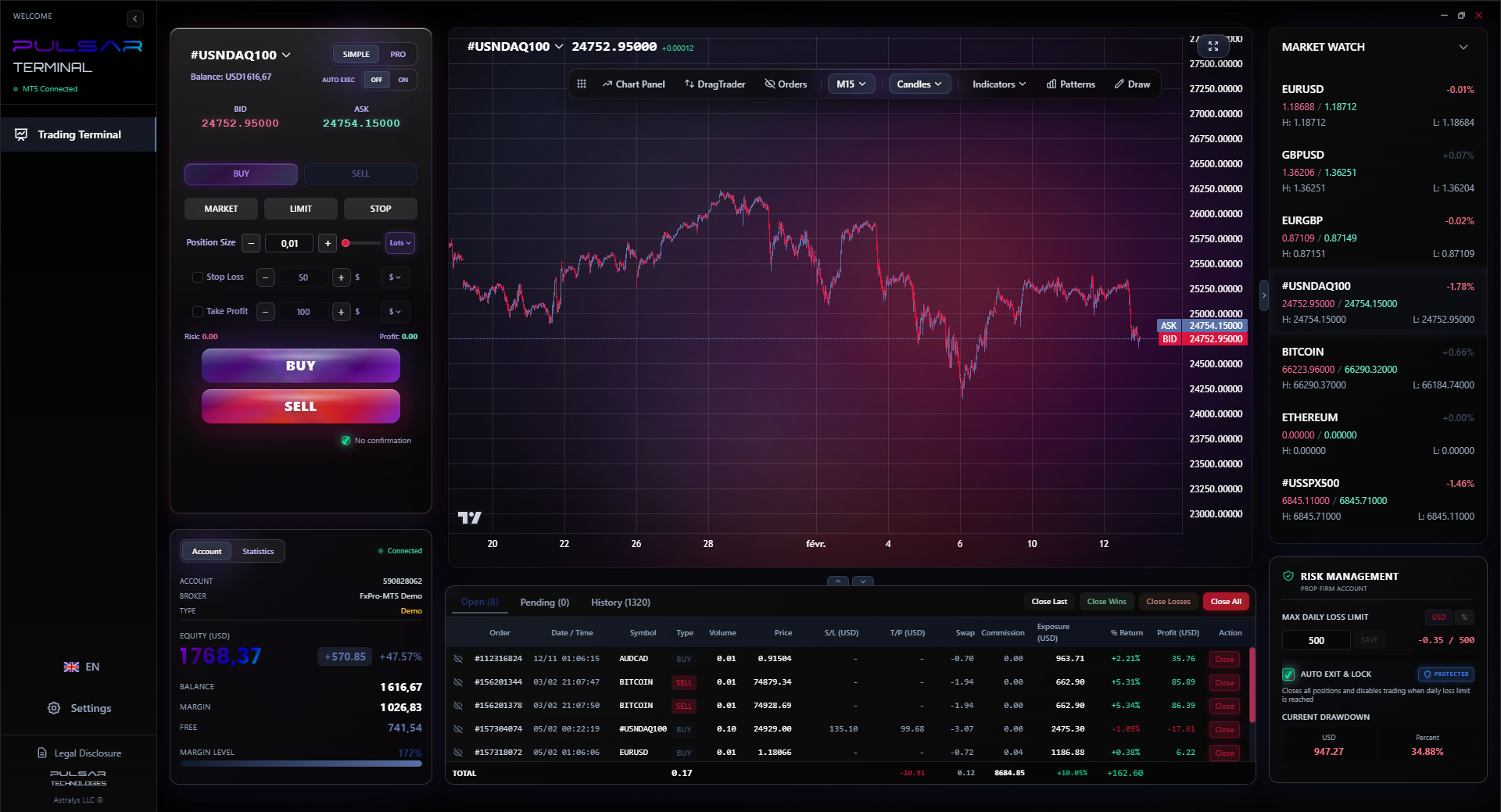
Managing multiple trades and complex exit strategies in a strong trend is where most traders fail; Pulsar Terminal automates this with multi-TP/SL and trailing stops directly on your MT5.
Pulsar Terminal
The all-in-one MT5 companion: drag-and-drop orders, multi-TP/SL, trailing stop, grid trading, Volume Profile, and prop firm protection. Used by 1,000+ traders daily.
You don't need all five indicators on your chart. That's a sure path to confusion and 'analysis paralysis.' Here’s a dead-simple, three-step framework you can start with today:
- Determine the Macro Trend: Use the Daily chart. Is price above or below the 200-period SMA? That's your primary bias. Only look for trades in that direction on lower timeframes.
- Gauge Trend Strength: Switch to the 4-hour chart. Add the ADX. Is it above 25? If yes, the trend is strong enough to trade. If it's below 20, consider sitting out or switching to a range-bound strategy.
- Find an Entry: On the 1-hour chart, use a faster moving average (like the 20 EMA) or a MACD indicator crossover in the direction of your macro trend as a potential entry signal.
Crucial Final Step: Position Sizing. No indicator in the world will save you if your position is too large. A 2% risk on a trade where your stop loss is 50 pips is a completely different beast than a 2% risk on a trade with a 15-pip stop. Always use a position size calculator. In 2019, I got overconfident after three wins in a row. I doubled my usual position on a EUR/USD trade that met all my criteria. The trade went 7 pips in my favor before reversing and hitting my stop. Because my position was doubled, that one loss wiped out the profits from the previous three wins. It was a brutal lesson in math over emotion.
“Your psychology is the final boss.”
Our environment creates unique challenges. Here’s what to watch for:
- Over-optimization: You'll find a setting that worked perfectly on last month's data. It will fail on next week's data. Stick to standard settings (20, 50, 200 for MAs; 14 for ADX). They work because everyone else sees them too, creating collective reaction levels.
- Ignoring Fundamentals: An indicator can't predict a CBN circular or a sudden change in oil prices (which affects the Naira). Before you trade USD/NGN or an oil-related pair like USD/CAD, check the news. A strong technical trend can reverse in seconds on fundamental news.
- Trading in Low-Liquidity Times: The sweet spot for volatility in major pairs like EUR/USD is during the London and New York overlaps. Trading the Naira pairs at 2 AM Lagos time is asking for wide, unpredictable spreads that can trigger your stop loss prematurely.
- Broker Choice: If your broker has unreliable feeds or constantly requotes you during news events, your indicators are useless because the price you see isn't the price you get. Do your homework. Read reviews of brokers like Exness, IC Markets, XM, or Pepperstone to see how they perform for Nigerian clients. Your edge depends on reliable execution.
- Not Accounting for Costs: That 0.6 pip spread on EUR/USD? On a standard lot, that's $6 gone before you even start. If you're scalping for 5-10 pips, that spread is a massive percentage of your profit target. Factor it into your strategy.
💡 Winston's Tip
Think of your ADX as a fuel gauge. A reading above 40 means you're in the fast lane with a full tank. Below 20 means you're idling in traffic. You don't try to drive 120 km/h in a go-slow. Adjust your strategy to the market's available energy.
I've given you the tools. The moving averages to see the path. The ADX to know if the path is a highway or a muddy trail. The MACD to check the engine's momentum. But here's the raw truth no indicator will tell you: your psychology is the final boss.
You will see a perfect trend setup and be too scared to enter. You will enter, and then get scared out by a tiny pullback. You will ignore a clear trend reversal because you're emotionally attached to your position. This happens to everyone.
The indicators provide a objective framework to fight that emotion. They give you rules. 'I only buy when price is above the 200 SMA and the ADX is above 25.' That's a rule. It's not a feeling.
Start simple. Master one or two of these forex trend indicators. Paper trade them first. Then trade with tiny, real money - amounts you can afford to lose completely - just to feel the emotional pressure. The goal isn't to get rich on that capital. The goal is to learn to follow your system without flinching.
The trend is your friend. But you have to be a good friend back. Listen to it. Don't argue with it. And know when it's time to walk away.
FAQ
Q1What is the single best forex trend indicator for beginners in Nigeria?
The 200-period Simple Moving Average (SMA) on the daily chart. It's simple, visual, and provides a clear, objective line to determine the overall market bias. It won't give you precise entries, but it will keep you from making the fatal mistake of trading against the major trend. Start there before adding anything else.
Q2How do I know if a trend is ending?
No indicator calls the exact top or bottom. However, watch for these warnings: 1) A sharp, sustained break of a key moving average (like the 50 EMA) against the trend. 2) Bearish or bullish divergence on the MACD or RSI, where price makes a new extreme but the indicator doesn't. 3) The ADX starting to fall from a high level (above 40), indicating the strong trend momentum is fading. These are signals to tighten stops or take profits, not necessarily to reverse your position immediately.
Q3Can I use these indicators on USD/NGN?
Yes, but with extreme caution. The USD/NGN pair is heavily influenced by CBN policies, forex supply, and oil prices, which can cause sudden, gap-like moves that ignore technical indicators. Use longer timeframes (daily, weekly) and give more weight to fundamental context. A trend on the USD/NGN chart can be more about policy than pure market sentiment.
Q4Why do my indicators give different signals on different timeframes?
This is normal and reflects market structure. The 200 SMA might be bullish on the daily chart (long-term trend up), but the 20 EMA could be bearish on the 1-hour chart (short-term pullback). This is why you must analyze from the top down. Always determine your bias from the higher timeframe first, then use the lower timeframe to fine-tune your entry in the direction of that larger trend.
Q5What settings should I use for the ADX?
The default period of 14 works well for most timeframes. The key number to watch is the ADX line value, not the +DI or -DI lines for direction. Focus on whether the ADX is above 25 (trending) or below 20 (ranging). Changing the period just makes the line more or less sensitive; stick with 14 until you deeply understand what it's telling you.
Q6Is it profitable to trade against the trend?
It can be, but it's a high-skill, high-risk strategy known as 'fading' or counter-trend trading. For 95% of traders, especially beginners, it's an account-destroying habit. Your odds are statistically better trading with the trend. Master trend-following first. If you want to explore counter-trend moves later, do it with very small size and strict rules, like only at major support/resistance levels with clear reversal candlestick patterns.
Q7How do I handle a ranging market when my indicators are for trends?
First, identify it using the ADX (below 20) and price bouncing between clear horizontal levels. Then, stop using your trend-following indicators. They will give false signals. Switch to a range-bound strategy: buy near identified support, sell near identified resistance. Use oscillators like the RSI to help identify overbought/sold conditions within the range. The most important skill is knowing when your trend system doesn't apply and having the discipline to switch or stay out.
Prof. Winston's Lesson
Key Takeaways:
- ✓Use the 200 SMA for your primary bias.
- ✓Only trade trend signals when ADX > 25.
- ✓MACD divergence warns of weakening momentum.
- ✓Risk a maximum of 2% per trade, always.
How useful was this article?
Click a star to rate
Weekly Trading Insights
Free weekly analysis & strategies. No spam.
About the Author
Olumide Adeyemi
West African Trading Pioneer
One of Nigeria's most active forex trading educators. 8 years of experience trading from Lagos. Specializes in low-capital strategies and prop firm challenges for African traders.
Comments
Risk Disclaimer
Trading financial instruments carries significant risk and may not be suitable for all investors. Past performance does not guarantee future results. This content is for educational purposes only and should not be considered investment advice. Always conduct your own research before trading.
You Might Also Like

Cara Trading Forex Sukses: 7 Prinsip dari Trader Profesional
Cara trading forex sukses dengan 7 prinsip trader pro: manajemen modal, disiplin, journal trading, backtest. Data nyata, bukan janji profit palsu.
Jam Trading Forex Terbaik untuk Trader Indonesia: Panduan Lengkap dengan Tabel Waktu
Panduan jam trading forex untuk trader Indonesia. Tabel 4 sesi dunia, jam emas 20:00-00:00, sesi mana yang harus dihindari. Data akurat + tips dari trader berpengalaman.
Top 5 Sàn Forex Uy Tín Nhất 2026: Review Jujur dari Trader Indonesia
Top 5 sàn forex uy tín 2026 untuk trader Indonesia. Review jujur: spread, deposit, withdraw, dukungan lokal. Exness, XM, IC Markets & lebih.
Get Pulsar Terminal
All these calculators are built into Pulsar Terminal with real-time data from your MT5 account. One-click position sizing, automatic risk management, and instant calculations.
Get Pulsar Terminal