


How many times have you drawn a perfect trendline, only to watch the price smash right through it? You're not alone.

Olumide Adeyemi
West African Trading Pioneer ·  Nigeria
☕ 11 min read
What you'll learn:
- 1What Exactly Is a Trendline (And What It Isn't)
- 2How to Draw Trendlines Correctly (The Nigerian Market Context)
- 3Entry and Exit Strategies: Turning Lines into Profit
- 4Common Mistakes Nigerian Traders Make (I Made Them All)
- 5Supercharging Your Strategy: Combine with These Tools
- 6Managing Risk and Psychology: The Naija Trader's Mindset
- 7Choosing the Right Broker in Nigeria: Regulations & Costs
How many times have you drawn a perfect trendline, only to watch the price smash right through it? You're not alone. I've been there, staring at the screen in my Lagos apartment, convinced my line was gospel. The truth is, a forex trendline trading strategy isn't about finding magic lines. It's about understanding market psychology and using simple tools to stack probabilities in your favour. Let me walk you through what I've learned over 12 years, including the expensive mistakes, so you can build a strategy that actually works for the Naira trader.
Let's get this straight from the start. A trendline is not a prediction. It's a visual representation of market sentiment over time. Think of it like drawing a support or resistance level, but at an angle.
In an uptrend, you connect the swing lows. The line acts as dynamic support - buyers keep stepping in at higher prices. In a downtrend, you connect the swing highs. That line becomes dynamic resistance - sellers keep pushing the price down from lower peaks.
I used to make this classic mistake: I'd force a line to fit. If I needed three touches, I'd ignore a clear spike and connect the dots that suited my bias. The market doesn't care about my bias. A valid trendline needs at least two clear touches (the more, the better), and the price should respect it, not just glance off it.

Warning: A trendline drawn on a 1-minute chart means almost nothing. The higher the timeframe, the more significant the line. A trendline on the 4-hour or daily chart carries real weight because it represents the consensus of bigger players, not just noise.
The real power of a forex trendline trading strategy comes from combining it with other elements. A line by itself is just a line. But a line that coincides with a key Fibonacci level, or a previous support/resistance zone? That's where you find high-probability setups.

💡 Winston's Tip
A trendline is a story of crowd psychology. The more times it's tested and holds, the more traders believe in it. Your job is to spot when that belief is about to change.
“A trendline is not a prediction. It's a visual representation of market sentiment over time.”
The Two-Touch Minimum Rule
You need at least two clear touches to draw a line. The third touch confirms its validity. When drawing an uptrend line, always use the lowest points of the candlestick wicks that mark the swing lows. For a downtrend, use the highest points of the wicks at the swing highs. Don't cut through bodies; that's a messy line the market won't respect.
Timeframe Hierarchy
Your analysis should flow from top down. Start with the daily chart to identify the major trend. Then drop to the 4-hour to find your trading trend within that. Finally, use the 1-hour or 15-minute for precise entry. If the daily chart shows a strong downtrend in GBP/NGN (yes, some brokers offer Naira pairs), but your 1-hour chart shows a tiny uptrend line, which one do you think will win? Trade with the higher timeframe trend.
A Real Example from My Trading Journal
Back in 2021, I was watching USD/NGN (offshore) on the daily chart. I drew an uptrend line connecting the lows from March to July. The price touched it perfectly three times. On the fourth approach in August, it broke cleanly below. That wasn't just a break; it was a signal that the fundamental pressure on the Naira was shifting. I didn't trade the spot pair directly, but that break informed my trades on USD-correlated majors like EUR/USD. The lesson? A trendline break on a major chart can be a powerful macro clue.

Pro Tip: Use a semi-transparent line. A thick, solid line can obscure price action. A thin, slightly see-through line lets you see the candles beneath it, helping you spot rejections or closes beyond the line more clearly.
“The real power of a forex trendline trading strategy comes from combining it with other elements.”
Here's where the rubber meets the road. Drawing is one thing; making money is another.
1. The Pullback Entry (My Personal Favourite) This is the core of my forex trendline trading strategy. Wait for the price to pull back to the trendline in an established trend. Don't buy or sell the exact touch. Wait for confirmation - a bullish engulfing candle for an uptrend, or a bearish engulfing for a downtrend. Place your entry just above (for buys) or below (for sells) that confirmation candle.
Example Trade: EUR/USD in a clear 4-hour uptrend. Price pulls back to the trendline and forms a nice bullish pin bar. I enter long at 1.0850, just above the pin bar's high. My stop loss goes just below the trendline and the recent swing low at 1.0820 (30 pips risk).
2. The Breakout/Breakdown Entry When a strong trendline finally breaks, it can signal a trend reversal or a major pause. The key is to avoid false breaks. I wait for the price to close beyond the trendline on my chosen timeframe (a 4-hour close is strong). Then, I wait for a retest of the broken trendline from the other side. That retest becomes the new resistance (in a breakdown) or support (in a breakout). Enter on the rejection from that retest.
Setting Stop Losses and Take Profits Your stop loss must be placed where your trade idea is invalidated. For a pullback to an uptrend line, that's below the line and the recent swing low. Never place your stop on the trendline; market noise will take you out.
For take profits, I use a multi-target approach. Target 1: the recent swing high. Target 2: a measured move using the height of the previous wave. I'll close half or a third at Target 1 and move my stop to breakeven. This is where a tool like a position size calculator is non-negotiable. If my stop is 40 pips away, I calculate my lot size so I'm only risking 1% of my account. No guesswork.
I learned this the hard way. In 2019, I caught a beautiful pullback to a downtrend line on Gold (XAU/USD). I got greedy, didn't take partial profit, and left my stop far away. A sudden reversal wiped out all my gains and hit my stop. A 150-pip win turned into a 20-pip loss. Don't be like old me.
💡 Winston's Tip
Never trust a trendline in isolation. Its true power is revealed in confluence. A line that aligns with a Fibonacci level and a 200-period moving average is a fortress. A lone line is just a stick in the sand.
“The real power of a forex trendline trading strategy comes from combining it with other elements.”
Let's be brutally honest about the pitfalls, especially in our market.
1. Ignoring the Spread on Exotic Pairs. You see a beautiful trendline on GBP/NGN. The spread might be 50 pips or more on some brokers. Your clever 30-pip profit target is dead on arrival. Always factor in the spread definition before entering. Stick to majors (EUR/USD, GBP/USD) or minors with tight spreads for trendline strategies, especially if you're scalping.
2. Over-leveraging on a "Sure Thing." A tested trendline feels like a sure bet. It's not. I once put 5% of my account on a "perfect" trendline bounce. A fake news spike blew through it, and I got a margin call. The trendline held an hour later, but I was already out. use is a tool, not a weapon. Use it like you would a sharp knife - with respect.
3. Trading Against the Higher Timeframe Trend. This is the #1 account killer. The daily chart shows USD strength crushing everything. The 1-hour chart shows a cute little uptrend line on EUR/USD. You go long. The daily trend eats your lunch. Always, always know the higher timeframe direction. A swing trading mindset helps here.
4. Not Accounting for News. The CBN makes a policy announcement. MPC meeting minutes are released. US NFP data drops. These events render all technical levels, including your beautiful trendline, temporarily irrelevant. Know the economic calendar. If major news is due, step away or widen your stops dramatically.
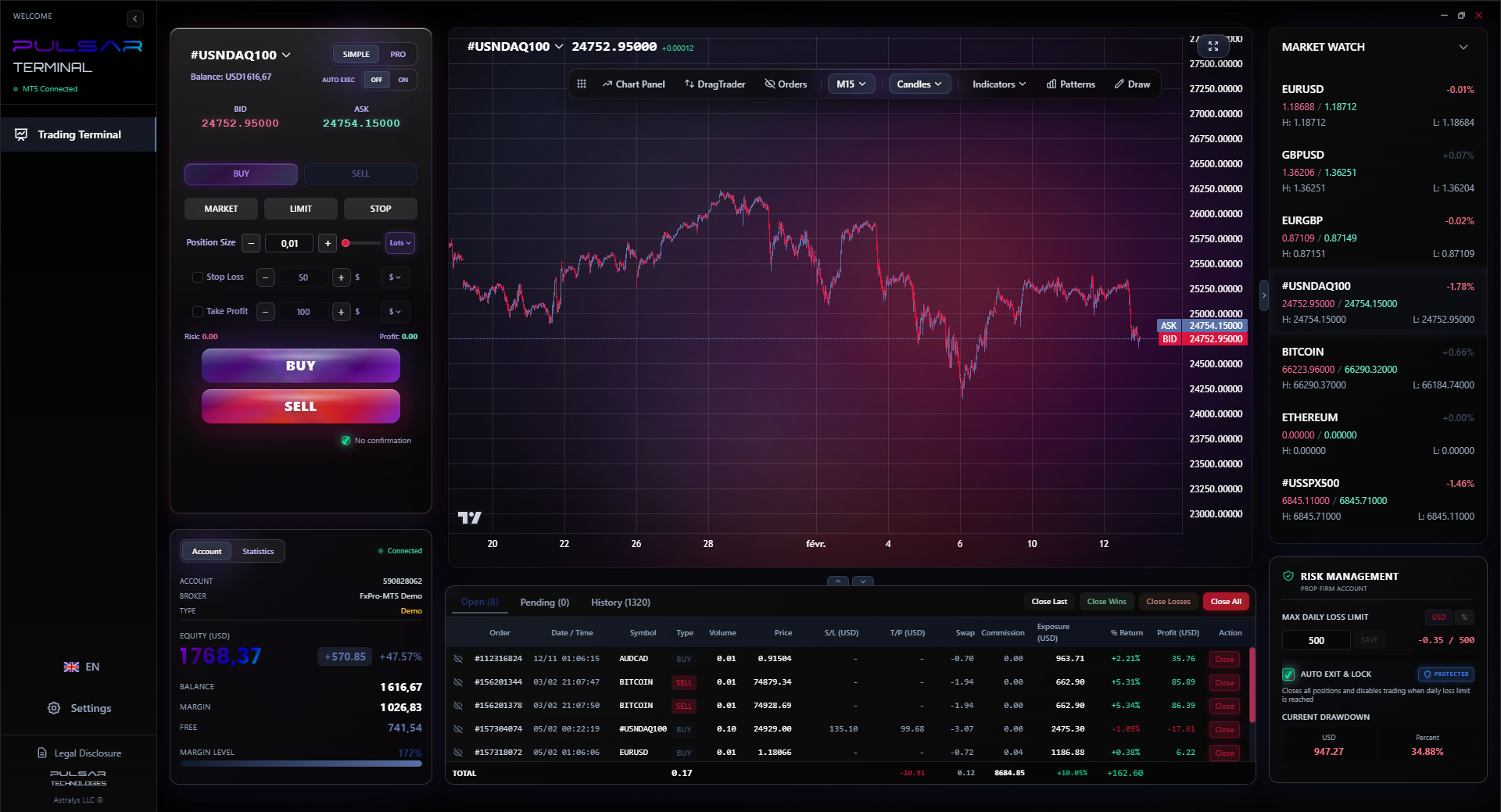
Managing multiple take-profit levels and moving stops to breakeven manually is stressful; Pulsar Terminal automates this with one-click order templates directly on your MT5 chart.
Pulsar Terminal
The all-in-one MT5 companion: drag-and-drop orders, multi-TP/SL, trailing stop, grid trading, Volume Profile, and prop firm protection. Used by 1,000+ traders daily.
“Strategy is 20%. Risk management and psychology are 80%.”
A trendline alone is a soldier. A trendline with an army is a force. Here’s how to build your army.
Trendlines + Horizontal Support/Resistance This is powerful confluence. When a rising trendline meets a major historical horizontal resistance level, you have a decision zone. The price will often respect one or the other. If both break, the move is usually explosive. Look for these zones on your chart.
Trendlines + Momentum Indicators I use the RSI indicator or MACD indicator for confirmation. In an uptrend pullback to the trendline, I want to see RSI also pulling back towards 40-50 (not oversold below 30), showing the bullish momentum is just pausing. If RSI is already oversold at the trendline, the trend might be weaker than it looks.
Trendlines + Fibonacci Retracement Draw your Fib retracement from the start of the trend wave to the end. The 50% and 61.8% retracement levels often align beautifully with a trendline. If the price finds support at the 61.8% Fib level and the trendline simultaneously, that’s a high-quality signal.
| Tool | How It Helps | What to Look For |
|---|---|---|
| Horizontal S/R | Identifies key price floors/ceilings | Trendline intersecting a horizontal level |
| RSI (Settings: 14) | Gauges momentum strength | RSI holding above 40 in an uptrend pullback |
| Fibonacci | Finds natural retracement zones | Trendline coinciding with 50% or 61.8% level |
A real trade: On AUD/USD, I saw an uptrend line meeting the 61.8% Fib retracement. The RSI was at 45. That was a triple-confluence buy signal. It worked like a charm. The tools don't guarantee a win, but they massively increase your odds.
💡 Winston's Tip
The most expensive lesson? A broken trendline doesn't mean 'reverse immediately.' It means 'the previous trend's engine has stalled.' Wait for the new car to arrive before you hop in.
“Strategy is 20%. Risk management and psychology are 80%.”
Strategy is 20%. Risk management and psychology are 80%. I'm serious.
The 1% Rule is Your Lifeline. Never, ever risk more than 1% of your trading capital on a single trade. With a $500 account, that's $5. If your stop loss is 25 pips away, your position size calculator tells you to trade a micro lot (0.01). This rule lets you survive a losing streak. Ten losses in a row? You're down 10%, not 50%. You live to fight another day.
Dealing with False Breaks. They will happen. The price will break your trendline, trigger your stop, and then reverse back in the original direction. It's infuriating. My solution? I use a "close filter." I only consider a break valid if the price closes beyond the trendline on my timeframe. For extra safety, I might wait for two consecutive closes. This filters out most false spikes.
Patience is a Currency. In Lagos, everything moves fast. The market doesn't. The best trendline setups might only appear 2-3 times a week on the 4-hour chart. If you're forcing trades every day, you're trading noise. Wait for the market to come to you. Set price alerts at your trendline levels and walk away. Go watch a football match. When the alert hits, then analyze.
Keep a Trading Journal. Write down every trade: the chart timeframe, why you took it (e.g., "pullback to daily trendline + 61.8% Fib"), your entry, stop, target, and your emotional state. Review it weekly. You'll quickly see if you're deviating from your forex trendline trading strategy and making emotional decisions.
“In Lagos, everything moves fast. The market doesn't.”
Your strategy is only as good as your broker's execution. Here’s the lay of the land post-ISA 2025.
The new Investments and Securities Act (ISA) 2025 is a game-changer. It requires any platform offering forex trading in Nigeria to register with the SEC. This is for your protection. While many of us still use internationally regulated brokers for their better conditions, the legal landscape is shifting. Always prioritize brokers with strong international regulation (like FCA, ASIC, CySEC) as a minimum safety net.
Key Costs for Nigerian Traders:
- Spreads: This is your main cost. For a trendline strategy where you might target 50-80 pips, a 2-pip spread eats a huge chunk. Look for brokers with tight spreads on majors. Exness and XM often have EUR/USD spreads under 0.5 pips on certain accounts. IC Markets and Pepperstone are also excellent for low-cost ECN execution.
- Commissions: Some low-spread accounts charge a commission (e.g., $3.50 per lot). Factor this into your profit targets.
- Capital Gains Tax: Remember, the FIRS expects 10% tax on your trading profits. Keep clean records.
- Minimum Deposit: You can start small. Brokers like XM allow deposits as low as $5. But be realistic. To trade a proper trendline strategy on the 4-hour chart with sensible stops, I'd recommend a starting capital of at least $200-$500. Trading with $10 and 1:500 use is a recipe for a quick blow-up.
Deposits and Withdrawals: Use brokers that support local bank transfers or fintechs like Flutterwave. It makes life easier. Check for any hidden fees on their end or from your bank.
FAQ
Q1Is forex trendline trading legal in Nigeria?
Yes, forex trading is legal for individuals in Nigeria. The regulatory environment is evolving, with the new ISA 2025 Act requiring platforms to register with the SEC. For safety, Nigerian traders should use brokers regulated by reputable international authorities like the FCA or ASIC.
Q2What is the best timeframe for drawing trendlines?
For a reliable forex trendline trading strategy, start with the daily chart to identify the primary trend. Then use the 4-hour chart for your main trading trendlines. The 1-hour chart can be used for finer entry details. Avoid relying solely on trendlines from very low timeframes (like 1-minute or 5-minute) as they are prone to false signals.
Q3How many touches are needed for a valid trendline?
You need a minimum of two clear touches to draw a trendline. The third touch confirms its strength and validity. The more times the price respects the trendline (touches and bounces), the more significant it becomes for future trading decisions.
Q4How do I avoid false trendline breakouts?
To filter false breaks, don't act on a simple spike. Wait for the price to close beyond the trendline on your chosen timeframe (e.g., a 4-hour candle close). For even more confirmation, wait for the price to retest the broken trendline from the other side and get rejected before entering a trade.
Q5What should I do if my trendline is broken?
First, if you're in a trade, your stop loss should already be placed (just beyond the trendline). If you're not in a trade, a break doesn't mean instant reversal. It means the trend's momentum has paused or reversed. Step back. Wait for a new structure to form - like a lower high in an uptrend break - or for a retest of the broken line before considering a trade in the new direction.
Q6Can I use trendlines for scalping?
You can, but it's tricky. Trendlines on very short timeframes (like 1 or 5 minutes) are less reliable due to market noise. If you want to try scalping with trendlines, use them on a slightly higher timeframe (like the 15-minute) to define the intraday trend, and then use price action on the 1 or 5-minute for entries. Always account for wider spreads on lower timeframes.
Q7How much money do I need to start trendline trading?
While some brokers allow accounts with $1, I strongly advise starting with at least $200-$500. This allows you to trade proper lot sizes (like 0.01 or 0.02 lots) while adhering to the 1% risk rule. With a $50 account, the math of risk management becomes nearly impossible, forcing you to over-use.
Prof. Winston's Lesson
Key Takeaways:
- ✓Two touches draw it, three confirm it.
- ✓Trade with the higher timeframe trend, always.
- ✓Risk a maximum of 1% per trade, no exceptions.
- ✓A close beyond the line beats a wick every time.
- ✓Confluence with Fib or S/R zones boosts probability by 60%.
How useful was this article?
Click a star to rate
Weekly Trading Insights
Free weekly analysis & strategies. No spam.
About the Author
Olumide Adeyemi
West African Trading Pioneer
One of Nigeria's most active forex trading educators. 8 years of experience trading from Lagos. Specializes in low-capital strategies and prop firm challenges for African traders.
Comments
Risk Disclaimer
Trading financial instruments carries significant risk and may not be suitable for all investors. Past performance does not guarantee future results. This content is for educational purposes only and should not be considered investment advice. Always conduct your own research before trading.
You Might Also Like

Cara Trading Forex Sukses: 7 Prinsip dari Trader Profesional
Cara trading forex sukses dengan 7 prinsip trader pro: manajemen modal, disiplin, journal trading, backtest. Data nyata, bukan janji profit palsu.
Jam Trading Forex Terbaik untuk Trader Indonesia: Panduan Lengkap dengan Tabel Waktu
Panduan jam trading forex untuk trader Indonesia. Tabel 4 sesi dunia, jam emas 20:00-00:00, sesi mana yang harus dihindari. Data akurat + tips dari trader berpengalaman.
Top 5 Sàn Forex Uy Tín Nhất 2026: Review Jujur dari Trader Indonesia
Top 5 sàn forex uy tín 2026 untuk trader Indonesia. Review jujur: spread, deposit, withdraw, dukungan lokal. Exness, XM, IC Markets & lebih.
Get Pulsar Terminal
All these calculators are built into Pulsar Terminal with real-time data from your MT5 account. One-click position sizing, automatic risk management, and instant calculations.
Get Pulsar Terminal