


You see the flashy cars and the '7-figure' screenshots.

Olumide Adeyemi
West African Trading Pioneer ·  Nigeria
☕ 12 min read
What you'll learn:
- 1The Legal Reality: Trading Isn't a Crime, But Funding Is Tricky
- 2The Real Numbers: What It Actually Costs to Start
- 3Picking Your Broker: Regulation, Deposits, and Survival
- 4The Tycoon Mindset: It's a Business, Not a Casino
- 5Strategy & Execution: What Works on Naija Time?
- 6Advanced Tools for Managing Risk & Scaling Up
- 7Pitfalls to Avoid: How the 'Tycoon' Dream Dies
- 8Your First Steps on the Real Path
You see the flashy cars and the '7-figure' screenshots. You want a piece of it. But how do you actually become a forex tycoon from Nigeria without getting scammed, blocked by your bank, or just blowing up your account? Let's cut through the noise. I've traded here for over a decade, watched regulations change, and seen countless 'gurus' come and go. This isn't about getting rich quick. It's about building something real, legally, and without losing your shirt in the process.
First thing first: forex trading is legal in Nigeria. The Central Bank of Nigeria (CBN) and the Securities and Exchange Commission (SEC) are the main watchdogs. But here's where it gets messy for you, the retail trader.
You're not breaking any law by opening an account with an international broker like Exness or IC Markets. The problem is getting your money to them. The CBN has strict controls on using Naira cards for international transactions. You'll hit limits fast, and your bank might just block the attempt.
The workaround? A domiciliary account. It's a dollar account with a Nigerian bank. You fund it (through official channels or the ever-present black market), then transfer from there to your broker. It's not seamless, but it's the most reliable method. E-wallets like Skrill and Neteller also work, but their fees add up.

Warning: Any 'broker' or 'investment manager' based in Nigeria asking you to send Naira directly to them for forex trading is a massive red flag. The SEC constantly warns against these unlicensed schemes. If they promise guaranteed returns, run. Soliciting public funds to trade without a fund manager license is illegal. Protect your capital.
Remember, your trading profits are subject to a 10% Capital Gains Tax payable to the FIRS. No one likes it, but it's the law. A real forex tycoon keeps clean books.
Forget the N50,000 starter pack nonsense. Let's talk real money. Your costs aren't just your initial deposit.
Broker Spreads & Commissions
This is your biggest ongoing cost. Look at the EUR/USD pair, the most traded market in the world. Here’s what you're really paying on different brokers popular in Nigeria:
| Broker | Account Type | Avg. EUR/USD Spread | Key Note for Nigerians |
|---|---|---|---|
| Exness | Raw Spread | 0.1 - 0.2 pips | Low minimum deposit, popular here. |
| FP Markets | Raw ECN | 0.0 pips + $6 commission per lot | True ECN pricing, tight but with a fee. |
| XTB | Standard | 0.92 pips | Strong regulation, $0 min deposit. |
| OctaFX | Variable | From 0.7 pips | Well-known in the region. |
| HF Markets | Cent Account | From 1.4 pips | Good for practicing with tiny risk. |
A pip on EUR/USD is worth about $10 on a standard lot. If your spread is 1 pip, the trade is already $10 in the hole when you enter. You need the market to move that much just to break even. This is why scalping strategies demand razor-thin spreads.
The Hidden Tax: Slippage & Rejections
During major news events (like CBN announcements), spreads can widen violently from 1 pip to 50 pips in a blink. Your stop-loss might get filled at a much worse price than you set. That's slippage. On some brokers, your market order might just get rejected. This isn't theoretical. I lost NGN 120,000 on a GBP/USD trade during a Brexit vote because my stop was 30 pips away from where it actually executed.
Education & Tools
You don't need a NGN 4 million course. Most of that content is repackaged free information. Start with free resources, then maybe invest in a solid position size calculator tool or a reputable book. Your biggest educational cost will be the money you lose learning. Budget for that.

💡 Winston's Tip
Your first NGN 100,000 profit will feel incredible. Your first NGN 100,000 loss will teach you ten times more. Don't run from the lesson.
“The problem isn't trading being illegal, it's getting your money to the broker.”
Choosing a broker in Nigeria isn't about who has the flashiest ads on Instagram. It's about who will hold your money safely and execute your trades fairly when the market goes crazy.
Regulation is Your Safety Net: You want a broker regulated by a reputable foreign authority (like CySEC in Cyprus, ASIC in Australia, or the FCA in the UK). Why? Because they enforce rules like client fund segregation. This means your money is kept in separate bank accounts from the broker's operating funds. If the broker goes bankrupt, your capital is protected. Brokers like Pepperstone and XM operate under such frameworks.
Funding and Withdrawal Ease: This is the Nigerian-specific headache. Test the withdrawal process with a small amount first. How long does it take to get your money back to your domiciliary account? 24 hours? 5 business days? A good broker processes withdrawals within a day. A bad one makes excuses. Also, check if they accept direct bank transfers in USD to/from Nigerian domiciliary accounts. It's often cheaper than e-wallets.
Trading Conditions: Match the broker to your style. If you're a scalper, you need that raw 0.0 pip spread account (even with a commission). If you're a swing trader holding trades for days, a slightly wider spread on a commission-free account might be more economical. Don't just look at the headline 'tight spreads' - read the fine print on commissions.

Pro Tip: Open demo accounts with 2-3 shortlisted brokers. Trade them simultaneously during a volatile session (like when US jobs data drops). See whose platform holds up, whose spreads stay relatively stable, and whose execution feels instant. This test tells you more than any review website.
This is where dreams die. A forex tycoon thinks like a business owner, not a gambler at a slot machine. Your trading capital is your business capital. Your job is to preserve it and grow it steadily.
Risk Management is Non-Negotiable: I don't care how good your signal is. You never, ever risk more than 1-2% of your account on a single trade. Let me give you a brutal example from my early days. I had a NGN 500,000 account. I was 'sure' the Naira would weaken further against the dollar. I put on a huge USD/NGN trade, risking about 10% of my account. A surprise CBN intervention shot the price against me. I lost NGN 50,000 in minutes. That single loss took me weeks of disciplined trading to recover from. Use a position size calculator for every single trade. No exceptions.
Emotional Discipline: The market doesn't care about your rent, your bills, or your need to 'make back' yesterday's loss. Trading out of desperation is a guaranteed path to a margin call. Have a written trading plan. Define your entry, your stop-loss, and your take-profit before you click buy. Then stick to it. The plan is the boss.
Focus on Process, Not Profits: Your goal for the day shouldn't be 'make NGN 100,000'. It should be 'execute my plan flawlessly'. Did you take all your set-ups? Did you respect your risk limits? Did you avoid impulsive trades? If you did, you had a successful day, even if you ended down a small amount. The profits come as a byproduct of a good process over time.
“Your goal for the day shouldn't be 'make NGN 100,000'. It should be 'execute my plan flawlessly'.”
Nigeria's time zone (WAT) actually gives us a unique advantage. The London session (8 AM - 5 PM our time) is the most liquid forex session. You can trade it fully during the day. The US session kicks off around 1:30 PM our time, so we get a good overlap in the afternoon.
For Beginners: Start with Swing Trading Trying to scalp the 1-minute chart as a newbie is a recipe for stress and losses. Swing trading, holding trades for several days, is more forgiving. You can use the daily or 4-hour charts. Look for clear trends using simple tools. A classic method is using the MACD indicator to spot trend direction and momentum, and the RSI indicator to find potential entry points when the market is overbought or oversold within that trend.
My Personal Go-To Setup I look for a strong trend on the daily chart for a pair like EUR/USD or XAU/USD (gold). Then, I drop to the 4-hour chart and wait for a pullback to a key moving average (like the 50-period EMA). I wait for the RSI to dip below 30 (oversold in an uptrend) or above 70 (overbought in a downtrend) and then start to turn back. That's my potential entry signal. My stop-loss goes just below the recent swing low (for a long trade).
Example Trade: In early 2023, I saw EUR/USD in a clear daily uptrend. On the 4-hour, it pulled back to the 50 EMA. The RSI hit 28 and curled up. I entered at 1.0725. My stop was at 1.0680 (45 pips risk). My first profit target was 1.0820. I moved my stop to breakeven when price hit 1.0770, and the trade eventually ran to 1.0950. That's the swing trade patience game.
The Infrastructure Hurdle: You need reliable, fast internet and a stable power supply. A generator or inverter isn't a luxury, it's a necessary business tool. You can't have your screen go dark during a trade.
💡 Winston's Tip
If you can't explain your trade setup in one simple sentence, you don't have a strategy. You have a hope.
Once you're consistently profitable with a small account, scaling up is the next challenge. This is where advanced order management separates the pros from the hopefuls.
Why Basic MT4/MT5 Isn't Enough: The native platforms are clunky for managing multiple trades. Manually moving stop-losses to breakeven, or setting multiple take-profit levels, is slow and error-prone. In a fast market, that's money left on the table or extra risk taken.
The Power of Partial Closures & Trailing Stops: Let's say you buy GBP/USD. Instead of one all-or-nothing take-profit, you set three. Close 50% of your position at a 30-pip profit, 30% at 50 pips, and let the final 20% run with a trailing stop. This books profit early and lets you ride a big trend. A trailing stop automatically moves your stop-loss up as the price moves in your favor, locking in profits. Doing this manually on 5 open trades is a nightmare.
Grid Trading in Ranging Markets: In a sideways market, you can place a series of buy orders at lower levels and sell orders at higher levels, creating a 'grid'. Each order has its own small profit target. It's a more advanced, mechanical style that requires precise tools to manage the basket of orders.

Example: You have a $10,000 account. You use a grid strategy on EUR/USD, which is stuck between 1.0850 and 1.0950. You place 10 buy orders every 10 pips down from 1.0900, and 10 sell orders every 10 pips up from 1.0900. Each trade risks 0.5% ($50). The tool automatically closes each trade for a 5-pip profit. When the price chops around, it can harvest small, consistent gains. But if the price breaks out strongly in one direction, you need a strong safety stop on the entire grid to prevent a large loss. This isn't for beginners.
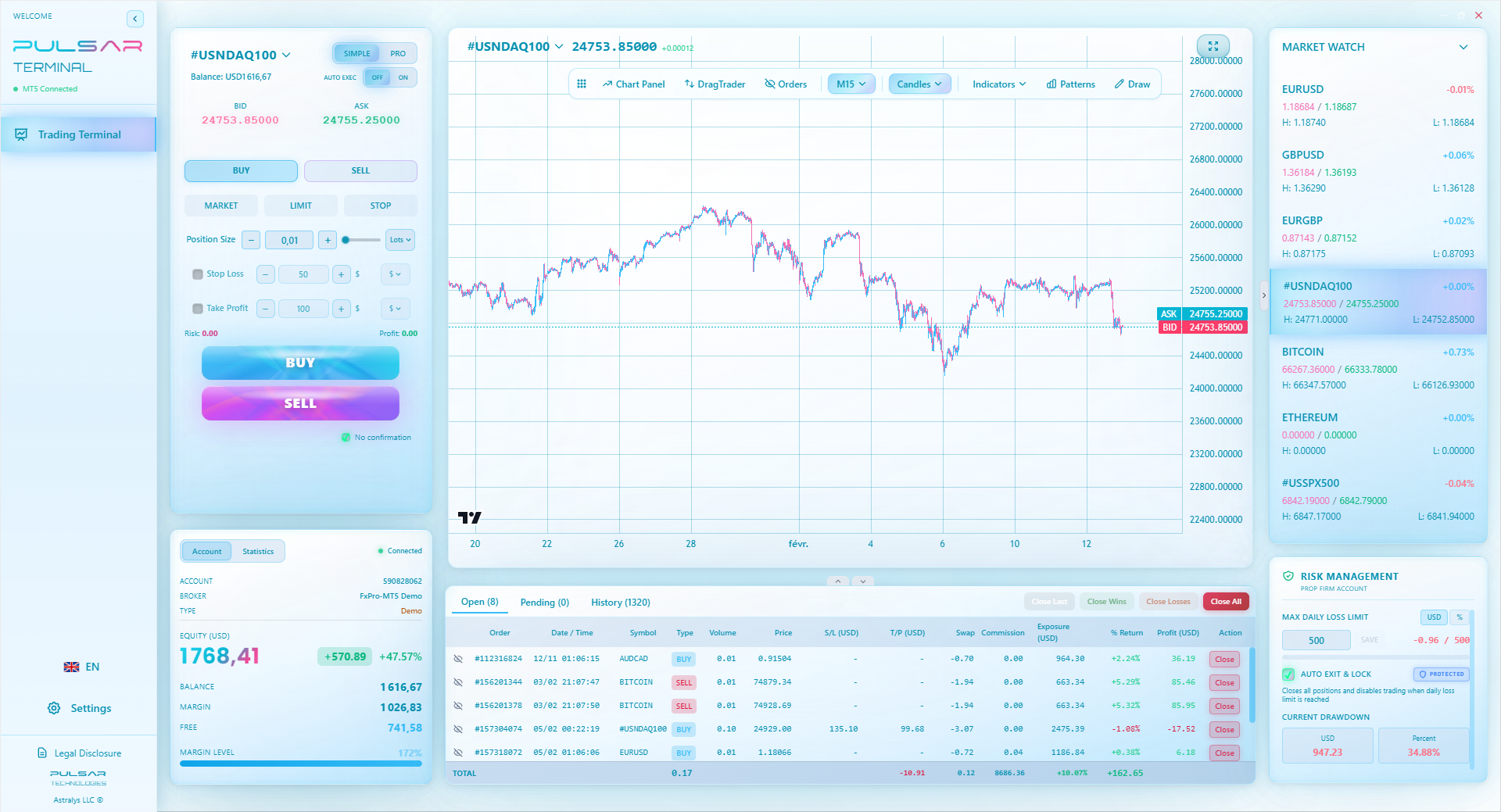
Managing complex strategies like grids and multiple take-profit levels manually is a headache; Pulsar Terminal automates all of this directly on your MT5 platform.
Pulsar Terminal
The all-in-one MT5 companion: drag-and-drop orders, multi-TP/SL, trailing stop, grid trading, Volume Profile, and prop firm protection. Used by 1,000+ traders daily.
“The forex tycoon path is lined with screens, self-doubt, and the relentless discipline to keep following your plan.”
I've made these mistakes. My students have made them. Let's save you the pain and money.
1. Chasing the 'Holy Grail' Indicator: There isn't one. Spending all your time searching for a magic setting on the RSI or buying expensive 'algorithm' signals is a distraction. Master one simple strategy. Understand its win rate and risk/reward. I wasted two years and a lot of money jumping from one fancy indicator to the next.
2. Overtrading: This is the silent killer. You're bored, the market is slow, so you take a low-probability trade just to be in the action. Or worse, you start revenge trading after a loss to 'get it back now'. This destroys discipline. Sometimes the best trade is no trade. Go watch a movie instead.
3. Ignoring Macro-Economics: You're trading currencies. What the CBN says about interest rates matters. What the Fed says matters. Global oil prices matter for the Naira. You don't need a PhD, but you need to know the weekly calendar. Trading blind into a major central bank announcement is like driving with your eyes closed.
4. Underestimating the Psychological Grind: This is a lonely, stressful business. You will have losing weeks, maybe losing months. Your family won't understand. You'll doubt yourself. The forex tycoon path isn't lined with Lamborghinis, it's lined with screens, self-doubt, and the relentless discipline to keep following your plan when it feels like it's not working. Build a support network, even if it's just one other serious trader you can talk to.
💡 Winston's Tip
The market's job is to find the most efficient way to prove you wrong. Your job is to have a plan for when it does.
So, you're still reading. Good. That means you're serious. Here's your action plan, in order.
- Education First, Money Later: Spend a month on a demo account. Not playing, but seriously testing one strategy. Record every trade in a journal. Why did you enter? Where was your stop? What was the outcome? Your goal is to make the demo account feel real, to feel the sting of a simulated loss.
- Get Your Finances in Order: Open a domiciliary account if you don't have one. Understand the process of funding it. Start saving your trading capital separately from your living expenses. Your first deposit should be money you can afford to lose 100% of without affecting your life.
- Choose One Broker: Based on your trading style (start with swing trading), pick one regulated broker from the list above. Open a live account with the minimum deposit. This makes it real. The goal of your first NGN 100,000 account is not to get rich. It's to survive for 6 months without blowing it up. That's a huge win.
- Implement Brutal Risk Management: Before you place your first real trade, set a hard rule. You will never risk more than 1% of your account. Use the calculator. Place your stop-loss order immediately after your entry. This is non-negotiable.
- Review and Adapt: At the end of each week, review your journal. What patterns do you see? Are you breaking your rules? Are you avoiding your set-ups? Adjust your behavior, not your strategy, every week.
The forex tycoon title isn't given, it's earned through thousands of small, correct decisions. It's a marathon of discipline. Now, go put in the work.
FAQ
Q1Is forex trading illegal in Nigeria?
No, it is not illegal. Trading with international brokers is legal. The complexity lies in funding your account due to CBN restrictions on international transfers using Naira cards. Using a domiciliary account is the standard legal workaround.
Q2How much money do I need to start forex trading in Nigeria?
You can start with as little as $10 (about NGN 15,000) on some brokers. However, I strongly advise starting with a minimum of NGN 100,000. This allows for proper position sizing and risk management without being wiped out by a few small losses. Your initial capital should be money you are prepared to lose entirely.
Q3Which is the best and safest forex broker for Nigerians?
There's no single 'best'. Safety comes from strong foreign regulation (like ASIC or CySEC). Brokers like Exness, IC Markets, and Pepperstone are popular choices among experienced Nigerian traders due to their regulation, reasonable spreads, and relatively smooth deposit/withdrawal processes for domiciliary accounts. Always verify their license yourself.
Q4How do I pay tax on my forex trading profits?
Forex trading profits are considered capital gains in Nigeria. You are required to declare them and pay a 10% Capital Gains Tax to the Federal Inland Revenue Service (FIRS). Keep detailed records of all your trades, deposits, and withdrawals for tax purposes.
Q5Can I become a full-time forex trader in Nigeria?
Yes, but it's an extremely difficult path. You should only consider it after you have consistently grown a demo account, then a small live account, over at least 18-24 months. You also need a financial cushion (at least 12 months of living expenses) saved separately so you're not forced to take money from your trading capital to pay bills.
Q6Why do most Nigerian forex traders fail?
They fail for the same reasons traders fail everywhere: poor risk management, lack of a tested plan, emotional trading, and underestimating the skill required. The Nigerian-specific accelerants are often get-rich-quick mentality, following 'gurus' selling dreams, and using undercapitalized accounts that get destroyed by a few bad trades.
Q7What time is best to trade forex in Nigeria?
The most active and liquid time is during the London session (8:00 AM to 5:00 PM WAT). The overlap with the US session (from about 1:30 PM WAT) creates even higher volatility and opportunity. The Asian session (overnight for us) is typically slower and less ideal for major currency pairs.
Prof. Winston's Lesson
Key Takeaways:
- ✓Never risk more than 2% of your capital on a single trade.
- ✓Fund your account via a domiciliary account, not a Naira card.
- ✓Verify your broker's foreign regulatory license yourself.
- ✓Profits are taxed at 10% as Capital Gains.
- ✓Master one simple strategy before trying anything advanced.
How useful was this article?
Click a star to rate
Weekly Trading Insights
Free weekly analysis & strategies. No spam.
About the Author
Olumide Adeyemi
West African Trading Pioneer
One of Nigeria's most active forex trading educators. 8 years of experience trading from Lagos. Specializes in low-capital strategies and prop firm challenges for African traders.
Comments
Risk Disclaimer
Trading financial instruments carries significant risk and may not be suitable for all investors. Past performance does not guarantee future results. This content is for educational purposes only and should not be considered investment advice. Always conduct your own research before trading.
You Might Also Like

Cara Trading Forex Sukses: 7 Prinsip dari Trader Profesional
Cara trading forex sukses dengan 7 prinsip trader pro: manajemen modal, disiplin, journal trading, backtest. Data nyata, bukan janji profit palsu.
Jam Trading Forex Terbaik untuk Trader Indonesia: Panduan Lengkap dengan Tabel Waktu
Panduan jam trading forex untuk trader Indonesia. Tabel 4 sesi dunia, jam emas 20:00-00:00, sesi mana yang harus dihindari. Data akurat + tips dari trader berpengalaman.
Top 5 Sàn Forex Uy Tín Nhất 2026: Review Jujur dari Trader Indonesia
Top 5 sàn forex uy tín 2026 untuk trader Indonesia. Review jujur: spread, deposit, withdraw, dukungan lokal. Exness, XM, IC Markets & lebih.
Get Pulsar Terminal
All these calculators are built into Pulsar Terminal with real-time data from your MT5 account. One-click position sizing, automatic risk management, and instant calculations.
Get Pulsar Terminal