


Here's a fact that will humble you: over 70% of new Nigerian traders who blow their first account can't correctly define a 'pip' or explain what a 'spread' actually costs them.

Olumide Adeyemi
West African Trading Pioneer ·  Nigeria
☕ 12 min read
What you'll learn:
- 1Market Basics: The Non-Negotiables
- 2Orders & Execution: How You Actually Make Moves
- 3use & Margin: Your Double-Edged Sword
- 4Analysis Lingo: Fundamental vs. Technical
- 5The Nigerian Context & Local Slang
- 6Risk Management: The Boring Stuff That Saves You
- 7Broker & Platform Terms
- 8Putting It All Together: A Real Trade Example
Here's a fact that will humble you: over 70% of new Nigerian traders who blow their first account can't correctly define a 'pip' or explain what a 'spread' actually costs them. They're throwing money at charts without understanding the language of the market. I've seen it for over a decade. This isn't about fancy jargon to sound smart at a party. This forex vocabulary is your survival toolkit. Misunderstand one term, and you could misplace a decimal point, turning a planned ₦10,000 risk into a ₦100,000 margin call. Let's fix that.
If you don't get these right, close your trading app and go back to watching football. Seriously.
Currency Pairs: Everything trades in pairs. EUR/USD, GBP/JPY, USD/NGN. The first currency is the 'base', the second is the 'quote'. When you buy EUR/USD, you're buying Euros and selling US Dollars. Simple.
Bid & Ask: This is where brokers make their bread. The Bid is the price the market will buy from you. The Ask is the price the market will sell to you. The Ask is always higher. You buy at the Ask, sell at the Bid. Remember that.
Spread: The difference between the Bid and Ask. This is your immediate cost of entering a trade. A 1.0 pip spread on EUR/USD means the price has to move 1 pip in your favor just for you to break even. Always check if your broker offers raw spreads with a commission, or wider spreads with no commission. For popular pairs, you should be looking at spreads under 1.0 pip on a good day. I use a position size calculator that factors in the spread cost before I even think about entering.

Warning: A 'zero spread' account is almost always a marketing gimmick. They just charge you a higher commission instead. Do the math on total cost per trade.
Pip: 'Percentage in Point'. Usually the fourth decimal place for most pairs (e.g., EUR/USD moving from 1.0850 to 1.0851 is a 1 pip move). For JPY pairs, it's the second decimal place. This is how you measure profit and loss. If you don't know what a pip is, you're gambling, not trading.
Placing a market order is like hailing a danfo - you get on at the next available price. Other orders let you be more specific.
Market Order: An order to buy or sell immediately at the current market price. Fast, but you're at the mercy of the spread.
Pending Orders: These are your set-and-forget tools.
- Buy Limit: Order to buy at a price below the current market price. You're betting on a dip before a rise.
- Sell Limit: Order to sell at a price above the current market price. Betting on a rally before a drop.
- Buy Stop: Order to buy at a price above the current market. Used to catch a breakout.
- Sell Stop: Order to sell at a price below the current market. Used to catch a breakdown.
Stop-Loss (SL): Your lifeline. An order that automatically closes your trade at a predetermined price to limit your loss. Not having one is professional suicide. I learned this the hard way in 2015 on a GBP/JPY swing trading setup. I was up 120 pips, got greedy, didn't move my SL to breakeven. News hit, it reversed and took out my original stop. I turned a potential ₦150,000 gain into a ₦80,000 loss in 45 minutes. Pride is expensive.
Take-Profit (TP): The order that closes your trade when it hits your profit target. Having a TP plan is what separates you from the guy who watches a 100-pip gain turn into a 20-pip loss.
Slippage: When your order is filled at a different price than you requested. Common during high volatility (like news events). Sometimes it helps you, usually it hurts.
“High use isn't a tool for making more money. It's a tool for blowing up faster.”
This is the section that makes or breaks Nigerian traders. We love use because it makes small accounts feel powerful. It's also the fastest way to get a margin call.
use: Expressed as a ratio (100:1, 500:1). It's a loan from your broker to control a larger position with less capital. With 100:1 use, you control $10,000 with just $100 of your own money.
Margin: The amount of your own money required to open and hold a leveraged position. That $100 in the example above is your margin.
Margin Call: A warning from your broker that your account equity is falling too close to the required margin level. You need to deposit more funds or close positions.
Stop Out Level: The point of no return. If your account hits this level (usually a percentage of your used margin), your broker will automatically start closing your losing positions, starting with the biggest loser, until your margin level is restored.
Let me give you a real example from my early days. I deposited $500 (about ₦225,000 at the time) with a broker like Exness that offered crazy high use. I used 500:1 use to open 5 mini lots on EUR/USD. My margin used was only about $100. I thought I was a genius. The trade moved 20 pips against me. A 20-pip loss on 5 mini lots is $100. My $500 account lost $100 in minutes, a 20% drawdown from one bad move. The volatility spiked, and I was seconds from a stop out. I sweated bullets. That trade, even though I eventually scraped a small profit, taught me that high use isn't a tool for making more money. It's a tool for blowing up faster. Now, I rarely use more than 20:1, even on a scalping strategy.

Pro Tip: Calculate your position size based on how much you're willing to lose (e.g., 1% of your account), NOT based on how much use your broker offers you. The use is there, but you don't have to use all of it.

💡 Winston's Tip
Never let a broker's advertised use dictate your position size. Your risk percentage (e.g., 1-2% of capital) should be the only dictator.
Traders argue about this like Arsenal and Man U fans. You need to understand both sides.
Fundamental Vocabulary
This is about the 'why'.
- Central Bank Policy: What the CBN, Fed, or ECB are doing with interest rates. This is the biggest driver. The CBN's moves directly affect USD/NGN.
- Interest Rates: The cost of borrowing money. Higher rates in a country generally strengthen its currency (hot money flows).
- Inflation (CPI): The rate prices are rising. High inflation can force a central bank to raise rates.
- Non-Farm Payrolls (NFP): The US jobs report, released first Friday of every month. It causes massive volatility. If you're trading during NFP without a tight SL, you're asking for trouble.
- Market Sentiment: The overall mood - 'risk-on' (traders buying stocks, commodities, riskier currencies) or 'risk-off' (traders fleeing to safe havens like USD, JPY, Gold).
Technical Vocabulary
This is about the 'when' and 'where'.
- Support & Resistance: Price levels where the market has historically reversed. Support is a floor, Resistance is a ceiling.
- Trend: The general direction. Upward (higher highs, higher lows), Downward (lower highs, lower lows), or Sideways (range-bound).
- Indicators: Mathematical calculations based on price/volume. Don't overload your chart.
- Moving Average (MA): Smoothes price to show the trend. The 50 and 200-period are watched closely.
- RSI (Relative Strength Index): Measures momentum on a scale of 0-100. Above 70 = potentially overbought, Below 30 = potentially oversold. I use it to spot divergences.
- MACD (Moving Average Convergence Divergence): Shows the relationship between two MAs. Good for spotting trend changes.
- Chart Patterns: Head & Shoulders, Double Tops/Bottoms, Triangles. These are stories of market psychology playing out on the chart.
“Profitable traders aren't the best at predicting markets. They're the best at managing risk when they're wrong.”
We have our own flavor here. Knowing the official terms is one thing, understanding how they play out in Lagos is another.
Funding/Withdrawal: This is our biggest headache. You'll hear about 'CBN restrictions' and 'international transfer limits'. Funding your broker account with your Naira card might hit a $20/month limit for international transactions. The workarounds involve using channels like crypto (USDT), direct bank transfers to a broker's local domiciliary account (if they have one), or payment processors. Always factor in transfer fees and time.
Prop Firms: 'Trading with a prop firm's capital' is huge here. The vocabulary shifts to 'Challenge', 'Verification', 'Profit Target', 'Maximum Daily Loss', and 'Scaling Plan'. The rules are strict. A tool that can automatically enforce your max daily loss for you is worth its weight in gold for this phase.
Local Broker Slang: You might hear about 'Naira accounts' (brokers offering trading where profits/losses are converted to Naira at their rate) vs. 'Dollar accounts' (the standard). Be wary of the spread on the conversion.
Trader Slang:
- 'I got liquidated' = My account hit stop out level.
- 'The market is doing shakara' = The market is moving erratically, choppy, no clear direction.
- 'I'm in profit, let me manage' = I've moved my stop-loss to breakeven or locked in some profit.
- 'That news was a bomb' = A high-impact news event caused a massive, volatile move.
Understanding this local context is as crucial as knowing what a pip is. Trading XAU/USD (Gold) during a period of high Naira volatility? That's a different beast altogether, often driven by local demand for safe-haven assets.
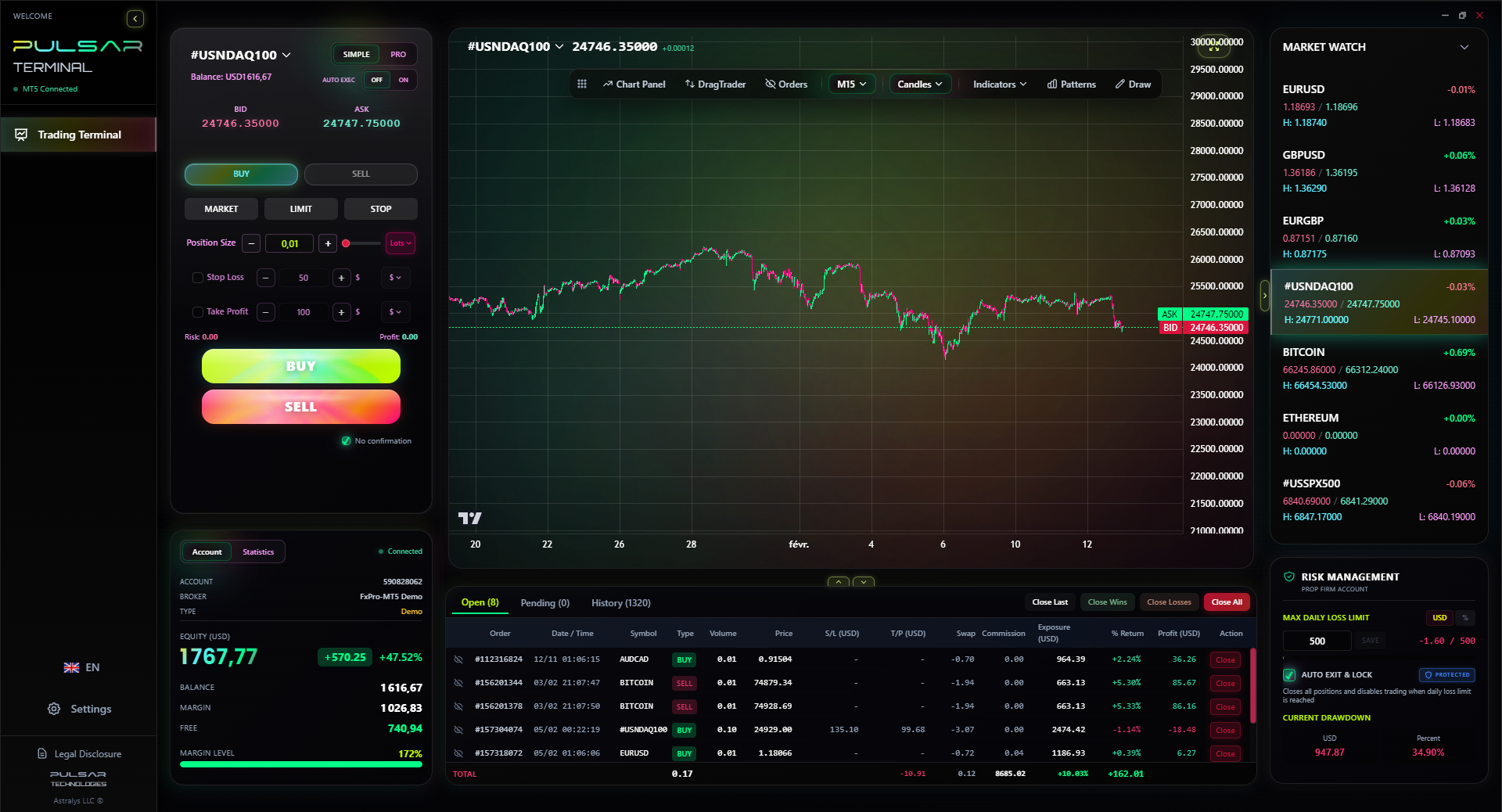
Managing prop firm rules like max daily loss is stressful; Pulsar Terminal automates this protection directly on your MT5, so you can focus on trading.
Pulsar Terminal
The all-in-one MT5 companion: drag-and-drop orders, multi-TP/SL, trailing stop, grid trading, Volume Profile, and prop firm protection. Used by 1,000+ traders daily.
Profitable traders aren't the best at predicting markets. They're the best at managing risk when they're wrong.
Risk-Reward Ratio (RRR): The comparison of potential profit to potential loss. A 1:3 RRR means you're risking 1% to make 3%. I never enter a trade without a predefined RRR of at least 1:1.5. It forces discipline.
Drawdown: The peak-to-trough decline in your account balance. A 10% drawdown means your account is down 10% from its highest point. It's inevitable. Managing it is key.
Hedging: Opening a position to reduce the risk of another position. Some brokers allow you to buy and sell the same pair simultaneously (which just locks in a loss plus spreads). Real hedging involves correlated instruments (e.g., being long on Oil companies stock and short on Crude Oil).
Correlation: How closely two instruments move together. EUR/USD and GBP/USD are positively correlated (often move similarly). USD/CHF and Gold (XAU/USD) are often negatively correlated. Opening two highly correlated trades doubles your risk, not your diversification.
Volatility: The statistical measure of price dispersion. High volatility = large price swings. You adjust your position size down when volatility is high. The ATR (Average True Range) indicator measures this.

Example: Your account is ₦500,000. Your risk per trade is 2% = ₦10,000. You're trading EUR/USD, and your stop-loss is 25 pips away. How much can you trade? ₦10,000 risk / 25 pips = ₦400 per pip. On a standard lot, 1 pip = $10 (approx ₦15,000). So you can only trade micro lots. This is where a position size calculator is non-negotiable.
💡 Winston's Tip
If you can't explain your trade setup using at least five terms from this guide (e.g., Support, RSI, RRR, SL, TP), you don't have a plan. You have a hope.
“Vocabulary in action turns a vague idea into a structured, measurable plan. Without the words, you're just guessing.”
You'll see these on every broker review site like ours when we compare IC Markets, XM, or Pepperstone.
ECN/STP vs. Market Maker:
- ECN (Electronic Communication Network)/STP (Straight Through Processing): Your order is routed directly to other participants in the interbank market (banks, hedge funds, other traders). Tighter spreads, but usually a commission per trade. More transparent.
- Market Maker: The broker acts as the counterparty to your trade. They 'make the market' for you. Can lead to conflicts of interest, but many are reputable. Might have slightly wider spreads but no commission.
Execution Type:
- Instant Execution: Your order is filled at the price you see, or you get a 'requote' (a new price).
- Market Execution: Your order is filled at the next best available price, may involve slight slippage.
Platforms: MT4/MT5 are the standards. Know these terms:
- Expert Advisor (EA): Automated trading robot.
- Custom Indicator: A user-created tool for analysis.
- Tick Chart: A chart that plots a new bar for every price change ('tick').
Swap/Rollover: The interest paid or earned for holding a position overnight. Based on the interest rate differential between the two currencies. If you're long a currency with a higher interest rate than the one you're short, you might earn a small daily credit. It adds up over time on longer-term swing trading positions.
Let's walk through a trade on EUR/USD using the vocabulary.
- Analysis: I see EUR/USD bouncing off a key Support level on the 4-hour chart. The RSI is showing bullish divergence (price made a lower low, RSI made a higher low). Fundamentally, the ECB is hinting at being less dovish. Sentiment is slightly risk-on.
- Plan: I'll place a Buy Limit order 5 pips above the support, anticipating a small bounce before entry. My Stop-Loss (SL) is placed 30 pips below my entry, at a level that invalidates my setup. My Take-Profit (TP) is 60 pips away, giving me a Risk-Reward Ratio of 1:2.
- Execution: My account balance is $2,000. I risk 1% per trade = $20. My risk is 30 pips. $20 / 30 pips = $0.666 per pip. I can trade 0.07 lots (where 1 pip = ~$0.70). I check the spread (0.7 pips) and commission ($3.50 per lot) to ensure my costs are low. I place the order.
- Management: Price hits my entry. It moves up 35 pips. I move my SL to breakeven (entry price), locking in no loss. It hits my TP for a $40 profit (minus costs).
Vocabulary in action turns a vague idea into a structured, measurable plan. Without the words, you're just guessing.
FAQ
Q1What is the most important forex term for a beginner in Nigeria to understand first?
Pip and Spread. If you don't understand your cost of doing business (spread) and how your profit/loss is measured (pip), you cannot calculate your risk or true profitability. Everything else builds on this foundation.
Q2Is forex trading legal in Nigeria?
Yes, retail forex trading is legal for individuals. However, the landscape is changing. The new Investments and Securities Act (ISA) 2025 requires platforms to register with the SEC. Always use reputable, internationally regulated brokers that accept Nigerian clients, as they operate under clearer financial authority guidelines.
Q3What does 'use 500:1' really mean for my money?
It means for every $1 of your own money (margin), you can control a $500 position. On a $100 deposit, you could open a $50,000 trade. While this magnifies potential gains, a 0.2% move against you (100 pips on most pairs) would wipe out your entire $100. It's a risk amplifier, not a skill amplifier.
Q4What's the difference between a Stop-Loss and a Margin Call?
A Stop-Loss is an order YOU set to close a single trade at a specific loss level. A Margin Call is a WARNING from your broker that your entire account equity is too low relative to your open positions. If ignored, it leads to a Stop Out, where the broker automatically closes your trades, often at the worst possible time.
Q5Why do I keep hearing about 'swap' fees?
Swap is the interest for holding a currency pair overnight. You pay or receive it based on the interest rate difference between the two countries. If you're long (buy) the currency with the higher rate, you might earn a small credit. It's crucial for long-term trades but often negligible for day traders.
Q6What is 'slippage' and when does it happen?
Slippage is when your order is filled at a worse price than you requested. It's common during high volatility - like major news releases (NFP, CPI), market opens, or low liquidity periods (holidays, weekends). A Stop-Loss can suffer negative slippage, increasing your loss.
Q7What does 'ECN Broker' mean, and should I use one?
ECN means your orders are matched with other participants in a network, not with the broker itself. It typically offers tighter spreads but charges a commission. It's good for scalpers and high-volume traders who need the best possible price. For beginners, a reliable STP or Market Maker with clear pricing is often simpler.
Prof. Winston's Lesson
Key Takeaways:
- ✓Master Pip & Spread first - they define your costs and P&L.
- ✓A Stop-Loss isn't optional; it's your financial seatbelt.
- ✓Use use like pepper: a little enhances, a lot destroys.
- ✓Always calculate position size based on your 1-2% risk rule.
- ✓Know your broker type (ECN vs. Market Maker) and its costs.
How useful was this article?
Click a star to rate
Weekly Trading Insights
Free weekly analysis & strategies. No spam.
About the Author
Olumide Adeyemi
West African Trading Pioneer
One of Nigeria's most active forex trading educators. 8 years of experience trading from Lagos. Specializes in low-capital strategies and prop firm challenges for African traders.
Comments
Risk Disclaimer
Trading financial instruments carries significant risk and may not be suitable for all investors. Past performance does not guarantee future results. This content is for educational purposes only and should not be considered investment advice. Always conduct your own research before trading.
You Might Also Like

Cara Trading Forex Sukses: 7 Prinsip dari Trader Profesional
Cara trading forex sukses dengan 7 prinsip trader pro: manajemen modal, disiplin, journal trading, backtest. Data nyata, bukan janji profit palsu.
Jam Trading Forex Terbaik untuk Trader Indonesia: Panduan Lengkap dengan Tabel Waktu
Panduan jam trading forex untuk trader Indonesia. Tabel 4 sesi dunia, jam emas 20:00-00:00, sesi mana yang harus dihindari. Data akurat + tips dari trader berpengalaman.
Top 5 Sàn Forex Uy Tín Nhất 2026: Review Jujur dari Trader Indonesia
Top 5 sàn forex uy tín 2026 untuk trader Indonesia. Review jujur: spread, deposit, withdraw, dukungan lokal. Exness, XM, IC Markets & lebih.
Get Pulsar Terminal
All these calculators are built into Pulsar Terminal with real-time data from your MT5 account. One-click position sizing, automatic risk management, and instant calculations.
Get Pulsar Terminal