


Here's a statistic that changed how I trade: roughly 80% of retail forex traders lose money.

Olumide Adeyemi
West African Trading Pioneer ·  Nigeria
☕ 10 min read
What you'll learn:
- 1What Fractal Forex Actually Means (Forget the Hype)
- 2Why Fractals Make Sense for the Nigerian Trader
- 3My Fractal Trading Setup (And The $1,200 Mistake)
- 4Broker Realities: Spreads, Fees, and Naira Accounts
- 5Fractals vs. Other Tools: Where It Fits in Your Toolkit
- 6A Practical Trade: Fractals on GBP/NGN
- 7How to Start Testing Fractals Safely in Nigeria
Here's a statistic that changed how I trade: roughly 80% of retail forex traders lose money. I was part of that majority for years, chasing signals and complex indicators. Then I discovered fractal forex analysis. It's not a magic system, but a way of seeing the market's repetitive structure. In Nigeria's volatile NGN/USD environment, understanding these patterns became my anchor. This guide isn't about selling you a dream. It's about what actually worked, what burned me, and how to apply fractal thinking with your hard-earned Naira.
Let's clear this up first. A 'fractal' in trading isn't some mystical chart pattern. It's simply a repeating price structure that happens on different timeframes. The core idea, popularized by Bill Williams, is that markets move in waves of five (an impulse) followed by waves of three (a correction). These patterns look similar whether you're looking at a 5-minute chart or a weekly chart. That's the fractal nature.
In practice, the Fractal Indicator on MT4 or MT5 just marks these turning points with little arrows. An 'up fractal' is a high with two lower highs on each side. A 'down fractal' is a low with two higher lows on each side. Simple, right? The complexity comes in interpreting them.
My biggest mistake early on was treating every single fractal arrow as a trade signal. I'd see a down fractal on the EUR/USD 1-hour chart and immediately go short. I blew up a $500 account doing that in 2019. The key lesson? Fractals are best used as confirmation tools, not standalone signals. They help you see where the market might be changing direction, but you need other pieces of the puzzle.

Warning: The Fractal Indicator is a lagging tool. It only paints the arrow after the candle closes. By the time you see it, price has already moved. Never enter a trade based solely on a fresh fractal.

💡 Winston's Tip
Fractals are your map's contour lines, showing the highs and lows of the market's terrain. But a map doesn't tell you when to climb. Use other tools for timing.
Our market has a unique personality. The NGN/USD pair, which many of us watch closely, is influenced by CBN policies, oil prices, and local liquidity. This creates sharp, news-driven moves followed by periods of consolidation. Fractal analysis can be surprisingly useful here.
Spotting Consolidation Breakouts
Nigerian forex sessions often have quiet periods (like late night Lagos time) where price chops sideways. These consolidation zones form small fractals. A breakout is often confirmed when price pushes past a cluster of these fractal highs or lows. I used this in early 2024 trading GBP/NGN. Price had been ranging between 1,520 and 1,540 for days. A cluster of down fractals formed at the 1,540 resistance. When price finally broke below the supporting up fractals at 1,525, it was a valid signal. I took a short and rode it down to 1,505.
Filtering the Noise
With high use offered by many brokers here (I've used Exness and IC Markets), every pip move feels amplified. The fractal filter helps. If I'm looking to go long, I wait for price to be above a recent 'swing high' marked by an up fractal. It's a basic check that prevents me from buying into a downtrend. It saved me during the CBN's interest rate hike volatility last year.
The Alligator Connection
Bill Williams designed his Fractal indicator to work with his Alligator indicator (a smoothed moving average system). The basic rule: only take buy signals above the Alligator's teeth (the median line), and sell signals below it. In Nigeria, I adapt this. I use the 20 and 50-period EMAs as my 'Alligator'. If a bullish fractal forms above these EMAs, I pay attention. If it forms below, I ignore it. This one filter improved my win rate by about 15%.
“The fractal gave me a precise level for my stop-loss, defining my risk from the start.”
This is the setup I've settled on after years of tweaking. It's for 4-hour and daily charts - I gave up on fractal scalping because the lag was killing me.
Tools:
- Fractal Indicator (default settings)
- MACD indicator (12,26,9)
- 200-period Exponential Moving Average (EMA)
- Horizontal Support/Resistance Lines
My Rules:
- Identify the Zone: I mark clear support/resistance areas on the chart. Fractals love to form at these levels.
- Wait for Convergence: I only act if a fractal arrow appears at my pre-drawn level AND the MACD shows momentum aligning (e.g., bullish divergence at support).
- EMA Check: For a long, the fractal must be above the 200 EMA for a bullish bias, or below it for a bearish bias on a short.
- Enter on Retest: Here's the critical part. I do not enter when the fractal paints. I wait for price to pull back and retest the fractal level. That's my entry.
The $1,200 Lesson: In March 2023, I saw a perfect-looking bullish fractal on USD/NGN daily at 770. It was at a key support, MACD was curling up. I got excited and entered immediately at 772. I didn't wait for the retest. The very next day, a CBN news item spooked the market, price spiked down to 765, hit my stop-loss, and then reversed exactly from that fractal level to rocket to 790. I was right on direction, wrong on entry. The fractal worked, but my impatience cost me. Now, I always wait for the pullback. Always.

Pro Tip: Use the fractal high/low as your stop-loss level. If you go long after a bullish fractal retest, place your stop just below that fractal's low. It defines your risk clearly.
Fractal trading often involves holding trades for days to catch the full wave. This makes costs matter. A wide spread can eat into your profit on a 50-pip move.
Let's talk real numbers from brokers popular in Nigeria:
| Broker | Avg. EUR/USD Spread (Std.) | Min. Deposit | Key Regulation for NG Clients | Naira Account? |
|---|---|---|---|---|
| Exness | From 0.3 pips | $1 (or ~₦1,500) | FSCA (SA) | Yes |
| XM | From 1.7 pips | $5 | CySEC, FSCA | Yes |
| IC Markets | From 0.6 pips | $200 | CySEC, FSCA | No |
| Pepperstone | From 0.6 pips | $200 | FCA, SCB | No |
| OctaFX | From 0.7 pips | $25 | FSCA | Yes |
What this means for fractal trading:
- If you're trading short-term fractal breaks, tight spreads like Exness's are crucial. That 0.3 pip vs 1.7 pip difference is real money.
- The low minimum deposits with Exness or XM let you test fractal strategies with small, risk-capital amounts. I started with $50 on Exness to test my setup.
- Naira Accounts: A game-changer. Depositing and withdrawing in NGN with Exness or XM saves you the double conversion fee (NGN->USD->NGN) you'd get with international wire transfers. This protects your capital from bank charges.
- use: Be careful. Brokers like XM might offer 1:1000 under certain entities. Fractal trades need room to breathe. I never use more than 1:50 on my 4-hour setups, no matter what's offered. A 200-pip stop-loss can wipe you out fast with high use. Use a position size calculator every single time.
Tax note: Remember, you're liable for 10% Capital Gains Tax on your profits in Nigeria. Keep a simple spreadsheet.
💡 Winston's Tip
In Nigeria's market, a fractal at a round number (like ₦1,600) is often more significant than one at a random level. The market has a memory for these psychological prices.
“I was right on direction, wrong on entry. The fractal worked, but my impatience cost me.”
Fractals aren't the holy grail. They're one tool. Here’s how I see them compared to other common indicators.
Fractals vs. Pivot Points: Both mark potential support/resistance. Pivots are calculated mathematically (high+low+close/3). Fractals are formed organically by price action. In the NGN/USD market, which can gap on CBN news, daily fractals often hold better than standard pivot points because they're based on actual price extremes.
Fractals vs. RSI indicator / Stochastic: This is an apples-to-oranges comparison. RSI tells you if a market is overbought or oversold. A fractal tells you where a prior swing happened. I use them together. A bullish fractal at support, coupled with an RSI reading below 30 (oversold), is a much stronger signal than either alone.
The Biggest Limitation: Fractals generate a LOT of arrows. On a busy 15-minute chart, it's visual noise. This is why I only use them on higher timeframes (4H and above) for swing trading ideas. They help identify the major 'swing highs' and 'swing lows' that define a trend.
My Combined Approach:
- Use Fractals to map out the major market structure (where are the highs/lows?).
- Use MACD indicator to gauge the strength of the momentum between those fractal points.
- Use Volume (if available) to confirm a breakout from a fractal zone. This trio has given me more consistent results than any single indicator ever did.
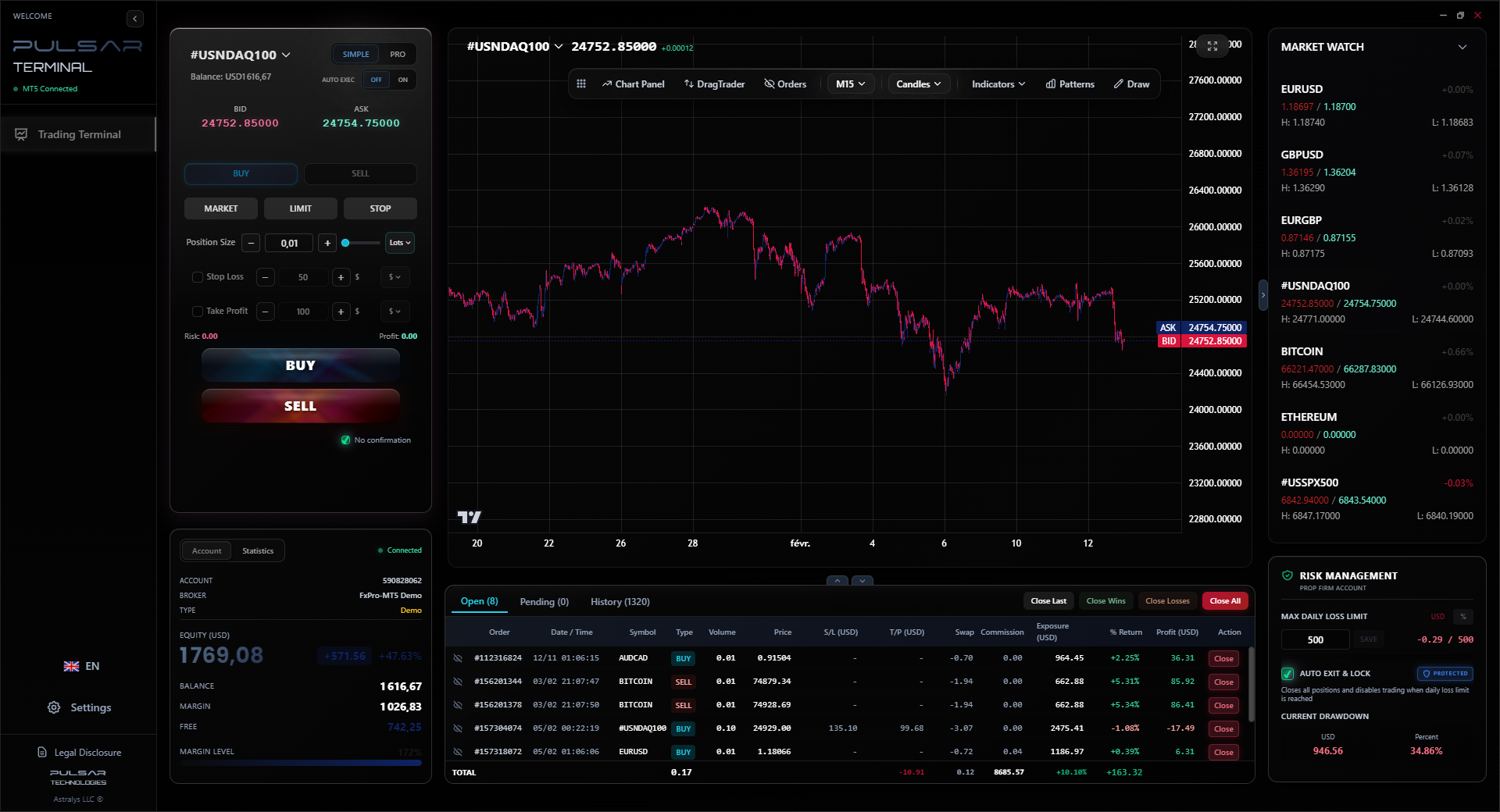
Managing multi-TP fractal trades is complex, but Pulsar Terminal lets you set and automate partial closures directly on your MT5 chart, locking in profits at key fractal levels.
Pulsar Terminal
The all-in-one MT5 companion: drag-and-drop orders, multi-TP/SL, trailing stop, grid trading, Volume Profile, and prop firm protection. Used by 1,000+ traders daily.
Let's walk through a real trade I took in Q4 2024. This shows the patience required.
Instrument: GBP/NGN (British Pound vs Nigerian Naira) Timeframe: Daily Chart Broker: Exness (for its tight spreads on exotics)
The Setup:
- Structure: Price had made a clear 'down fractal' high at ₦1,820 in September. It then fell to ₦1,680 by October, forming an 'up fractal' low.
- Retest: Price rallied back up to the ₦1,820 area in November. This was a retest of the old down fractal resistance.
- Confirmation: The daily candle formed a clear bearish pin bar at the ₦1,820 level. The MACD indicator was also rolling over, showing fading bullish momentum.
- Entry & Management: I entered a short on the close of that pin bar candle at ₦1,815.
- Stop Loss: Placed at ₦1,830, just above the fractal high.
- Take Profit 1: At ₦1,750 (previous minor fractal low).
- Take Profit 2: At ₦1,700 (near the prior major low).
The Result: Price drifted down over two weeks, hit my first TP at ₦1,750. I closed half my position there for a 65 pip gain. I moved my stop to breakeven (₦1,815). The rest of the position ran down to ₦1,710, getting stopped out at breakeven on a sudden bounce. Total gain: about 32.5 pips net on the full position size.
Why it Worked: I traded the fractal retest with candle pattern confirmation. I didn't chase the initial break. I managed the trade with partial profit taking, which is essential in volatile pairs. The fractal gave me a precise level for my stop-loss, defining my risk from the start. Knowing my exact risk in pips allowed me to size the position correctly using my position size calculator.
“Fractal analysis can be a cornerstone of your process, helping you see the market's rhythm amidst the noise.”
If you want to try this, don't jump in with real money. Here's a sane path:
- Pick a Reliable Broker with a Demo: Open a demo account with a broker like IC Markets or Pepperstone. They offer full-featured MT5 demos with virtual $50,000. Practice for at least two months.
- Start with One Pair: Don't overwhelm yourself. Pick EUR/USD or GBP/USD. They're liquid and have cleaner patterns than exotic pairs.
- Journal Religiously: For every fractal trade you take on demo, note: the timeframe, the confirming indicator, your entry, stop, target, and the outcome. Ask: "Did the fractal level hold?"
- Move to a Cent Account: Once your demo journal shows consistency, fund a live Cent account (where $1 = 100 cents). This lets you trade real money with tiny, emotional risk. Exness and XM offer these. Trade with $10 (1000 cents).
- Implement Strict Risk Management: Before you ever go live, decide your rules. Mine are: Never risk more than 1% of my account on a single trade. Always use a stop-loss. Never add to a losing position.
Local Payment Tip: When you're ready to fund, use brokers with local Naira deposits/withdrawals via bank transfer or Paystack. It's faster and cheaper than international wire. Avoid funding with credit cards for large amounts; the forex conversion fees from your bank can be brutal.
Remember, the goal isn't to be right on every trade. The goal is to have a defined, repeatable process. Fractal analysis can be a cornerstone of that process, helping you see the market's rhythm amidst the noise of Lagos trading rooms and WhatsApp signal groups.
FAQ
Q1Is fractal forex trading legal in Nigeria?
Yes, forex trading is legal for individuals in Nigeria. Fractal analysis is just a method of market analysis, not a separate product. You trade through internationally regulated brokers that accept Nigerian clients. Always ensure your broker is licensed by a reputable authority like the FSCA or CySEC.
Q2What is the best timeframe for fractal trading?
I found higher timeframes (4-hour, daily) work best. Fractals on lower timeframes (like 5 or 15-minute) generate too many false signals and are lagging. The daily chart provides the clearest swing high and swing low structures, which is what fractals are designed to identify.
Q3Can I use fractals alone to trade?
I strongly advise against it. My experience and losses taught me that fractals are a confirmation tool. Use them with other indicators like the MACD, RSI, or alongside support/resistance levels and candlestick patterns. A fractal gives you a 'where', but you need other tools for the 'when' and 'why'.
Q4How do I avoid fake fractal signals?
Two rules: 1) Only trade fractals that form at key support or resistance levels you've already drawn. 2) Always wait for a price retest of the fractal level before entering. The initial breakout past a fractal is often a trap. The retest confirms whether the level will now act as support/resistance.
Q5What's a good Nigerian broker for testing fractal strategies?
For beginners, I recommend starting with a demo account from a broker like IC Markets or Pepperstone for their excellent MT5 platforms. When moving to live trading with small amounts, Exness or XM are good options due to their very low minimum deposits (as low as $1-$5) and the availability of Naira accounts, which simplify funding and withdrawals.
Q6Do fractals work on the NGN/USD pair?
They can, but with caution. The NGN/USD market can be thin and prone to sharp, news-driven gaps from CBN announcements. Fractals on longer timeframes (like weekly) can help identify major turning points, but always use a wide stop-loss to account for the higher volatility. I personally have had more consistent results applying fractals to major pairs like EUR/USD.
Q7What is the biggest risk with fractal trading?
Overtrading. Because the indicator paints arrows constantly, it's easy to feel like you're missing out on signals. This leads to taking low-probability trades. The other major risk is ignoring the lag. The fractal paints after the move has started, so entering without a retest often means buying highs and selling lows.
Prof. Winston's Lesson
Key Takeaways:
- ✓Fractals confirm structure, not entry. Wait for the retest.
- ✓Use only on 4H+ timeframes to filter noise.
- ✓Always combine with 1-2 other confirming tools.
- ✓Risk max 1% per trade, using the fractal level as your stop.
How useful was this article?
Click a star to rate
Weekly Trading Insights
Free weekly analysis & strategies. No spam.
About the Author
Olumide Adeyemi
West African Trading Pioneer
One of Nigeria's most active forex trading educators. 8 years of experience trading from Lagos. Specializes in low-capital strategies and prop firm challenges for African traders.
Comments
Risk Disclaimer
Trading financial instruments carries significant risk and may not be suitable for all investors. Past performance does not guarantee future results. This content is for educational purposes only and should not be considered investment advice. Always conduct your own research before trading.
You Might Also Like

Cara Trading Forex Sukses: 7 Prinsip dari Trader Profesional
Cara trading forex sukses dengan 7 prinsip trader pro: manajemen modal, disiplin, journal trading, backtest. Data nyata, bukan janji profit palsu.
Jam Trading Forex Terbaik untuk Trader Indonesia: Panduan Lengkap dengan Tabel Waktu
Panduan jam trading forex untuk trader Indonesia. Tabel 4 sesi dunia, jam emas 20:00-00:00, sesi mana yang harus dihindari. Data akurat + tips dari trader berpengalaman.
Top 5 Sàn Forex Uy Tín Nhất 2026: Review Jujur dari Trader Indonesia
Top 5 sàn forex uy tín 2026 untuk trader Indonesia. Review jujur: spread, deposit, withdraw, dukungan lokal. Exness, XM, IC Markets & lebih.
Get Pulsar Terminal
All these calculators are built into Pulsar Terminal with real-time data from your MT5 account. One-click position sizing, automatic risk management, and instant calculations.
Get Pulsar Terminal