


My screen was a sea of red.

Olumide Adeyemi
West African Trading Pioneer ·  Nigeria
☕ 12 min read
What you'll learn:
- 1The Frankfurt Session on Nigerian Time
- 2The Best Frankfurt Session Forex Pairs to Trade
- 3A Simple Trading Strategy for the European Open
- 4Brokers, Costs, and the Naira Reality
- 5Risk Management When Volatility Spikes
- 6Common Mistakes Nigerian Traders Make (I've Made Them All)
- 7My Go-To Tools and Indicators for the Session
- 8Using the Frankfurt Session for Longer-Term Swings
My screen was a sea of red. It was 8:15 AM WAT, just after the Frankfurt session kicked off, and the EUR/USD had just ripped 40 pips south in about three minutes. I was in a bad long position from the Asian session, hoping for a quiet morning. The European banks had other ideas. That loss, back in early 2024, taught me a brutal lesson: you don't just trade during the Frankfurt session, you trade for it. Your entire approach has to shift when London and Frankfurt traders log on. For us in Nigeria, that's our 8 AM to 5 PM window. It's where the real money moves, especially in specific frankfurt session forex pairs. Let's break down how to trade this timezone, not just survive it.
First things first, let's sync our watches. The global forex market calls it 7 AM to 4 PM GMT. For us in Nigeria, on West African Time (GMT+1), that means the Frankfurt session runs from 8:00 AM to 5:00 PM WAT. This is your core trading day if you're not a night owl.
This session is powerful for two main reasons. First, it's when major European financial hubs - Frankfurt, London, Paris - are fully online. The big institutional banks are executing orders, creating massive liquidity. Second, it overlaps with the tail end of the Asian session (for the first hour) and later with the start of the New York session (from about 1:00 PM WAT onwards). These overlaps are volatility engines.

Warning: The first 60-90 minutes (8:00-9:30 AM WAT) are the most volatile. Price can spike on economic news or just from the sheer volume of orders hitting the market. I learned the hard way not to have unmanaged positions from Asia still open at this time.
For the Nigerian trader, this schedule is actually perfect. It fits a normal workday. You can analyse the market at 7:30 AM, be ready for the open at 8 AM, and manage trades through the afternoon. It's far more sustainable than trying to trade the New York session late into our night.

💡 Winston's Tip
The market's first move at the open is often a trap for the impatient. Let the initial 30-minute candle close. The real direction reveals itself in the following price action, not the initial spike.
Not all pairs are created equal when Europe wakes up. You want to focus on pairs where the Euro (EUR) or British Pound (GBP) is a primary currency. Liquidity follows the sun, and during these hours, it's shining on Europe.
The Major Euro Pairs
These are your bread and butter. The EUR/USD is the king. It often sees its clearest trends and highest volume during the Frankfurt session. I've had my most consistent scalping strategy results on this pair between 9 AM and 12 PM WAT. Next is the EUR/GBP. It's a pure European cross, so it's hyper-sensitive to news from both the Eurozone and the UK. It can be range-bound but offers fantastic breakout opportunities around 8:30 AM WAT when UK data drops.
The Other High-Activity Pairs
Don't ignore GBP/USD. It's incredibly active, but be warned - it's also nicknamed 'the beast' for a reason. Its moves can be sharp and unpredictable. USD/CHF and EUR/CHF also get a boost from Swiss bank activity. For a touch of risk, EUR/JPY and GBP/JPY (the 'Yen crosses') can see massive swings during the overlap, but they're for experienced hands only due to their volatility.
Here’s a quick cheat sheet for a typical Frankfurt session:
| Currency Pair | Why It's Good | When to Watch (WAT) |
|---|---|---|
| EUR/USD | Highest liquidity, clear trends | 8:00 AM - 4:00 PM (All session) |
| EUR/GBP | Reacts to European/UK news | 8:30 AM (UK data), 10:00 AM (EU data) |
| GBP/USD | High volatility, big moves | 8:30 AM sharp (UK data releases) |
| USD/CHF | Safe-haven flows, often inverse to EUR/USD | During European uncertainty |

Pro Tip: I keep a separate watchlist just for the Frankfurt session. It only has these 6-7 pairs. This focus stops me from getting distracted by slow-moving pairs like AUD/USD that are really waiting for the Asian session to come back around.
“A 10-pip stop loss that worked in Asia is just a donation to the market makers at 8:15 AM WAT.”
You don't need a complicated system. The Frankfurt session often provides its own structure. Here’s a basic, price-action focused approach I've used for years.
Step 1: Identify the Asian Range. Before 8 AM WAT, note the high and low of the Asian session (roughly 12 AM - 7 AM WAT). Draw horizontal lines on your chart. This range is your first key area.
Step 2: Watch the 8:00-8:30 AM WAT Break. As volume floods in, price will often test one edge of this Asian range. A strong, sustained break (with a 15-minute candle closing outside the range) can signal the initial directional bias for the day. For example, if price breaks above the Asian high, look for initial long opportunities on pullbacks.
Step 3: The First Pullback Trade. Price rarely goes straight up or down. After the initial spike, it often pulls back to retest the broken Asian range boundary (which now becomes support or resistance). This is a classic, lower-risk entry. My rule: I only take this trade if the pullback happens within the first 2 hours of the session.
A Real Trade Example: On March 15, 2025, EUR/USD had an Asian range between 1.0880 and 1.0895. At 8:05 AM WAT, it broke above 1.0895 on strong volume. I waited. It rallied to 1.0910, then pulled back to 1.0897 - right to the old Asian high. I entered a long at 1.0898 with a stop at 1.0889 (9 pips). The session trend continued up, and I took profit at 1.0922 for a 24-pip gain. The key was patience and letting the market show its hand.
This strategy works because you're trading with the session's initial momentum, not against it. Always use a position size calculator to ensure your stop loss won't blow up your account on a fakeout.
Let's talk practicalities. You're trading from Nigeria, so funding and costs matter. The landscape is unique. Retail forex isn't illegal, but the CBN's official windows aren't for funding trading accounts. You'll be using international brokers.
The good news? Many top brokers welcome Nigerian clients. You want one with low spreads on the major European pairs, reliable Naira deposit/withdrawal options, and a solid global license (like ASIC or FSCA). From my experience and testing, a few stand out for Frankfurt session trading.
Exness is hugely popular here for a reason. Their spreads on EUR/USD can be razor-thin, sometimes under 0.1 pips on their Raw Spread account (with a commission). Depositing in Naira is straightforward. IC Markets and Pepperstone are also excellent choices for serious traders wanting raw spreads from 0.0 pips. For a beginner-friendly option with great educational materials, XM is a solid pick.
Now, the costs you can't avoid:
- Spreads: This is your main cost. On a standard account, expect 0.8 - 1.5 pips on EUR/USD during the Frankfurt session. On a raw account, you might see 0.0 pips but pay a $3-$7 commission per lot.
- Taxes: Here's the big one. The Federal Inland Revenue Service (FIRS) views trading profits as capital gains. That's subject to a 10% tax on your gross profits. Keep careful records. If trading is your main business, it becomes taxable income, which is a different calculation.
- Minimum Deposit: You can start with $50 (about ₦75,000), but honestly, that's tough. A single 20-pip stop loss on a 0.1 lot trade is $20. I recommend a minimum of $500 (₦750,000+) to give yourself breathing room for proper risk management.
💡 Winston's Tip
Your most important analysis happens between 7:00 and 7:55 AM WAT. Identify the Asian range and key levels. Once the bell rings at 8 AM, you're an executor, not an analyst. Hesitation is expensive.
“Your best tool for the Frankfurt open isn't an indicator, it's the volume profile and yesterday's high and low.”
The Frankfurt session can go from calm to chaotic in seconds. A surprise comment from the ECB, a miss on German GDP data - price can move 30 pips before you can blink. Your strategy is nothing without iron-clad risk rules.
First, widen your stops. In the Asian session, a 10-pip stop on EUR/USD might be fine. At 8:30 AM WAT, it's a guaranteed loss. During the first two hours, I use a minimum stop of 15-20 pips on majors, sometimes more for pairs like GBP/USD. This gives the trade room to breathe through normal volatility.
Second, reduce your position size. Higher volatility means bigger potential losses. If you normally risk 1% of your account per trade, consider dropping to 0.5% during the high-volatility open (8-10 AM WAT). I got cocky once and put on my full size right at the open. A false breakout on EUR/GBP hit my stop for a 2% loss in under ten minutes. A painful, but valuable, lesson.
Third, know the news calendar. This is non-negotiable. At 9:00 AM WAT (10:00 CET), Eurozone data drops. At 8:30 AM WAT, it's UK data. If you have a trade on, you either close it before the news or you ensure your stop is so wide it can survive the spike. I prefer to just be flat. Trading the MACD indicator or RSI indicator divergence is great, but not when CPI data is about to print.
Warning: use is a double-edged sword. Brokers might offer 1:500 or even 1:1000. Using high use during the volatile Frankfurt open is a shortcut to a margin call. I never use more than 1:30 for my intraday Frankfurt session trades, no matter what my account allows.
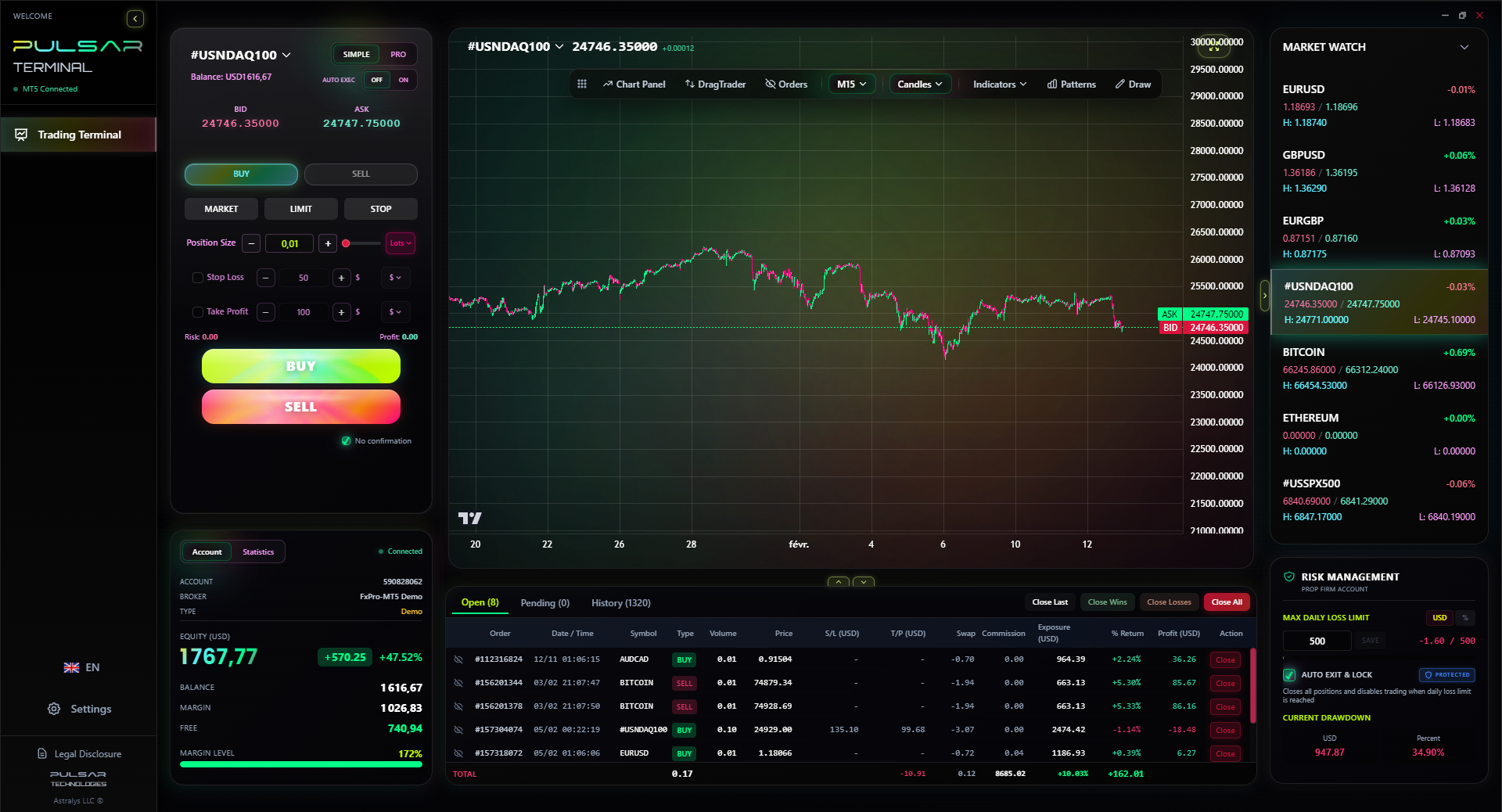
Managing multiple trades with precise stops during the volatile Frankfurt open is stressful, but Pulsar Terminal lets you set and automate trailing stops and breakeven orders directly on your MT5 charts.
Pulsar Terminal
The all-in-one MT5 companion: drag-and-drop orders, multi-TP/SL, trailing stop, grid trading, Volume Profile, and prop firm protection. Used by 1,000+ traders daily.
Let's be real. We all mess up. Here are the classic errors I see (and have personally funded) when trading the Frankfurt session from Nigeria.
Mistake 1: Trading Like It's Still Asia. The slow, ranging price action of the Asian session (which we often watch) conditions us. Then at 8 AM, the market changes personality. Jumping in with a limit order at a minor Asian level without a stop loss is a recipe for disaster. The market will blow straight through it.
Mistake 2: Chasing the Open. You see EUR/USD fly 25 pips in the first 5 minutes. FOMO kicks in, and you buy at the very top. Nine times out of ten, you're buying into the first pullback. Wait for the structure to form. Let the pros make the first move.
Mistake 3: Ignoring the Naira Cost. We think in dollars on the chart, but our capital is in Naira. A $100 loss isn't just $100; it's ₦150,000 (at roughly ₦1,500/$). That psychological weight can lead to revenge trading. Always do the mental conversion. It keeps you grounded.
Mistake 4: Overtrading the Session. Just because the market is open from 8 AM to 5 PM doesn't mean you need to be in a trade the whole time. The best trends often establish themselves in the first few hours. Some of my most profitable months involved taking 1-2 high-quality setups in the morning and then stepping away. Trying to scalp every little 5-pip move is exhausting and usually unprofitable after spreads and slippage.
“Profit in the Frankfurt session comes from patience in the first hour, not activity.”
Keep your charts clean. Too many indicators will paralyse you when speed matters. Here’s my minimalist Frankfurt session setup.
1. The 15-Minute and 1-Hour Charts. I use the 15-minute for precise entry timing and the 1-hour to see the broader session trend. The 5-minute is too noisy during the open.
2. Volume Indicator (Not the default MT4 one). You need to see if a breakout has actual volume behind it or if it's just a fake move. I use a better volume indicator that colours bars based on relative volume. A breakout on a tall green volume bar at 8:15 AM? That's a signal you can trust.
3. Simple Moving Averages. A 20-period and 50-period Exponential Moving Average (EMA) on the 1-hour chart. If price is above both, I'm only looking for long setups on the 15-minute chart. It keeps me on the right side of the session's momentum.
4. Horizontal Support/Resistance Lines. This is the most important tool. I mark the Asian session high/low, the previous day's high/low, and any major round numbers (like 1.0900 on EUR/USD). Price respects these levels, especially when European liquidity hits.
I made the mistake early on of loading up my chart with every indicator under the sun. All it did was give me conflicting signals. Now, I just watch price action at key levels with a volume confirmation. It’s far more effective.
💡 Winston's Tip
If you can't articulate in one sentence why your trade should work based on a Frankfurt session dynamic (e.g., 'breaking the Asian high on high volume'), don't take the trade. You're just gambling on noise.
You don't have to be a day trader. The Frankfurt session is also the best time to analyse and place trades for a swing trading perspective (holding for days or weeks).
Why? Because the major daily moves often start here. A trend that kicks off with strong European buying or selling at 9 AM WAT can last for days. If you're a swing trader, the best thing you can do is do your analysis and place your orders during the Frankfurt session.
For instance, if I'm looking to buy XAU/USD (Gold) on a dip, I'll set my limit buy order at a key support level. But I'll only activate that order during the Frankfurt session hours. Why? Because if the price hits my level during the illiquid Asian session, it might just keep sliding. If it hits my level during the Frankfurt session and finds support on high volume, that's a much stronger signal that the big players are also buying there.
The Frankfurt session sets the tone. A strong bullish or bearish daily candle that forms its body during these hours carries more weight than one that forms in a quiet period. Use the session's energy to your advantage, even if you're not staring at the screen all day.
FAQ
Q1What is the best time to trade the Frankfurt session in Nigeria?
The absolute best time is between 8:30 AM and 12:00 PM West Africa Time (WAT). This captures the volatile open, the initial trend establishment, and the reaction to key European economic data releases. The overlap with the New York session starting around 1:00 PM WAT can also create a second wave of activity.
Q2Which forex pair is most active during the Frankfurt session?
The EUR/USD is the most active and liquid pair during the Frankfurt session. It benefits directly from European bank and institutional activity. Other highly active frankfurt session forex pairs include GBP/USD (especially at 8:30 AM WAT with UK data) and EUR/GBP.
Q3Is forex trading legal in Nigeria?
Yes, forex trading by individuals is legal in Nigeria. However, the retail market is not heavily regulated by the CBN for day-to-day trading. You cannot use official CBN foreign exchange windows to fund your account. You must use an international broker, and your profits are subject to a 10% capital gains tax.
Q4Can I fund my trading account in Nigerian Naira (NGN)?
Yes, many international brokers like Exness, HF Markets, and XM offer Naira-denominated accounts or direct Naira deposit options through local bank transfers or cards. This saves you from dealing with dollar conversions and extra bank charges.
Q5Why do I keep getting stopped out right at the Frankfurt open?
This is extremely common. Your stop loss is probably too tight. The spread can widen dramatically in the first few minutes, and normal volatility can easily be 15-20 pips. Widen your stops for the first two hours of the session, or better yet, wait 30-60 minutes for the market to settle into a direction before entering.
Q6What use should I use for Frankfurt session trading?
Use low use. The high volatility means your account equity can swing wildly. While brokers might offer 1:500 or more, I strongly recommend not exceeding 1:30 for intraday trading during this session. High use combined with Frankfurt session volatility is the number one cause of blown accounts.
Q7How much money do I need to start trading the Frankfurt session?
You can technically start with $50, but it's very difficult to manage risk properly. A more realistic minimum is $500 (roughly ₦750,000). This allows you to trade sensible position sizes (like 0.1 lots) and withstand normal 20-30 pip stop losses without risking a huge percentage of your account.
Prof. Winston's Lesson
Key Takeaways:
- ✓Trade the EUR/USD & GBP/USD for maximum Frankfurt liquidity.
- ✓Widen stops to 15-20 pips minimum during the volatile 8-10 AM WAT window.
- ✓Pay your 10% capital gains tax on gross profits - keep records.
- ✓Use the session's first pullback for higher-probability entries.
How useful was this article?
Click a star to rate
Weekly Trading Insights
Free weekly analysis & strategies. No spam.
About the Author
Olumide Adeyemi
West African Trading Pioneer
One of Nigeria's most active forex trading educators. 8 years of experience trading from Lagos. Specializes in low-capital strategies and prop firm challenges for African traders.
Comments
Risk Disclaimer
Trading financial instruments carries significant risk and may not be suitable for all investors. Past performance does not guarantee future results. This content is for educational purposes only and should not be considered investment advice. Always conduct your own research before trading.
You Might Also Like

Cara Trading Forex Sukses: 7 Prinsip dari Trader Profesional
Cara trading forex sukses dengan 7 prinsip trader pro: manajemen modal, disiplin, journal trading, backtest. Data nyata, bukan janji profit palsu.
Jam Trading Forex Terbaik untuk Trader Indonesia: Panduan Lengkap dengan Tabel Waktu
Panduan jam trading forex untuk trader Indonesia. Tabel 4 sesi dunia, jam emas 20:00-00:00, sesi mana yang harus dihindari. Data akurat + tips dari trader berpengalaman.
Top 5 Sàn Forex Uy Tín Nhất 2026: Review Jujur dari Trader Indonesia
Top 5 sàn forex uy tín 2026 untuk trader Indonesia. Review jujur: spread, deposit, withdraw, dukungan lokal. Exness, XM, IC Markets & lebih.
Get Pulsar Terminal
All these calculators are built into Pulsar Terminal with real-time data from your MT5 account. One-click position sizing, automatic risk management, and instant calculations.
Get Pulsar Terminal