


Here's a statistic that might surprise you: over 90% of the 'free forex bots' advertised to South African traders are either scams, useless, or come with hidden costs that make them anything but free.

David van der Merwe
Emerging Markets Trader ·  South Africa
☕ 11 min read
What you'll learn:
Here's a statistic that might surprise you: over 90% of the 'free forex bots' advertised to South African traders are either scams, useless, or come with hidden costs that make them anything but free. I've tested dozens over the last decade, and I've lost real money on more than a few before I figured out the game. This isn't about scaring you off automation. When done right, it's a powerful tool. But in our market, with our specific rules from the FSCA and SARB, you need to know exactly what you're getting into. Let's cut through the hype and talk about what a free forex bot actually means for a trader in Johannesburg, Cape Town, or Durban.
When someone says 'free forex bot,' they're usually talking about an automated trading program, often called an Expert Advisor (EA) for MetaTrader. It's a piece of software that places trades for you based on a set of rules. The 'free' part is where things get tricky.
In my experience, 'free' usually falls into one of three categories:
- A crippled demo: This is the most common. You get a version that works on a demo account but shuts off or limits trades on a live account. It's a sales tactic to get you to buy the 'pro' version.
- A very basic strategy: It might be a simple moving average crossover bot. These are often shared for free in trading forums. They work, technically, but they're rarely profitable long-term because they're too simplistic. I coded one of these myself years ago. It made R2,300 in a good week, then gave it all back plus more the next month when the market changed.
- A scam requiring 'activation': You download it, install it, and it does nothing until you pay a 'one-time activation fee' or deposit money with a specific broker (where the bot seller gets a kickback).

Warning: If a 'free' bot promises guaranteed profits or insane returns with no drawdown, run. That's the oldest trick in the book. The FSCA regularly warns against these schemes.
The real cost of any bot, free or paid, isn't just the purchase price. You have to factor in the broker's spread, potential swap fees, and the cost of a VPS to run it 24/7. A cheap VPS in SA will still set you back around R200-R400 per month. That's not free.

💡 Winston's Tip
A 'free' bot that works is like a free car that never breaks down. If it existed, everyone would have one. Someone is always paying, usually the user through hidden fees or losses.
This is the most critical section for any South African trader. The rules are nuanced, and getting them wrong can have serious consequences.
The Tool vs. The Trade Automated trading software itself is legal. The FSCA doesn't ban the use of Expert Advisors on platforms like MT4 or MT5. However, what you use that software for is heavily regulated.
Here's the crucial distinction that many new traders miss:
- Using a bot to trade international markets (like EUR/USD or Gold) with funds from your foreign investment allowance: This is generally the accepted path for individuals. You can use your annual R1 million single discretionary allowance (or the R10 million foreign capital allowance) to fund an account with an international or FSCA-regulated broker like IC Markets or Exness, and run a bot on those markets.
- Using a bot to speculate directly against the South African Rand (ZAR) as an individual: This is the grey area. The National Treasury's position is that individual speculative forex trading against the Rand is not permitted under the old Exchange Control Regulations. Many local brokers offering this have been targeted in the FSCA's recent regulatory cleanup.

Pro Tip: Always, always check your broker's regulatory status on the FSCA's website. If they're not listed, your funds are not protected. The recent push for ODP licenses means only the most reputable operators will survive.
The Broker is Key Your bot is only as good and as legal as the broker it runs on. Stick with well-known, FSCA-regulated brokers. They offer client fund segregation, which means your money is kept separate from the broker's company funds. This is non-negotiable for peace of mind. use is capped at 1:500 by the FSCA, which is actually quite generous compared to many other regions.
“The real cost of any bot isn't the purchase price; it's the spread, the commissions, and the inevitable drawdown you didn't plan for.”
Let's talk numbers. This is where the dream of a 'free' bot crashes into reality. I'll use a real example from a trade I ran with a grid bot last year.
My Bot Trade Example:
- Bot: A free grid EA I modified myself.
- Pair: EUR/USD
- Broker: An ECN broker (similar to Pepperstone)
- Entry: 1.0850. I set a grid of 10 orders above and below.
- Result: After a week, 6 orders closed for a net profit of $42.
Sounds okay, right? Now let's subtract the real costs:
| Cost Factor | Amount | Note |
|---|---|---|
| Spread | ~$15 | Even at 0.1 pips average, this adds up over 16 trades. |
| Commission | $32 | $4 per lot, round turn. 8 lots traded total. |
| VPS Hosting | ~$11 | R400 for the month, prorated. |
| Net Profit | -$16 | A loss, not a gain. |
I actually lost money because I didn't account for the commission properly. The bot was 'free,' but the trading wasn't.
South African Specific Costs: If you're trading ZAR pairs, the spreads are much wider. Expect 5-15 pips on USD/ZAR. That means your bot needs to overcome a much larger cost just to break even on each trade. A bot strategy that works on EUR/USD might be completely unprofitable on a ZAR pair because of this.
You also need to watch for:
- Currency Conversion Fees: Funding your account in Rands? The broker or your bank might take 1-2%.
- Inactivity Fees: If your bot doesn't trade for a few months, some brokers charge a fee.
- Swap Fees: If your bot holds positions overnight, you'll pay or receive interest. This can be a major factor in long-term swing trading strategies.
Before you run any bot, use a position size calculator and factor in all these costs. What looks like a 5-pip win might be a loss after the spread and commission.
So, are there any worthwhile free options? Yes, but you have to be a detective.
Where to Look (Safely):
- The MetaTrader Market: MQL5.com is the official marketplace. They have a 'free' section. The quality varies wildly, but you can see user reviews and track records. Avoid anything with less than a year of visible history.
- Reputable Trading Forums: Look for communities where coders share simple EAs. The key is that they share the source code (.mq4 or .mq5 files). If you can't see the code, you have no idea what it's really doing.
- Open-Source Projects: GitHub has some forex EA projects. These are often more educational than profitable, but they're transparent.
My Testing Protocol (The 3-Month Rule): I never, ever run a new bot on a live account first. Here's my process:
Step 1: Strategy Understanding
Don't run a bot if you don't understand its core strategy. Is it a scalping strategy? A trend follower? If it uses indicators, learn what the RSI indicator or MACD indicator is actually measuring. If you can't explain it, you can't trust it.
Step 2: Rigorous Backtest & Forward Test
- Backtest: Use MT5's strategy tester on at least 5-10 years of data. Look for consistent performance across different market conditions (trending, ranging, volatile).
- Forward Test (Demo): This is non-negotiable. Run the bot on a demo account for a minimum of 3 months. One good month is luck. Three months of stable performance starts to hint at robustness. Monitor its drawdown closely.
Step 3: Micro-Live Test
Only then do I go live. I start with the absolute minimum lot size - 0.01 lots. I'm not trying to make money here; I'm testing for 'live execution slippage' and verifying that all the costs align with my demo tests. I might run it for a month like this.

Example: I once tested a popular free martingale EA. It made steady 2% gains per week for 2 months on demo. On a micro-live account, a single news event caused a 12-lot trade to open, hitting my stop loss and wiping out 40% of the account. The demo didn't simulate that extreme slippage. Lesson learned.
This process takes patience. Most free bots fail at Step 2. That's okay. Failing with fake money is the whole point.
💡 Winston's Tip
Your first profitable automated system shouldn't be bought, it should be built from your first profitable manual trade. Automate what you know works, not what a salesman promises.
“Automation isn't abdication. You must monitor your bot like a gardener watches a new plant.”
This is the real secret most gurus won't tell you. The most control and the only path to truly understanding comes from building your own automation, even if it's simple.
You don't need to be a full-time programmer. I'm not. Here's a practical approach:
- Start with a Strategy You Trade Manually: Do you have a simple rule? Like, "Buy when price touches the 50-day moving average and the daily RSI is below 30." That's a tradable idea.
- Use a No-Code Bot Builder: Platforms like MetaTrader have visual drag-and-drop EA builders. They're limited, but perfect for turning a simple idea into a testable bot. This is how I built my first working EA.
- Hire a Coder on MQL5 Jobs: This is what I do now. I write out my exact trading rules in painful detail - entry, exit, position size, risk management. Then I pay a coder R1,500-R3,000 to build it. Yes, that's an upfront cost, but I own the code forever. It's cheaper than buying a dozen 'magic' bots that don't work.
- Learn to Modify: Learn just enough MQL4 to tweak settings. Can you change the take profit from 20 to 25 pips? Can you add a trailing stop? This middle-ground skill is incredibly valuable.
This approach turns the bot from a black-box mystery into a tool that executes your edge. If it loses, you can figure out why and adjust the strategy. You're no longer just hoping some unknown code works.
Managing multiple take-profit levels or a complex trailing stop on a manual trade is stressful. Having a bot execute that perfectly is where the real edge lies.
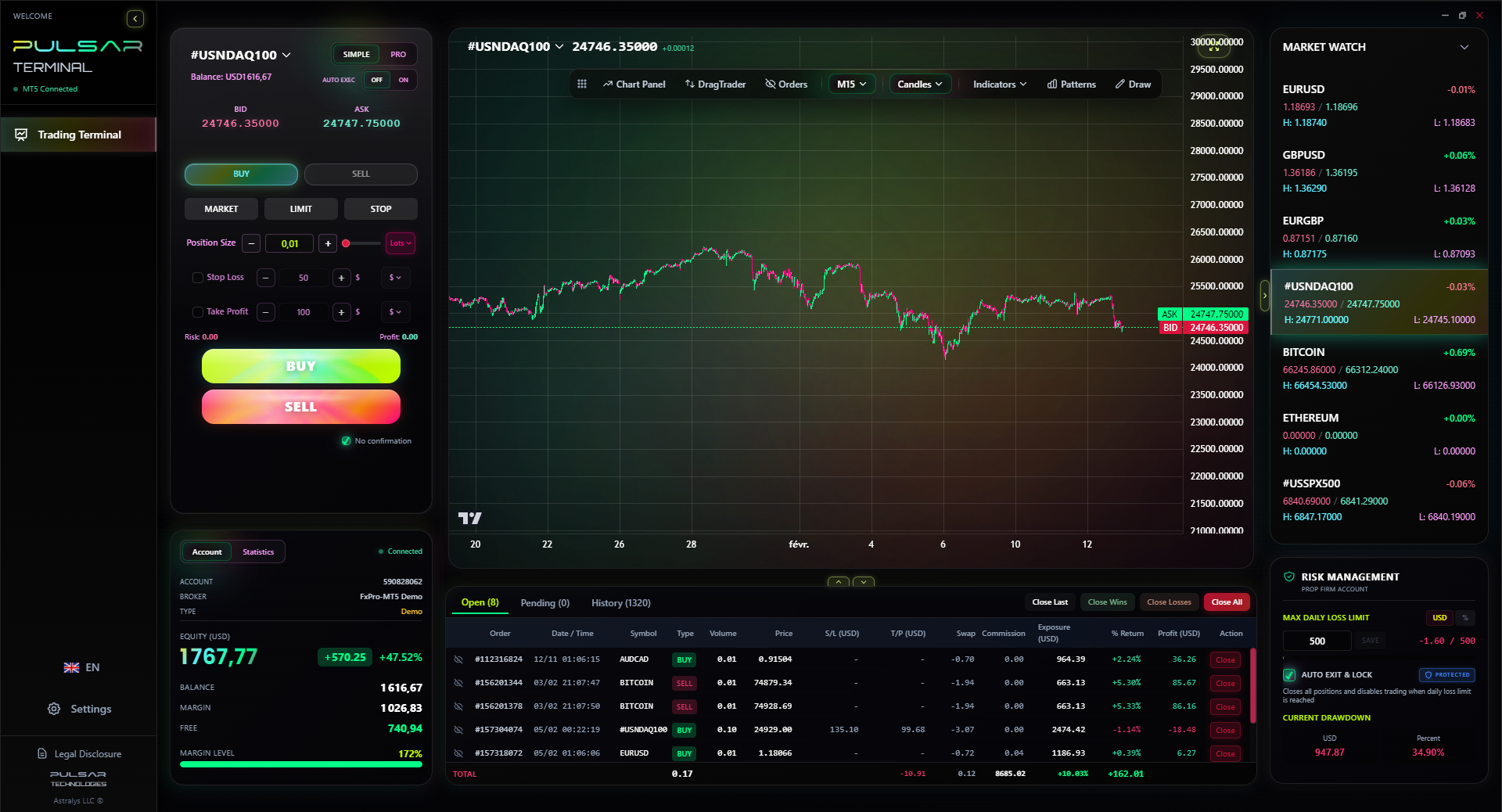
Manually managing a complex strategy with multiple take-profit levels is error-prone, but tools like Pulsar Terminal let you build and automate those precise exit rules directly on your MT5 charts.
Pulsar Terminal
The all-in-one MT5 companion: drag-and-drop orders, multi-TP/SL, trailing stop, grid trading, Volume Profile, and prop firm protection. Used by 1,000+ traders daily.
I've made these mistakes so you don't have to.
Pitfall 1: Over-Optimization (Curve-Fitting) This is the killer. You backtest a bot, tweak it until it makes a perfect, smooth equity curve on past data, then it fails live. You've just taught it to pass a history test, not to trade the future. My rule: if the strategy has more than 3-4 core parameters, it's probably over-optimized.
Pitfall 2: Ignoring Market Context No bot works in all conditions. A trend-following bot will lose money in a ranging market. You must know what market regime your bot is designed for and have a way to identify when that regime changes. Sometimes, the best thing a bot can do is nothing.
Pitfall 3: Poor Risk Management This is the biggest one. You must build absolute loss limits into the bot's code.
- Daily Loss Limit: The bot should stop trading if it hits a -3% daily loss.
- Maximum Position Size: Never let it risk more than 1-2% of your account on a single trade cycle.
- Maximum Drawdown Stop: Shut it off entirely at -15% account drawdown.
I learned this the hard way early on. I let a 'free' arbitrage bot run. It hit a series of losses, tried to 'average down,' and triggered a margin call. I lost R8,000 in an afternoon. The bot had no built-in circuit breaker. Now, every EA I use or build has these rules hard-coded. It's saved me countless times.
Pitfall 4: Set-and-Forget Mentality Automation isn't abdication. You must monitor your bot's performance weekly. Check its logs. Is it executing trades as expected? Have market conditions changed? Regular maintenance is part of the job.
“Failing with demo money is the whole point. It's the cheapest education you'll ever get.”
So, should you use a free forex bot in South Africa?
The honest answer: not as a ready-made, profit-generating machine. The chances of finding one that is genuinely free, legal, strong, and profitable for the long term in our specific market are almost zero.
However, as an educational tool, a starting point for your own development, or a way to automate a very simple, well-understood task, they have value.
My Recommended Path for a South African Trader:
- Learn to trade manually first. Develop and prove a strategy with your own hands. Understand what a pip and spread really cost you on your broker's platform.
- Once profitable manually, then explore automation. Start by automating just your trade execution. Let the bot place the trade, set the stop loss, and take profit based on your manual signal. This removes emotion and saves time.
- Graduate to full strategy automation. Code (or hire someone to code) your own proven manual strategy. This is the only way to have true confidence in your automated trading.
A Better 'Free' Alternative: Instead of hunting for a free bot, use free trading journal software. carefully logging your manual trades, analyzing your wins and losses, and improving your own decision-making will yield far greater returns than any black-box bot ever will. Your own disciplined mind is the most powerful trading tool you'll ever own. Start there.
FAQ
Q1Is it illegal to use a forex trading bot in South Africa?
No, the software itself isn't illegal. The FSCA regulates the brokers and the activity. The legal issue revolves around what you're trading. Using a bot to trade international markets (like EUR/USD) with funds from your foreign investment allowance is the standard, legal approach for individuals. Using it to speculate directly against the ZAR as an individual is where you run into problems with Exchange Control Regulations. Always use an FSCA-regulated broker.
Q2What is the best free forex bot?
I'm wary of recommending any specific 'best' free bot, as most are marketing traps. Instead, I recommend the best approach: look for simple, open-source EAs on communities like MQL5 where the code is visible. Use them as educational tools to understand how automation works, not as a plug-and-play profit system. The best bot for you will be one based on a strategy you already understand and trust.
Q3Can a free forex bot make me money?
It's highly unlikely in the long run. While a free bot might have a lucky streak, sustainable profitability requires a strong strategy that adapts to changing markets, coupled with professional-level risk management. These elements are almost never found in free software. The hidden costs (spreads, commissions, VPS) will also eat into any small gains it might generate.
Q4Do I need a VPS for a forex bot?
Absolutely, if you want it to run 24/7 without interruption. Running a bot on your home PC means it stops when your computer sleeps, your internet drops, or during loadshedding. A VPS (Virtual Private Server) runs continuously in a data center. For any serious automated trading, it's a necessary cost, typically R150-R500 per month in South Africa.
Q5What's the difference between a forex bot and a copy trading service?
A forex bot is a software program that follows a fixed set of rules to execute trades on your account. A copy trading service automatically replicates the trades of another human trader (a signal provider) onto your account. With a bot, you're trusting code. With copy trading, you're trusting a person. Both carry significant risk, but with copy trading, you're also subject to that person's emotional decisions and potential recklessness.
Q6How much money do I need to start with a forex bot?
Much more than you think. Even with a 'free' bot, you need enough capital to withstand normal drawdowns without risking a huge percentage of your account. I would never recommend starting with less than R20,000 in a live account for any form of automated trading. This allows for sensible position sizing (e.g., 0.01-0.05 lots) and gives the strategy room to breathe without one bad week wiping you out. Start on a demo account first, always.
Prof. Winston's Lesson
Key Takeaways:
- ✓Free bots are usually sales demos or overly simplistic strategies.
- ✓Legal use hinges on your broker and trading ZAR vs. international pairs.
- ✓Hidden broker fees can turn a winning bot into a loser.
- ✓Test any bot for 3+ months on demo before risking real money.
- ✓The best automation executes your own proven manual strategy.
How useful was this article?
Click a star to rate
Weekly Trading Insights
Free weekly analysis & strategies. No spam.
About the Author
David van der Merwe
Emerging Markets Trader
Johannesburg-based trader with 11 years in emerging market currencies. Specializes in ZAR pairs, FSCA-regulated trading, and South African market analysis.
Comments
Risk Disclaimer
Trading financial instruments carries significant risk and may not be suitable for all investors. Past performance does not guarantee future results. This content is for educational purposes only and should not be considered investment advice. Always conduct your own research before trading.
You Might Also Like

Cara Trading Forex Sukses: 7 Prinsip dari Trader Profesional
Cara trading forex sukses dengan 7 prinsip trader pro: manajemen modal, disiplin, journal trading, backtest. Data nyata, bukan janji profit palsu.
Jam Trading Forex Terbaik untuk Trader Indonesia: Panduan Lengkap dengan Tabel Waktu
Panduan jam trading forex untuk trader Indonesia. Tabel 4 sesi dunia, jam emas 20:00-00:00, sesi mana yang harus dihindari. Data akurat + tips dari trader berpengalaman.
Top 5 Sàn Forex Uy Tín Nhất 2026: Review Jujur dari Trader Indonesia
Top 5 sàn forex uy tín 2026 untuk trader Indonesia. Review jujur: spread, deposit, withdraw, dukungan lokal. Exness, XM, IC Markets & lebih.
Get Pulsar Terminal
All these calculators are built into Pulsar Terminal with real-time data from your MT5 account. One-click position sizing, automatic risk management, and instant calculations.
Get Pulsar Terminal