


Let's get one thing straight: there's no such thing as a free lunch, and that goes double for funded trading accounts.

Olumide Adeyemi
West African Trading Pioneer ·  Nigeria
☕ 11 min read
What you'll learn:
- 1What Exactly is a 'Free' Funded Account?
- 2The Real Costs for Nigerian Traders
- 3Prop Firms Actually Working for Nigerians in 2024
- 4A Step-by-Step Plan to Pass the Challenge
- 5Pitfalls That Will Fail You (And How to Avoid Them)
- 6Trading Strategies That Work for Funded Accounts
- 7You Passed! Now What? (The Real Funded Account)
Let's get one thing straight: there's no such thing as a free lunch, and that goes double for funded trading accounts. Every month, I see hundreds of Nigerian traders get burned chasing the dream of 'free' capital. The reality? You're not getting free money. You're paying for an audition, and the house always wins if you don't know the rules. This guide cuts through the hype to show you how these programs really work, which ones are worth your time, and how to actually pass the evaluation without blowing your own cash first.
When a prop firm or broker says 'free funded forex account,' they're talking about a specific deal. You don't pay the capital, but you pay to prove you can handle it. It's a performance-based contract.
Think of it like this: a bank won't give you a loan to start a business without checking your credentials. Prop firms won't give you their capital without checking your trading. The 'free' part usually means you don't need a huge deposit. Instead, you pay a one-time evaluation fee - anywhere from ₦15,000 to ₦80,000 - for the chance to trade a simulated account under strict rules. Pass those rules, and they'll give you a live account with their money.
Here's the core trade-off: you risk a relatively small fee for access to potentially large capital. They risk their capital on a proven trader. Your profit is split (often 50/50 to 90/10 in your favor). It's not charity; it's a business partnership with a very high bar for entry.

Warning: The word 'free' is a marketing hook. Your evaluation fee is real money. I've seen traders blow ₦200,000 in a month trying and failing different 'free' challenges. Treat that fee as your most important trade of the month.
“The word 'free' is a marketing hook. Your evaluation fee is real money.”
Let's talk numbers in Naira. That 'free' account has layers of costs you must budget for.
The Evaluation Fee: This is your ticket. For a $100,000 account challenge, fees range from $99 to $250. At current rates, that's ₦45,000 to ₦115,000. Some firms offer discounts or sales, especially around Black Friday.
The Hidden Cost of Rules: This is the big one. To pass, you'll face rules like a 5% maximum daily loss and a 10% maximum total loss. Hit that limit, and you fail. These rules force a conservative style. If your normal strategy involves 5% risk per trade, you'll fail in a day. You need a strategy built for consistency, not home runs. I learned this the hard way. Back in 2021, I failed a ₦50,000 challenge in 48 hours because my usual swing trading stop was too wide for their daily loss limit.
Profit Split & Withdrawal Fees: You pass! Now you share profits. A 80/20 split is common. On a ₦10 million profit, you keep ₦8 million. But check the withdrawal terms. Some firms charge fees or have minimum withdrawal amounts. Always read the FAQ.
Infrastructure Cost: You need a reliable laptop, stable internet (we all know the struggle), and possibly a VPN for some international platforms. This isn't optional. A disconnection during a volatile news event can trigger a stop-loss and fail your challenge.
A Typical Cost Breakdown
Let's say you go with a mid-tier prop firm:
| Item | Cost in Naira (Approx.) | Notes |
|---|---|---|
| Evaluation Fee | ₦55,000 | One-time payment |
| Data Subscription (Optional) | ₦5,000/month | For economic calendars, news feeds |
| Backup Internet (GSM) | ₦10,000/month | A must-have for reliability |
| Total Initial Outlay | ~₦70,000 | Before you place a single trade |
This is why you must use a position size calculator religiously. One oversized trade can wipe out your entire investment.

💡 Winston's Tip
Your challenge fee is your most important trade. Risk it only after you've passed your own 2-week simulation with the exact same rules. If you can't beat the demo, you won't beat the challenge.
“Passing isn't about genius trades. It's about discipline and a system.”
Not all prop firms are created equal. Some have terrible payout records or impossible rules. Based on my experience and community feedback, these are the ones that consistently work for Nigerian traders right now.
1. FTMO: The gold standard, but also the toughest. They're well-regulated, pay on time, and are respected globally. The downside? Their evaluation is strict. They use a 5% daily loss and 10% overall loss rule, and you must hit a 10% profit target. I passed an FTMO challenge in 2022. My strategy was painfully boring: only trading the EUR/USD London session with a 0.5% risk per trade. It took 3 weeks to hit the 10% target, but the consistency paid off.
2. The5%ers: A great alternative. They offer a 'Bootcamp' model with more flexible rules. They sometimes allow higher daily drawdowns (scaled to your account size). Their profit split starts at 50/50 but can go up to 100% for top performers. Payouts to Nigerian bank accounts (via wire transfer) have been reliable, though they take 3-5 business days.
3. FundedNext: Gaining popularity for their straightforward rules and good support. They have a two-phase evaluation but offer a 'Consistency Rule' instead of a strict profit target in phase two, which can be easier for certain styles.
4. Local/Regional Options: Be very careful here. I've tested two 'Nigerian' prop firms. One vanished after 6 months. The other had such wide spreads on major pairs it was nearly impossible to be profitable. Stick with internationally recognized, transparent firms with years of track record.

Pro Tip: Before paying any fee, join online forums or Telegram groups for Nigerian traders. Search for the prop firm's name + 'payout Nigeria.' Real user experiences from last month are worth more than any slick website promise.
“Passing isn't about genius trades. It's about discipline and a system.”
Passing isn't about genius trades. It's about discipline and a system. Here's the plan I give my students.
Phase 1: The Preparation (1-2 Weeks) Don't even look at the challenge rules yet. First, you need a verified, consistent strategy. Pick one major pair - like the EUR/USD or XAU/USD. Backtest it for at least 100 trades. The key metric isn't total profit; it's your maximum consecutive losses and largest drawdown. If your strategy ever had a 15% drawdown in testing, it will fail a 10% max-loss challenge.
Phase 2: The Simulation (2+ Weeks) Open a demo account with the same broker the prop firm uses (often IC Markets or Pepperstone). Load it with the exact amount of the challenge account (e.g., $100,000). Now, trade your strategy but impose the CHALLENGE RULES on yourself. Use a spreadsheet to track your daily drawdown like a hawk. This is where you'll fail mentally, and it's free. I simulated an FTMO challenge three times before I paid the fee. Failed the sim twice. That saved me over ₦100,000.
Phase 3: The Execution (The Actual Challenge) By now, trading should feel mechanical.
- Risk Per Trade: Never, ever exceed 1% of the account's starting balance. I use 0.5%. On a $100k account, that's $500 risk per trade. This is non-negotiable.
- Daily Stop: The moment you're down 3% on the day, stop trading. Close the platform. The 5% limit is a cliff edge, not a target.
- Target: Aim for 0.5%-1% profit per day. Small, consistent gains. The 10% target will come in time. Greed is your number one enemy.
The Mental Key: This is not your money. You are a risk manager first, a trader second. Your job is to preserve capital, not impress anyone. One of my most successful challenge passes netted just 1.2% in the first week. It was boring. It was perfect.
💡 Winston's Tip
The daily loss limit is a circuit breaker, not a target. If you're down 2-3% on the day, shut it down. Preserving capital for tomorrow is a winning trade.
“You are a risk manager first, a trader second. Your job is to preserve capital, not impress anyone.”
I've failed challenges. My friends have failed. Here are the classic mistakes.
1. Overtrading: The rules create psychological pressure to 'hurry up.' You see you're down 2% for the day, so you take a 3% risk trade to get back. That's a recipe for a margin call on your challenge. The fix? Limit yourself to 1-3 high-probability setups per day.
2. Ignoring Time Zones: Most firms calculate the daily loss limit over a 24-hour period, often based on GMT/Server time. If you trade at 11 PM Nigerian time, and your trade is still open at midnight server time, any loss at that rollover counts for the NEXT day. I failed a challenge exactly like this. A winning trade reversed at rollover, hit my stop, and breached the next day's daily limit at 12:05 AM. Game over.
3. Not Understanding 'Balance vs. Equity': This is critical. Your max loss is usually based on the starting balance or the highest equity (floating profit), not your current balance. If you start at $100,000 and make $5,000, your new 'high watermark' is $105,000. Your max loss is now 10% of THAT ($94,500), not 10% of the start ($90,000). This protects your profits but is confusing.
4. Choosing the Wrong Account Size: Starting with a $200,000 account because the fee is slightly higher is a trap. The profit target is a percentage. 10% of $200k is $20k - much harder to achieve psychologically and practically than 10% of $50k ($5k). Start small. Prove the system. Then scale up.

Example: You start a $100k challenge. Max loss is 10% = $90,000 floor. You profit to $103,000. Your new floor is $103,000 - 10% = $92,700. If your equity falls to $92,600, you fail, even though you're still above the original $90k floor. Track your current allowable loss every single day.
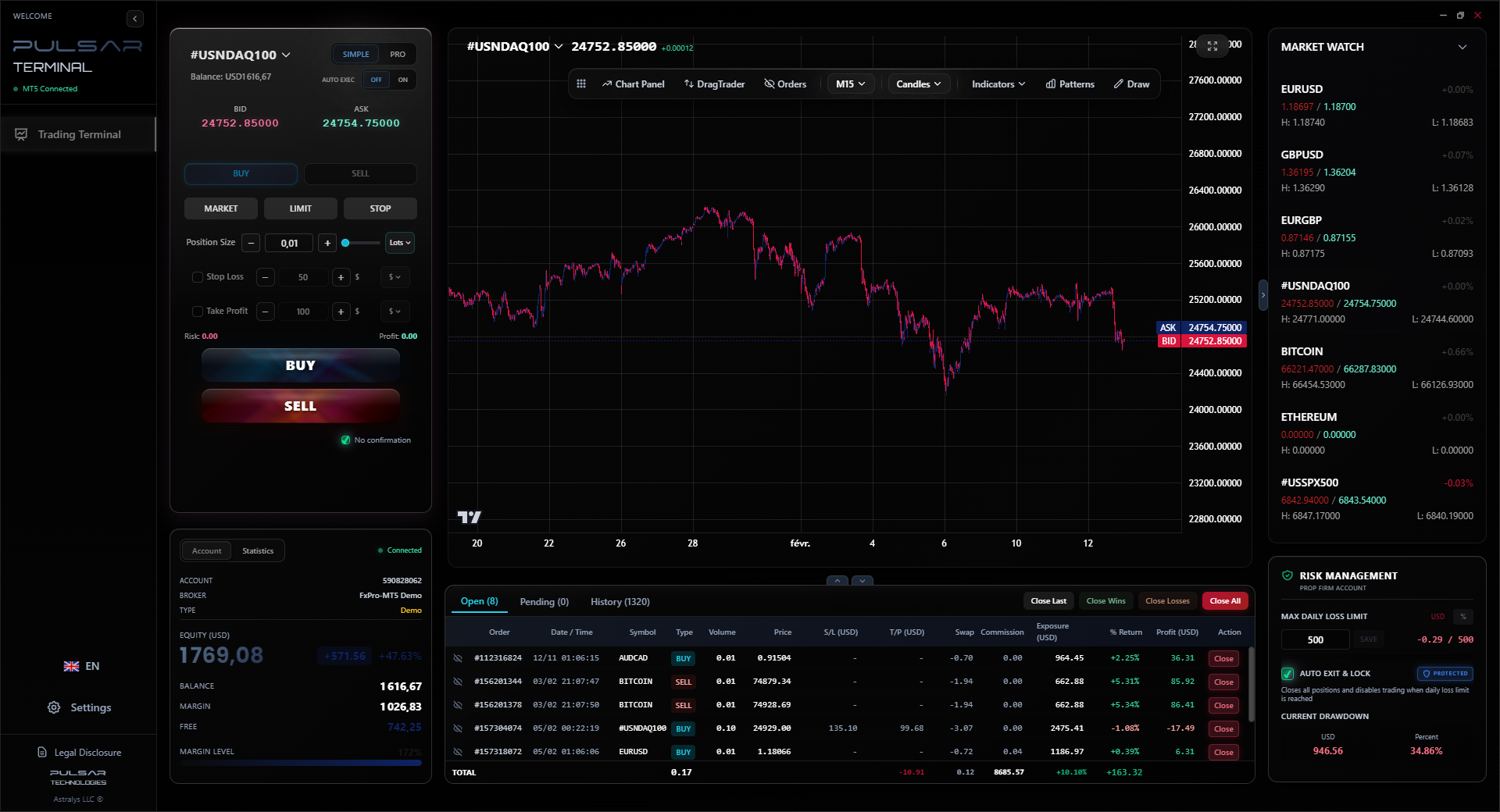
Managing the complex daily loss and trailing stop rules of a prop firm challenge is stressful, but a tool like Pulsar Terminal can automate those protections directly on your MT5 platform.
Pulsar Terminal
The all-in-one MT5 companion: drag-and-drop orders, multi-TP/SL, trailing stop, grid trading, Volume Profile, and prop firm protection. Used by 1,000+ traders daily.
“You are a risk manager first, a trader second. Your job is to preserve capital, not impress anyone.”
Your Nollywood-style 'big blowout' trade strategy won't work here. You need a grind-it-out approach.
High-Probability, Low-Risk Scalping: This is my go-to for challenges. I look for 1:1.5 risk-reward ratios on the 5-minute chart. The win rate needs to be high (60%+). The profits are small per trade, but they add up without large drawdowns. A proper scalping strategy built around key London or New York session levels is perfect. Use the RSI indicator for overbought/oversold confluence, but keep it simple.
Swing Trading with Tight Stops: If you're a swing trader, you must adapt. Instead of a 100-pip stop on XAU/USD, you need to find entries with 30-40 pip stops. This means waiting for much more precise levels. Use the MACD indicator on the 4-hour chart for trend confirmation, but enter on a 1-hour pin bar or engulfing candle. Your position size must be smaller to accommodate the tighter stop.
The 'News Avoidance' Strategy: Honestly, one of the safest. During major news events (US NFP, CPI), spreads widen and volatility spikes. A quick spike can trigger your stop and ruin your daily drawdown. My rule in a challenge: I do not trade 30 minutes before or after high-impact news. I'd rather miss a move than get whipsawed out. The economic calendar is your bible.
The common thread? Precision over prediction. You're not trying to catch the entire move. You're trying to catch a predictable, small piece of it, over and over again. It's a marathon where sprinting gets you disqualified.
“The funded stage is where the real discipline begins. Don't trade to be a hero. Trade to be consistent.”
Congratulations! You've swapped the challenge account for a live, funded account. The psychology changes here, and so should your approach.
The First Month Mindset: The pressure should decrease, but don't get complacent. The firm is now watching your real risk management. Stick to the exact same strategy that got you through. Your first goal is not to make a million; it's to secure your first payout. That proves the system works end-to-end.
Scaling and Payouts: Most firms have scaling plans. If you hit your profit targets for 3-4 months consistently, they might increase your capital. This is how you grow. For payouts, they're usually monthly. You request a withdrawal, they process it (taking their split), and send your share via bank transfer or crypto. Document everything. Keep screenshots of your withdrawal requests and confirmations.
The Bigger Picture: A funded account is a tool, not an end goal. It removes the barrier of personal capital. Your focus shifts entirely to the quality of your trading. The best traders I know treat the prop firm's capital with more respect than their own. It's a professional relationship.
One final, hard truth: even with a funded account, you can lose it. The rules (daily loss, max drawdown) still apply. I've seen traders pass a challenge, get a $200k account, and then blow it in a week trying to 'get rich quick.' The funded stage is where the real discipline begins. Don't trade to be a hero. Trade to be consistent.
💡 Winston's Tip
When funded, your first withdrawal is more important than your biggest win. It proves the entire system - your skill, their payout - works. Make that your initial goal.
FAQ
Q1Are there any truly free funded accounts with no evaluation fee?
Almost never. If you find one, it's likely a scam or has impossible trading conditions (like 50-pip spreads). Some brokers like Exness or XM might run rare promotions with 'contest' prizes, but these are one-offs, not sustainable funding programs. The standard model is pay-to-play via an evaluation challenge.
Q2What is the best prop firm for beginners in Nigeria?
For a beginner, I'd recommend starting with a firm that has a lower profit target and more educational support, like The5%ers' 'Bootcamp' model. Their rules can be slightly more forgiving as you learn the strict discipline required. Avoid the toughest firms (like FTMO) for your very first attempt. Start small, learn the process, then scale up.
Q3How do I receive payouts from prop firms in Nigeria?
Most international prop firms pay via international bank wire transfer or cryptocurrencies (USDT, Bitcoin). Bank wires can take 3-7 business days and your local bank will convert to Naira, often at a less-than-ideal rate and with fees. Crypto withdrawals are faster (often within 24 hours) and you can convert to Naira on a local P2P platform. Always check the firm's specific withdrawal policy.
Q4Can I use Expert Advisors (EAs) or robots on a funded account?
This is a firm-by-firm rule. Most major prop firms like FTMO and The5%ers DO allow EAs, but with a big caveat: the EA must not violate any other rule (like news trading restrictions) and must not be used to exploit the system (e.g., latency arbitrage). You must declare you're using an EA. Always get written confirmation from support before using one.
Q5What happens if I hit the profit target very quickly?
Don't! This is a common mistake. If you hit a 10% target in 2 days, it often raises a red flag for the risk team. They might review your trades for gambling-like behavior. It's better to take 2-4 weeks, showing consistent, controlled trading. The goal is to look like a reliable risk manager, not a lottery winner.
Q6Is my evaluation fee refundable if I pass?
Sometimes, but don't count on it. A few firms offer to refund your challenge fee after you've made a certain amount of profit in the live funded account (e.g., after your first 2-3 payouts). This is a bonus, not the norm. Always assume the fee is a sunk cost - the price of your audition.
Prof. Winston's Lesson
Key Takeaways:
- ✓A 'free' funded account costs ₦45k-₦115k in evaluation fees.
- ✓Never risk more than 0.5-1% of the starting balance per trade.
- ✓Simulate the challenge for 2+ weeks on a demo first.
- ✓Track your 'high watermark' equity to avoid accidental failure.
- ✓Your first funded account goal is a successful payout, not a million.
How useful was this article?
Click a star to rate
Weekly Trading Insights
Free weekly analysis & strategies. No spam.
About the Author
Olumide Adeyemi
West African Trading Pioneer
One of Nigeria's most active forex trading educators. 8 years of experience trading from Lagos. Specializes in low-capital strategies and prop firm challenges for African traders.
Comments
Risk Disclaimer
Trading financial instruments carries significant risk and may not be suitable for all investors. Past performance does not guarantee future results. This content is for educational purposes only and should not be considered investment advice. Always conduct your own research before trading.
You Might Also Like

Cara Trading Forex Sukses: 7 Prinsip dari Trader Profesional
Cara trading forex sukses dengan 7 prinsip trader pro: manajemen modal, disiplin, journal trading, backtest. Data nyata, bukan janji profit palsu.
Jam Trading Forex Terbaik untuk Trader Indonesia: Panduan Lengkap dengan Tabel Waktu
Panduan jam trading forex untuk trader Indonesia. Tabel 4 sesi dunia, jam emas 20:00-00:00, sesi mana yang harus dihindari. Data akurat + tips dari trader berpengalaman.
Top 5 Sàn Forex Uy Tín Nhất 2026: Review Jujur dari Trader Indonesia
Top 5 sàn forex uy tín 2026 untuk trader Indonesia. Review jujur: spread, deposit, withdraw, dukungan lokal. Exness, XM, IC Markets & lebih.
Get Pulsar Terminal
All these calculators are built into Pulsar Terminal with real-time data from your MT5 account. One-click position sizing, automatic risk management, and instant calculations.
Get Pulsar Terminal