


It was 3:15 PM SAST on a Tuesday, and my phone was buzzing non-stop.

David van der Merwe
Emerging Markets Trader ·  South Africa
☕ 10 min read
What you'll learn:
It was 3:15 PM SAST on a Tuesday, and my phone was buzzing non-stop. A Telegram group I’d joined for ‘free reliable forex signals’ was blowing up. ‘SELL USD/ZAR AT 18.7520, SL 18.8020, TP 18.6800.’ The admin, ‘ForexProphetZA,’ had posted a screenshot of a massive winning trade from the day before. I hesitated, then pulled the trigger. Two hours later, I was stopped out for a R1,200 loss. The group went silent. The ‘prophet’ had vanished, and I was left staring at a red P&L, realizing I’d just paid for my ‘free’ signal in the worst way possible.
Let's cut through the marketing fluff. A forex signal is just a suggestion to buy or sell a currency pair at a specific price, with suggested stop-loss and take-profit levels. That's it. It's a trade idea, not a magic spell. The promise of free reliable forex signals is the ultimate siren song for new traders: let someone else do the hard work, and you just collect the profits. Sounds perfect, right?
Here's the reality. A signal is only as good as the strategy and discipline behind it. Most free signals you'll find in South Africa are generated in one of three ways: by a half-baked algorithm backtested for two weeks, by a 'guru' looking at a single chart with no context, or, worst of all, completely fabricated after the fact. I've seen admins post a 'signal' after a big move has already happened, then edit the original message timestamp to make it look predictive. It's a dirty game.

Warning: The FSCA considers providing trading signals a financial service. In 2024, they fined a guy over R1 million and banned him for 10 years for running an unlicensed signal service on Telegram. If you're following some random on social media, you have zero legal recourse if it all goes wrong.
The core question isn't 'are the signals free?' It's 'what is the provider's motive?' If they're not charging you, they're making money another way - often from the broker via a dodgy affiliate deal that encourages you to trade more (and lose more), or they're building a following to later sell a 'premium' course. Your profit is not their primary concern.
“The promise of free reliable forex signals is the ultimate siren song for new traders.”
The Incentive Problem
Think about it. If you had a genuinely profitable trading method that took years of pain and thousands in losses to develop, would you give the signals away for free? Of course not. You'd either trade it yourself with your own capital or charge a serious premium for access. Free signal providers lack the most important ingredient: skin in the game. They don't lose money when you do.
The Data Is Usually Fake
This is the biggest red flag. You'll see screenshots of trading accounts with 90% win rates and massive profits. Anyone with a basic charting package and Photoshop can make those. Real trading isn't like that. A professional swing trading strategy might have a 55-60% win rate. The profits come from letting winners run and cutting losers fast, not from a flawless record. I once tracked a 'free signal guru' for a month. His posted signals had a claimed 80% win rate. When I manually checked every single entry and exit against the actual price chart, the real win rate was under 40%. The losses were just never mentioned.
No Risk Management Context
A signal is just three numbers: entry, stop loss, take profit. What it never tells you is the position size. A 50-pip stop on EUR/USD is very different from a 50-pip stop on USD/ZAR, which can be far more volatile. A free signal doesn't know if that trade represents 1% or 10% of your account. Using a position size calculator is your job, but most newbies ignore it and blow up their accounts following 'sure thing' signals with stops that are way too tight for the pair's normal noise.

Example: Let's say you get a free signal to buy EUR/USD at 1.0850, SL 1.0820 (30 pips), TP 1.0910 (60 pips). Looks good, right? 2:1 reward-to-risk. But if you put R10,000 on that trade with 30:1 use (the FSCA max for retail), a 30-pip loss would cost you roughly R1,000, or 10% of your account. One loss wipes out weeks of careful gains. The signal provider won't tell you that.

💡 Winston's Tip
A 'free' signal that loses you money is the most expensive advice you'll ever get. The cost is measured in lost capital and reinforced bad habits.
“If you had a genuinely profitable trading method, would you give the signals away for free? Of course not.”
This isn't a theoretical discussion. Our regulator, the Financial Sector Conduct Authority (FSCA), has drawn a line in the sand. Providing financial advice or trading signals without a license is illegal. Full stop. The case of Kabelo Emanuel Mogale in 2024 is your wake-up call. R1,015,315.87 fine. 10-year debarment. All for running a Telegram signal group.
What does this mean for you, the trader? It means any South African offering you 'free reliable forex signals' on WhatsApp, Telegram, or Instagram is likely operating illegally. If they scam you, your chances of getting your money back are almost zero. The FSCA can't help you recover funds from an unlicensed entity they've already busted.
This is why I only use brokers with a solid regulatory footprint. I need to know my funds are segregated and there's a real entity to complain to if something goes wrong with execution. I've had good experiences with the platforms and spreads from Exness and IC Markets for international access, but for pure peace of mind on regulation, a local FSCA-licensed broker is the safest bet. It removes one massive variable of risk.
The use cap of 30:1 for retail traders, enforced by the FSCA, is actually a blessing in disguise when dealing with signals. It prevents the wild, account-obliterating position sizes that unregulated offshore brokers allow. That signal telling you to load up with 500:1 use? That's a one-way ticket to a margin call.
“If you had a genuinely profitable trading method, would you give the signals away for free? Of course not.”
Okay, let's say you're still curious and want to test the waters. Here's how to investigate without setting your money on fire.
1. Demand a Verifiable Track Record: Not screenshots. A link to a verified myfxbook or FXBlue live account statement that spans at least 6-12 months. Look for consistency, not astronomical returns. Check the average win vs. average loss, the win rate, and the maximum drawdown (the biggest peak-to-trough loss). If the drawdown is over 20%, it's a rollercoaster, not a strategy.
2. Demo Test for a FULL Market Cycle: Don't use real money. Take their signals for a minimum of one month, and ideally through a volatile news period (like an SARB interest rate decision). Track every signal carefully in a spreadsheet: entry price, time, stop, target, and the actual market outcome. This will reveal the real spread slippage and execution issues you'd face.
3. Understand Their Strategy: Ask what they are trading and why. If they say 'proprietary algorithm' and refuse to explain the core concept (e.g., 'we trade breakouts during London open using volume confirmation'), walk away. If they can explain it, see if it makes sense to you. Does it align with a known approach like scalping or swing trading?
4. Check for Realistic ZAR-Pair Knowledge: Many international signal services ignore ZAR pairs. A good local service should understand the unique quirks of USD/ZAR or EUR/ZAR - like wider spreads, higher volatility, and sensitivity to local political news. If all their signals are only for EUR/USD, that's fine, but know that you're getting a generic product.
I made the mistake early on of following a UK-based signal service for ZAR trades. Their model didn't account for the local liquidity crunches. Their 15-pip stop losses on GBP/ZAR were getting hit by normal market noise within minutes. I lost on 8 trades in a row before I realized their system was broken for our market.
💡 Winston's Tip
Your first profitable month following signals is a trap. It builds dependency. Your first profitable month trading your own plan is liberation.
“Spending 100 hours learning to read a chart is infinitely more valuable than spending 100 hours searching for a free holy grail signal.”
Here's the honest truth from a mentor: spending 100 hours learning to read a chart is infinitely more valuable than spending 100 hours searching for a free holy grail signal. The goal isn't to find someone to follow blindly; it's to learn the language of the market so you can assess any trade idea, free or paid, on its own merits.
Start with one major pair like EUR/USD. Learn its average daily range, what moves it (interest rate differentials, economic data from the EU and US), and what its chart tends to look like. Use a simple strategy. For years, my bread and butter was just trading bounces off key support and resistance on the 4-hour chart, using the RSI indicator for overbought/oversold clues. No fancy signals needed.

Pro Tip: Instead of paying for signals, pay for data. A TradingView Pro subscription gives you better charts and backtesting tools. Use that to test your own ideas. A journaling app like TraderSync forces you to review your own trades. This is an investment in you, not a payment to a guru.
Use free signal ideas as a learning tool, not a command. See a signal to buy gold (XAU/USD)? Don't just copy it. Pull up the gold chart. Why might that be a good buy? Is it at a support level? Is the US dollar weakening? Doing this homework turns a passive signal into an active learning exercise. Eventually, you'll start seeing the setups yourself before any signal service posts them.
“Spending 100 hours learning to read a chart is infinitely more valuable than spending 100 hours searching for a free holy grail signal.”
If you are going to act on trade ideas quickly, you need a professional setup. This is where most free signal followers fail miserably. They're trying to manually enter a complex trade with multiple targets on a phone app while the market is moving. It's a recipe for slippage and errors.
You need a platform that lets you execute a plan precisely. MetaTrader 5 (MT5) is the standard for a reason, but its native interface can be clunky for complex order management. This is where companion tools show their value.
Let's say you get a signal with a main target and two partial profit targets - a common strategy to bank some profit early and let the rest run. Manually closing parts of a position on MT5 is slow. A tool that allows drag-and-drop order placement and multi-level take-profit/stop-loss management automates the entire execution plan the moment you enter the trade. It takes the emotion and delay out of the process.
Similarly, if a signal service suggests using a trailing stop, you shouldn't be babysitting the chart to move it manually. Automation ensures the rule is followed without you needing to stare at the screen. Whether you're testing signals on a demo or executing your own plans, this level of control is non-negotiable for serious trading. It turns a good idea into a well-managed trade.
💡 Winston's Tip
The FSCA fine isn't just news; it's a map. It shows you exactly where the amateurs and frauds are operating. Regulators do your scouting for you - pay attention.
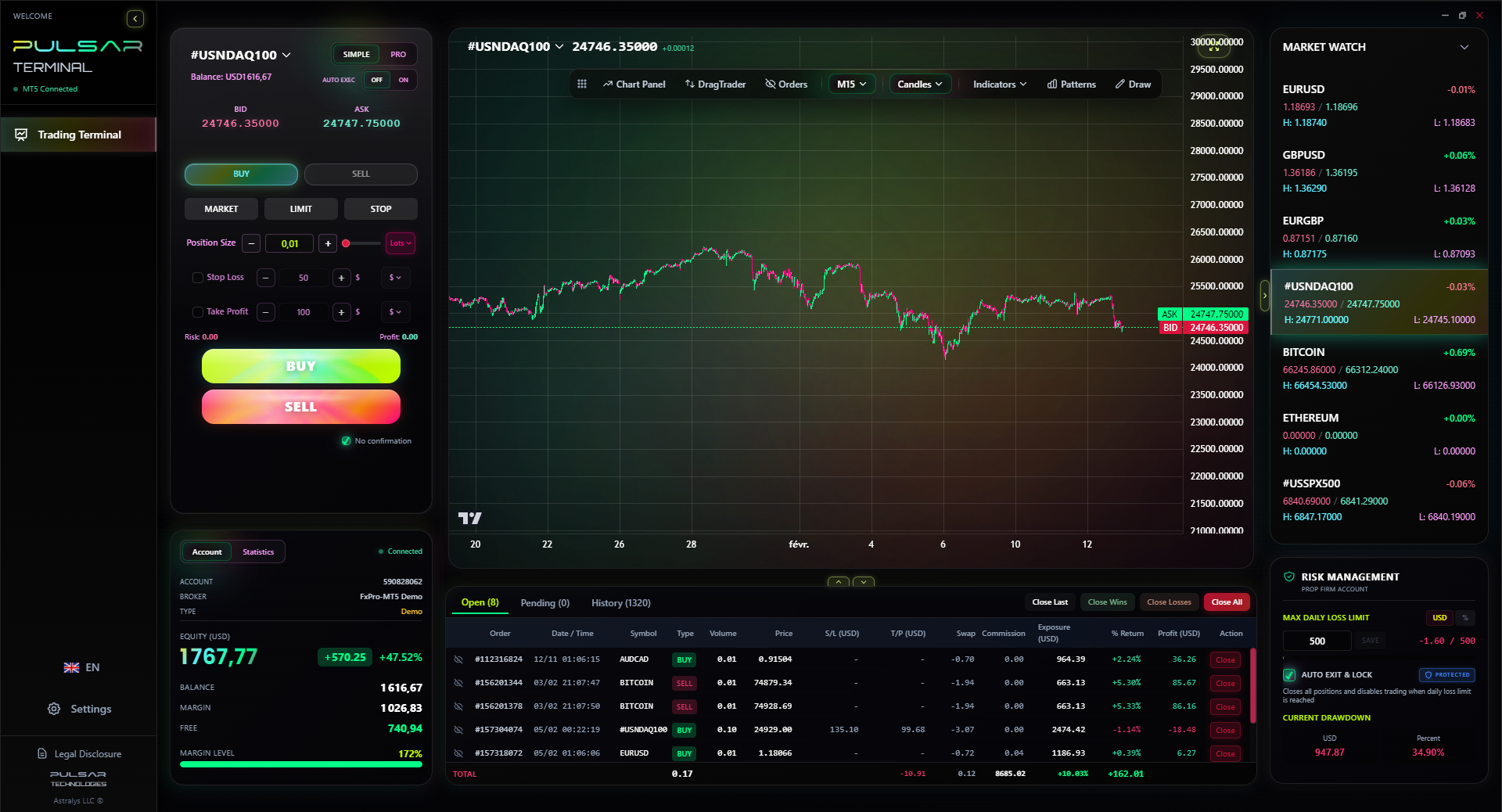
If you're testing signal-based strategies or managing multi-target trades, a tool like Pulsar Terminal that automates complex order execution on MT5 removes human error and delay.
Pulsar Terminal
The all-in-one MT5 companion: drag-and-drop orders, multi-TP/SL, trailing stop, grid trading, Volume Profile, and prop firm protection. Used by 1,000+ traders daily.
“The market doesn't reward followers; it rewards those who understand its rhythms.”
So, do free reliable forex signals exist in South Africa? In the way most beginners hope for - a consistent, profitable, no-strings-attached service - the answer is almost certainly no. The regulatory action proves the space is filled with bad actors. The incentive structure is broken.
The reliable path is longer and harder, but it's the only one that leads to sustainable trading. It involves:
- Education First: Learn basic technical and fundamental analysis.
- Broker Choice: Use a reputable, well-regulated broker like those we've reviewed (XM, Pepperstone).
- Demo Trading: Develop and test your own simple strategy for months.
- Informed Use of Ideas: If you look at signals, use them as a starting point for your own analysis, not the end of it.
I lost nearly R15,000 in my first year chasing signals and 'sure things' from online gurus. The turning point was when I stopped looking for the next trade and started studying why my last trade failed. That shift from external dependency to internal accountability changed everything. The market doesn't reward followers; it rewards those who understand its rhythms. Your energy is better spent learning the rhythm yourself.
FAQ
Q1Are free forex signals legal in South Africa?
Receiving them is not illegal for you, the trader. However, providing them as a service without an FSP license from the FSCA is illegal. The FSCA's R1 million fine in 2024 against an unlicensed signal provider shows they are actively enforcing this. This means most free signal groups are operating outside the law, offering you no protection.
Q2What is the best free forex signal app?
I'm going to be blunt: there isn't one. The 'best' apps or Telegram channels are often just the best at marketing. Instead of an app, use a demo account on a platform like MT5 and follow economic calendars (like Forex Factory). The news and data releases themselves are the original 'signals'; learning to interpret them is your real edge.
Q3Can I make money with free forex signals?
It's possible, but highly unlikely over the long term. You might get lucky on a few trades, but without understanding the strategy behind the signals, you won't know when to stick with it or abandon it during a losing streak. You also have no control over risk management. Most people end up losing money because they risk too much on a single 'free' tip.
Q4What should I look for in a signal service?
Look for transparency: a verified, long-term track record (not screenshots), a clear explanation of their trading strategy, and realistic performance stats (win rate between 50-70%, reasonable drawdown). They should also discuss risk management. If they promise guaranteed profits or 90% win rates, run.
Q5How do I start forex trading without signals?
Start small. Open a demo account with an FSCA-regulated broker. Pick one major currency pair. Learn what a pip is, how to place a trade, and how to set a stop loss. Practice identifying basic support and resistance levels. Use free resources to learn about one or two indicators, like the MACD indicator. Trade your demo account for at least 3-6 months before even thinking about real money.
Q6Why do so many signal services use Telegram?
Because it's easy, free, and allows for anonymity. Admins can create large groups, post images and messages instantly, and then delete evidence or vanish overnight. It's the perfect platform for the 'pump-and-dump' style of signal promotion with zero accountability.
Q7Are paid signals better than free signals?
Not necessarily. A high price tag doesn't guarantee quality. The same vetting process applies: demand verified results and a clear strategy. Many paid services are just free services with a subscription fee slapped on. The real value is in education, not just being told where to click.
Prof. Winston's Lesson
Key Takeaways:
- ✓Free signals lack provider skin in the game.
- ✓The FSCA fined a signal provider R1 million in 2024.
- ✓Demo-test any signal source for a full month.
- ✓Real win rates are 50-70%, not 90%.
- ✓Invest in education, not signal subscriptions.
How useful was this article?
Click a star to rate
Weekly Trading Insights
Free weekly analysis & strategies. No spam.
About the Author
David van der Merwe
Emerging Markets Trader
Johannesburg-based trader with 11 years in emerging market currencies. Specializes in ZAR pairs, FSCA-regulated trading, and South African market analysis.
Comments
Risk Disclaimer
Trading financial instruments carries significant risk and may not be suitable for all investors. Past performance does not guarantee future results. This content is for educational purposes only and should not be considered investment advice. Always conduct your own research before trading.
You Might Also Like

Cara Trading Forex Sukses: 7 Prinsip dari Trader Profesional
Cara trading forex sukses dengan 7 prinsip trader pro: manajemen modal, disiplin, journal trading, backtest. Data nyata, bukan janji profit palsu.
Jam Trading Forex Terbaik untuk Trader Indonesia: Panduan Lengkap dengan Tabel Waktu
Panduan jam trading forex untuk trader Indonesia. Tabel 4 sesi dunia, jam emas 20:00-00:00, sesi mana yang harus dihindari. Data akurat + tips dari trader berpengalaman.
Top 5 Sàn Forex Uy Tín Nhất 2026: Review Jujur dari Trader Indonesia
Top 5 sàn forex uy tín 2026 untuk trader Indonesia. Review jujur: spread, deposit, withdraw, dukungan lokal. Exness, XM, IC Markets & lebih.
Get Pulsar Terminal
All these calculators are built into Pulsar Terminal with real-time data from your MT5 account. One-click position sizing, automatic risk management, and instant calculations.
Get Pulsar Terminal