


Are you searching for a 'fundamental analysis forex pdf' and finding nothing but generic, US-centric theory that doesn't help you trade the Rand? I was there too.

David van der Merwe
Emerging Markets Trader ·  South Africa
☕ 11 min read
What you'll learn:
- 1Why Those Generic PDFs Are Setting You Up to Fail
- 2The Real Drivers: What Actually Moves the ZAR
- 3Building Your South African Economic Calendar
- 4From News to Trades: A Practical ZAR Pair Strategy
- 5Mistakes I've Made (So You Don't Have To)
- 6Your Essential Local Resources (The Real 'PDF')
- 7Putting It All Together: Your Weekly Routine
Are you searching for a 'fundamental analysis forex pdf' and finding nothing but generic, US-centric theory that doesn't help you trade the Rand? I was there too. For years, I tried to force global models onto our local market and got burned. This guide is what I wish I'd had: a no-fluff, practical walkthrough of how fundamental analysis actually works for a trader sitting in Johannesburg or Cape Town, trying to make sense of USD/ZAR moves.
Let's be honest. You download a 'forex fundamental analysis pdf,' and it's full of beautiful theories about the US Federal Reserve and Eurozone inflation. It tells you to watch Non-Farm Payrolls. Great. But what does that tell you about why the Rand just spiked 50 pips against the Aussie dollar? Almost nothing.
The problem is context. Global fundamental analysis treats all currencies as equal players on the same field. They're not. The South African Rand (ZAR) is what we call a 'risk-sensitive' and 'commodity-linked' currency. Its value dances to a different tune than the US Dollar or the Euro. Applying a textbook model designed for stable, reserve currencies to the ZAR is like using a city map to navigate the bushveld. You'll get lost.
I learned this the hard way. Early in my career, I saw strong US GDP data and shorted USD/ZAR, thinking a strong US economy was good for global risk... therefore good for the Rand? Wrong. The data sparked a 'flight to quality,' and money poured into the dollar as a safe haven. USD/ZAR ripped higher, and I took a nasty loss. The global theory didn't account for the ZAR's specific role in the market's risk hierarchy.

Warning: Relying solely on international economic calendars is a classic mistake for SA traders. You'll miss the local events that actually move your pairs.

💡 Winston's Tip
The market discounts the expected. Your edge lies in gauging how the *actual* data differs from the *true* market expectation, not the published forecast.
Forget the textbook for a second. To trade ZAR pairs profitably, you need to monitor a specific set of local and global catalysts. Here’s what moves the needle.
Commodity Prices Are Your North Star
South Africa's economy is built on what comes out of the ground. Platinum, gold, coal, iron ore. When global prices for these commodities rise, the companies that mine them earn more foreign currency (mostly dollars). Those dollars get converted to Rands, increasing demand for the ZAR and pushing its value up. It's a direct pipeline. I keep a live widget of key commodity prices next to my USD/ZAR chart. It's that important.
The SARB and Interest Rate Differentials
This is where many new traders get confused. It's not just whether the South African Reserve Bank (SARB) hikes or cuts rates. It's about the difference between our rates and everyone else's. This is called the 'carry trade.' If South Africa offers 8% interest and the US offers 3%, international investors might borrow in USD, convert to ZAR, and earn that 5% difference. This buying pressure supports the Rand.
But, and it's a big but, this only works if investors believe the Rand will be stable or appreciate. If political risk spikes, that 5% yield won't be enough to compensate for a potential 10% currency crash. You have to weigh the yield against the risk sentiment. Tracking the SARB's statements, especially their view on inflation, is non-negotiable. Their tone can shift the market weeks before an actual rate decision.
The Ugly Truth: Political and Structural Risk
This is the part the pretty PDFs skip. In South Africa, fundamentals include Eskom's load-shedding stage, news about Transnet's rail lines, and the latest political scandal. These aren't abstract concepts; they directly impact GDP growth forecasts, investor confidence, and thus, the Rand's value. A major corruption headline can wipe out a week's worth of gains from strong commodity data. You have to factor in this 'South African risk premium.'

Example: In Q1 2024, platinum prices were decent, but USD/ZAR kept grinding higher. Why? Because persistent Stage 6 load-shedding was crippling economic output. The commodity signal was positive, but the local structural risk signal was screaming sell. The local risk won out.
“Applying a textbook model designed for stable, reserve currencies to the ZAR is like using a city map to navigate the bushveld.”
Your trading platform's built-in calendar isn't enough. You need to curate your own. Here are the key local data points I watch like a hawk, and how I interpret them.
Inflation (CPI) Data: The SARB's primary mandate is price stability. A CPI print significantly above their 4.5% target band (like the 5.6% we saw recently) immediately raises the probability of a rate hike. This can cause a short-term ZAR rally. I use the MACD indicator on the 1-hour chart to catch the momentum shift right after the data drop.
Retail Sales and Manufacturing Production: These are real-time health checks on the consumer and industrial economy. Weak numbers here reinforce negative growth stories and hurt the ZAR, even if global markets are calm. I often see a stronger reaction in EUR/ZAR or GBP/ZAR to this data than in USD/ZAR, as European traders assess emerging market risk.
Budget Speech and Medium-Term Budget Policy Statement (MTBPS): Mark these in red. The government's tax and spending plans can trigger massive volatility. A budget perceived as fiscally irresponsible can lead to instant Rand selling. I remember one MTBPS where I had a small long USD/ZAR swing trading position. The finance minister's speech was a disaster. The pair moved 300 pips in my favour in under an hour. I closed half for profit and let the rest ride with a trailing stop. It was a lesson in how local politics is fundamental analysis.
Baltic Dry Index & Chinese Industrial Data: This is your indirect early warning system. South Africa ships raw materials to China. If the Baltic Dry Index (shipping costs) is falling and Chinese data is soft, it forecasts weaker demand for our commodities. This often hits the Rand before local data confirms the slowdown.
| Data Point | Why It Matters | Typical ZAR Reaction |
|---|---|---|
| SA CPI (Inflation) | Core SARB mandate. Guides interest rates. | Strong > Target = ZAR Strengthens (hike expected) |
| SARB Interest Rate Decision | Directly affects yield attractiveness. | Hike = ZAR Strengthens, Cut = ZAR Weakens |
| Commodity Price Index | Direct link to export earnings. | Rising Index = ZAR Strengthens |
| Eskom Load-Shedding Announcement | Direct impact on GDP, business confidence. | Higher Stage = ZAR Weakens |
| National Budget Speech | Assesses fiscal health, investor risk. | Perceived as reckless = ZAR Weakens |
💡 Winston's Tip
On ZAR pairs, the spread is part of your fundamental reality. A 15-pip spread means your thesis needs 15 pips of movement just to break even. Factor it into every plan.
Okay, you're watching the right data. How do you turn it into a trade? Let's walk through a recent example.
The Setup (March 2026): The SARB had held rates steady, but the statement was hawkish (concerned about inflation). US Federal Reserve officials, meanwhile, were starting to sound dovish (hinting at future cuts). The interest rate differential was poised to widen in the Rand's favour. Commodity prices were ticking up. But, risk sentiment globally was shaky.
My Thesis: The fundamental carry-trade argument for ZAR was improving. I wanted to buy AUD/ZAR. Why? Australia is also a commodity economy, so it wouldn't be purely a 'risk-on' bet. I was betting that the relative fundamentals (SARB hawkish vs. RBA neutral) would favour the ZAR more than the AUD.
The Trade:
- Pair: AUD/ZAR
- Direction: SELL (Betting ZAR will strengthen vs AUD)
- Entry: 12.2150
- Stop Loss: 12.2850 (70 pips, respecting normal volatility)
- Take Profit 1: 12.1500
- Take Profit 2: 12.1000
I used a broker with tight spreads on exotic pairs, like IC Markets, to keep costs down. The spread was about 18 pips, which you must always factor in on these pairs.
The Result: The trade took two weeks to play out. It initially went against me by 40 pips, then slowly turned. Weaker-than-expected Australian employment data was the final catalyst. I hit my first take profit at 12.1500 for a 65 pip gain (minus spread). I moved my stop to breakeven and let the second half run, which was eventually stopped out for a small profit. A 1.5% total account gain from a single, fundamentally-driven idea.
The key was patience and position sizing. I used a position size calculator to ensure my 70-pip stop wouldn't cost me more than 1% of my account. Fundamental trades aren't for scalping; they need room to breathe.

Pro Tip: When trading ZAR exotics like AUD/ZAR or CAD/ZAR, you're analysing two commodity currencies. Your edge comes from figuring out which country's fundamentals are deteriorating relative to South Africa's.
“The market trades on the deviation from the *true* expectation, not the published consensus.”
I've blown up accounts with bad fundamental analysis. Here's the raw truth.
Mistake 1: Overleveraging on 'Sure Things.' In 2022, everyone knew the SARB was hiking. I went massively long ZAR against everything, using high use. Then, a sudden cabinet reshuffle and rumours of policy shift caused a panic. USD/ZAR ripped higher 800 pips in days. The fundamental story was still intact long-term, but the short-term political noise triggered a margin call. I was right on the economics, but wiped out on the politics. Lesson: No fundamental thesis is a sure thing. use must be low enough to survive volatility shocks.
Mistake 2: Ignoring the 'Whisper Number.' I once traded ahead of a CPI print that was expected to be 5.2%. It came out at 5.3%. Technically, it was higher than expected, which should be ZAR positive. The Rand sold off instantly. Why? Because the real 'whisper number' among big banks was 5.4%. The 5.3% was actually a miss relative to that hidden expectation. Lesson: The market trades on the deviation from the true expectation, not the published consensus. You need to gauge market sentiment from price action in the hours before the news.
Mistake 3: Conflicting Timeframes. I took a long-term fundamental view that ZAR was undervalued (6-month horizon). But then I tried to scalp USD/ZAR on a 5-minute chart based on technicals. The short-term noise completely messed with my psychology and caused me to abandon my correct long-term position. Lesson: Decide your timeframe before you enter. If it's a fundamental trade, use a daily or weekly chart for your entries and exits. Don't let a 15-minute candle scare you out.
💡 Winston's Tip
Your best fundamental indicator for the ZAR is often the JSE All Share Index. If local money is fleeing South African equities, it's often fleeing the Rand too.
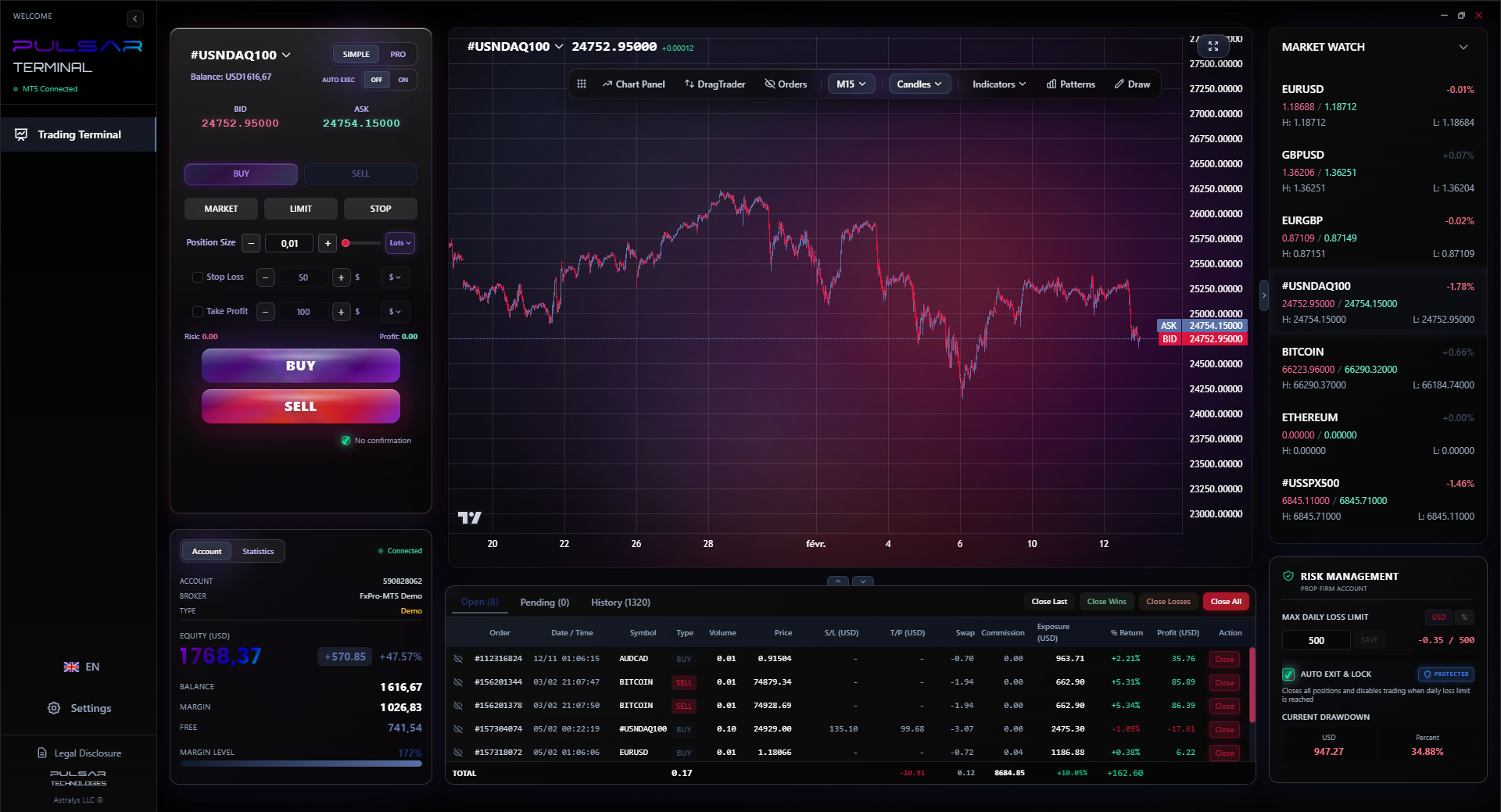
Managing multiple take-profit levels on a fundamental swing trade is critical, and Pulsar Terminal lets you set them all with a simple drag-and-drop directly on your MT5 chart.
Pulsar Terminal
The all-in-one MT5 companion: drag-and-drop orders, multi-TP/SL, trailing stop, grid trading, Volume Profile, and prop firm protection. Used by 1,000+ traders daily.
Forget searching for a magic 'fundamental analysis forex pdf.' Build your own live information dashboard with these sources.
Primary Data Sources:
- Statistics South Africa (Stats SA): The official source for CPI, employment, GDP, production data. Bookmark it.
- South African Reserve Bank (SARB): For monetary policy statements, meeting minutes, and financial stability reviews. Read the actual statements, not just the headlines.
- National Treasury: For budget documents and the MTBPS.
Analysis & Context:
- Credible Local Financial News: Bloomberg EMEA, Reuters South Africa, Moneyweb. Avoid the sensationalist tabloid takes on finance.
- Trading Economics Website: It aggregates global and SA data calendars in one place, which is incredibly useful.
- Broker Research: The better FSCA-regulated brokers, like Exness or XM, provide daily market commentary that often includes fundamental insights on ZAR pairs.
Your Personal Journal: This is the most important resource. Start a trading journal. For every fundamental trade, write down:
- Your thesis (e.g., 'SARB to be more hawkish than Fed').
- The key data/events you're watching.
- Your entry, stop, target, and position size.
- The outcome and, crucially, why it worked or didn't.
Over time, this journal becomes your personalized, battle-tested 'fundamental analysis forex pdf.' It's specific to you, your strategy, and the South African market.
“Your trading journal becomes your personalized, battle-tested 'fundamental analysis forex pdf.'”
Fundamental analysis isn't a one-off study session. It's a habit. Here's a simple weekly routine to stay on top of it without getting overwhelmed.
Sunday Evening:
- Scan the global and SA economic calendar for the week ahead. Flag the high-impact events (SARB speech, CPI, US CPI/Fed stuff).
- Check the closing prices of key commodities (platinum, gold, iron ore).
- Glance at the political headlines for any looming local risks.
Morning Before London Open (6:30 AM SAST):
- Check for any Asian session news that impacted risk sentiment.
- Look at the ZAR's performance overnight. Did it move with commodities, or against them? That tells you what driver was in charge.
- Review your open positions. Do the fundamentals behind them still hold?
After Major News Drops:
- Don't trade immediately unless that's your specific strategy. Watch for 15-30 minutes. See if the initial spike holds or reverses. The market often overreacts initially.
- Update your journal with the event and the market's reaction.
This process turns fundamental analysis from an academic exercise into a practical tool. It helps you understand the why behind the price moves you see on your XAU/USD or EUR/USD charts, even when you're not directly trading the Rand. Everything is connected.
The goal isn't to predict every pip. It's to develop a consistent framework for understanding market forces. This framework gives you the confidence to place trades with an edge, manage your risk properly, and, most importantly, learn from both your wins and losses. That's what will make you a better trader, long after any downloaded PDF is forgotten.
FAQ
Q1Is fundamental analysis or technical analysis better for trading ZAR pairs?
It's not an 'or' question, it's an 'and.' Use fundamentals to decide the overall direction and strength of your bias (e.g., ZAR bullish due to rate hikes). Use technical analysis to find precise entry and exit points within that trend (e.g., buying on a pullback to a key support level on the daily chart). Ignoring fundamentals on volatile pairs like USD/ZAR is like driving blindfolded.
Q2What's the most important fundamental indicator for a beginner SA trader to watch?
Start with one: South African Inflation (CPI) data. It's released monthly, it's easy to understand (higher number = higher prices), and it has a direct and predictable link to the SARB's next move. Watch how USD/ZAR reacts in the hour after the release. This one exercise will teach you more about price action and fundamentals than any theory.
Q3How do I manage risk when trading around high-impact news like the Budget Speech?
First, reduce your position size by at least 50% compared to a normal trade. The volatility is immense. Second, use a wider stop loss - at least 1.5 to 2 times your usual amount. Third, consider waiting for the initial 5-10 minute panic spike to settle before entering. Often, the best risk/reward entry comes after the initial emotional reaction.
Q4Can I use fundamental analysis for short-term trading, or is it only for long-term?
You can absolutely use it for short-term swings. The key is focusing on scheduled high-impact events. For example, you might place a trade 30 minutes before a CPI release based on your bias, with a tight stop, aiming to capture the initial 50-100 pip spike. This is a specific strategy that requires practice and excellent execution, often using tools that allow for quick order management.
Q5Where can I find a reliable economic calendar for South African data?
The Trading Economics website is the most complete free resource. For a more integrated experience, many premium trading platforms and data terminals (like the one offered by some brokers) have built-in calendars you can filter for 'South Africa.' Always cross-reference the time (SAST vs. GMT) to avoid costly mistakes.
Q6Do I need to understand complex economics to do this?
No. You need to understand cause and effect, not advanced theory. Start simple: Higher SA interest rates relative to others = potential ZAR strength. Political instability = ZAR weakness. Strong commodity prices = ZAR strength. You're looking for clear, logical relationships, not writing a PhD thesis.
Prof. Winston's Lesson
Key Takeaways:
- ✓Trade the ZAR's role as a commodity currency: watch platinum, gold, and iron ore.
- ✓The SARB's tone matters more than the headline rate 80% of the time.
- ✓Always factor in a 15-30 pip spread on exotic pairs before calculating profit.
- ✓Local political risk can invalidate a perfect global fundamental setup in minutes.
How useful was this article?
Click a star to rate
Weekly Trading Insights
Free weekly analysis & strategies. No spam.
About the Author
David van der Merwe
Emerging Markets Trader
Johannesburg-based trader with 11 years in emerging market currencies. Specializes in ZAR pairs, FSCA-regulated trading, and South African market analysis.
Comments
Risk Disclaimer
Trading financial instruments carries significant risk and may not be suitable for all investors. Past performance does not guarantee future results. This content is for educational purposes only and should not be considered investment advice. Always conduct your own research before trading.
You Might Also Like

Cara Trading Forex Sukses: 7 Prinsip dari Trader Profesional
Cara trading forex sukses dengan 7 prinsip trader pro: manajemen modal, disiplin, journal trading, backtest. Data nyata, bukan janji profit palsu.
Jam Trading Forex Terbaik untuk Trader Indonesia: Panduan Lengkap dengan Tabel Waktu
Panduan jam trading forex untuk trader Indonesia. Tabel 4 sesi dunia, jam emas 20:00-00:00, sesi mana yang harus dihindari. Data akurat + tips dari trader berpengalaman.
Top 5 Sàn Forex Uy Tín Nhất 2026: Review Jujur dari Trader Indonesia
Top 5 sàn forex uy tín 2026 untuk trader Indonesia. Review jujur: spread, deposit, withdraw, dukungan lokal. Exness, XM, IC Markets & lebih.
Get Pulsar Terminal
All these calculators are built into Pulsar Terminal with real-time data from your MT5 account. One-click position sizing, automatic risk management, and instant calculations.
Get Pulsar Terminal