


You want to know the fundamentals of forex trading? Forget the textbook definitions of pips and lots for a second.

Olumide Adeyemi
West African Trading Pioneer ·  Nigeria
☕ 9 min read
What you'll learn:
You want to know the fundamentals of forex trading? Forget the textbook definitions of pips and lots for a second. The real fundamentals in Nigeria aren't about charts; they're about navigating a market where the rules are fuzzy, the use is insane, and your biggest enemy is the person in the mirror. I've seen more accounts blown up by ignorance of these local realities than by any bad trade. Let's talk about what actually matters.
The first fundamental isn't a candlestick pattern. It's knowing if you're even allowed to do this. In Nigeria, the answer is... complicated.
Forex trading is legal. The Central Bank of Nigeria (CBN) and the Securities and Exchange Commission (SEC) are the main watchdogs. But here's the messy part: while they regulate activities within Nigeria, the framework for you, the retail trader sitting at home with an international broker, is what we politely call 'evolving.' Many sources say you need a CBN license to trade. Practically, thousands of Nigerians trade with offshore brokers regulated by bodies like the UK's FCA or Cyprus's CySEC. The CBN has at times tried to block these transactions. You're operating in a grey area.
The black-and-white part? Taxes. If you make money, the Federal Inland Revenue Service (FIRS) wants its share. Forex trading profits are subject to Capital Gains Tax at a rate of 10% on your gross profits. It doesn't matter if your broker is in Seychelles or your money is in a USD account. If you're a Nigerian resident and you profit, that tax liability is real. I know traders who've made life-changing money only to get a nasty surprise later. This isn't a 'maybe'; it's a fundamental cost of doing business.

Warning: Don't assume offshore brokers shield you from Nigerian tax law. You are responsible for declaring your trading income. Ignorance isn't a defense with the taxman.
Your first step before placing a single trade should be getting clarity on your personal compliance. Talk to a local accountant who understands forex. The regulatory landscape is the most critical, and most overlooked, part of your foundation.

💡 Winston's Tip
The market doesn't care what you need the money for. Trade the chart, not your bills.
“The real fundamentals in Nigeria aren't about charts; they're about navigating a market where the rules are fuzzy and your biggest enemy is the person in the mirror.”
Brokers advertise 'low spreads' like it's the only thing that matters. For a Nigerian trader, that's only part of the story. Your real costs come from three places, and two of them will sneak up on you.
First, the obvious: broker fees. On a standard account, you pay the spread. For EUR/USD, that can range from 0.6 pips on a good day to 1.8 pips during volatile news. On a Raw or ECN account, you might see a 0.0 pip spread but pay a commission, say $3.50 per lot. You need to do the math. For a typical Nigerian trader starting with a few hundred dollars, a standard account is often simpler.
Second, the silent killer: swap fees. If you hold a trade overnight, you pay or receive interest based on the difference between the two currencies' central bank rates. Holding a buy position on USD/NGN? Forget it, the swap cost will eat you alive. I learned this the hard way on a GBP/JPY swing trade I left open for two weeks. The spread was 2 pips on entry, but the overnight swaps totaled over 15 pips in costs. My position size calculator didn't save me from that oversight.
Third, the Nigerian-specific costs: funding and withdrawals. Using your local bank card for international broker deposits often attracts extra charges from your bank and sometimes fails due to CBN restrictions. Using e-wallets like Neteller or Skrill adds another layer of fees. That N5000 you deposit might only be $4.80 by the time it hits your trading account. These friction costs mean you can't afford to trade tiny positions; they'll get erased by fees alone.
| Cost Type | Typical Range | Impact on a $500 Account |
|---|---|---|
| Spread (EUR/USD) | 0.6 - 1.8 pips | $3 - $9 per standard lot |
| Bank Transfer Fee | N500 - N2500 | $0.55 - $2.75 (on conversion) |
| E-wallet % Fee | 1% - 3% | $5 - $15 on a $500 deposit |
| Swap Fee (per night) | Varies by pair | Can exceed your target profit |
“Thinking in Naira while trading in USD is a psychological trap that turns a $50 loss into an emotional crisis.”
This is where Nigerian traders get slaughtered. Brokers here offer use up to 1:1000, 1:2000, even 'Unlimited.' It's marketed as a gift. It's a trap.
Let's break down what 1:500 use really means. With $100 in your account, you can control a $50,000 position. Sounds powerful, right? Here's the reality. If you buy one standard lot of EUR/USD (a $100,000 position) with just $200 margin, a move of just 20 pips against you - a common blink-of-an-eye fluctuation - wipes out 10% of your margin. A 200-pip move, which happens regularly during news events, obliterates your entire account. That's not trading; it's gambling with a time limit.
I used high use when I started. My first major blow-up was in 2017. I deposited $300, used 1:500 use, and went all-in on a USD/CAD 'sure thing.' The trade went 47 pips against me. My account was down to $53 before I could even react. The loss wasn't from a wrong analysis; it was from insane position sizing enabled by use.
The Right Way to Use use
Think of use not as buying power, but as a margin requirement. Use it to free up capital, not to maximize position size. If you have a $1,000 account, trade as if you have $100. Use the use to post the required margin for a sensible 0.01 or 0.1 lot position, not to trade 5 lots. Your risk per trade should still be 1-2% of your capital. A proper scalping strategy with tight stops might use slightly higher use responsibly, but for most swing trading, high use is your enemy.

Pro Tip: In your broker settings, manually lower your maximum use to 1:50 or 1:100. It forces discipline. You can't accidentally size a trade that will trigger a margin call on a minor pullback.
💡 Winston's Tip
Lower your use. Seriously. Your future self will thank you when a news spike doesn't wipe you out.
“High use isn't a gift from your broker; it's a trap dressed up as an opportunity.”
Your brain doesn't think in USD. It thinks in Naira. This mental conversion is a fundamental flaw that destroys risk management.
You see a $50 profit on your screen. Your mind instantly calculates: 'That's almost N80,000! I can pay my light bill.' This leads to two fatal errors. First, you close winning trades too early to 'secure' that Naira profit, never letting a trend run. Second, and worse, you let losing trades run because a $100 loss 'is just N160,000, the market will come back.'
I fought this for years. I'd set a 30-pip stop loss on a trade. The market would hit it, and I'd watch the '-$75' in my MT4 window. Instead of accepting the loss, I'd think, 'That's someone's monthly salary gone. I can't let it be real.' So I'd delete the stop loss, turning a controlled 1.5% risk into a 20% account disaster. The pain of converting the loss to Naira was too great.
The solution is brutal but simple: you must start thinking in the base currency of your account. If you trade a USD account, a $50 loss is just $50. It's a number, disconnected from its Naira value. Base all your calculations - risk per trade, profit targets, daily limits - in USD. Only convert your net profit or loss at the end of the month, when you withdraw. This mental separation is the single most important psychological fundamental. Tools that help you visualize risk in percentage terms, not dollar or Naira terms, are useful for this.
“High use isn't a gift from your broker; it's a trap dressed up as an opportunity.”
You can't just copy a strategy from a YouTube trader in London. Nigerian traders face unique challenges: power instability, internet fluctuations, and trading mostly outside local market hours. Your strategy must be strong to these conditions.
First, choose your session. The most liquid sessions for major pairs are the London (8 AM - 5 PM GMT) and New York (1 PM - 10 PM GMT) overlaps. For Nigeria (WAT, GMT+1), that's 9 AM - 6 PM and 2 PM - 11 PM. These times have the tightest spreads and most reliable moves. Trying to trade the Asian session from Nigeria is often a waste of time; the spreads are wider and moves are erratic.
Second, account for infrastructure. If your power or internet is unreliable, avoid strategies that require you to babysit the chart, like certain types of scalping. A swing trading approach where you analyze, place your trade with a stop loss and take profit, and walk away is far more sustainable. I lost a trade not because I was wrong, but because NEPA took light and my mobile data didn't kick in before my stop was hit. After that, I only traded setups where I could set my orders and be offline for an hour.
Third, focus on a few pairs. The EUR/USD guide is a good start because of its liquidity and lower spreads. GBP/USD and USD/JPY are also solid. Avoid exotic pairs that include the Naira unless you have a specific edge; they're often illiquid and manipulated. I once traded USD/NGN on a platform with a 50-pip spread. I was doomed before I started.
Your strategy isn't just entry and exit rules. It's a full plan that answers: What time do I trade? What pairs? What is my maximum acceptable slippage? What happens if my internet drops? Writing this down is non-negotiable.
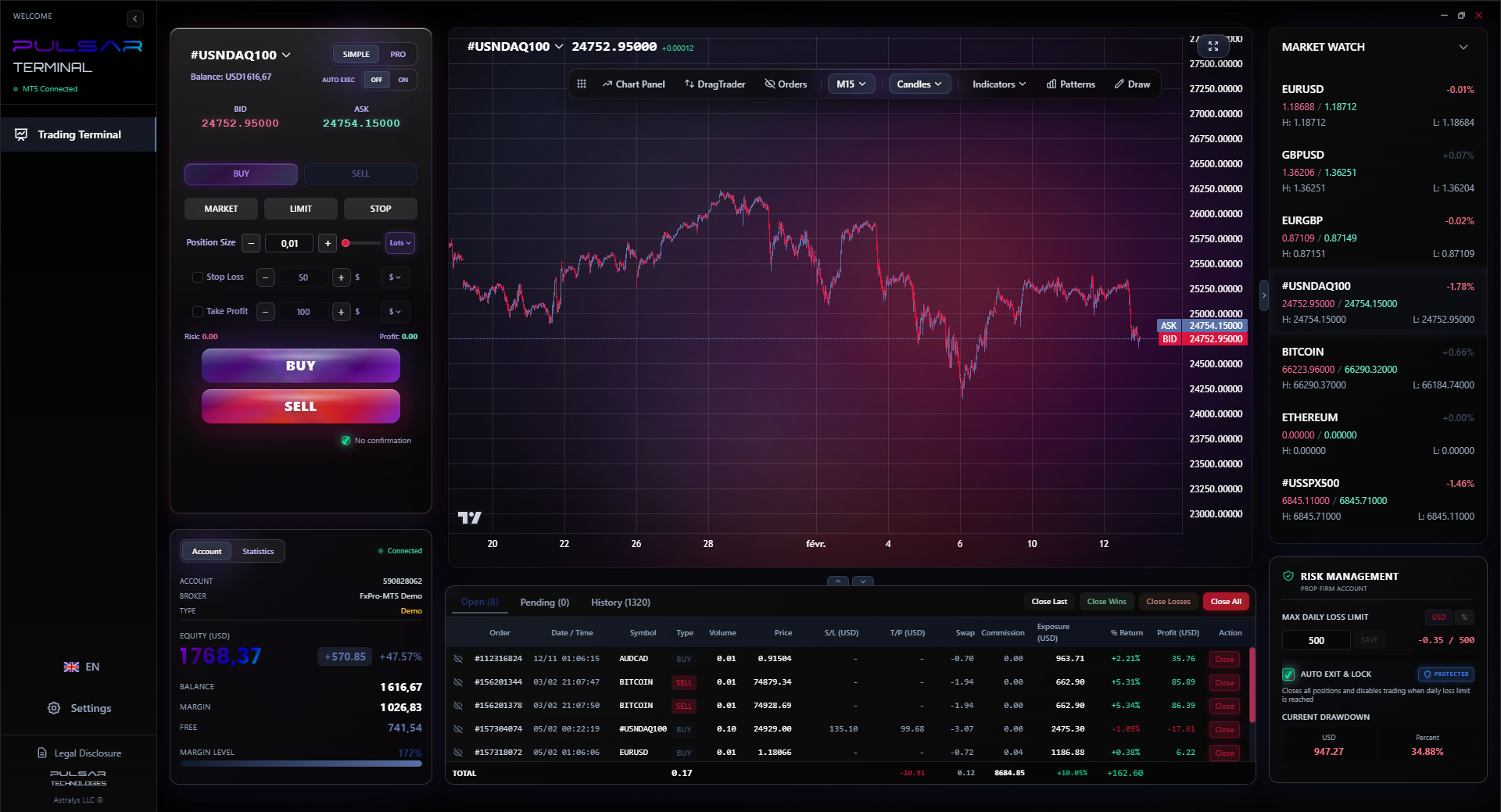
Executing a disciplined strategy is easier with tools that automate risk management, like setting multiple take-profit levels and trailing stops directly on your MT5 chart.
Pulsar Terminal
The all-in-one MT5 companion: drag-and-drop orders, multi-TP/SL, trailing stop, grid trading, Volume Profile, and prop firm protection. Used by 1,000+ traders daily.
“Your strategy must include a plan for power cuts and bad internet, or it's not a real strategy.”
Knowing the fundamentals is one thing. Applying them under pressure is another. This is where the final piece comes in: a routine.
Your pre-market routine should include checking for scheduled high-impact news (like US Non-Farm Payrolls or CBN announcements) on an economic calendar. Trading through major news is a different, riskier game. Your routine must also include checking your broker's news feed or website for any notifications about margin requirement changes or platform maintenance.
Your trade execution must be mechanical. You've done your analysis. You see your setup. Now:
- Calculate your position size based on your 1% risk rule and the distance to your stop loss. Use a calculator, don't guess.
- Enter the trade with a stop loss and a take-profit order immediately. No 'I'll place it later.'
- Walk away. If you've done steps 1 and 2 correctly, your job is over. Monitoring the trade tick-by-tick will only tempt you to break your rules.
Finally, keep a journal. Not just 'bought EUR/USD, won.' Record your reasoning, the chart time frame, your emotional state, and the outcome. Review it weekly. You'll quickly see if you're consistently breaking your rules on losing trades or cutting winners short. This feedback loop is what turns knowledge into consistent skill. Without it, you're just repeating the same mistakes with different currency pairs.
💡 Winston's Tip
Your trading journal is your most important tool. You can't fix what you don't measure.
FAQ
Q1What is the minimum amount I need to start forex trading in Nigeria?
While brokers like XM or Exness let you start with $5 or $10, that's practically useless. With fees and realistic position sizing, you can't properly manage risk. A serious minimum is $500. This allows you to risk $5-$10 per trade on micro lots (0.01) and withstand a series of losses without blowing up. Starting with less usually leads to overtrading and excessive risk-taking just to see meaningful profits.
Q2Is forex trading taxable in Nigeria?
Yes. Profits from forex trading are considered capital gains and are subject to a 10% tax on the gross profit. You are responsible for declaring this income to the Federal Inland Revenue Service (FIRS), regardless of whether your broker is local or international.
Q3Which broker is best for Nigerian traders?
There's no single 'best.' It depends on your needs. Look for brokers with strong international regulation (like FCA, CySEC, ASIC), low and transparent fees, and reliable deposit/withdrawal methods for Nigeria (e.g., support for bank transfers, e-wallets). Brokers like IC Markets, Pepperstone, and XM are popular choices among experienced Nigerian traders for their platforms and conditions. Always verify the broker's regulatory status yourself.
Q4What is a pip and how is it calculated?
A pip is the smallest price move a currency pair can make. For most pairs (like EUR/USD), it's 0.0001. If EUR/USD moves from 1.1050 to 1.1051, it moved 1 pip. For pairs with the JPY (like USD/JPY), a pip is 0.01. The monetary value of a pip depends on your trade size (lot size). A 1-pip move on a standard lot (100,000 units) is worth approximately $10. Our full pip definition guide breaks down the calculations.
Q5Can I trade forex with my Naira debit card?
It's possible for small amounts, but often problematic. The CBN has restrictions on international transactions with Naira cards. You may face declined transactions, extra fees, or limits. Many traders use domiciliary accounts (USD accounts in Nigerian banks) or international e-wallets like Neteller or Skrill to fund their trading accounts more reliably.
Q6What's the difference between MT4 and MT5?
MT5 is the newer platform from MetaQuotes. It offers more timeframes, more order types, a built-in economic calendar, and access to more markets (like stocks and futures). MT4 is simpler, lighter on computer resources, and still perfectly adequate for forex and CFD trading. Most indicators and Expert Advisors (EAs) were built for MT4, so it has a larger library of tools. Many Nigerian traders still prefer MT4 for its simplicity and widespread support.
Q7How do I avoid scams and fake investment schemes?
If someone promises you guaranteed daily profits, a 'secret algorithm,' or asks you to send money directly to them instead of a regulated broker, it's a scam. Only deposit funds into an account in the name of the regulated brokerage firm. Do your own due diligence on the broker's license. Never give your trading account login details to a 'signal provider' or 'account manager.' Real trading involves risk and loss is part of the game.
Prof. Winston's Lesson
Key Takeaways:
- ✓Comply with local tax law: 10% on gross profits.
- ✓Treat use as margin, not buying power.
- ✓Think in your account's base currency, not Naira.
- ✓Build a routine that survives power cuts.
How useful was this article?
Click a star to rate
Weekly Trading Insights
Free weekly analysis & strategies. No spam.
About the Author
Olumide Adeyemi
West African Trading Pioneer
One of Nigeria's most active forex trading educators. 8 years of experience trading from Lagos. Specializes in low-capital strategies and prop firm challenges for African traders.
Comments
Risk Disclaimer
Trading financial instruments carries significant risk and may not be suitable for all investors. Past performance does not guarantee future results. This content is for educational purposes only and should not be considered investment advice. Always conduct your own research before trading.
You Might Also Like

Cara Trading Forex Sukses: 7 Prinsip dari Trader Profesional
Cara trading forex sukses dengan 7 prinsip trader pro: manajemen modal, disiplin, journal trading, backtest. Data nyata, bukan janji profit palsu.
Jam Trading Forex Terbaik untuk Trader Indonesia: Panduan Lengkap dengan Tabel Waktu
Panduan jam trading forex untuk trader Indonesia. Tabel 4 sesi dunia, jam emas 20:00-00:00, sesi mana yang harus dihindari. Data akurat + tips dari trader berpengalaman.
Top 5 Sàn Forex Uy Tín Nhất 2026: Review Jujur dari Trader Indonesia
Top 5 sàn forex uy tín 2026 untuk trader Indonesia. Review jujur: spread, deposit, withdraw, dukungan lokal. Exness, XM, IC Markets & lebih.
Get Pulsar Terminal
All these calculators are built into Pulsar Terminal with real-time data from your MT5 account. One-click position sizing, automatic risk management, and instant calculations.
Get Pulsar Terminal