


I was staring at the TradeLocker platform, my FunderPro challenge account up a clean 7.2%.

James Mitchell
Senior Trading Analyst
☕ 11 min read
What you'll learn:
- 1What Is FunderPro and How Does It Actually Work?
- 2The Real Costs, Rules, and Key Numbers for 2025
- 3Trading Conditions: use, Spreads, and Platforms
- 4The US Regulation Gray Area (And What It Means For You)
- 5My Personal Experience: Passing the $100K Challenge
- 6How FunderPro Stacks Up Against Other Major Prop Firms
- 7Final Verdict: Should You Try the FunderPro Prop Firm?
I was staring at the TradeLocker platform, my FunderPro challenge account up a clean 7.2%. The EUR/USD trade had just hit my first take-profit. For a second, it felt real. Then I remembered: this was a simulated environment, my 'funds' were fictitious, and a single bad day could blow my 5% daily loss limit. That's the weird, high-stakes game of modern prop firms. Let's talk about FunderPro specifically - what it really costs, how their rules work in 2025, and whether it's a legit path for US traders or just an expensive video game.
FunderPro is a proprietary trading firm, or 'prop firm,' founded in 2023. Their pitch is simple: you pay a one-time fee for a trading challenge. Pass it, and they give you a funded account with their capital. You keep a big chunk of the profits. Sounds great, right?
Here's the real structure. You don't start with real money. You start with a simulated account. All trading during the evaluation happens in what they call a 'simulated trading environment.' The funds are fictitious. This is a massive legal distinction, especially in the US, and we'll get to that. Your goal is to hit a profit target without breaking specific risk rules, like daily and maximum drawdown limits.
If you pass, you 'graduate' to what they term a 'real capital account.' This is where you can actually earn a profit split. They've recently made noise about reintroducing a 90% profit split (more on that later), which is a major selling point. The entire model is built on the premise that they can identify consistently profitable traders through these challenges, fund them, and share the upside.

Warning: The line between 'simulated' and 'real' is blurry here. Even funded accounts might operate under similar simulated conditions with a profit-and-loss mirror. Always read the Terms of Service. This isn't like depositing with a regulated broker like IC Markets.
I took their $100,000 Regular Challenge last year. The fee was $549. The goal was 10% profit in Phase 1, then 8% in Phase 2. I passed Phase 1 in about 12 trading days using a conservative swing trading approach on indices. The psychology is different. You're not just trading charts; you're trading against their rulebook.

💡 Winston's Tip
Your first trade in any challenge should risk no more than 0.25% of the account. It's not about making money; it's about calibrating your nerves to the new rule set.
This is where you need to sharpen your pencil. The marketing shows big account sizes, but the fees and rules determine if it's viable.
Challenge Fees & Profit Splits
The entry point is a $5,000 account for $79. Most serious traders look at the $100k level. A $100,000 'Regular' challenge costs about $549. A 'Swing' challenge (longer timeframes) is around $599. The good news? This fee is usually refunded with your first funded account payout.
The profit split is a hot topic. For a long time, FunderPro offered up to 80%. In 2025, they brought back a 90% split option. Here's the catch: for accounts bought after June 18th, 2025, you can opt for the 90/10 split by increasing your challenge fee by 20%. So, that $549 challenge becomes about $659. You need to calculate if the extra 10% in profit share outweighs the higher upfront cost. For their 'Pro' accounts with daily rewards, the 90/10 split is automatic.
The Make-or-Break Rules: Drawdowns
This is the core of the challenge. You must manage two critical limits:
- Daily Loss Limit: Usually 5% of your starting balance. For a $100k account, that's $5,000. Hit that, and your challenge is failed. No second chances.
- Maximum Drawdown: Typically 10% overall. This is measured from your starting balance equity peak. It's a trailing limit once you're in profit.
They also have a 45% Consistency Rule during the evaluation. Your most profitable day cannot account for more than 45% of your total profit. This stops you from just gambling on one lucky trade. I learned this the hard way early on with another firm - nailed a huge gold short, made 8% in a day, and instantly failed for inconsistency. It was brutal.
Profit Targets & Payouts
For the common two-phase challenge: Phase 1 target is 10%, Phase 2 is 8%. You have unlimited time. Once funded, you can request a payout when you're up just 1% from your starting balance ($1,000 on a $100k account). The minimum withdrawal is $50, and they claim payouts within 8-48 hours.

Example: Your $100k account is up $1,200 (1.2%). You request a payout. With an 80% split, you'd get $960. With a 90% split, you'd get $1,080. That extra $120 is why the split math matters.
“Prop firm trading isn't about beating the market; it's about passing a test designed by someone else.”
You're not just trading against the market; you're trading with their toolbox. The conditions directly impact your strategy.
use: This isn't uniform. It varies wildly by account type and asset.
| Asset Class | Classic/Pro Account | One Phase Account |
|---|---|---|
| Forex | Up to 1:100 | 1:50 |
| Indices, Oil, Metals | Up to 1:30 | 1:10 |
| Stocks | 1:5 | 1:3 |
| Crypto | 1:2 | 1:2 |
If you're a forex scalping fan, the 1:100 is decent. But if you trade NASDAQ, the 1:30 on indices is a constraint. It forces lower position sizes. I primarily trade the US30, and the 1:30 use meant my usual lot size had to be cut by more than half compared to my personal IC Markets account. You must use a position size calculator religiously.
Spreads & Commissions: They advertise $0 commission per lot. Execution is via STP/ECN models. The spreads are variable. I found them to be generally competitive on major forex pairs like EUR/USD, often 0.8-1.2 pips. On XAU/USD (gold), spreads could widen to $3.50-$5.00 during volatile sessions, which eats into short-term strategies.
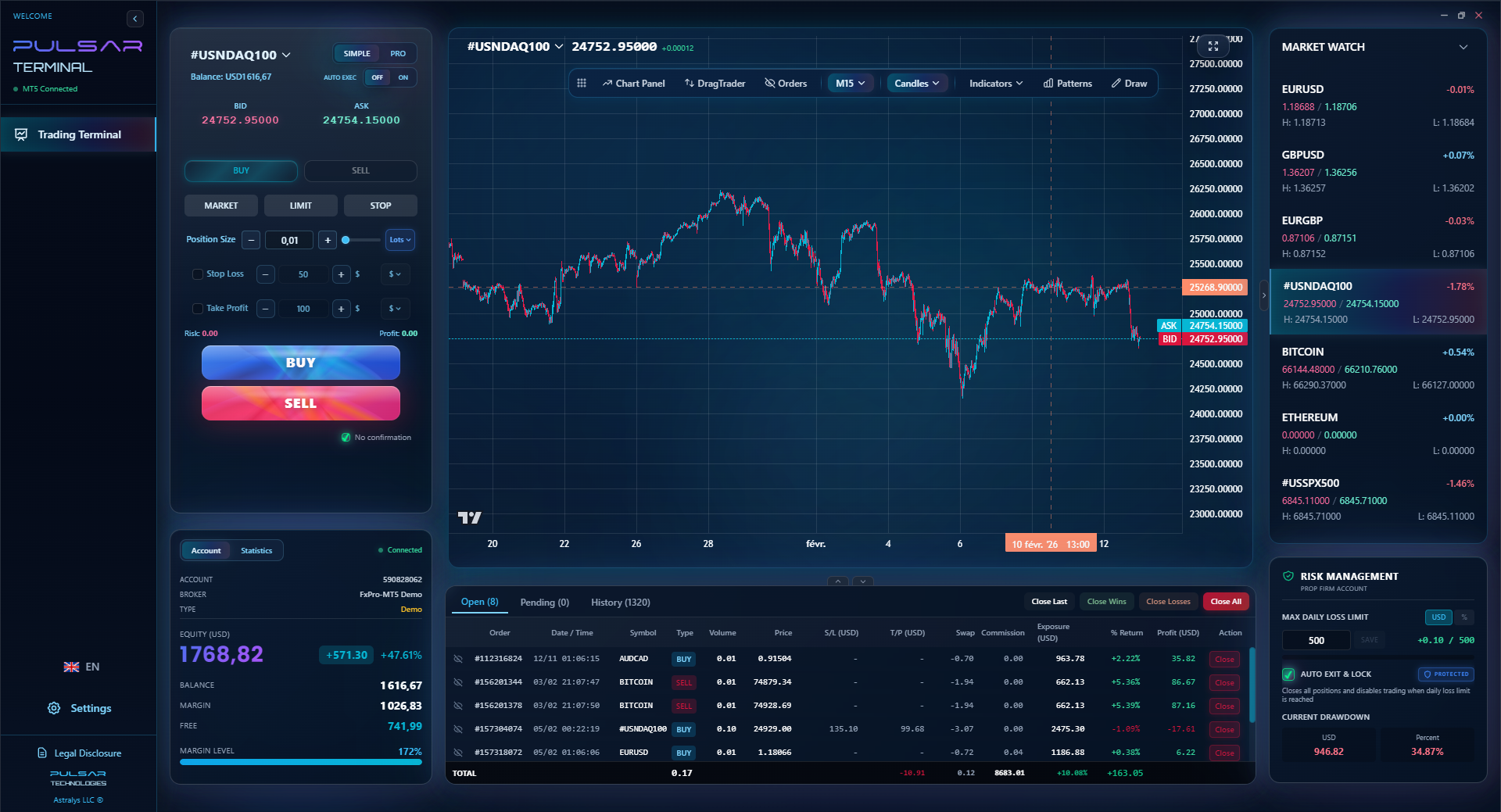
Platforms: You can use TradeLocker (their own platform), cTrader, or MT5. I used MT5 to keep my workflow consistent. A huge advantage of MT5 is that you can use advanced tools like Pulsar Terminal for risk management, which is critical for adhering to prop firm rules.
💡 Winston's Tip
The consistency rule is a sneaky killer. Keep a simple spreadsheet. If your best day's profit ever nears 40% of your total, stop trading for the day. Take the win.
Okay, let's talk about the elephant in the room. Are prop firms like FunderPro legal in the US? The answer is messy.
FunderPro is not regulated by the SEC, CFTC, or NFA. They're headquartered in Malta. They operate in a regulatory gray area because of their business model: they charge a fee for an evaluation service and trade their own (or simulated) capital. They are not acting as a broker-dealer or holding your securities. This is a key loophole.
What does this mean for you, the trader?
- You Have Minimal Protection. If FunderPro goes bankrupt or decides to withhold your payout citing a vague rule violation, you have little recourse. There's no SIPC insurance. Your challenge fee and any earned profits are at risk. This is the biggest difference between them and a regulated entity like Pepperstone.
- The 'Simulated' Label is a Shield. Their own website states all trading is in a simulated environment with fictitious funds. This legally distances them from being classified as a financial service provider subject to strict US regulation.
- The Onus is on You. You are responsible for understanding the contract (the Terms of Service). They have final say on rule interpretations and payout approvals. I've heard stories from other traders about accounts being closed for 'overleveraging' based on the firm's internal metrics, not just the stated drawdown.

Pro Tip: Treat the challenge fee as a sunk cost - money you're okay with losing. Never risk more on a challenge than you would on a nice dinner out. This mindset protects you financially and psychologically.
It's not all doom. Many traders get paid. But you must go in with your eyes wide open. This is not a protected, client-focused relationship. It's a performance-based contract with an unregulated offshore entity.
Managing the strict daily and trailing drawdown limits of a FunderPro challenge is a constant manual headache, which is why a tool like Pulsar Terminal that automates stop-loss and breakeven management directly on MT5 is a game-saver.
Pulsar Terminal
The all-in-one MT5 companion: drag-and-drop orders, multi-TP/SL, trailing stop, grid trading, Volume Profile, and prop firm protection. Used by 1,000+ traders daily.
“The 5% daily loss limit isn't a buffer for your strategy; it's a cliff edge you must stay miles away from.”
Let me walk you through my actual attempt. I chose the $100,000 Regular Challenge in Q4 2024. My fee was $549. My strategy was to swing trade the US30 (Dow Jones) using a combination of daily chart structure and the 4-hour MACD indicator for confluence.
Phase 1 (10% Target): I started slow. My first trade was a short on the US30 at 34,120. I used a tiny 0.50 lot size (respecting the 1:30 use and my daily loss limit). My risk was 20 points, or $100. That's just 0.1% of the account - super conservative. I took profit at 33,950 for a 170-point gain, about $850. A solid 0.85% start. I compounded slowly, never risking more than 0.5% per trade. I hit the 10% target ($10,000 profit) in 12 trading days. The hardest part was the consistency rule. I had to actively avoid adding to winners too aggressively, lest my best day become too large a percentage of the total.
Phase 2 (8% Target): This felt harder psychologically. You're so close. I tightened up even more. I made a mistake here: I misread a RSI indicator divergence on a pullback and entered a long prematurely. The trade went 35 points against me, and I closed it for a $175 loss. It stung, but it was only 0.175% of the account. I stuck to the plan, grinded out small gains, and hit the 8% ($8,000) target over the next 10 days.
The Funded Phase: Getting the 'funded' account felt anticlimactic. It was just a new login. The rules relaxed slightly (no consistency rule). I made my first 1% ($1,000) in about a week and requested a payout of $800 (80% split). It arrived in my crypto wallet in about 14 hours. It worked. But the constant awareness of the 10% maximum drawdown, trailing behind my equity peak, was mentally taxing. One prolonged drawdown period could wipe out weeks of work.
💡 Winston's Tip
Prop firm psychology is 90% of the game. If you feel the urge to 'get back to breakeven' after a loss, log off. That's the #1 path to a [margin call](/en/glossary/margin-call) in this context.
Is FunderPro the best choice? It depends on your profile. Let's compare some key aspects with other common names.
FunderPro vs. Firms Like FTMO (or similar):
- Profit Split: FunderPro's optional 90% is currently among the highest. Many others cap at 80% or 90% only after a long scaling plan.
- Time Limits: FunderPro's challenges have no time limit. This is a huge advantage if you're a patient, low-frequency trader. Some firms give you 30 days.
- Rule Clarity: I found FunderPro's dashboard relatively clear on drawdown calculations. Some firms have hidden 'overleveraging' rules or stop-out levels based on balance, not equity, which is a trap.
- Platform Choice: Offering MT5/cTrader/TradeLocker is good. Some firms are locked to MT4/5 only.
FunderPro vs. Broker-Based Funding (e.g., Exness or XM contests): This is a different beast. Broker contests are often free but have leaderboard structures where only the top few win. Prop firm challenges are pass/fail; if you hit your target, you get funded, regardless of how others perform.
The main drawback for FunderPro, in my view, is the lack of regulatory oversight compared to simply trading your own capital with a top-tier broker. You're paying for access to larger capital, but you're accepting counterparty risk.
“That first funded account payout feels real, but never forget you're dancing in a regulatory gray area.”
Here's my straight take.
Consider FunderPro if:
- You have a proven, conservative strategy with a high win rate and low risk-per-trade.
- You are disciplined enough to trade a rulebook first and the market second.
- You treat the challenge fee as a tuition cost you can afford to lose.
- The allure of trading larger capital (even if simulated) outweighs the regulatory uncertainties.
- You want a no-time-limit challenge and are attracted by the potential 90% split.
Avoid FunderPro (and maybe prop firms in general) if:
- You need the safety of regulated client fund protection.
- You have a high-risk, high-reward strategy that regularly sees drawdowns over 5%.
- You're looking for a quick cash grab. This is a grind.
- You don't have the emotional control to stick to tiny position sizes. Blowing a 5% daily loss limit is easier than you think.
For me, it was a valuable experience. It forced surgical discipline. That first payout was real. But I also know it's a fragile environment. I wouldn't put all my trading aspirations into this basket. Use it as one potential revenue stream, not the foundation of your career. And for heaven's sake, practice their exact rules on a demo account for a month before you ever pay a challenge fee. Your wallet will thank you.
FAQ
Q1Is FunderPro legit and do they really pay out?
Based on my experience and numerous community reports, yes, they do process payouts to traders who pass their challenges and follow the funded account rules. My first payout for $800 arrived in about 14 hours. However, 'legit' in the prop firm space doesn't mean 'regulated.' They are an unregulated entity, so your standard investor protections do not apply. Payouts are contingent on their continued operation and their interpretation of your compliance with their rules.
Q2What is the biggest mistake traders make with FunderPro?
Overleveraging on the first few trades. A 5% daily loss limit sounds huge, but with high use, a few bad trades can hit it fast. Traders see a $100k account and trade 5-lot positions. A 10-pip move against them on such a size can be a 2-3% loss instantly. They panic, revenge trade, and blow the account. Always calculate your position size based on your stop-loss and the dollar value of the daily limit. Use a position size calculator every single time.
Q3Can I use Expert Advisors (EAs) or copy trading with FunderPro?
You need to check their latest Terms of Service. Generally, most prop firms, including FunderPro, prohibit fully automated trading and copy trading during the evaluation phase. They want to assess your skill. Some may allow it in the funded phase, but it's often restricted. Using an EA that doesn't adhere to their risk rules (like the daily loss limit) is a surefire way to get your account terminated.
Q4How does the 90% profit split work in 2025?
For challenges purchased after June 18th, 2025, you can opt for a 90/10 profit split by increasing your challenge fee by 20%. For example, a $549 challenge becomes ~$659. You must select this option at purchase. For their 'Pro' account tier with the 'Daily Rewards' feature, the 90/10 split is automatic. Weigh the higher upfront cost against the long-term benefit of keeping 10% more profit.
Q5What happens if I hit the maximum drawdown?
Your challenge or funded account is immediately and permanently closed. The maximum drawdown (usually 10% from the starting balance) is a trailing limit. Once your account equity peaks, the drawdown limit trails that peak. If your equity then falls to that trailing level, it's a violation. There are no warnings or second chances. This rule alone eliminates most impatient traders.
Q6Are FunderPro accounts available to traders in all US states?
FunderPro operates globally, but it's the trader's responsibility to ensure participation is legal in their jurisdiction. Since they are unregulated by US bodies, there's no state-by-state licensing. However, some US states have stricter laws regarding financial contests or simulated trading for profit. You should review their Terms and, if in doubt, consult with a legal professional in your state. I am not a lawyer, and this is not legal advice.
Prof. Winston's Lesson
Key Takeaways:
- ✓Treat every challenge fee as tuition, not an investment.
- ✓Risk a maximum of 0.5% per trade during evaluations.
- ✓The consistency rule (45%) is a silent account killer.
- ✓use varies: 1:30 on indices, 1:100 on forex.
- ✓Payouts can come fast, but protection is non-existent.
How useful was this article?
Click a star to rate
Weekly Trading Insights
Free weekly analysis & strategies. No spam.
About the Author
James Mitchell
Senior Trading Analyst
Based in New York with over 9 years of trading experience. Focuses on major USD pairs, prop firm challenges, and the US regulatory landscape.
Comments
Risk Disclaimer
Trading financial instruments carries significant risk and may not be suitable for all investors. Past performance does not guarantee future results. This content is for educational purposes only and should not be considered investment advice. Always conduct your own research before trading.
You Might Also Like

Cara Trading Forex Sukses: 7 Prinsip dari Trader Profesional
Cara trading forex sukses dengan 7 prinsip trader pro: manajemen modal, disiplin, journal trading, backtest. Data nyata, bukan janji profit palsu.
Jam Trading Forex Terbaik untuk Trader Indonesia: Panduan Lengkap dengan Tabel Waktu
Panduan jam trading forex untuk trader Indonesia. Tabel 4 sesi dunia, jam emas 20:00-00:00, sesi mana yang harus dihindari. Data akurat + tips dari trader berpengalaman.
Top 5 Sàn Forex Uy Tín Nhất 2026: Review Jujur dari Trader Indonesia
Top 5 sàn forex uy tín 2026 untuk trader Indonesia. Review jujur: spread, deposit, withdraw, dukungan lokal. Exness, XM, IC Markets & lebih.
Get Pulsar Terminal
All these calculators are built into Pulsar Terminal with real-time data from your MT5 account. One-click position sizing, automatic risk management, and instant calculations.
Get Pulsar Terminal