


Thinking about trading with a prop firm's capital? You're not alone.

James Mitchell
Senior Trading Analyst
☕ 10 min read
What you'll learn:
Thinking about trading with a prop firm's capital? You're not alone. But the game you're signing up for in 2026 isn't the same one that existed two years ago. The 'future prop firm' is being shaped by regulators, a brutal industry consolidation, and a massive shift toward futures trading. I've seen dozens of firms come and go, and the ones that survive this purge will look very different. Let's cut through the hype and look at what's really happening, what it costs you, and how to not get left holding the bag when the music stops.
Here's the uncomfortable truth most prop firm ads won't tell you: the entire retail prop industry in the US has been operating in a regulatory gray area. They've skirted direct oversight from the CFTC and SEC by calling themselves 'evaluation services' or educational programs. You pay a fee to try out for their team, and if you pass, you trade their capital. They're not technically your broker, and they're not holding your money (except your challenge fee).
That loophole is closing. Fast.
The CFTC is now seriously asking: if a firm charges a fee, sets trading rules, and takes a cut of your profits, isn't that exactly what a Commodity Trading Advisor (CTA) does? If the answer in 2026 is 'yes,' it changes everything. CTAs must register with the CFTC and NFA. They face capital requirements, regular audits, and strict record-keeping. This isn't speculation; it's the stated direction of travel for regulators.

Warning: The 'evaluation model' that defines today's prop firms is under direct regulatory scrutiny. A firm that hasn't prepared for CTA-like regulation may not be a firm in 2027.
I learned this the hard way in early 2024. I was halfway through a challenge with a firm that seemed solid. Then the MetaQuotes crackdown hit (when the maker of MT4/MT5 changed its rules), and the firm's entire model collapsed overnight. They suspended all accounts. My challenge fee? Gone. The time invested? Wasted. That event wiped out nearly 100 firms. It was a preview of what regulatory action looks like.
The future prop firm will either be fully compliant or it will be gone. Your first question to any firm should be: 'What's your plan for CFTC registration in 2026?' If they don't have a clear answer, walk away.
They advertise a '$50,000 account for $299!' It sounds like a steal. But that's just the entry ticket. The real cost of trading with a future prop firm is a layered fee structure designed to be profitable for them, whether you pass or not.
Let's break down a real example from my own trading. In 2023, I took a $100,000 futures challenge with a major firm.
- Evaluation Fee: $399 (on a 'sale').
- Activation Fee: $149 (paid when I passed to get the 'live' funded account).
- Monthly Data Fees: As a funded trader, you're often classified as a 'professional' by exchanges. My CME real-time data feed? About $130 per month. The prop firm didn't cover that. I did.
- Commissions: $4.50 per side for a standard E-mini S&P 500 contract. A simple round-trip trade cost me $9 before I made a single cent in profit.

Example: Let's say you make 20 round-trip trades in a month on the E-mini. Your costs are: Data ($130) + Commissions (20 trades * $9 = $180) = $310 in hard costs. You need to generate at least $310 in gross profit just to break even on fees before your profit split kicks in.
And then there's the profit split. While 80-90% is common, remember it's a split of net profits, after all commissions and fees are taken out. That $310 overhead eats directly into your performance.
You need to factor all this into your position size calculator. Trading one micro contract ($MES) with a $5 target doesn't make sense if commissions and data eat half your potential gain. The future prop firm that survives will be transparent about these costs upfront, not bury them in FAQ #47.

💡 Winston's Tip
The 'evaluation fee' is not an investment. It's a tuition payment for the world's most stressful trading exam. Only pay it if you're ready to treat it as such.
“Your $299 challenge fee is the cost of an audition. Treat it as tuition.”
Look at any prop firm forum now. The buzz is all about /ES, /NQ, and /CL. There's been a 600%+ surge in searches for futures prop firms since 2020. Why the massive shift away from forex?
It boils down to clarity and centralization. The forex market is decentralized and, frankly, riddled with less-reputable brokers manipulating spreads. The futures market, by contrast, is traded on centralized, regulated exchanges like the CME. The rules are clear, the data is clean, and the regulatory framework is already strong. For a prop firm staring down new CFTC rules, basing its model on an already-regulated asset class is a no-brainer.
From a trader's perspective, futures offer pure price action. I can look at the order book for the E-mini S&P 500 (/ES) and see real liquidity. When I traded forex, a news event could cause a spread to widen from 1 pip to 20 pips in a blink, instantly blowing through a stop loss. In futures, the slippage is generally more predictable, especially on the major indices.
This 'Great Migration' to futures means the future prop firm will likely specialize. You'll see fewer firms offering 100+ instruments and more focusing on providing deep liquidity and good commissions on key futures products like stock indices, treasuries, and oil. Your trading platform choice will also shift towards platforms built for futures, like NinjaTrader, Tradovate, or Rithmic, alongside the ever-present MT5.
With a third of firms vanishing since 2024, due diligence is your most important skill. Here are the red flags I've learned to watch for.
1. Unrealistic Profit Splits or Rules. A firm offering a 95% split with a 10% max drawdown is mathematically unsustainable. They're either lying about the rules (you'll get a margin call sooner) or they're a Ponzi scheme using new challenge fees to pay old traders. Sustainable future prop firms need to make money to survive; their rules will reflect that.
2. Opaque or Slow Payouts. This is the ultimate test. Go to their social media or independent forums (not their moderated Discord). Search for 'payout' and 'withdrawal.' Are there consistent complaints from funded traders waiting weeks for their money? I got burned once waiting 45 days for a $1,800 payout. The excuse was always 'bank processing.' The firm folded two months later.
3. No Clear Broker/Execution Partner. If they can't tell you which regulated Futures Commission Merchant (FCM) or broker is executing the trades, run. Your trades should be flowing through a CFTC-regulated entity like NinjaTrader Brokerage, Tradovate, or Ironbeam. If it's all shrouded in mystery, you're likely trading in a simulated environment where the firm is just betting against you.
4. Constant, Desperate Discounts. A 90% off sale every other week isn't a marketing strategy; it's a cash flow lifeline. It signals they need a constant influx of new challenge fees to stay afloat. A stable future prop firm might have seasonal sales, but its standard pricing should be relatively consistent.
5. Poor Communication on Regulatory Plans. As I said before, ask them directly. 'How is the firm preparing for potential CFTC CTA registration?' A good answer involves talking about legal counsel, internal compliance hires, or a existing NFA registration (like TopStep has). A bad answer is confusion, deflection, or 'that won't affect us.'
💡 Winston's Tip
When a firm brags about its profit split, ask about its commission structure. A 90% split on profits after $10 in commissions per trade is often worse than an 80% split with $2 commissions.
“The 5% daily loss limit isn't a rule; it's the entire game.”
Passing a challenge and surviving as a funded trader are two different games. The rules force a specific, disciplined approach. The classic retail mindset of 'revenge trading' or 'doubling down' will blow up your account faster than you can say 'margin call.'
The Psychology of the Daily Loss Limit
This is the single most important rule. A typical 5% daily loss limit on a $50k account is $2,500. Once you hit that, you're done for the day. Full stop. The system will lock you out.
I had to learn this painfully. I was down $1,800 on a bad /ES scalping session. My ego kicked in. I took a larger position on the /NQ, trying to claw it back quickly. I lost another $1,000 in minutes, hit my daily limit, and got locked out. An hour later, my original /ES setup played out perfectly for a $2,200 move. I was on the sidelines, sick to my stomach. The rule saved me from a total meltdown, but my lack of discipline cost me a winning day.
The future prop firm's risk tech will only get stricter. Automated systems will enforce these limits without emotion. Your strategy must have predefined daily loss points, often well before the firm's limit.
Position Sizing for the Long Haul
Forget about 'getting rich quick.' Your goal is consistency to trigger account scaling. This means tiny, sustainable position sizes.

Pro Tip: Risk no more than 0.5% of your account's trailing equity on any single trade. On a $50k account, that's $250. If your stop loss on the /ES is 10 points ($50 per point), you can trade 1 micro contract ($MES). Not 5 standard contracts. This low-risk approach is boring, but it's the only one that survives the 6-10% maximum drawdown over the long term.
Adapting Your Style
The volatile, news-driven scalping that might work on your personal account can be dangerous with a firm's daily loss limit. Many successful funded traders adopt a more patient, swing trading approach on higher timeframes, aiming for fewer, higher-probability setups. They use tools like the RSI indicator or MACD indicator not for direct signals, but to gauge momentum within a broader trend. The key is reducing noise and frequency to preserve mental capital and stay within the rules.
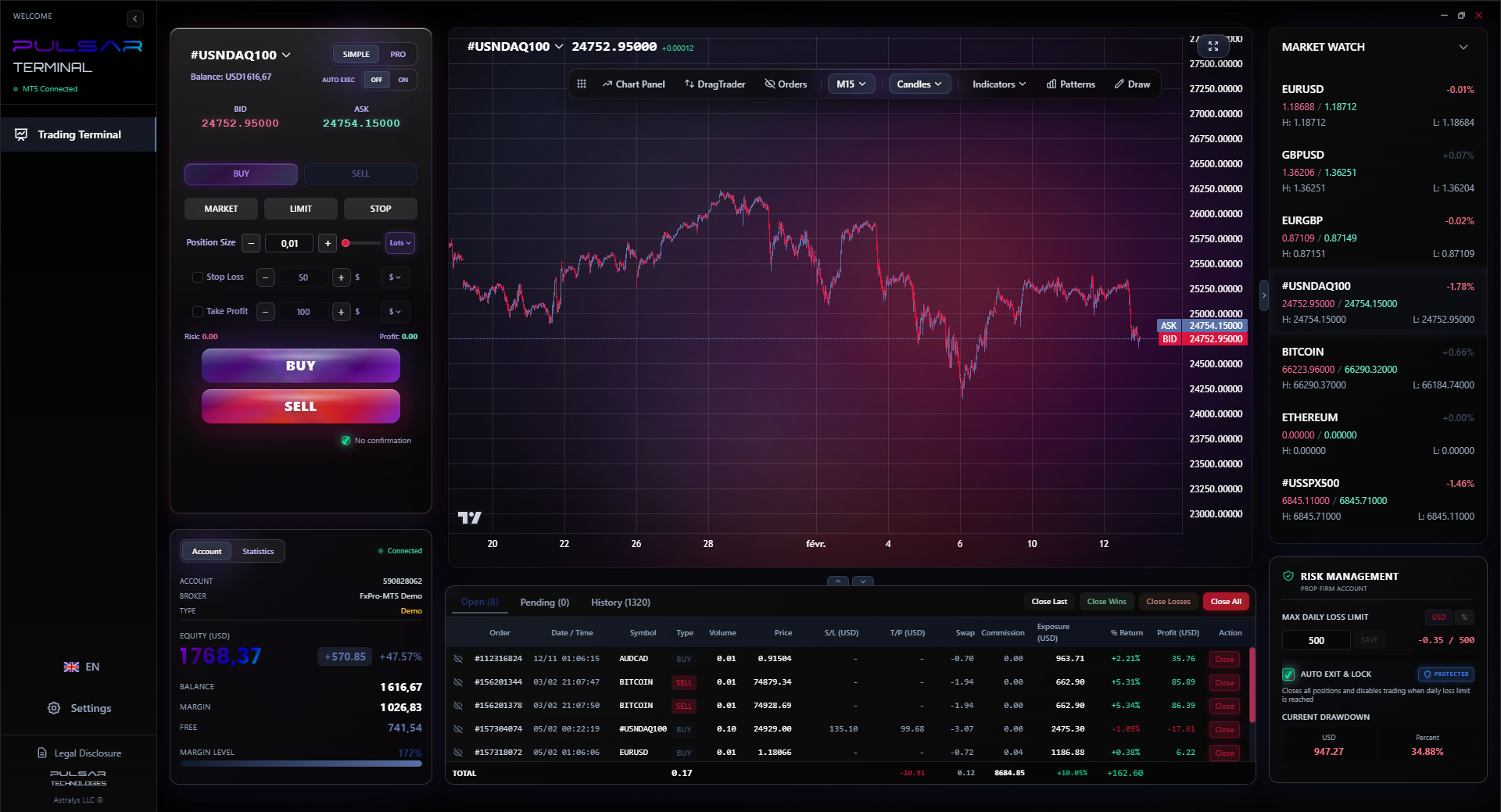
Managing prop firm risk rules like daily loss limits is a constant mental battle, which is why automating that protection with a tool like Pulsar Terminal is a game-saver.
Pulsar Terminal
The all-in-one MT5 companion: drag-and-drop orders, multi-TP/SL, trailing stop, grid trading, Volume Profile, and prop firm protection. Used by 1,000+ traders daily.
So, with all this chaos, how do you pick a partner that might actually be around in 2027?
| Feature | Old Model (Risky) | Future-Proof Model |
|---|---|---|
| Regulatory Stance | Avoids the topic, calls itself an 'eval.' | Openly discusses 2026, has legal/compliance plans, may already be NFA-registered. |
| Asset Focus | Offers 1000+ forex pairs, crypto, CFDs. | Focuses on core, exchange-regulated futures (Indices, Treasuries, Commodities). |
| Payout Transparency | Vague timelines, hidden fees on withdrawals. | Clear, published payout schedule (e.g., bi-weekly), shows aggregate payout stats (like Apex's $600M+). |
| Fee Structure | Low challenge fee, but high hidden commissions/data costs. | Transparent, all-inclusive pricing, or clear breakdown of pass-through costs (exchange data). |
| Platform | MT4 only, proprietary platform. | Offers strong, professional platforms like NinjaTrader, Rithmic, Tradovate, MT5. |
Look for firms that have already weathered the storm. The ones that survived the 2024-2025 purge have stronger infrastructure. Check their payout history - real, verifiable numbers. Apex Trader Funding, for instance, publicly shares its cumulative payout figures (over $598 million). That's a sign of a real business, not a fly-by-night operation.
Finally, manage your own expectations. The industry-wide pass rate is still only 5-10%. The future prop firm model isn't a lottery ticket; it's a rigorous audition for a job as a risk-managed trader. Your $299 challenge fee is the cost of that audition. Treat it as a tuition payment for an intense, real-world trading education. If you pass, the capital access is incredible. If you don't, the lessons in discipline are worth far more than the fee you lost.
FAQ
Q1Will current prop firms be shut down by the CFTC in 2026?
Not necessarily 'shut down,' but they will likely be forced to change. The most probable outcome is that firms will have to register as Commodity Trading Advisors (CTAs) or similar entities, bringing them under direct CFTC/NFA oversight. Firms that can't or won't comply will exit the market. The ones that prepare now are the ones you should consider.
Q2Are futures really better than forex for prop trading?
For the prop firm model, yes, and the market is voting with its feet. Futures are traded on centralized, regulated exchanges (CME, CBOT), which provides cleaner data, more transparent pricing, and exists within a clear regulatory framework. This reduces operational and regulatory risk for the prop firm, making it a more stable foundation for the 'future prop firm.' For traders, it often means more consistent execution and less spread manipulation.
Q3What's the single biggest mistake traders make in prop firm challenges?
Ignoring the daily loss limit. They treat a $50,000 account like they have $50,000 of their own risk capital. They don't. They have a $2,500 (5%) daily risk budget. Blowing through that in the first two hours by over-trading or poor position sizing is the most common failure mode. Survival hinges on treating that daily limit as your most sacred rule.
Q4How much money can I realistically make with a funded futures account?
Temper your expectations. The average successful payout is around 4% of the account size per period. So, on a $50,000 account, a realistic good month might see a $2,000 profit split (your share after an 80/20 split). The goal isn't a 100% return month; it's consistent 3-8% months that trigger account scaling over time, growing your capital base from $50k to $100k, $200k, and beyond.
Q5What happens if my prop firm goes bankrupt?
You lose your funded account status and any outstanding profits. Your challenge and activation fees are gone. This is why due diligence on the firm's financial stability and payout history is critical. You are an independent contractor trading the firm's capital; you are not a secured creditor if they fail.
Q6Do I need a special strategy to pass a futures challenge?
You need a strategy built for survival, not maximum gain. It must have extremely strict risk management (position sizing under 1% per trade), respect for the daily loss limit, and often works better on higher timeframes (like 1-hour or 4-hour charts) to avoid the noise that leads to overtrading. Patience and discipline are the core strategies.
Prof. Winston's Lesson
Key Takeaways:
- ✓Regulatory change in 2026 will redefine the industry.
- ✓Real costs include data fees and commissions, not just the challenge.
- ✓Futures are now the dominant asset class for prop firms.
- ✓A 5% daily loss limit demands a survival-first strategy.
- ✓Industry pass rates are still only 5-10%.
How useful was this article?
Click a star to rate
Weekly Trading Insights
Free weekly analysis & strategies. No spam.
About the Author
James Mitchell
Senior Trading Analyst
Based in New York with over 9 years of trading experience. Focuses on major USD pairs, prop firm challenges, and the US regulatory landscape.
Comments
Risk Disclaimer
Trading financial instruments carries significant risk and may not be suitable for all investors. Past performance does not guarantee future results. This content is for educational purposes only and should not be considered investment advice. Always conduct your own research before trading.
You Might Also Like

Cara Trading Forex Sukses: 7 Prinsip dari Trader Profesional
Cara trading forex sukses dengan 7 prinsip trader pro: manajemen modal, disiplin, journal trading, backtest. Data nyata, bukan janji profit palsu.
Jam Trading Forex Terbaik untuk Trader Indonesia: Panduan Lengkap dengan Tabel Waktu
Panduan jam trading forex untuk trader Indonesia. Tabel 4 sesi dunia, jam emas 20:00-00:00, sesi mana yang harus dihindari. Data akurat + tips dari trader berpengalaman.
Top 5 Sàn Forex Uy Tín Nhất 2026: Review Jujur dari Trader Indonesia
Top 5 sàn forex uy tín 2026 untuk trader Indonesia. Review jujur: spread, deposit, withdraw, dukungan lokal. Exness, XM, IC Markets & lebih.
Get Pulsar Terminal
All these calculators are built into Pulsar Terminal with real-time data from your MT5 account. One-click position sizing, automatic risk management, and instant calculations.
Get Pulsar Terminal