


I lost R4,200 in under an hour back in 2018.

David van der Merwe
Emerging Markets Trader ·  South Africa
☕ 11 min read
What you'll learn:
- 1Why Gold (XAU/USD) is Different for Us
- 2What Actually Moves the Gold Price? Forget the Hype
- 3Reading Gold's Charts: It Has a Personality
- 4Strategies That Work (And One That Cost Me Money)
- 5Managing Risk: This is How You Survive
- 6Local Realities: ZAR, Taxes, and Your Broker
- 7Building Your Daily Gold Trading Routine

I lost R4,200 in under an hour back in 2018. Gold had been trending up nicely, and I jumped into XAU/USD at $1,890, convinced it was heading to $1,920. I didn't check the economic calendar. The Fed minutes hit, the dollar spiked, and gold dropped $30 like a stone. My stop-loss was too tight, it got taken out, and the price immediately reversed and went right back up. That painful lesson cost me real money and taught me that trading gold isn't just about drawing lines on a chart. You need a proper, grounded approach to gold analysis forex, especially with our volatile Rand and the specific rules our brokers work under.
For a South African trader, gold isn't just another forex pair. It's deeply personal. We live in a country with massive gold reserves, a mining history in our blood, and a local currency that often moves inversely to the gold price. When the Rand weakens, the dollar price of gold frequently strengthens. This creates a unique double-play opportunity (and risk) that traders in London or New York don't naturally feel.
XAU/USD, which shows how many US dollars one ounce of gold costs, is the most liquid way to trade it. But you're not just trading a metal. You're trading global fear, inflation expectations, and central bank policy against the dollar. I've found it reacts more sharply to US data and Fed speeches than most currency pairs. A bad inflation print can send it soaring, while strong jobs data can hammer it down.

Warning: Don't confuse the international XAU/USD price with local gold mining shares or Krugerrands. The CFD you're trading on MT5 is a pure, leveraged bet on the global spot price. Local factors like Eskom or SA politics have almost zero direct impact on its minute-to-minute movement.
Your broker's conditions matter hugely. I've seen spreads on XAU/USD swing from a tight 25 cents during the London session to over R8 (about 40 cents) during volatile news events with some brokers. That's a big chunk of your potential profit gone before you even start. Always check if your broker is FSCA-regulated. That ODP license isn't just paperwork. It means they have to keep client funds segregated and adhere to some basic conduct rules. I stick with brokers like IC Markets or Pepperstone for gold because their spreads are consistently among the tightest I've found for South African clients.

💡 Winston's Tip
Gold has a long memory. That price level it struggled at six months ago? It will matter again. Always trade with a multi-year chart open.
If you listen to financial TV, you'll hear a hundred reasons gold moves. In my experience, it boils down to three core drivers, and you need to watch them like a hawk.
Real Interest Rates (The Big One)
This is the most reliable long-term driver. Gold pays no interest. So, when real interest rates (bond yield minus inflation) are low or negative, gold becomes attractive. When they rise, gold suffers. I keep a simple chart on my screen: the US 10-year Treasury yield and the US inflation breakeven rate. When that real yield line starts climbing, I get cautious on my long gold positions.
The US Dollar
Gold is priced in dollars. A strong dollar usually means weaker gold, and vice versa. But it's not a perfect inverse correlation. Sometimes both rise together during a major crisis (a 'flight to quality'). You need to watch the Dollar Index (DXY) as part of your gold analysis forex routine, but don't rely on it alone.
Market Sentiment & Crisis Demand
This is the emotional driver. War, banking fears, stock market crashes – they send people scrambling for safety. The key here is to differentiate between a short-term panic spike and a sustained move. The 2023 banking scare sent gold up sharply, but it gave back half those gains within weeks. I got caught buying the very top of that spike. The lesson? Wait for the initial panic to settle before jumping in.

Example: In March 2023, during the Silicon Valley Bank collapse, gold jumped from $1,810 to $1,960 in days. I bought at $1,950, thinking the fear would continue. It didn't. The price stalled and rolled over. I exited at $1,920 for a $30 per ounce loss. The smarter play, I learned later, would have been to wait for a pullback to the $1,880 support zone that held afterward.
“Trading gold isn't just about drawing lines on a chart. You need a proper, grounded approach.”
Gold doesn't move like the EUR/USD. It's more volatile, it respects historical levels with eerie precision, and it can trend for months. Technical analysis works, but you have to adjust your settings.
Key Levels are Sacred: Gold has long-term memory. Prices like $1,800, $1,680, and $2,075 aren't random. They are decade-old battle zones. I always have a multi-year chart open to see where major swing highs and lows are. A break above or below these is a big deal.
Indicators Need Room: Because gold is so jumpy, standard indicator settings can give false signals. I use a slower RSI indicator (like 14 or even 21 periods) to filter out the noise. A weekly RSI reading over 70 often precedes a decent pullback, while under 30 can signal a buying opportunity. The MACD indicator on the daily chart is great for spotting trend changes, but ignore its signals on the 1-hour chart during major news – it'll whip you to death.
Volume & Momentum: Gold often makes its biggest moves on high volume during the US/London overlap. A sharp price move on low volume is suspect and might reverse. I also watch for momentum divergences. If gold makes a new high but the RSI makes a lower high, that's a classic warning sign that the uptrend is running out of steam.

Pro Tip: Draw horizontal lines at the daily and weekly opening prices. Gold has a habit of getting 'stuck' around these levels for hours, especially if there's no major news. They act as temporary magnets for price. I use these zones for entries when I'm scalping.

Let's get practical. Here are two frameworks I use, and one I abandoned.
1. The Trend-Following Pullback (My Bread and Butter) Gold loves to trend. When the daily chart is clearly making higher highs and higher lows, I wait for a pullback to a key support level. This could be a moving average (the 50 or 100-period EMA works well), a previous resistance-turned-support, or a Fibonacci retracement level (38.2% or 61.8%). I then look for a bullish price action signal (like a pin bar or a strong engulfing candle) to enter long. My stop-loss goes just below the swing low of the pullback.
Real Trade Example (2024): In early February, gold was in an uptrend. It pulled back from $2,065 to the $2,020 area, which was also the 50-day EMA. A strong bullish daily candle closed above $2,030. I entered at $2,032. Stop at $2,015. Target at the previous high of $2,065. It worked, hitting the target in about 10 days.
2. Range Trading at Major Levels When gold is stuck between two of those major historical levels with no clear trend, I switch to a swing trading range strategy. I sell near the top of the range and buy near the bottom, using shorter-term charts (4-hour, 1-hour) for precise entries. This requires patience and strict discipline to not chase breakouts that fail.
The Strategy That Failed Me: News Scalping I tried to scalp gold around high-impact news like the Non-Farm Payrolls. The spreads would widen to R10 or more, the price would jump 150 points in a second, and my orders would get slipped. The broker's latency gave them an edge I couldn't beat. I lost small amounts repeatedly before admitting this game was rigged against the retail trader. Now, I close my positions before major news or just watch from the sidelines.
💡 Winston's Tip
The most expensive lesson I learned: never add to a losing gold position. A trend in gold can run much further than your margin can handle.

“A tight stop-loss on gold is asking to be stopped out by random noise. Give your trade room to breathe.”
Gold will test your emotions. Without iron-clad risk management, a few bad trades can wipe you out. Here’s my non-negotiable checklist.
Position Sizing is Everything: Never risk more than 1-2% of your account on a single gold trade. The volatility is too high. Use a position size calculator every single time. For example, if your account is R20,000 and you risk 1% (R200), and your stop-loss is 100 points ($10) away from entry, you can only trade 0.02 lots. That’s it. No arguments.
Wider Stops are Often Smarter: Because of gold's volatility, a tight stop-loss is asking to be stopped out by random noise. Give your trade room to breathe. If the logical technical level for your stop is 150 points away, then size your position smaller so that 150-point risk still equals 1% of your account. A margin call happens when your position is too big for your stop.
The Overnight Cost (Swap): Holding a gold CFD overnight incurs a swap fee. It can be positive or negative depending on the direction. Check your broker's swap rates. Sometimes, holding a long position for weeks can eat a meaningful amount into your profits, especially if you're trading smaller sizes. Factor this into your profit targets.
One Trade at a Time: When starting, trade only one gold position. Don't pyramid or add to a losing trade. Gold can move against you fast, and doubling down is a surefire way to turn a small loss into a catastrophic one. I learned this the hard way early on.

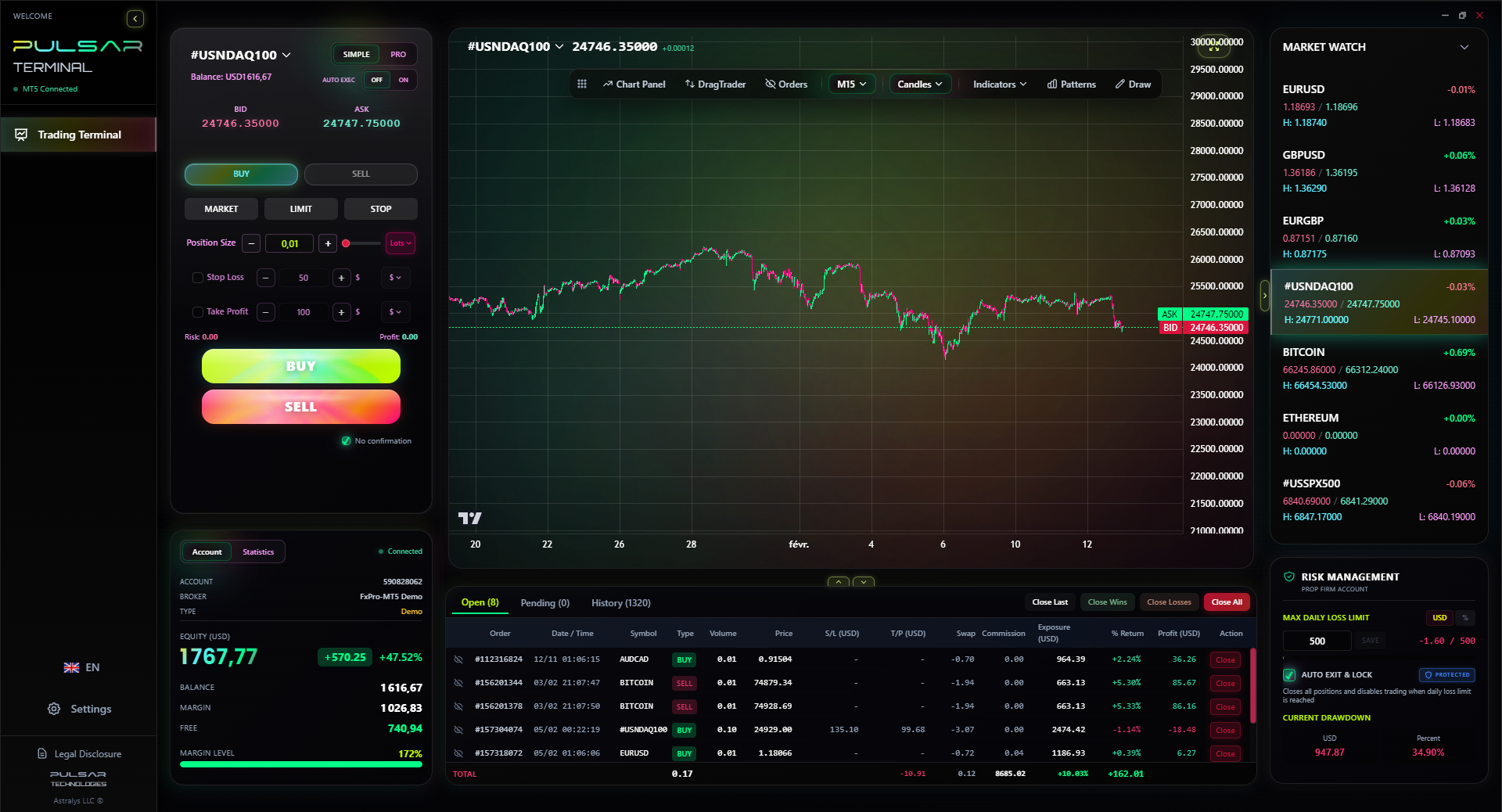
Managing multiple targets and a trailing stop on a volatile gold trade is stressful, but tools like Pulsar Terminal let you set them all with a single drag-and-drop directly on your MT5 chart.
Pulsar Terminal
The all-in-one MT5 companion: drag-and-drop orders, multi-TP/SL, trailing stop, grid trading, Volume Profile, and prop firm protection. Used by 1,000+ traders daily.
Trading from South Africa adds a few unique layers to your gold analysis forex plan.
The ZAR Factor: Your trading account is likely in USD, but your bank account is in Rand. When you deposit or withdraw, the USD/ZAR exchange rate applied by your broker or bank becomes a hidden cost (or gain). I try to make larger, less frequent withdrawals to minimize the impact of transfer fees and poor exchange rates. Some local brokers, like those reviewed on our site such as XM or Exness, offer ZAR-denominated accounts, which removes this currency risk from your capital but check their gold spreads carefully.
Tax (SARS and You): The South African Revenue Service views profits from CFD trading as capital gains. You have an annual exclusion (around R40,000 as of now, but check the latest). Gains above that are included in your taxable income. Keep careful records of every trade – entry, exit, fees, and the ZAR value at the time. It's a headache, but not doing it is a bigger one.
Choosing the Right Local Broker: An FSCA license is the absolute minimum. Beyond that, look for:
- Tight, average spreads on XAU/USD (under 35 cents is good).
- Reliable deposit/withdrawal in ZAR via EFT without crazy fees.
- A stable MT4/MT5 platform. Server stability is crucial during volatile gold moves.
- Responsive local support. You don't want to wait 24 hours for an email reply from Cyprus if your platform freezes.
Your analysis might be perfect, but if your broker's execution is slow or their spreads are predatory, you'll lose. Test with small amounts first.
💡 Winston's Tip
Your first target in any gold trade should be to move your stop-loss to breakeven. Gold's volatility can gift you profits, then snatch them back in a heartbeat.
“Most of trading is waiting. If price doesn’t come to my level, I do nothing. That’s the hardest part.”
Consistency beats brilliance. Here’s the 20-minute routine I follow every day before I even consider a trade.
- The Big Picture (5 mins): Open the weekly and daily chart. What’s the trend? Is price near a major historical level? I note the key support and resistance zones.
- Check the Drivers (5 mins): Glance at the US 10-year yield, the DXY, and the economic calendar. Is there a Fed speech or US inflation data today? That will dictate volatility.
- Plan the Day (10 mins): Based on steps 1 & 2, I decide my bias: bullish, bearish, or neutral. I identify my key entry level, my stop-loss level, and my profit target. I calculate my position size using my position size calculator. I write this plan down on a sticky note next to my screen.
Then, I wait. If price doesn’t come to my level, I do nothing. That’s the hardest part. Most of trading is waiting. When a setup triggers, I execute the plan exactly, set my stop and limit orders, and walk away. I don’t sit and watch it tick up and down. That’s how you make emotional mistakes.
Gold trading can be incredibly rewarding. It offers clarity in its trends and reactions to fundamental forces. But respect it. It’s not a get-rich-quick scheme. It’s a skill built on disciplined gold analysis forex, strict risk management, and learning from every single trade, especially the losing ones. Start small, keep a journal, and focus on the process. The profits will follow the discipline.
FAQ
Q1What is the best time of day to trade gold (XAU/USD) from South Africa?
The overlap between the London and New York sessions (3:00 PM to 6:00 PM SAST) is typically the most liquid and volatile, offering the best opportunities and tightest spreads. The Asian session (early morning SAST) is usually the quietest and least predictable.
Q2How much money do I need to start trading gold forex in South Africa?
While some FSCA brokers allow minimum deposits as low as R100, I strongly advise starting with at least R5,000-R10,000. This allows for proper position sizing and risk management. With a R1,000 account, a single 50-point move against you on a micro lot could wipe out 5% of your capital.
Q3Do I pay tax on my gold trading profits in South Africa?
Yes. Profits from CFD trading are considered capital gains by SARS. You have an annual exclusion (confirm the current amount). Gains above this are included in your taxable income. Keep detailed records of all trades in ZAR.
Q4Why does the spread on gold sometimes get so wide with my broker?
Spreads widen during periods of low liquidity (Asian session, holidays) and high volatility (major news releases like US CPI or Fed decisions). It's the broker's way of managing their risk. Always check the economic calendar and avoid trading right before high-impact news if you're sensitive to spread costs.
Q5Is technical analysis or fundamental analysis more important for gold?
You need both. Fundamentals (interest rates, dollar strength, crises) set the long-term direction. Technical analysis gives you the precise entry, exit, and risk management levels for your trades. Ignoring one is like driving with one eye closed.
Q6Can I trade gold in South African Rands (XAU/ZAR)?
It's rare as a CFD. You'll almost always trade XAU/USD. Some brokers offer ZAR-based accounts, but the underlying asset is still priced in USD. This means your profit/loss is converted to ZAR at your broker's rate, adding an extra layer of exchange rate risk to your P&L.
Q7What's a realistic monthly return goal for a gold forex trader?
If you're consistently making 5-10% per month on your risk capital, you're doing exceptionally well. Aiming for 20%+ monthly is a recipe for overtrading and blowing up your account. Focus on protecting your capital first; consistent returns come from survival.
Prof. Winston's Lesson
Key Takeaways:
- ✓Always check the economic calendar before trading gold.
- ✓Risk a maximum of 1-2% of capital per trade.
- ✓Use weekly/daily charts to identify key historical levels.
- ✓Wider stops are better than tight ones on XAU/USD.
How useful was this article?
Click a star to rate
Weekly Trading Insights
Free weekly analysis & strategies. No spam.
About the Author
David van der Merwe
Emerging Markets Trader
Johannesburg-based trader with 11 years in emerging market currencies. Specializes in ZAR pairs, FSCA-regulated trading, and South African market analysis.
Comments
Risk Disclaimer
Trading financial instruments carries significant risk and may not be suitable for all investors. Past performance does not guarantee future results. This content is for educational purposes only and should not be considered investment advice. Always conduct your own research before trading.
You Might Also Like

Cara Trading Forex Sukses: 7 Prinsip dari Trader Profesional
Cara trading forex sukses dengan 7 prinsip trader pro: manajemen modal, disiplin, journal trading, backtest. Data nyata, bukan janji profit palsu.
Jam Trading Forex Terbaik untuk Trader Indonesia: Panduan Lengkap dengan Tabel Waktu
Panduan jam trading forex untuk trader Indonesia. Tabel 4 sesi dunia, jam emas 20:00-00:00, sesi mana yang harus dihindari. Data akurat + tips dari trader berpengalaman.
Top 5 Sàn Forex Uy Tín Nhất 2026: Review Jujur dari Trader Indonesia
Top 5 sàn forex uy tín 2026 untuk trader Indonesia. Review jujur: spread, deposit, withdraw, dukungan lokal. Exness, XM, IC Markets & lebih.
Get Pulsar Terminal
All these calculators are built into Pulsar Terminal with real-time data from your MT5 account. One-click position sizing, automatic risk management, and instant calculations.
Get Pulsar Terminal