


Most Indian 'gurus' will tell you gold trading is a safe haven, a patriotic duty, and a one-way ticket to riches.

Rajesh Sharma
Senior Forex Analyst ·  India
India
☕ 9 min read
What you'll learn:

Most Indian 'gurus' will tell you gold trading is a safe haven, a patriotic duty, and a one-way ticket to riches. They're selling you a fairy tale, not a trading plan. The truth? Trading gold in India is a unique beast, tangled in taxes, sentiment, and global forces that can eat your capital faster than Diwali sweets. I've made and lost lakhs on the MCX, traded digital gold apps, and learned the hard way what works in our market. Forget the fluff. Let's get real about making money with gold.
You've been fed a line. Gold isn't just an asset here, it's emotional baggage. It's your grandmother's necklace, your parent's hedge against chaos, and a symbol of status. That cultural weight makes Indian gold markets behave irrationally. Global prices can be crashing, but local demand might still push premiums up because of a wedding season. You're not just trading a commodity, you're trading against centuries of sentiment.
I learned this the painful way in 2013. The global spot price (XAU/USD) was in a clear downtrend. Logically, I shorted MCX Gold Mini. What I forgot? It was Akshaya Tritiya. The physical buying frenzy created a temporary but powerful local price floor. My perfectly logical global short got squeezed by local sentiment, and I took a 45,000 rupee loss before I bailed. The lesson? In India, you need two charts: one for the world price (like the one you'd analyze in our XAU/USD guide), and one for the local MCX price. The gap between them, the 'India premium,' is a tradeable signal in itself.

Warning: Never assume MCX Gold will move in perfect lockstep with international prices. Festivals, import duty changes, and even rupee volatility can decouple them for weeks. Always check both.

💡 Winston's Tip
The 'India Premium' on gold isn't just noise, it's a sentiment gauge. When local premiums spike during a global sell-off, it's often a contrarian signal that a short-term bottom is near.

So you want in. Here's the menu, with the real cost of each dish.
MCX Futures: The Main Event
This is where the serious action is. You're trading contracts for 1 kg (Gold) or 100 grams (Gold Mini, Gold Guinea) of gold, not buying the metal. It's leveraged, volatile, and where I do 90% of my gold trading.
| Instrument | Contract Size | Approx. Margin (2025) | Good For |
|---|---|---|---|
| Gold | 1 Kg | ₹1.2 - 1.5 Lakh | Big players, institutions |
| Gold Mini | 100 g | ₹12,000 - 15,000 | Retail traders (most popular) |
| Gold Guinea | 8 g | ₹1,000 - 1,500 | Micro traders, testing strategies |
The liquidity is fantastic during market hours (10 AM to 11:30 PM). But remember, this is futures. You have an expiry date. You can't just 'hold forever' like physical gold. You'll need a decent broker for this. I've found platforms like Zerodha and Angel One reliable for Indian derivatives, though their research is often generic.
Gold ETFs & Sovereign Gold Bonds (SGBs)
These are for buying, not trading. ETFs (like Nippon India Gold ETF) track domestic price but have tracking error and expense ratios (~0.5-1%). SGBs are government-backed, pay 2.5% annual interest, and have an 8-year lock-in for full tax benefits. They're a savings product, not a trading vehicle. Don't kid yourself.
Digital Gold & Apps
Platforms like MMTC-PAMP, Paytm Gold, etc., let you buy grams digitally. It's simple and accessible. The spread is criminal - often 5-7% between buy and sell prices. You're paying a huge premium for convenience. It's a terrible way to trade, but an okay way to save small amounts if you ignore the cost.

Pro Tip: Start with Gold Mini on MCX. The contract size and margin are sane for a retail trader. Use a position size calculator religiously. With a ₹50,000 account, risking 1% means your stop-loss can only be ₹500. That's a very tight leash on gold's volatile moves.
“Always, always trade with a post-tax profit target. It changes your entire risk management mindset.”
This is where dreams of profit go to die. Most new traders only think about entry and exit, not the taxman's cut. Get this wrong, and your winning trade becomes a loser.
MCX Futures (Your Trades): Every profitable trade is subject to Speculative Business Income. It gets added to your total income and taxed at your applicable income tax slab rate (could be 30%+). Losses can be carried forward for 8 years to set off against future speculative gains. You need to maintain detailed trade logs. Your broker's P&L statement is your bible.
Physical Gold, ETFs, SGBs: Held for less than 3 years? Short-term Capital Gains (STCG), added to income, taxed at slab rate. Held for more than 3 years? Long-term Capital Gains (LTCG) at 20% with indexation benefit. SGBs have a special perk: if held to maturity (8 years), the entire capital gain is tax-free. The interest is taxable, though.
Here's a real example from my book: In FY 2023-24, I had ₹2,80,000 in net profits from MCX Gold Mini trades. That got added to my other income. I was already in the 30% slab. So, the tax hit was roughly ₹84,000. I didn't account for that initially when calculating my 'success.' My actual net return was far lower. Always, always trade with a post-tax profit target. It changes your entire risk management mindset.
💡 Winston's Tip
Always calculate your profit target and stop-loss in rupees per gram first, then convert it to points. It keeps you grounded in real money, not abstract numbers.
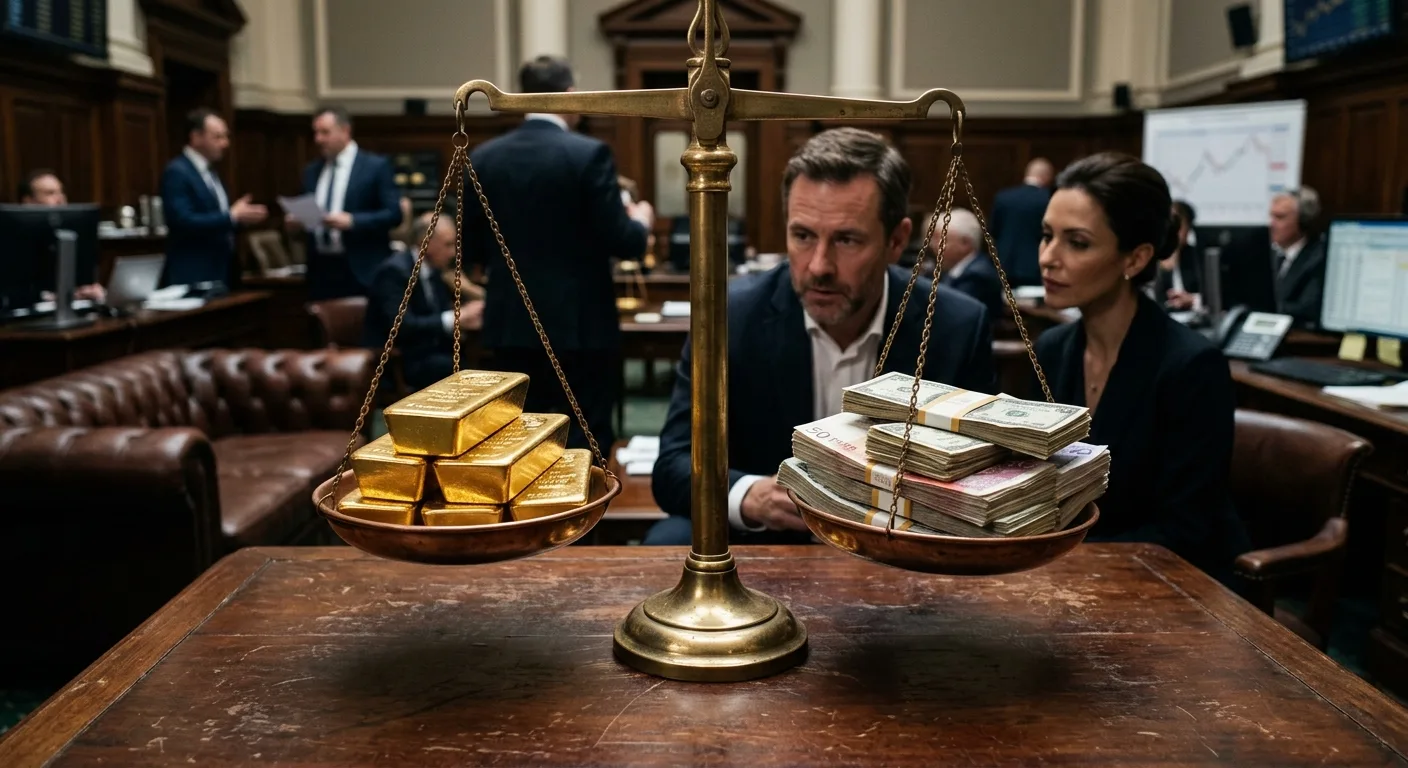

Forget complex indicators. Gold responds best to clean price action and key levels. Here's a swing trading framework I've used for years on the 4-hour chart of MCX Gold Mini.
The Setup: Trend & Retracement
- Identify the clear trend. Use a simple 50-period Exponential Moving Average (EMA). Price above it? Bias is up. Price below? Bias is down.
- Wait for a pullback (retracement) towards that 50 EMA. In an uptrend, you want price to dip back near the EMA.
- Look for a price action signal at that zone. My favorite is a bullish or bearish engulfing candle on the 4H chart.
- Enter on a break of that engulfing candle's high (for longs) or low (for shorts).
The Trade Management:
- Stop Loss: Place 1.5% to 2% beyond the recent swing low (for long) or high (for short). On a 100g contract, a 2% move is about ₹1,200. That's your risk.
- Take Profit 1: Set at 1:1 Risk/Reward (R:R). Move your stop to breakeven once this target is hit.
- Take Profit 2: Let the rest run, trailing your stop below the most recent 4-hour swing low (for longs).
Real Trade Example (MCX Gold Mini, April 2024):
- Trend was up (price above 50 EMA). Price pulled back to 72,100 ₹/10g, right at the EMA.
- A bullish engulfing candle formed on the 4H chart.
- Entry: 72,350 (break of candle high). Stop Loss: 71,550 (800 points risk).
- TP1: 73,150 (800 points profit). Hit in 2 days. Stopped moved to breakeven.
- TP2: Price rallied further. I trailed my stop and was finally exited at 74,100 for an additional 1,750 point gain.
- Total Gain: 2,550 points on a 100g contract = ₹2,550 profit per contract, minus brokerage.
This isn't get-rich-quick. It's about consistency. This is a form of swing trading that suits gold's rhythmic movements. For faster action, some adapt this to lower timeframes, but that veers into scalping strategy territory, which is tougher with gold's spreads.

“Your biggest edge is understanding local sentiment drivers, and having the discipline to trade the chart, not the sentiment.”
Your broker is your gateway. For MCX trading in India, you're using a domestic broker. I've used many. The big names (Zerodha, Angel One, Upstox) have low costs but their advanced charting platforms (Kite, Sensibull) can be lacking for serious technical analysis.
Many professional traders I know (myself included) use a two-system setup:
- Execution Platform: Your broker's terminal (like Zerodha Kite) to place orders. It's reliable for order entry.
- Analysis Platform: A dedicated charting software. I use TradingView for its superior charts, indicators, and community scripts. I analyze there, then execute on my broker's platform.
What about International Brokers? You might hear about trading XAU/USD with brokers like Exness or IC Markets. Yes, you can access them. But remember: you're trading in USD. Your deposit, profit, and loss are in foreign currency. This adds a layer of currency risk. If the rupee strengthens, your USD profits are worth less in INR. It also complicates your taxes. For most Indian traders starting out, stick to MCX. The currency, contract sizes, and taxes are all in your home context.
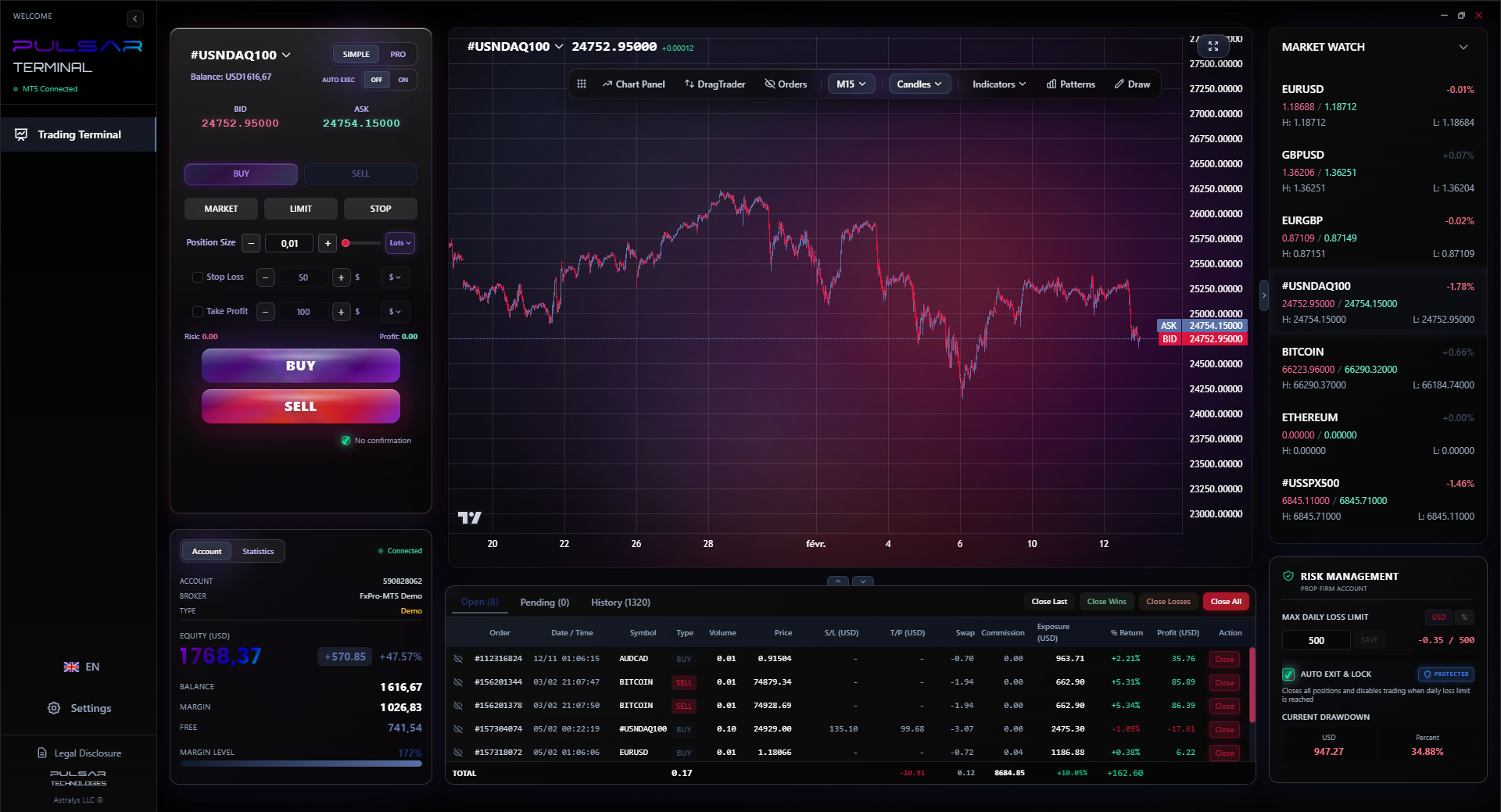
The single biggest upgrade to my trading wasn't a new indicator, it was a tool that managed my trades automatically. Manually moving stops to breakeven or trailing them is a chore and you'll miss it. Now, I use a trade management tool attached to my MT5 (which some international brokers offer). It lets me set rules: 'Move stop to breakeven when trade is up 1x risk,' 'Start a trailing stop after price moves 1.5x risk.' This takes the emotion out of the most emotional part - managing an open trade.
Manually trailing stops on volatile gold swings is a nightmare; Pulsar Terminal automates it with one-click trailing stop and breakeven rules directly on your MT5 chart.
Pulsar Terminal
The all-in-one MT5 companion: drag-and-drop orders, multi-TP/SL, trailing stop, grid trading, Volume Profile, and prop firm protection. Used by 1,000+ traders daily.
This is the final boss. You're fighting internal programming. Every time you short gold, a little voice says, 'But gold always goes up in the long run!' That voice will lose you money.
Detach from the Metal: You are not trading your mother's bangles. You are trading a ticker symbol that represents a price. It has no inherent value beyond what the market says right now. This mental shift is non-negotiable.
Ignore the Noise: During festivals, your family, the news, every advertisement will scream 'BUY GOLD!' As a trader, you must be ready to do the opposite if your system says so. In October 2022, during Diwali season, the charts showed a clear distribution pattern (price failing to make new highs). While everyone was buying for Lakshmi Puja, I was building a short position. It went against every cultural instinct, but it was one of my most profitable trades that quarter.
Embrace the Boredom: Gold can trend beautifully, but it also spends weeks in tight, choppy ranges. This is when most traders lose money, overtrading out of boredom. If there's no clear RSI indicator divergence or MACD indicator crossover confirming a breakout, stay out. Preserving capital is a win. Go watch a movie instead of forcing a trade.
Your biggest edge in Indian gold trading isn't a secret indicator. It's understanding the local sentiment drivers better than an international trader, and having the discipline to trade the chart, not the sentiment.
💡 Winston's Tip
If you find yourself constantly checking physical gold prices at your local jeweller for trading cues, you haven't detached. You're an investor, not a trader. Close the charts.

FAQ
Q1What is the best time to trade gold in India?
The most liquid and volatile times for MCX Gold are during overlap with international markets: 1:30 PM to 5:30 PM IST (London open) and 6:30 PM to 11:30 PM IST (US session open). Avoid the early morning (10 AM - 12 PM) which is often thin and erratic.
Q2Can I trade gold with just ₹10,000?
Technically, yes, via the MCX Gold Guinea contract (8g, margin ~₹1,000). But practically, it's very hard. With a ₹10,000 account, proper risk management (risking 1%) means your stop-loss can only be ₹100. Gold's normal volatility will stop you out constantly. I'd recommend at least ₹50,000 to trade Gold Mini with sensible stops.
Q3Is trading gold futures safer than buying physical gold?
It's not about 'safer,' it's about different risks. Physical gold has storage risk and high making charges, but no expiry. Futures have use risk, expiry dates, and require active management. Futures are for trading; physical is for saving. Don't confuse the two.
Q4How do I handle the daily settlement in MCX futures?
Mark-to-market (MTM) settlement happens daily. Your profit or loss is credited/debited from your trading account each day. This is automatic. The key thing to watch is your margin. A series of losing days can erode your margin fast, leading to a margin call. Always keep a buffer above the minimum required margin.
Q5What moves gold prices the most?
US Dollar strength (inverse relationship), US real interest rates (higher rates = bad for gold), global geopolitical tension (flight to safety), and central bank buying/selling. In India, add the USD/INR rate (a weaker rupee makes imported gold more expensive, supporting MCX prices) and domestic demand seasons.
Q6Should I use use when trading gold?
Use it like a surgeon's scalpel, not a hammer. The inherent use in futures (often 10x or more) is enough. Never over-use by maxing out your margin. A 2% move against you with max use can wipe out 20% of your margin. I never use more than 30-40% of my available margin at any time.
Prof. Winston's Lesson
Key Takeaways:
- ✓Trade MCX Gold Mini, not spot or digital gold, for real efficiency.
- ✓Factor in a 30%+ tax hit on futures profits before celebrating.
- ✓Use the 50 EMA pullback with engulfing candles for high-probability swings.
- ✓The best trade often feels wrong culturally (e.g., shorting before Diwali).
How useful was this article?
Click a star to rate
Weekly Trading Insights
Free weekly analysis & strategies. No spam.
About the Author
Rajesh Sharma
Senior Forex Analyst
Trading Indian and South Asian markets for over 10 years. Started with NSE currency derivatives before moving to international forex. Specializes in USD/INR and emerging market pairs.
Comments
Risk Disclaimer
Trading financial instruments carries significant risk and may not be suitable for all investors. Past performance does not guarantee future results. This content is for educational purposes only and should not be considered investment advice. Always conduct your own research before trading.
You Might Also Like

Cara Trading Forex Sukses: 7 Prinsip dari Trader Profesional
Cara trading forex sukses dengan 7 prinsip trader pro: manajemen modal, disiplin, journal trading, backtest. Data nyata, bukan janji profit palsu.
Jam Trading Forex Terbaik untuk Trader Indonesia: Panduan Lengkap dengan Tabel Waktu
Panduan jam trading forex untuk trader Indonesia. Tabel 4 sesi dunia, jam emas 20:00-00:00, sesi mana yang harus dihindari. Data akurat + tips dari trader berpengalaman.
Top 5 Sàn Forex Uy Tín Nhất 2026: Review Jujur dari Trader Indonesia
Top 5 sàn forex uy tín 2026 untuk trader Indonesia. Review jujur: spread, deposit, withdraw, dukungan lokal. Exness, XM, IC Markets & lebih.
Get Pulsar Terminal
All these calculators are built into Pulsar Terminal with real-time data from your MT5 account. One-click position sizing, automatic risk management, and instant calculations.
Get Pulsar Terminal