


Here's a fact that should make you pause: over 70% of Indian retail traders who jump into gold futures on the MCX blow their first account within six months.

Rajesh Sharma
Senior Forex Analyst ·  India
India
☕ 11 min read
What you'll learn:
- 1Why Gold Trading Isn't Like Stocks or Crypto
- 2Where to Trade: MCX, ETFs, and the SGB Trap
- 3Strategies That Actually Work on the MCX
- 4Risk Management: Your Rupee Survival Guide
- 5The Trader's Mind: Gold's Emotional Rollercoaster
- 6Your Personal Gold Trading Blueprint
- 7From Course to Live Trading: The Path Forward

Here's a fact that should make you pause: over 70% of Indian retail traders who jump into gold futures on the MCX blow their first account within six months. They treat it like a shiny Nifty stock, and it eats them alive. Gold isn't just another asset class; it's a beast with its own psychology, driven by global dollars and local rupee whims. This isn't a theoretical guide. This is the gold trading course I wish I had when I lost ₹1.2 lakhs in a week trying to short gold during a geopolitical flare-up.
If you're coming from equities or crypto, forget everything you think you know about momentum. Gold moves on fear, real interest rates, and central bank stupidity. It doesn't care about PE ratios or quarterly earnings. In India, you've got the added layer of the USD/INR rate. A falling rupee can make gold in rupees go up even when the international dollar price is flat. I learned this the hard way in 2018. I was correctly bearish on gold in USD terms, but the rupee tanked from 68 to 74. My short position on the MCX, which should have been profitable, ended up as a ₹45,000 loss. The instrument itself was right, but I ignored the currency overlay.
The Two Prices You Must Watch
You are trading two markets simultaneously:
- XAU/USD: The global benchmark. This is the pure gold price.
- USD/INR: The exchange rate.
Your MCX price is roughly:
XAU/USD price * USD/INR rate. If gold is stable but the rupee weakens by 2%, your MCX gold price rises 2%. You need to watch both charts. A strong tool for this is the simple correlation check. When global uncertainty spikes, gold and the dollar can sometimes rise together, which supercharges the rupee price move. This dual-driver nature is what makes a dedicated gold trading course essential; you're not learning one asset, you're learning a system.

Warning: Never, ever base your MCX gold trade solely on a news headline about "gold demand in India during Diwali." That's a physical market story. The futures market is 95% driven by international prices and forex flows. That local demand story is often already priced in and is a classic trap for retail traders.

💡 Winston's Tip
The rupee is your silent partner in every MCX gold trade. If you don't understand what it's doing, you're trading blind. Keep a USD/INR chart pinned next to your gold chart.
“Gold isn't just another asset class; it's a beast with its own psychology, driven by global dollars and local rupee whims.”
You have options, but they're not all equal. Picking the right instrument is half the battle.
| Instrument | What It Is | Good For | The Catch |
|---|---|---|---|
| MCX Futures | Contracts for 1kg, 100g, 8g, 1g of gold. | Active trading, use, short-term speculation. | High use means quick ruin. You must understand margin call mechanics. |
| Gold ETFs | Exchange-Traded Funds that track domestic gold price. | Long-term, passive buying. No storage issues. | You don't own physical gold. There's a tiny tracking error and expense ratio. |
| Sovereign Gold Bonds (SGBs) | Government bonds linked to gold price. | Ultra-long-term (8-year) holders. You get 2.5% annual interest. | Your capital is locked. Terrible for trading. Liquidity in secondary market is poor. |
| Digital Gold | Promises of fractional physical gold via apps. | Absolutely nothing for a trader. | Largely unregulated. SEBI has issued warnings. Avoid like the plague. |
The MCX is where the action is for a course like this. The Gold Mini (100g) and Gold Petal (1g) contracts are the retail gateways. As of now, the initial margin for a Mini lot is around ₹79,000. That's not pocket change, but it gives you serious exposure. My bread and butter for years was the Mini contract. The liquidity is decent, and the spread is tolerable for anything other than ultra-fast scalping.

Pro Tip: Before you place a single trade, paper trade the MCX Gold Mini for a month. Track your P&L in rupees, accounting for brokerage and taxes. Most brokers like Zerodha (for ETFs) or Angel One offer decent platforms for this. Don't touch real money until you can consistently be profitable on paper. It sounds boring, but it's free education.
“Over 70% of Indian retail traders who jump into gold futures on the MCX blow their first account within six months.”
Forget complicated systems with 15 indicators. Gold responds best to clean price action and a few key levels. Here are the two frameworks I use 90% of the time.
1. The Macro Swing Trade
This is a swing trading approach, holding for days to weeks. You're trading the big picture.
- Setup: Identify a clear range on the daily chart of MCX Gold. Gold loves to consolidate for weeks, then explode.
- Trigger: Wait for a daily close above the resistance or below the support of that range on above-average volume.
- Entry: Enter on the retest of the broken level. Don't chase the initial breakout; it often pulls back.
- Stop Loss: Place your stop on the other side of the range.
- Take Profit: Aim for a target equal to the height of the previous range.
Real Trade Example (2023): MCX Gold had been stuck between ₹58,000 and ₹60,500 per 10g for almost a month. It closed above ₹60,600. I waited. It pulled back to ₹60,200. I went long there. Stop at ₹59,800. Target at ₹62,700 (the 2,500-point range height added to breakout). It ran to ₹62,900. That was a ₹2,700 profit per 10g, or ₹27,000 on a single Mini lot.
2. The Intraday USD/INR Alignment Trade
This is for the more active trader. You're playing the convergence or divergence between international gold and the rupee.
- Setup: Have charts for XAU/USD and USD/INR open next to MCX Gold.
- Trigger: Look for a strong, clear move in XAU/USD (use a 15-min or 1-hour chart). Then, check if USD/INR is moving in a direction that amplifies it (e.g., Gold up + Rupee weakening = STRONG buy signal for MCX).
- Entry: Enter the MCX trade in the direction of the combined force. Use a shorter timeframe (5-min) for precise entry.
- Management: This is a fast trade. Your stop needs to be tight, and you should be out within hours. This is where a tool with precise order management is key. Manually moving stops is a recipe for disaster when price is moving fast.
These strategies require discipline. The number one mistake is turning a swing trade into a hope-and-pray long-term investment because it's going against you. Use a position size calculator every single time. For the swing trade, I risk no more than 1.5% of my capital. For the intraday trade, it's 0.5%.

“Over 70% of Indian retail traders who jump into gold futures on the MCX blow their first account within six months.”
This is the chapter where most gold trading courses fail. They teach you the entry, but not how to walk away with money. Gold volatility can double overnight. A ₹60,000 Mini contract can see ₹3,000 swings in a single session. Here’s the only way to handle it.
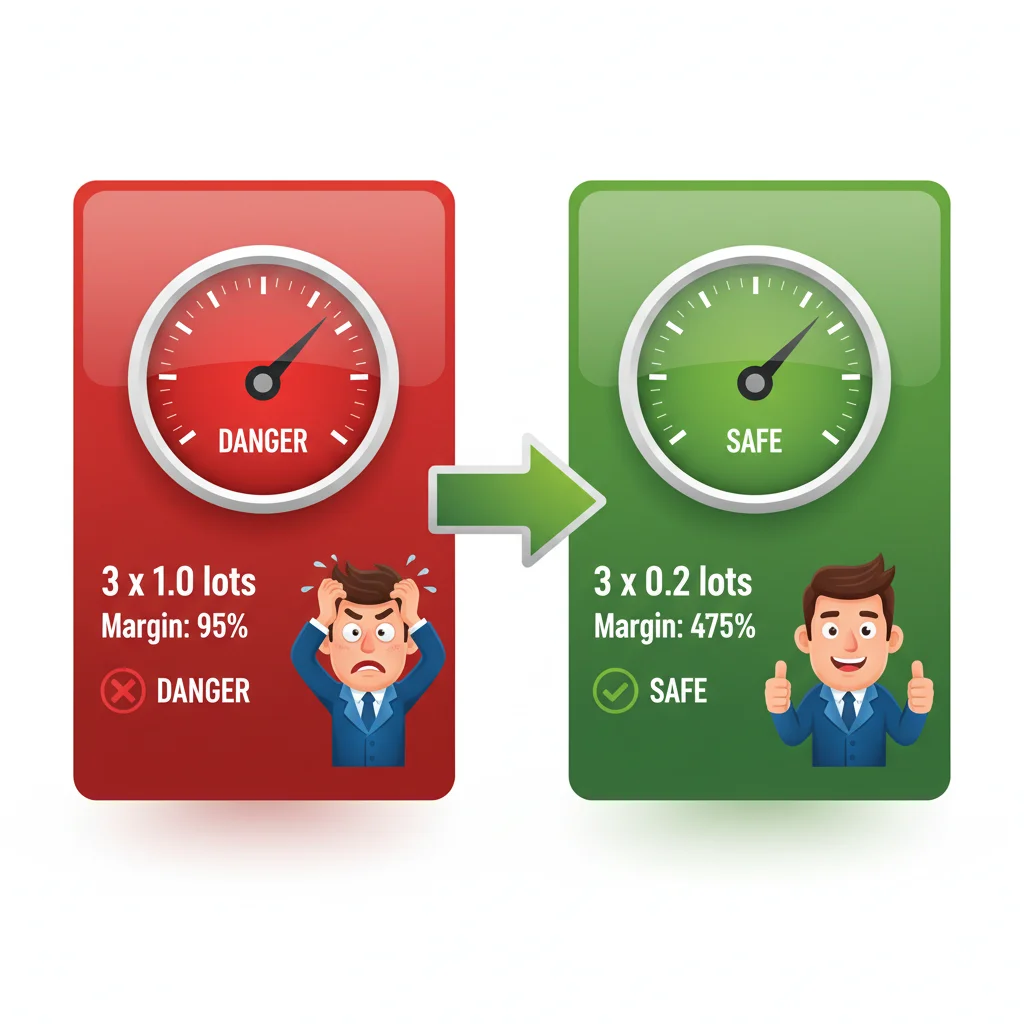
First, Position Size. I don't care if you have a "sure thing" tip from a guru. If your account is ₹2 lakhs, a single Mini contract (margin ~₹79k) is nearly 40% of your capital. That's suicide. As a rule, your total margin for all open trades should never exceed 20-25% of your liquid capital. For a ₹2 lakh account, that means total margins of ₹40k-50k. You might only be able to trade Petals (1g) or a very small Mini position.
Second, The Stop Loss. Your stop is sacred. It is not a suggestion. Before you enter, know exactly where you're wrong. That level should be based on the chart, not on how much money you're willing to lose. "I'll risk ₹5,000" is not a stop loss strategy. "I'll exit if price closes back inside the consolidation range" is.
Third, The Trailing Stop. This is where you make real money. Once your trade is in profit by 1.5x your initial risk, move your stop to breakeven. Then, trail it. A simple method: on a daily chart swing trade, move your stop to the low of the previous two daily candles (for a long trade). This locks in profits and lets winners run. Doing this manually is stressful and error-prone.

Example: You buy MCX Gold Mini at ₹60,000. Stop at ₹59,000 (risk = ₹1,000 per 10g, or ₹10,000 per lot). Price moves to ₹61,500. You're now up ₹15,000 (1.5x your risk). Move stop to ₹60,000 (breakeven). Price then climbs to ₹62,500. Update stop to ₹61,800 (near the recent swing low). Price reverses and hits your stop at ₹61,800. You bank ₹18,000 per lot. Without the trail, you might have watched it fall back to ₹60,500 and taken only ₹5,000.
💡 Winston's Tip
Your first profitable month is the most dangerous. It breeds overconfidence. Stick to your position sizing rules like your life depends on it - because your trading account does.
“Trade the chart, not the headline. 'Safe haven' buying is often already priced in by the time you read the news.”
Gold trades on emotion - global fear, greed, inflation panic. And you, sitting in Mumbai or Delhi, will absorb that emotion. The most dangerous phase is when your trade is in decent profit but hasn't hit your target. The voice says, "It's going parabolic! Add more!" Or, "It's pulling back, get out now!" This is where journals are non-negotiable.
I keep a simple log: Date, Instrument, Entry, Stop, Target, Exit, P&L, and one line for "Reason for Entry/Exit." The reason is the most important part. Reviewing it, I saw a pattern: 80% of my early exits were due to fear of losing paper profits, not because the trade thesis broke. I was leaving ₹50,000 on the table regularly because I couldn't handle the volatility.
The fix was mechanical. I made a rule: I do not touch a trade once the stop is moved to breakeven. I only adjust the trailing stop according to my pre-defined plan (e.g., the 2-day low method). This took the emotion out. The software handles the protection; I just monitor the chart structure. If you're manually clicking every stop adjustment while watching the P&L flicker, you will make a costly, emotional mistake. Guaranteed.
Another psychological trap is "gold is a safe haven" dogma. You buy because there's a war headline, but the market has already priced it in. It sells off on "buy the rumor, sell the news." You're left holding a losing position, confused because the news was "good" for gold. Trade the chart, not the headline.
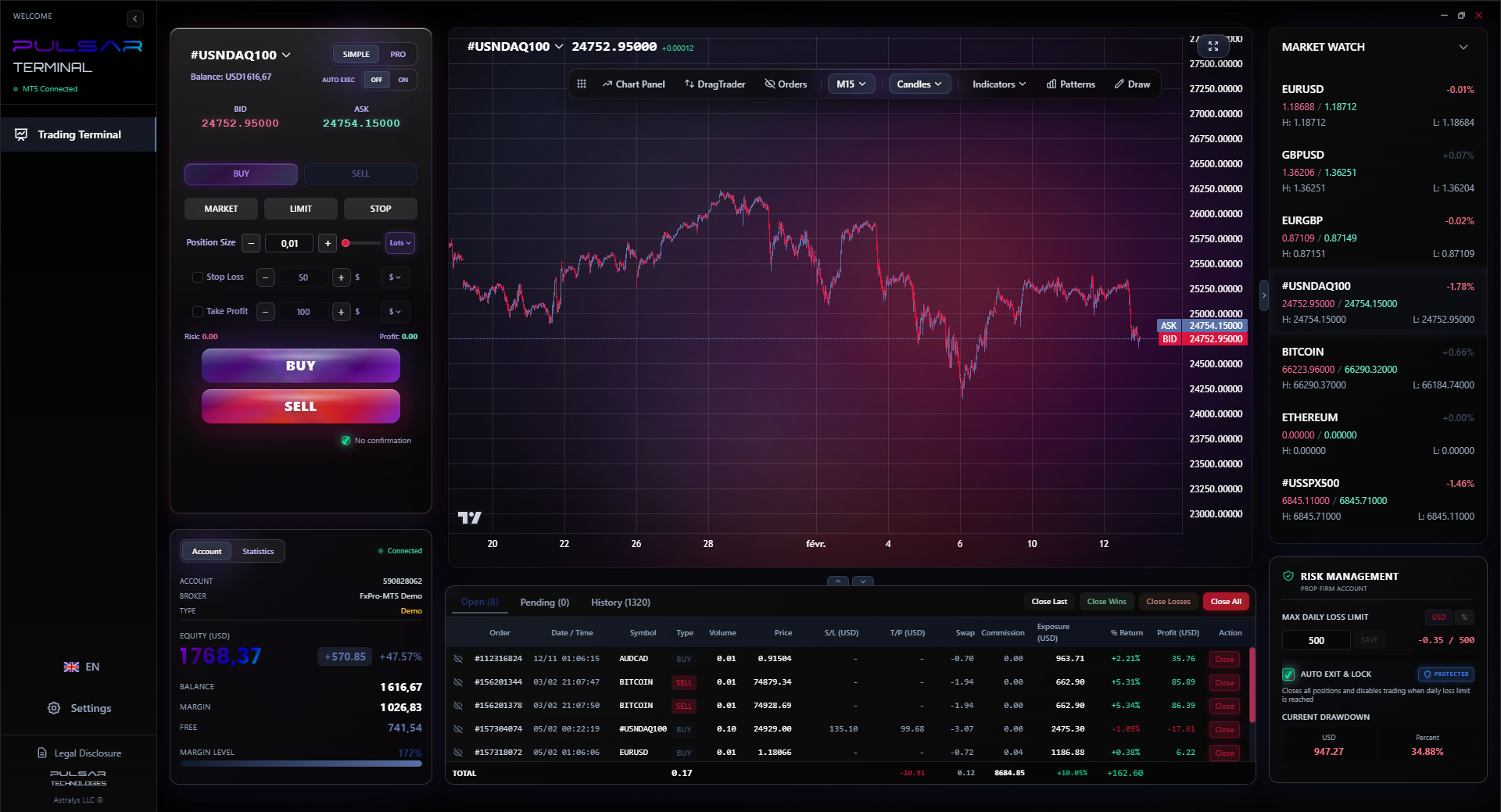
Managing the emotional volatility of gold trades requires mechanical discipline, which is where automating your stop-loss and take-profit strategy becomes essential.
Pulsar Terminal
The all-in-one MT5 companion: drag-and-drop orders, multi-TP/SL, trailing stop, grid trading, Volume Profile, and prop firm protection. Used by 1,000+ traders daily.
“Trade the chart, not the headline. 'Safe haven' buying is often already priced in by the time you read the news.”
A course is theory. A trading plan is your field manual. Let's build yours.
- Market Selection: Are you focusing on MCX Futures only? Or will you also take occasional positions in XAU/USD with an international broker like Exness or IC Markets for direct exposure? Stick to one primary market initially.
- Strategy Definition: Write down the exact conditions for your two favorite strategies from earlier. Be so specific that a robot could execute it. "Buy when the MACD crosses above zero" is bad. "Buy when price closes above the 20-day high on the daily chart, with the RSI indicator above 50 but not above 80, and enter on the next pullback to the 20-period EMA on the 1-hour chart" is better.
- Risk Parameters:
- Maximum capital allocated to trading: ₹______
- Maximum risk per trade (% of capital): ___% (I recommend 1%).
- Maximum number of open positions: ___ (I recommend 2-3).
- Daily loss limit: ___% (Shut down if you hit this).
- Weekly loss limit: ___% (Take a break if you hit this).
- Broker & Tools: Choose a reliable broker with a stable MCX platform. Your tools should include a good charting package (many brokers offer decent ones), a position size calculator, and a journal (a simple spreadsheet works).
- Review Schedule: Every Sunday evening, review your trades. Not to beat yourself up, but to find one thing to improve. Was your stop too tight? Did you ignore the USD/INR trend? This 30-minute weekly review is more valuable than another 100 hours of random chart staring.
This plan is your anchor. When gold is gyrating and your heart is pounding, you look at the plan, not the P&L.
💡 Winston's Tip
The best gold trade is often the one you don't take. If the chart is messy and choppy, stay out. Gold will give you 3-4 clean, high-probability setups a year. Wait for them.
“The goal of your first 20 live trades is not profit. The goal is to execute your plan under real emotional pressure.”
You don't need another 50-hour video course. You need applied practice. Here's your sequence:
- Paper Trade for 2-3 Months: Use the strategies in this guide on a demo account. Your goal isn't to make fake money, but to execute 50-100 trades exactly as per your plan. Build the muscle memory.
- Start Small, Painfully Small: When you go live, start with a position size that is 1/5th of what your plan allows. If your risk per trade is ₹2,000, start with trades that risk ₹400. The goal of your first 20 live trades is not profit. The goal is to execute your plan under real emotional pressure.
- Analyze One Asset Deeply: Don't jump between gold, silver, crude, and zinc. Master gold. Understand its seasonal tendencies (it often weakens in early spring, strengthens into fall), its correlation with the US 10-year yield, and how the MCX reacts to RBI announcements.
- Consider Your Tools: As you progress, you'll find manual order management on fast moves is a liability. Look for tools that integrate with your platform (like MT5) to automate trailing stops, set multiple take-profit levels, and manage risk systematically. This turns you from a reactive button-clicker into a strategic manager of positions.
Remember, this is a marathon. The trader who survives 100 trades with disciplined risk management will still be here. The genius who nails two big trades but ignores risk will be gone. Focus on the process outlined in this gold trading course, and the rupees will follow.
FAQ
Q1What is the minimum capital needed to start trading gold on the MCX?
Technically, the smallest contract is Gold Petal (1g), which requires a margin of less than ₹800. However, for sensible risk management, you shouldn't commit more than 20% of your capital to margin. So, a realistic starting capital to trade even Petals without over-leveraging is around ₹50,000. For the more liquid Gold Mini (100g), which needs ~₹79,000 margin, a starting capital of at least ₹4-5 lakhs is prudent.
Q2Is trading gold on the MCX considered legal in India?
Yes, absolutely. Trading gold futures and options on the SEBI-regulated Multi Commodity Exchange (MCX) is completely legal. It's a formal, exchange-traded derivative product. You must complete KYC with your broker. Avoid unregulated 'digital gold' platforms that SEBI has warned against.
Q3How do I account for GST and other taxes on MCX gold profits?
Profits from MCX futures trading are treated as speculative business income and are added to your total income, taxed as per your income tax slab. There is no GST on the profit itself. However, brokerage and transaction charges will have GST applied to them. Keep accurate records of all trades for ITR filing. Losses can be carried forward for 8 years to set off against future speculative income.
Q4What's the main difference between trading MCX Gold and buying Sovereign Gold Bonds (SGBs)?
They are completely different products. MCX Gold is for active trading with use; you can go long or short, hold for minutes to months, and aim for profit from price movements. SGBs are a long-term, buy-and-hold investment where you're locked in for 8 years to get tax-free status and earn 2.5% annual interest. SGBs are an investment. MCX is for trading.
Q5Which time frame is best for trading gold?
It depends on your personality. For beginners, start with the daily chart for swing trades (holding days/weeks). It's less noisy. Intraday traders use 15-minute to 1-hour charts, but this requires more screen time and sharper reflexes. Never use a time frame shorter than you can consistently monitor.
Q6Why does my MCX gold chart sometimes move differently from international gold news?
Because of the USD/INR exchange rate. If international gold (XAU/USD) is flat but the Indian rupee is weakening, MCX gold will rise. Always monitor both prices. A strong dollar can suppress gold globally but still cause MCX gold to rise if the rupee is weakening even faster.
Q7Can I use the same strategies for trading silver on the MCX?
The core principles of technical analysis and risk management apply, but silver is a more volatile, industrial metal. It often has sharper swings and can decouple from gold's safe-haven moves. Apply the frameworks (like range breakouts) but adjust your position size for silver's higher volatility and use wider stop losses.
Prof. Winston's Lesson
Key Takeaways:
- ✓Always monitor both XAU/USD and USD/INR; the rupee move can make or break your trade.
- ✓Start with the MCX Gold Mini contract; it offers the best balance of liquidity and accessibility.
- ✓Never risk more than 1% of your capital on a single gold trade.
- ✓Use a trailing stop method religiously once a trade is 1.5x in profit.
- ✓Paper trade your strategy for 2-3 months before risking a single rupee.
How useful was this article?
Click a star to rate
Weekly Trading Insights
Free weekly analysis & strategies. No spam.
About the Author
Rajesh Sharma
Senior Forex Analyst
Trading Indian and South Asian markets for over 10 years. Started with NSE currency derivatives before moving to international forex. Specializes in USD/INR and emerging market pairs.
Comments
Risk Disclaimer
Trading financial instruments carries significant risk and may not be suitable for all investors. Past performance does not guarantee future results. This content is for educational purposes only and should not be considered investment advice. Always conduct your own research before trading.
You Might Also Like

Cara Trading Forex Sukses: 7 Prinsip dari Trader Profesional
Cara trading forex sukses dengan 7 prinsip trader pro: manajemen modal, disiplin, journal trading, backtest. Data nyata, bukan janji profit palsu.
Jam Trading Forex Terbaik untuk Trader Indonesia: Panduan Lengkap dengan Tabel Waktu
Panduan jam trading forex untuk trader Indonesia. Tabel 4 sesi dunia, jam emas 20:00-00:00, sesi mana yang harus dihindari. Data akurat + tips dari trader berpengalaman.
Top 5 Sàn Forex Uy Tín Nhất 2026: Review Jujur dari Trader Indonesia
Top 5 sàn forex uy tín 2026 untuk trader Indonesia. Review jujur: spread, deposit, withdraw, dukungan lokal. Exness, XM, IC Markets & lebih.
Get Pulsar Terminal
All these calculators are built into Pulsar Terminal with real-time data from your MT5 account. One-click position sizing, automatic risk management, and instant calculations.
Get Pulsar Terminal