


Most forex trading books are a complete waste of your time and money.

James Mitchell
Senior Trading Analyst
☕ 9 min read
What you'll learn:

Most forex trading books are a complete waste of your time and money. They're filled with recycled theory, vague platitudes, and strategies that haven't worked since the 90s. I've spent over a thousand dollars and countless hours reading them so you don't have to. In this guide, I'll cut through the noise and show you the handful of books that genuinely changed my trading for the better. I'll also tell you exactly why the popular ones often fail traders in the real world.
Let's be brutally honest. The majority of books on forex are written by people who make more money selling books than trading. They're designed to sound smart, not to be useful. The classic structure is painfully predictable: a history of forex, an explanation of a candlestick, a basic definition of a pip definition, and then a generic strategy using common indicators like RSI or MACD. The problem? This teaches you to trade in a vacuum, ignoring the critical elements of live execution, psychology under pressure, and real-world broker dynamics like spread definition widening during news.
I learned this the hard way. Early on, I devoured a famous book that preached a clean breakout strategy. The charts in the book looked perfect. My first live trade following it was on the EUR/JPY. I entered the breakout, the price immediately reversed, and I was stopped out for a 2% loss. The book never mentioned false breakouts, how to filter them, or what to do when price action gets messy. It presented a fantasy.

Warning: Be deeply skeptical of any book where every chart example is a perfect, hindsight illustration of the author's point. The market is rarely that clean.
The real value isn't in the simplistic strategy; it's in the nuanced understanding of market behavior, risk management frameworks, and the mental game. Those are the books that survive on my shelf.

“The real value isn't in the simplistic strategy; it's in the nuanced understanding of market behavior, risk management frameworks, and the mental game.”
Before you even think about a forex-specific tactic, you need to understand trading's universal truths. These two books have nothing to do with forex charts directly, but everything to do with becoming a trader who survives.
Trading in the Zone by Mark Douglas
This is the single most important book I've ever read. It's not about a strategy. It's about your brain. Douglas dismantles the myth of predictive certainty and builds a mindset of probabilistic thinking. He forces you to see that losses are a cost of doing business, not a personal failure. After reading this, I stopped revenge trading. I remember a bad week where I took three losing trades in a row on XAU/USD guide. The old me would have doubled down on the fourth. The new me, armed with Douglas's principles, just walked away. I saved my account from a blowup that day.
The Disciplined Trader by Mark Douglas
Consider this the prequel. It's more raw, more focused on the internal conflicts that destroy traders. Douglas talks about the need to surrender to the market's truth. This book helped me create my first set of rigid trading rules. It's uncomfortable reading because it holds up a mirror to all your worst trading habits.

Pro Tip: Read these books twice. Once when you start, and again after your first major drawdown. You'll understand them on a completely different level.

💡 Winston's Tip
A book's value is measured not by how many 'aha!' moments it gives you while reading, but by how many of its principles are still in your trading plan six months later.

“You can have a mediocre strategy and survive with brilliant risk management. A brilliant strategy with poor risk management will blow you up.”
Forex is a pure price market. No earnings reports, just supply and demand flowing through price. These books teach you to read that story.
Japanese Candlestick Charting Techniques by Steve Nison
This is the bible. Don't get a condensed version. Get the full, dense second edition. It's not a casual read; it's a reference manual. Nison doesn't just show you patterns, he explains the psychology behind them - the battle between bulls and bulls that forms a Doji or a Hammer. I keep it on my desk. When I see a complex formation on the EUR/USD guide daily chart, I'll crack it open. The depth here stops you from making simplistic, wrong interpretations.
The Art and Science of Technical Analysis by Adam Grimes
This book bridges the gap between classic theory and实战. Grimes, a former professional musician and fund manager, applies statistical rigor to chart patterns. He shows you which patterns actually have a reliable edge (fewer than you think) and how to test them yourself. This book killed my reliance on a dozen useless indicators. It pushed me towards clean price action and volume (via futures proxies). After applying his concepts of market structure, my win rate on swing trading setups improved by about 15% because my entries were at better structural levels.
“You can have a mediocre strategy and survive with brilliant risk management. A brilliant strategy with poor risk management will blow you up.”
You can have a mediocre strategy and survive with brilliant risk management. A brilliant strategy with poor risk management will blow you up. Guaranteed.
The Universal Principles of Successful Trading by Brent Penfold
This short, direct book is all about the framework. Penfold's 'Trading Plan Template' alone is worth the price. He drills into position sizing like no one else. It was after reading this that I built my first serious position size calculator spreadsheet, one that accounted for account risk percentage and stop-loss distance dynamically. He makes the math non-negotiable.
A Trader's First Book on Risk by Van K. Tharp
Tharp is a legend in trading psychology, but this book is his most practical. It breaks down the different types of risk (systematic, liquidity, volatility) and how to plan for each. It taught me to adjust my position size not just based on my stop, but based on the upcoming economic calendar. A high-impact news event like an NFP release isn't the time for your full-sized position, no matter how good the setup looks. This book ingrained that discipline.
I once ignored this lesson before a Fed announcement, thinking my tight stop would protect me. The spread definition on my Pepperstone review Raw account blew out from 0.3 to over 20 pips instantly, and I was filled far beyond my planned loss. That was a $400 lesson that this book would have prevented.
💡 Winston's Tip
If a trading book has more author bio pages than chapters on managing losses, close it. The author is selling their image, not a viable method.

“Complexity is the enemy of execution.”
Finally, a book that talks specifically about the forex market with modern relevance.
The Little Book of Currency Trading by Kathy Lien
Don't let the 'Little Book' title fool you. Lien is a managing director at BK Asset Management and trades real money. This book is fantastic for understanding the fundamental drivers of currencies - not just interest rates, but capital flows, risk sentiment, and geopolitical shifts. She explains why the Yen might strengthen during a market panic (carry trade unwinding) or how Brexit negotiations moved the Pound in predictable waves.
It shifted my analysis from purely technical to a 'technamental' blend. For example, I used to just trade the EUR/USD guide based on support and resistance. After Lien's book, I started paying attention to ECB vs. Fed policy divergence whispers. It helped me stay on the right side of the longer-term trend, making my swing trading positions much easier to manage.

Example: Lien discusses how a country's current account deficit can be a long-term weight on its currency. This helped me understand the persistent pressure on the USD during certain cycles, adding context to my technical setups.
This is the only forex-specific book on this list because it provides actionable macro context, not just repackaged technical analysis.
“Complexity is the enemy of execution.”
Here's where I might make some enemies, but truth matters. These books are often recommended but, in my experience, lead traders down unproductive paths.
| Book / Category | Why It's Problematic |
|---|---|
| "Magic Bullet" Indicator Books | Any book promising a single, never-fail indicator is selling a dream. The market adapts. These systems work until they don't, often after you've paid for the book and the associated software. |
| Extreme scalping strategy Guides | Books teaching 1-minute chart scalping for retail traders often ignore the brutal reality of transaction costs (spreads + commissions) and the need for institutional-grade execution. What works for a prop desk with colocated servers won't work from your home. |
| Overly Complex System Books | Some books present systems requiring you to monitor 15 charts and 10 indicators simultaneously. It's intellectually stimulating but practically impossible to execute consistently. Complexity is the enemy of execution. |
| Autobiographies of Famous Traders | Books like Market Wizards are inspirational, but they're not instructional. They're stories. Trying to copy Jesse Livermore's tactics in the modern, electronic market is a recipe for disaster. Read them for psychology glimpses, not for strategy. |
The common thread? They offer a false sense of simplicity or a path to easy money. Trading is a serious business. The good forex trading books are the ones that treat it as such, focusing on process, probability, and self-management.
💡 Winston's Tip
Treat your trading library like a toolbox. You don't need every tool, just the right ones that fit your hands and the job you're doing.

“Your understanding evolves. A concept that seemed abstract during your first year will feel viscerally real after you've experienced a margin call scare.”
Buying the right books is only 20% of the battle. How you use them is everything.
- Read with a Notebook, Not a Highlighter. Don't just highlight passages. Write down the one or two core ideas from each chapter in your own words. What is the actionable principle?
- Backtest and Journal Immediately. If a book discusses a chart pattern or a concept (e.g., 'failed breakouts are strong signals'), go to your charting platform the next day and look for it on historical data. Then, when you see it live, paper trade it. Log the result in your journal. Did it work as described? What was different?
- Integrate One Concept at a Time. After reading Trading in the Zone, my only goal for two weeks was to take every trade according to my plan and accept the outcome without emotion. I didn't change my strategy. I just worked on that one skill. After Penfold's book, I focused solely on perfecting my position sizing for a month.
- Revisit Annually. Your understanding evolves. A concept that seemed abstract during your first year will feel viscerally real after you've experienced a margin call scare or a winning streak that turned you overconfident.
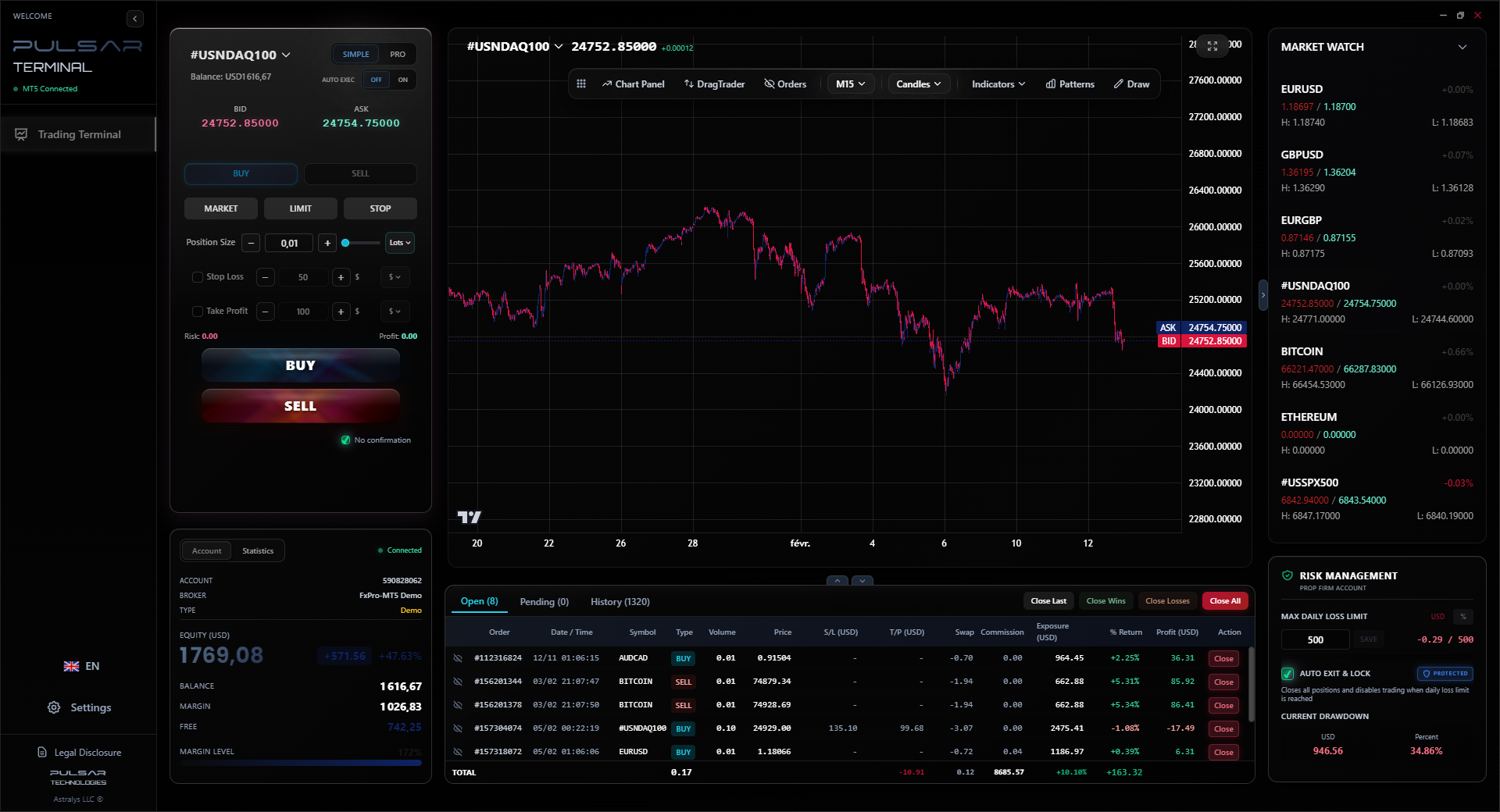
This process turns static information into lived experience. It's how you build your own edge, which is really just a deep, personal understanding of a few reliable concepts. The tools in a platform like Pulsar Terminal, such as its advanced order management, let you execute the disciplined plans these books teach without manual slippage or error.
The disciplined execution these books demand is exactly what tools like Pulsar Terminal are built for, automating complex order management on MT5 so you can focus on the strategy.
Pulsar Terminal
The all-in-one MT5 companion: drag-and-drop orders, multi-TP/SL, trailing stop, grid trading, Volume Profile, and prop firm protection. Used by 1,000+ traders daily.
FAQ
Q1What is the #1 most important book for a beginner forex trader?
Hands down, Trading in the Zone by Mark Douglas. A beginner's biggest enemy isn't a lack of strategy; it's their own psychology. This book builds the mental foundation you need to even have a chance of applying any strategy successfully.
Q2Are books about Warren Buffett or stock investing useful for forex traders?
Generally, no. The principles of value investing (buying undervalued companies) don't apply to currencies. However, books on general market psychology or macroeconomic concepts can provide useful background. Focus on material specific to liquid, technical markets like forex and futures.
Q3I've read a lot of books but still can't make money. What am I missing?
You're likely missing the translation from knowledge to disciplined execution. Reading about a stop-loss is different from actually placing one when you're in a losing trade, hoping it'll come back. This gap is closed by simulated and live trading experience, rigorous journaling, and working on your mental game as hard as you work on your chart analysis.
Q4Should I buy the latest edition of a trading book?
Usually, yes - especially for books covering technical analysis or platforms, as charts and software change. For timeless psychology or risk management books, an older edition is often just fine. Check the publication date; anything pre-2005 might have outdated examples regarding technology and market structure.
Q5Can these books help with passing a prop firm challenge?
Absolutely, but indirectly. The risk management books (Penfold, Tharp) are critical for teaching you how to survive the strict drawdown limits. The psychology books (Douglas) are essential for handling the pressure. They won't give you a secret strategy, but they'll give you the discipline to follow your rules, which is 90% of passing a challenge.
Q6How many trading books should I read?
Quality over quantity. Deeply internalize the 7 books listed here before you even look at another one. Master the fundamentals of mind, price, and risk. Reading 50 mediocre books is far worse than mastering 5 excellent ones.
Prof. Winston's Lesson
Key Takeaways:
- ✓Psychology books are more critical than strategy books for long-term survival.
- ✓Only one forex-specific book made the cut; focus on universal trading principles.
- ✓Risk management is a non-negotiable skill, not an afterthought.
- ✓Price action mastery comes from deep study, not pattern memorization.
How useful was this article?
Click a star to rate
Weekly Trading Insights
Free weekly analysis & strategies. No spam.
About the Author
James Mitchell
Senior Trading Analyst
Based in New York with over 9 years of trading experience. Focuses on major USD pairs, prop firm challenges, and the US regulatory landscape.
Comments
Risk Disclaimer
Trading financial instruments carries significant risk and may not be suitable for all investors. Past performance does not guarantee future results. This content is for educational purposes only and should not be considered investment advice. Always conduct your own research before trading.
You Might Also Like

Cara Trading Forex Sukses: 7 Prinsip dari Trader Profesional
Cara trading forex sukses dengan 7 prinsip trader pro: manajemen modal, disiplin, journal trading, backtest. Data nyata, bukan janji profit palsu.
Jam Trading Forex Terbaik untuk Trader Indonesia: Panduan Lengkap dengan Tabel Waktu
Panduan jam trading forex untuk trader Indonesia. Tabel 4 sesi dunia, jam emas 20:00-00:00, sesi mana yang harus dihindari. Data akurat + tips dari trader berpengalaman.
Top 5 Sàn Forex Uy Tín Nhất 2026: Review Jujur dari Trader Indonesia
Top 5 sàn forex uy tín 2026 untuk trader Indonesia. Review jujur: spread, deposit, withdraw, dukungan lokal. Exness, XM, IC Markets & lebih.
Get Pulsar Terminal
All these calculators are built into Pulsar Terminal with real-time data from your MT5 account. One-click position sizing, automatic risk management, and instant calculations.
Get Pulsar Terminal