


Most traders think harmonics forex is about finding perfect, magical patterns that print money.

David van der Merwe
Emerging Markets Trader ·  South Africa
☕ 11 min read
What you'll learn:
Most traders think harmonics forex is about finding perfect, magical patterns that print money. I used to think that too. I spent months drawing lines, convinced the next Gartley would be my ticket. The reality? It's a framework for understanding market psychology and structure, not a crystal ball. For us trading from SA, with the ZAR's wild swings and the FSCA's 30:1 use cap, using harmonics correctly can be a game-saver. Let me walk you through what actually works, what doesn't, and how to apply it without blowing up your account.
Forget the complex definitions. In simple terms, harmonic patterns are specific price structures that use Fibonacci ratios to identify potential reversal zones. They're based on the idea that markets move in cycles and that these cycles have a geometric, almost rhythmic, relationship. The core belief is that price action isn't random; it has a memory and tends to repeat certain proportional moves.
Think of it like the waves at Muizenberg. They don't all crash at the exact same spot, but there's a recognizable pattern to the sets. Harmonics tries to predict where the next big wave will peak or trough based on the size and timing of the previous ones. The key ratios you'll live with are 0.618, 0.786, 1.272, and 1.618. These aren't just random numbers; they're derived from the Fibonacci sequence and appear everywhere in nature and, in crowd psychology.
There are five main patterns you need to know: the Gartley, the Bat, the Butterfly, the Crab, and the Shark. Each has its own specific Fibonacci rules for the legs (labeled XA, AB, BC, CD). The "Potential Reversal Zone" (PRZ) is where the pattern completes (point D), and that's where you look for a trade entry. The biggest mistake beginners make? They see a pattern that's 90% there and jump in, ignoring the precise ratio requirements. That 10% difference is often the difference between a winning reversal and getting run over by the trend.

Warning: Harmonics are not a standalone signal. A perfect pattern forming during a major SARB interest rate announcement or a sudden shift in gold prices (which heavily impacts the ZAR) will likely fail. They work best when confirming other elements of market context.

💡 Winston's Tip
A pattern is only valid if you can measure the ratios precisely. 'Close enough' is the fastest way to the poorhouse. If point B isn't between 0.382 and 0.618 of XA, it's not a Gartley. Walk away.
You can't trade what you can't see clearly. In South Africa, our internet isn't always the most reliable, and trading during load-shedding requires preparation. Here’s how I set up to trade harmonics effectively from Johannesburg.
Platform Choice: MT4/MT5 is King
Most FSCA-regulated brokers like FP Markets or XM offer MetaTrader. It's the standard for a reason. The drawing tools are precise, and you can save templates. I use MT5 for the slightly better visual rendering. Avoid trying to trade complex harmonics on a phone app; you need the screen real estate.
The Essential Tools
You need two things on your chart: a Fibonacci retracement tool and a Fibonacci extension tool. That's it. Don't clutter your screen with 20 indicators. I keep my charts clean: candlesticks (Heikin Ashi can help smooth noise for pattern recognition), my Fib tools, and maybe a simple RSI indicator for divergence confirmation at the PRZ. Set your Fibonacci levels to display the key harmonic ratios: 0.382, 0.50, 0.618, 0.786, 0.886, 1.13, 1.272, 1.414, 1.618.
Timeframes That Work
Harmonics need space to develop. I found my sweet spot on the 4-hour and daily charts. On the 1-hour, you get a lot of false, sloppy patterns. On the weekly, you might get one valid setup a month. The 4-hour gives a good balance between signal clarity and trade frequency. This is especially important for pairs like USD/ZAR, which can have wide, news-driven spreads - trading on too low a timeframe amplifies that cost.
A Local Consideration: ZAR Pairs
When drawing patterns on USD/ZAR or EUR/ZAR, remember the spread. A 5-pip spread on USD/ZAR means your PRZ needs to be wider. I always add the average spread to my stop-loss calculation. If my stop is 30 pips away and the spread is 5, my real risk is 35 pips from my entry. Always use a position size calculator that lets you input the spread.
“The power of harmonics isn't in the win rate; it's in the risk-to-reward. One 3:1 winner covers three 1:1 losers.”
The Bat pattern, popularized by Scott Carney, became my most reliable setup after I blew a few accounts trying to force less precise ones. Its rules are strict, which I like. It forces discipline.
The Rules:
- Move AB: Should be a 0.382 to 0.50 retracement of XA.
- Move BC: Can be a 0.382 to 0.886 retracement of AB.
- Move CD: This is the key. It must be a 1.618 to 2.618 extension of AB. The Potential Reversal Zone (PRZ) is defined by two levels: the 0.886 retracement of XA and the BC projection (either 1.618 or 2.618).
- Point D: Must not exceed point X.
Why it works for me: The 0.886 retracement of XA is a deep level. It often coincides with exhaustion. When the AB extension (1.618-2.618) aligns with it, you have two Fibonacci confluences, not just one.
A Real Trade Example (That Hurt): In early 2023, I spotted a potential Bat pattern forming on GBP/USD on the 4-hour chart. XA was clear, AB was a 0.45 retracement (good). BC was a 0.618 retracement of AB (good). Price was approaching the PRZ. My calculated PRZ was between 1.2100 (0.886 XA) and 1.2125 (1.618 AB extension). I got excited. I placed a sell limit order at 1.2115, right in the zone. Stop at 1.2170 (55 pips), target at 1.1980 (135 pips). Risking R550 to make R1,350.
What happened? Price tapped 1.2112, filled my order, and immediately reversed. It shot past my stop and never looked back. I lost the full R550. My mistake? I saw the pattern, but I ignored a major weekly support level at 1.2100 that was also the 0.886 retracement. The market respected that major level with a violent bounce. The pattern was technically valid, but the broader market structure overruled it.

Pro Tip: Never enter on the first touch of the PRZ. Wait for price to react within the zone. Look for a bearish candlestick pattern (like a pin bar or engulfing) or RSI divergence after price enters the zone. Patience here saves capital.
💡 Winston's Tip
The market doesn't care about your beautiful pattern. Always place your stop-loss beyond point X. That's the level that proves your entire analysis wrong. Respect it.
Let's be brutally honest. Harmonics lure you in with their geometric beauty, but they are a master of deception if you're not careful. Here are the pitfalls I learned from the hard way.
1. Pattern Forcing (The Biggest Sin): You want to see a pattern so badly that you start fudging the Fibonacci levels. "Oh, that's close enough to 0.618," you say when it's actually 0.65. Close doesn't count. The ratios are the engine of the pattern. If they're not correct, you're not trading a harmonic; you're trading a hope.
2. Ignoring the Trend Context: A bullish Gartley pattern in the middle of a strong, established downtrend on the daily chart is a trap. It's a correction, not a reversal. Harmonics work best when the CD leg is against the larger trend, offering a trend-continuation entry. I now only take harmonic signals that align with the higher timeframe trend direction.
3. Neglecting Risk Management: A harmonic PRZ is not a guaranteed reversal. It's a high-probability zone. You must use a stop-loss. Your stop should be placed beyond the extreme of the pattern (beyond point X). If price goes there, the pattern is invalidated. Period. Using the FSCA's 30:1 use, a small move against you can do serious damage if you're over-leveraged. A margin call is a humbling experience.
4. Trading Low-Probability Patterns: The Butterfly and Crab patterns have extreme extensions (like 1.618 of XA for the Crab). These often occur in parabolic, emotional markets. They are harder to trade and, in my experience, have a lower success rate than the Bat or Gartley. I simply avoid them now.
5. Not Accounting for ZAR Volatility: When trading USD/ZAR, a 50-pip stop might be too tight. News from the SARB or a shift in commodity prices can cause gaps. I use wider stops on ZAR pairs and correspondingly smaller position sizes to keep my rand risk the same. A tool that helps manage multiple orders and stops efficiently, like Pulsar Terminal, becomes useful here to adjust quickly if volatility spikes.
“I never enter on the first touch of the PRZ. I wait for price to react within the zone. Patience here saves capital.”
Harmonics alone are like a car with no fuel. You need confluence - other factors agreeing with your pattern - to get the engine running.
1. Support and Resistance: This is non-negotiable. Does your PRZ align with a major historical support or resistance level? A trendline? In my failed Bat example, it did, but it was major support that caused a reversal against my direction. Look for your PRZ to be at a key level, not just near it.
2. Divergence: This is my favourite filter. As price makes its final CD leg into the PRZ, I watch the RSI indicator or MACD. If I see bullish divergence (price making lower lows, RSI making higher lows) in a bullish pattern PRZ, my confidence soars. It shows weakening momentum.
3. Candlestick Confirmation: I never enter as price first hits the zone. I wait for it to close inside the PRZ and then show a reversal candle. A pin bar, an engulfing pattern, or a doji right on the 0.886 level is my entry signal.
4. Market Sentiment: For a SA trader, what's the gold price doing? If I'm looking at a bullish pattern on USD/ZAR, but gold is crashing (often negative for ZAR), I'm very cautious. Check the broader risk mood.
How This Looks in Practice: Let's say I see a Bullish Bat forming on EUR/USD on the 4H chart. The PRZ is at 1.0750-1.0765. I check the daily chart and see 1.0750 was a previous swing low (support). Price enters the zone, and on the 1H chart, I see a clear bullish engulfing candle. The RSI shows bullish divergence on the 4H. Now I have a trade with high confluence. This is the difference between gambling and trading.
This multi-layered approach moves you from a pattern-recognition gambler to a strategic trader. It also fits well with a swing trading mindset, allowing you to hold for larger moves from these high-probability zones.
💡 Winston's Tip
For South African traders: Your edge isn't in the pattern itself, but in applying it to volatile pairs like USD/ZAR while managing risk under the FSCA's 30:1 use. Size small, survive long.
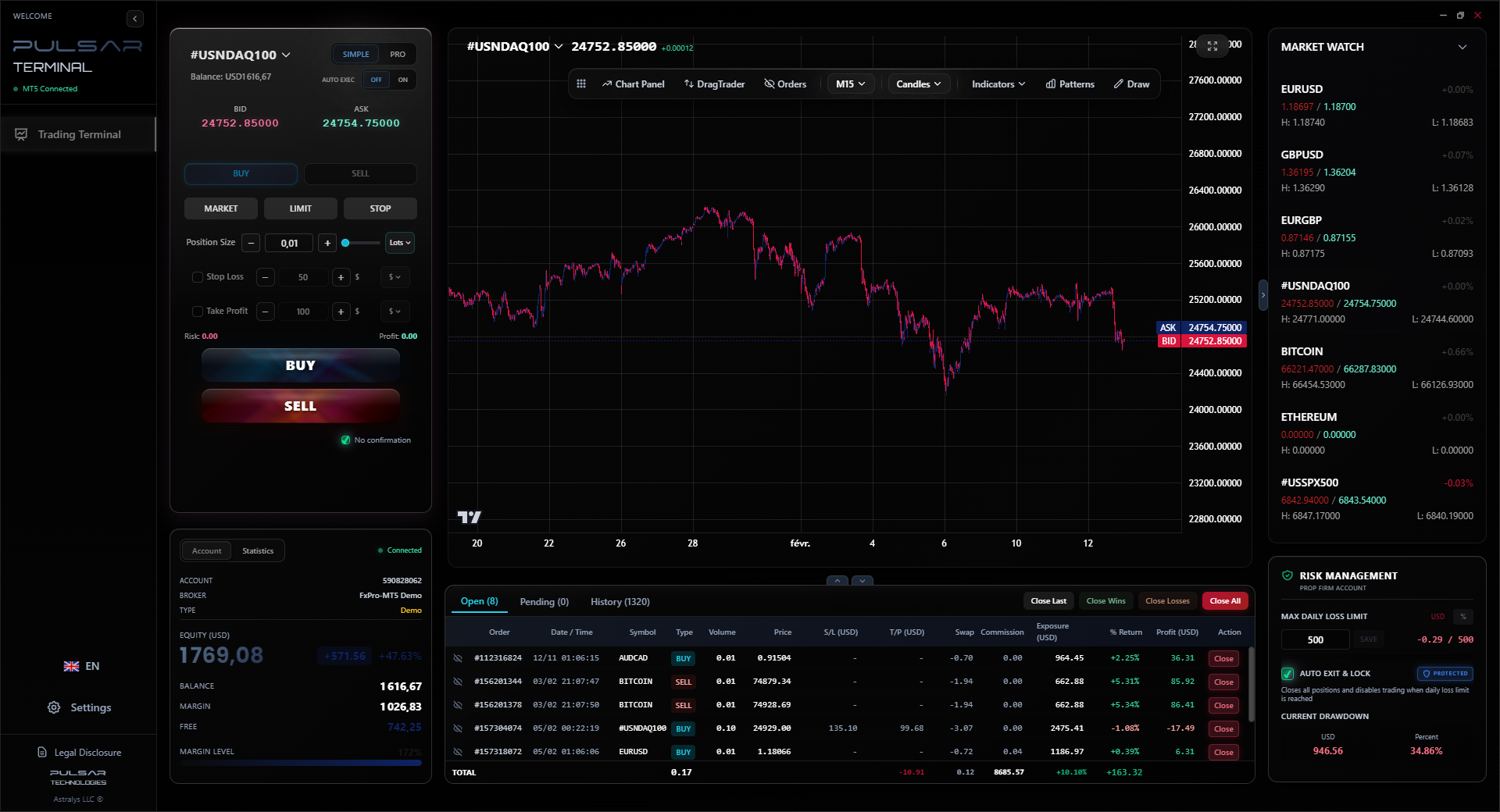
Managing multiple orders and adjusting stops quickly is critical when trading volatile harmonic setups, and Pulsar Terminal's drag-and-drop order management on MT5 makes this process seamless.
Pulsar Terminal
The all-in-one MT5 companion: drag-and-drop orders, multi-TP/SL, trailing stop, grid trading, Volume Profile, and prop firm protection. Used by 1,000+ traders daily.
Ready to try? Don't jump in with real money. Follow this plan to build skill without burning capital.
Weeks 1-2: The Detective Phase Open a demo account with a broker like Pepperstone or Exness. Don't trade. Just scan. Pick three major pairs (EUR/USD, GBP/USD, XAU/USD) and one exotic (USD/ZAR). Go back through the last 6 months of 4-hour charts. Your only job is to find and label every potential Gartley and Bat pattern you can see. Use your Fibonacci tools to measure the ratios. How many were perfect? How many failed? Note where the successful ones reversed. This builds pattern recognition in your subconscious.
Weeks 3-4: The Paper Trade Phase Now, look for live developing patterns. Use your knowledge to project where the PRZ will be. Mark it on your chart. Set a price alert. When price enters the zone, go through your confluence checklist: Is there S/R? Wait for a candle close. Is there divergence? If 2 out of 3 confirm, paper trade it. Log every detail: entry, stop, target, why you took it, the outcome. Review your log weekly. Are you forcing trades? Are you patient?
Going Live (With Guardrails) Start with a micro account. Your first 10 live trades should be at 1/10th of your normal position size. The goal is to validate your process, not make money. Stick to the Bat pattern only - it's the most forgiving. Remember, with FSCA use at 30:1, you need to be extra careful with position sizing. A 50-pip stop on a standard lot is a R1,500 move. Use a calculator.
A Final, Critical Mindset Shift: Harmonics won't give you a 90% win rate. A good harmonic strategy might hit 50-60% wins. The profit comes from your risk-reward. You're aiming for trades where you risk R500 to make R1,000 or more. One good Bat pattern on XAU/USD can pay for several small losses. It's a marathon of discipline, not a sprint for perfection.
FAQ
Q1Is harmonics forex trading legal in South Africa?
Yes, absolutely. Harmonic patterns are a method of technical analysis, not a financial product. Forex trading itself is legal and regulated by the FSCA. You must use an FSCA-licensed broker to ensure your funds are protected under South African law.
Q2What's the best timeframe for trading harmonics?
For most traders, especially beginners, the 4-hour chart is the sweet spot. It filters out market noise from lower timeframes (which leads to false patterns) and provides more reliable setups than the 1-hour. Daily charts are excellent but offer fewer opportunities. I strongly advise against starting on anything below the 1-hour.
Q3Can I use harmonics for scalping?
I wouldn't recommend it. Harmonic patterns need space and time to develop properly. The precision required for the Fibonacci ratios is very hard to find on 1-minute or 5-minute charts. The spreads and commissions will also eat into your profits. Harmonics are far better suited for swing trading or longer-term day trades.
Q4How do I handle the wide spreads on USD/ZAR when trading harmonics?
This is a crucial SA-specific point. First, always add the spread to your risk calculation. If your stop-loss is 30 pips away and the spread is 5 pips, you're actually risking 35 pips. Second, use wider PRZs and stops for ZAR pairs. Third, consider trading ZAR pairs during London or New York overlap sessions when liquidity is highest and spreads are typically tightest.
Q5Which harmonic pattern is the most reliable?
In my 12 years of experience, the Bat and the Gartley patterns have been the most consistent. They have stricter, more defined rules. The Crab and Butterfly patterns involve extreme extensions and are trickier to trade successfully. I suggest you master the Bat first before exploring others.
Q6Do I need special software to trade harmonics?
No. MetaTrader 4 or 5, which almost every FSCA broker offers, has all the Fibonacci tools you need. There are paid tools that auto-detect patterns, but I believe drawing them manually trains your eye and understanding far better. The skill is in the recognition, not the automation.
Q7What's a good win rate to expect with harmonics?
If you're doing it right - waiting for perfect ratios and strong confluence - a win rate between 50% and 65% is realistic and excellent. The power of harmonics isn't in the win rate; it's in the risk-to-reward. You're looking for setups where your potential profit is 1.5 to 3 times your risk. One 3:1 winner covers three 1:1 losers.
Prof. Winston's Lesson
Key Takeaways:
- ✓Precision over hope: Perfect ratios are mandatory.
- ✓Confluence is your fuel: Never trade a pattern alone.
- ✓Respect point X: Your stop-loss lives beyond it.
- ✓Trade the 4H chart: It filters noise, provides clarity.
- ✓ZAR requires wider stops: Adjust position size, not your risk %.
How useful was this article?
Click a star to rate
Weekly Trading Insights
Free weekly analysis & strategies. No spam.
About the Author
David van der Merwe
Emerging Markets Trader
Johannesburg-based trader with 11 years in emerging market currencies. Specializes in ZAR pairs, FSCA-regulated trading, and South African market analysis.
Comments
Risk Disclaimer
Trading financial instruments carries significant risk and may not be suitable for all investors. Past performance does not guarantee future results. This content is for educational purposes only and should not be considered investment advice. Always conduct your own research before trading.
You Might Also Like

Cara Trading Forex Sukses: 7 Prinsip dari Trader Profesional
Cara trading forex sukses dengan 7 prinsip trader pro: manajemen modal, disiplin, journal trading, backtest. Data nyata, bukan janji profit palsu.
Jam Trading Forex Terbaik untuk Trader Indonesia: Panduan Lengkap dengan Tabel Waktu
Panduan jam trading forex untuk trader Indonesia. Tabel 4 sesi dunia, jam emas 20:00-00:00, sesi mana yang harus dihindari. Data akurat + tips dari trader berpengalaman.
Top 5 Sàn Forex Uy Tín Nhất 2026: Review Jujur dari Trader Indonesia
Top 5 sàn forex uy tín 2026 untuk trader Indonesia. Review jujur: spread, deposit, withdraw, dukungan lokal. Exness, XM, IC Markets & lebih.
Get Pulsar Terminal
All these calculators are built into Pulsar Terminal with real-time data from your MT5 account. One-click position sizing, automatic risk management, and instant calculations.
Get Pulsar Terminal