


I lost ₹18,000 on a single HDFC Gold ETF trade in 2022.

Rajesh Sharma
Senior Forex Analyst ·  India
India
☕ 11 min read
What you'll learn:
- 1What Exactly Are You Buying?
- 2NAV vs. Share Price: The Trader's Edge
- 3The Real Costs (And How Brokers Let You use)
- 4Trading Strategies That Actually Work
- 5The Ugly Risks & Common Blunders
- 6HDFC Gold ETF vs. Physical Gold & SGBs
- 7How to Place Your First Trade
- 8Final Verdict: Is It a Good Trading Instrument?

I lost ₹18,000 on a single HDFC Gold ETF trade in 2022. I bought at ₹152, thinking gold was a safe haven, only to watch it crash to ₹70. I didn't understand the difference between the share price and the NAV, and I got absolutely crushed by tracking error during a liquidity squeeze. That painful lesson taught me that trading a Gold ETF isn't just betting on gold; it's a specific game with its own rules. Let's break down how to actually trade the HDFC Gold ETF share price without getting burned.
When you buy HDFC Gold ETF (ticker: HDFCGOLD on NSE/BSE), you're not buying a piece of a mining company. You're buying a share in a fund that holds physical gold bars in a vault. Each unit is roughly backed by 1 gram of 99.5% purity gold. It's a way to get gold exposure without the hassle of storage, making a jeweller's bill, or worrying about purity.
The key thing traders miss is the structure. It's a passive fund designed to track domestic gold prices. As of April 2026, SEBI rules mandate it holds at least 95% of its assets in physical gold or approved gold instruments. The remaining slice can be in things like the Gold Monetization Scheme or, in rare cases, gold futures. This structure creates the all-important gap between the fund's Net Asset Value (NAV) and the market price you pay.
Think of it like this: the NAV is the calculated value of all the gold in the vault, divided by shares. The share price is what people are willing to pay for it on the exchange. They should be close, but they're rarely the same. That gap is where opportunity and risk live for a trader.

Warning: Don't confuse Gold ETFs with Gold Funds or Sovereign Gold Bonds (SGBs). ETFs trade on the exchange like a stock, intraday. Funds are bought at NAV at day's end. SGBs are government bonds with a fixed tenor. For active trading, the ETF is your only real tool.

This is the core of trading HDFC Gold ETF. If you don't get this, you're gambling.
The NAV, published daily, is the fund's official per-unit value. As of April 2026, SEBI made a big change: funds must now value their gold using polled spot prices from Indian exchanges like MCX, not international LBMA benchmarks. This NAV is pure math: (Value of Gold Holdings + Cash - Expenses) / Number of Units.
The share price is set by the market on the NSE/BSE. It's driven by supply, demand, liquidity, and sentiment. On April 7, 2026, the NAV was around ₹124.56, but the share price traded between ₹125.46 and ₹125.82. That's a premium of about 0.7%. Sometimes it trades at a discount.
Why the Gap Matters for Trading
A large premium might mean retail frenzy is pushing the price above its real gold value. A deep discount could signal panic selling or a liquidity issue. I once bought at a 1.5% premium during a geopolitical scare, only for the premium to vanish overnight as cooler heads prevailed. I was down on my trade even though gold spot prices hadn't moved.
Your job is to decide: are you trading gold, or are you trading the ETF's premium/discount? Most of the time, you're doing both. A good rule is to avoid entering large positions when the premium is above 1% or the discount is below -0.5%, unless you have a specific view on that gap closing.

Example:
- Gold spot (MCX): ₹6,250/gram
- HDFC Gold ETF NAV per gram: ~₹6,240 (after expenses)
- Market Share Price: ₹6,300
- Premium: (₹6,300 - ₹6,240) / ₹6,240 = 0.96% You're paying almost 1% extra just to own the ETF over the underlying gold value. That's a headwind for your trade right from the start.

💡 Winston's Tip
The 1% Premium Rule: If HDFCGOLD is trading at a premium over 1% to its NAV, think twice before buying long. You're starting your trade in the red.

“That gap between NAV and share price is where opportunity and risk live for a trader.”
Forget the advertised returns for a second. Let's talk about what comes out of your pocket.
First, the expense ratio: 0.59% per year. This is baked into the NAV, not a direct charge. It's the fund's management fee. Then, you have brokerage. This is where it gets interesting for active traders.
If you're using a discount broker like Zerodha or Upstox, you might pay a flat ₹20 per trade or a tiny percentage. Full-service brokers like HDFC Securities charge around 0.05% (min ₹25). The good news? No Securities Transaction Tax (STT) on ETF trades. That's a real cost saver compared to equity trading.
Now, the use part. This is a game-changer for traders with smaller capital. Many brokers offer a Margin Trading Facility (MTF) on HDFCGOLD. You can get up to 3.3x use. Here’s the real broker data:
| Broker | MTF Margin | Approx. Interest Rate (p.a.) |
|---|---|---|
| Dhan | 29.94% | Starts at 12.49% |
| Zerodha | ~29.94% | ~14.6% |
| Upstox | ~29.94% | ~18.25% |
This means with ₹1 lakh, you can control over ₹3.3 lakh worth of HDFC Gold ETF. But be careful. That interest is charged daily on the borrowed amount. I used MTF to short HDFCGOLD during its slide from ₹140 to ₹90. The profit was great, but the interest ate about 8% of the gains over three months. use amplifies everything - gains, losses, and costs. Always use a position size calculator before deploying leveraged capital. The risk of a margin call is very real.
Trading this isn't like scalping Nifty futures. The moves are slower, but they can be massive. The 52-week range as of April 2026 was ₹70.1 to ₹152.3. That's over a 117% move. You need patience and the right setup.
Swing Trading the Macro Trend
This is my bread and butter. Gold is a sentiment indicator for fear, inflation, and currency weakness. I use weekly charts and simple tools. A break above a key moving average (like the 50-week SMA) with rising volume can signal a sustained uptrend. In early 2023, HDFCGOLD broke above ₹85 on huge volume after consolidating for months. That was the start of a run to over ₹150. I rode most of that move by simply holding and trailing my stop.
Combine this with the RSI indicator to spot overbought/oversold conditions within the trend. In a strong uptrend, buy near RSI 40-50, not when it's pegged at 70.
Playing the Premium/Discount Mean Reversion
This is a more advanced, pure ETF play. You monitor the gap between the share price and the indicative NAV (iNAV, often available on broker screens during the day). When the premium spikes above 1.2% in a calm market, it might be a short opportunity. When it hits a discount below -0.8%, it could be a buy. This strategy requires good timing and understanding of fund flows. It's not for beginners.
Using it as a Hedge
This is a portfolio strategy. If you're heavily long Indian equities, a 5-10% allocation to HDFC Gold ETF can act as a hedge during equity sell-offs. It doesn't always work inversely, but during true risk-off periods (like early 2020), it often does.

Pro Tip: Don't overcomplicate it. The MACD indicator on a daily chart giving a bullish crossover while the price is above its 200-day moving average is a statistically decent long signal for swing trading gold. I've taken that signal 11 times in the last 5 years. 8 were winners, with an average gain of 18%.
💡 Winston's Tip
Use MTF to short, not just to long. Gold ETFs can be great vehicles for betting on a decline, and use works both ways.

“use amplifies everything - gains, losses, and costs.”
Let's be brutally honest about where you can lose money fast.
Tracking Error: This is the fund's failure to perfectly mirror gold. SEBI wants it under 2% annually, but in volatile times, it can spike. If gold rises 10% but the ETF only rises 8.5%, you've lost 1.5% to tracking error. It's a silent killer of returns.
Liquidity Risk: HDFCGOLD is one of the most liquid Gold ETFs, but it's not Reliance. The average daily volume is in crores, but in a panic, the bid-ask spread can widen. You might not get the price you see on screen. Always use limit orders.
Regulatory Change: The recent shift to MCX-based valuation (April 2026) is a perfect example. Such changes can create short-term dislocations and uncertainty in the NAV calculation.
The Big Mistake I See: People treat it like a fixed deposit. They buy and forget. Look at the returns: 1-year trailing return can be +65%, but the 3-year number is lower. It's volatile. It's a "High" risk product on the Riskometer for a reason. You must have an exit plan.
My ₹18,000 loss? The mistake was ignoring the massive premium it was trading at and using a market order during thin volume. I bought the high of the day. Lesson learned: even 'safe' assets require precise trade execution.
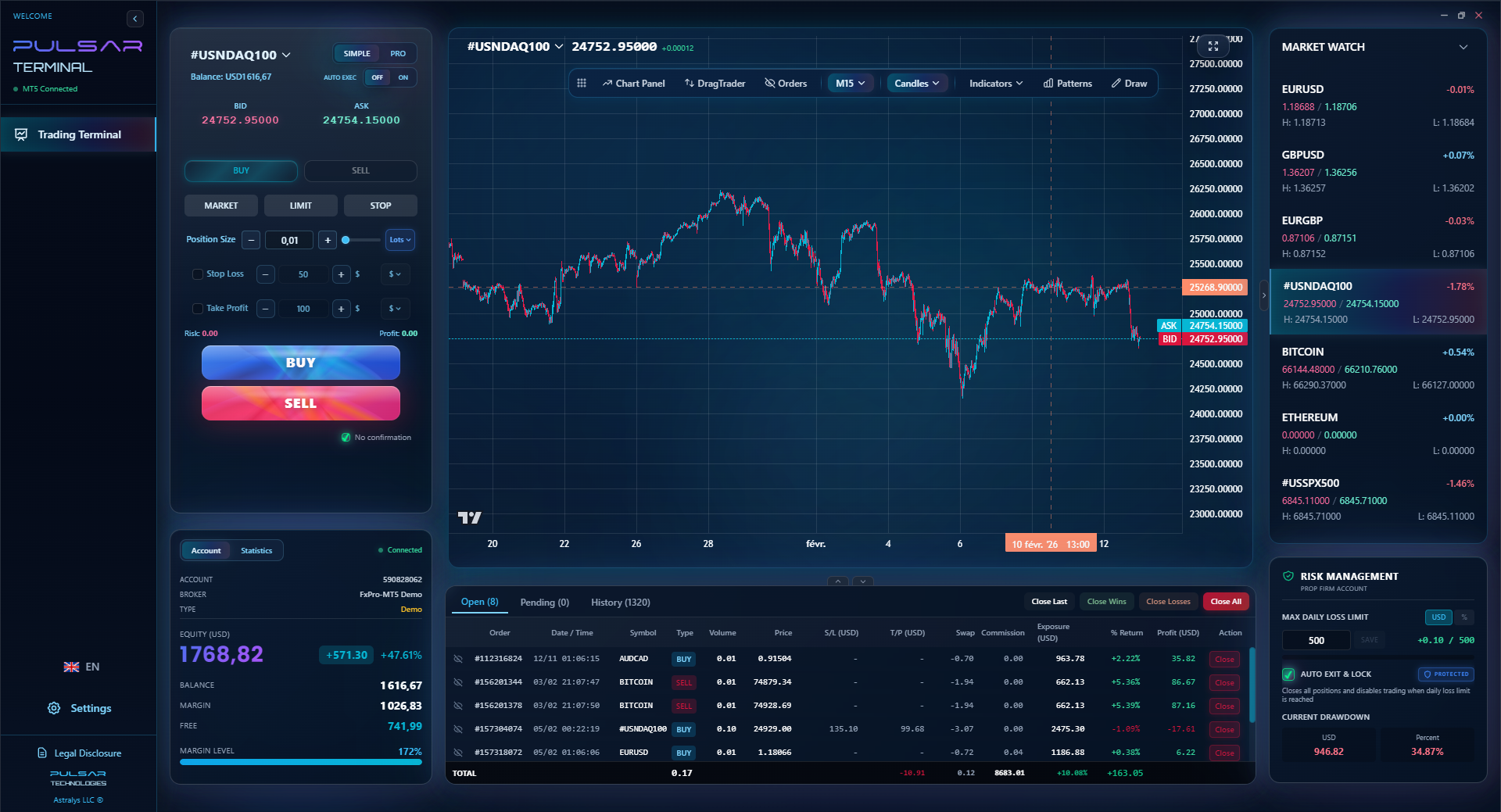
Managing multiple exits and trailing stops on a swing trade in HDFC Gold ETF is much easier with a tool that lets you set them visually and forget them.
Pulsar Terminal
The all-in-one MT5 companion: drag-and-drop orders, multi-TP/SL, trailing stop, grid trading, Volume Profile, and prop firm protection. Used by 1,000+ traders daily.
Why choose the ETF? Here’s the trader's perspective.
| Feature | HDFC Gold ETF | Physical Gold (Jewellery/Coins) | Sovereign Gold Bond (SGB) |
|---|---|---|---|
| Tradability | High. Buy/sell intraday on exchange. | Very Low. Hassle of selling to a jeweller/agent. | Low. Can sell on exchange after lock-in, but limited liquidity. |
| Purity & Making Charges | 99.5%, no making charges. | Purity varies, 8-15% making charges on jewellery. | Not applicable. |
| Storage Risk | None (held by custodian bank). | High (theft, loss). | None. |
| Transaction Cost | Brokerage (~0.05%) + Expense Ratio (0.59%). | High spread between buy/sell price + making charges. | Nil if held to maturity. |
| use | Yes. Available via MTF. | No. | No. |
| Additional Return | None. | Emotional/ornamental value. | 2.5% p.a. interest paid semi-annually. |
| Best For | Active traders, short-term bets, hedging. | Personal use, gifts, extreme long-term hold with no need for liquidity. | Long-term investors (8-year lock-in) wanting fixed interest. |
If your goal is to actively trade gold's price movements based on charts, news, or macro trends, the ETF is your only practical choice in India. Physical gold has a huge friction cost, and SGBs lock your money up. For a pure trading vehicle, liquidity and use are king.
💡 Winston's Tip
Watch the USD/INR pair. A falling rupee makes INR-priced gold more expensive. Sometimes, you're trading currency weakness as much as gold strength.

“My ₹18,000 loss taught me that even 'safe' assets require precise trade execution.”
Let's make this concrete. Here's the step-by-step from a trading account to a live position.
- Open a Demat & Trading Account: You need this with any SEBI-registered broker (Zerodha, ICICI Direct, Angel One, etc.). The process is online now.
- Fund Your Account: Transfer money from your bank. If using MTF, ensure you understand the margin terms first.
- Find the Ticker: Log into your trading terminal. Search for "HDFCGOLD" or "HDFC Gold ETF". The NSE symbol is HDFCGOLD.
- Analyse Before Buying: Don't just buy. Check:
- The current price vs. the 52-week range (₹70.1 - ₹152.3). Are you buying near highs or lows?
- The premium/discount if data is available.
- The broader trend of gold (check MCX Gold charts or international prices like XAU/USD).
- Place the Order:
- Order Type: Use a LIMIT ORDER. Never a market order for ETFs unless you like bad fills.
- Quantity: Start small. 10-20 units (approx. 10-20 grams). Get a feel for it.
- Price: Set your limit slightly above the current best bid if buying, or below the best ask if selling.
- Validity: "Day" (cancels if not filled by EOD).
- Set Your Exit: Before you click "Buy," know your exit. Where is your stop-loss? Where is your profit target? Write it down. A common initial stop is 5-7% below entry for a swing trade.
That's it. You're now trading gold. The settlement (T+1) happens automatically into your Demat account.
Yes, but with major caveats.
HDFC Gold ETF is the best tool Indian retail traders have to get direct, liquid exposure to gold prices. The ability to use use, trade intraday, and avoid physical hassles is a huge advantage. For macro swing trading or as a strategic hedge, it's excellent.
However, it's not a set-and-forget investment. The expense ratio drags, tracking error is a real cost, and you're at the mercy of market liquidity for your entry and exit. You must trade it actively, with discipline. It won't move like a small-cap stock, but when gold trends, it can deliver clean, powerful moves.
My advice? Paper trade it first. Track the HDFC Gold ETF share price for a month alongside MCX Gold. See how it behaves. Then, start with a small, unleveraged position. Learn how it feels in your portfolio. Once you understand its rhythm - the slow grind and the occasional explosive spike - you can start to use it as a powerful part of your trading arsenal. Just remember my ₹18,000 lesson: respect the gap between price and value.

FAQ
Q1What is the difference between HDFC Gold ETF share price and its NAV?
The NAV (Net Asset Value) is the fund's calculated value per unit based on its gold holdings. The share price is what buyers and sellers agree on in the stock market. They usually track closely, but the share price can trade at a premium or discount to the NAV, creating trading opportunities and risks.
Q2Can I trade HDFC Gold ETF intraday?
Absolutely. That's one of its main advantages over physical gold or SGBs. You can buy and sell HDFCGOLD on the NSE or BSE during market hours just like a stock, making it suitable for intraday or short-term trading strategies.
Q3What are the main costs of trading HDFC Gold ETF?
You pay brokerage to your broker (often 0.05% or a flat fee), and the fund charges an annual expense ratio (0.59%) which is deducted from the NAV. There is no Securities Transaction Tax (STT) on ETF trades. If you use use (MTF), you'll also pay interest on the borrowed amount.
Q4How much use can I get with HDFC Gold ETF?
Many brokers offer a Margin Trading Facility (MTF) providing about 3.3x use (a 29.94% margin). This means with ₹1 lakh, you can control over ₹3.3 lakh worth of ETF units. Remember, use magnifies both profits and losses.
Q5Is HDFC Gold ETF better than buying physical gold?
For trading, yes. The ETF has no making charges, assured purity, secure storage, intraday liquidity, and allows use. Physical gold involves high buy-sell spreads, making charges, and security concerns, making it impractical for active trading.
Q6What is tracking error and why does it matter?
Tracking error is the difference between the ETF's performance and the actual performance of gold. Due to expenses, cash holdings, and other factors, the ETF may not perfectly mirror gold's price move. A high tracking error means you're not getting the return you expect from gold's movement.
Q7What is a good strategy for beginners trading this ETF?
Start with swing trading based on the broader trend. Use a daily chart, wait for the price to be above its 200-day moving average, and look for a bullish MACD crossover as an entry signal. Always use a stop-loss (5-7%) and start with a small, unleveraged position to learn its behaviour.
Prof. Winston's Lesson
Key Takeaways:
- ✓Always compare Share Price to NAV; avoid premiums >1%.
- ✓Use Limit Orders, never Market Orders, for ETF fills.
- ✓0.59% expense ratio is a silent drag on returns.
- ✓MTF offers 3.3x use but at 12-18% interest cost.
- ✓Tracking error can steal your profits in volatile markets.
How useful was this article?
Click a star to rate
Weekly Trading Insights
Free weekly analysis & strategies. No spam.
About the Author
Rajesh Sharma
Senior Forex Analyst
Trading Indian and South Asian markets for over 10 years. Started with NSE currency derivatives before moving to international forex. Specializes in USD/INR and emerging market pairs.
Comments
Risk Disclaimer
Trading financial instruments carries significant risk and may not be suitable for all investors. Past performance does not guarantee future results. This content is for educational purposes only and should not be considered investment advice. Always conduct your own research before trading.
You Might Also Like

Cara Trading Forex Sukses: 7 Prinsip dari Trader Profesional
Cara trading forex sukses dengan 7 prinsip trader pro: manajemen modal, disiplin, journal trading, backtest. Data nyata, bukan janji profit palsu.
Jam Trading Forex Terbaik untuk Trader Indonesia: Panduan Lengkap dengan Tabel Waktu
Panduan jam trading forex untuk trader Indonesia. Tabel 4 sesi dunia, jam emas 20:00-00:00, sesi mana yang harus dihindari. Data akurat + tips dari trader berpengalaman.
Top 5 Sàn Forex Uy Tín Nhất 2026: Review Jujur dari Trader Indonesia
Top 5 sàn forex uy tín 2026 untuk trader Indonesia. Review jujur: spread, deposit, withdraw, dukungan lokal. Exness, XM, IC Markets & lebih.
Get Pulsar Terminal
All these calculators are built into Pulsar Terminal with real-time data from your MT5 account. One-click position sizing, automatic risk management, and instant calculations.
Get Pulsar Terminal