


Staring at a regular candlestick chart full of noise and false signals? Ever wish you could just see the trend clearly without all the market drama? That's exactly what the Heikin Ashi trading strategy aims to do.

Rajesh Sharma
Senior Forex Analyst ·  India
India
☕ 10 min read
What you'll learn:
- 1What is Heikin Ashi? It's Not Just a Pretty Chart
- 2How to Read Heikin Ashi Signals: The Simple Rules
- 3Applying Heikin Ashi in the Indian Market: Nifty, Stocks, and More
- 4Supercharging Your Strategy: Combining Heikin Ashi with Other Tools
- 5The Honest Truth: Risks and Limitations You Must Know
- 6SEBI's Algo Rules & Heikin Ashi: The Regulatory Reality
- 7The Indian Cost Factor: How Taxes Eat into Your Profits
- 8Your First Steps: A Simple Heikin Ashi Trading Plan
Staring at a regular candlestick chart full of noise and false signals? Ever wish you could just see the trend clearly without all the market drama? That's exactly what the Heikin Ashi trading strategy aims to do. It's a Japanese charting method that smooths out price action, making it a favourite for traders in volatile markets like India's Nifty and Bank Nifty. But here's the thing: it's not a magic bullet. I've used it for years, and while it can save you from a lot of headaches, you need to understand its quirks, especially with India's specific costs and SEBI's tightening rules on automated strategies. Let's break down how to use it properly.
Heikin Ashi translates to "average bar." Unlike a regular candlestick that shows the open, high, low, and close of a specific period, a Heikin Ashi candle uses averaged and calculated data. This creates a smoother, more filtered view of price movement.
The formula might look intimidating, but the concept is simple. Each candle's close is an average of the current period's open, high, low, and close. The open is an average of the previous candle's open and close. This averaging process is what creates the visual smoothing.
Why does this matter for you? Because it acts as a built-in filter. It dampens the market noise - those little wicks and dojis that can trick you into entering or exiting a trade prematurely. When a strong trend is in place, Heikin Ashi candles will often appear as long, consistent bodies with little to no lower wicks in an uptrend (or upper wicks in a downtrend). It visually reinforces the trend's strength, which is gold for a discipline like swing trading.

Pro Tip: Don't try to calculate Heikin Ashi manually. Every decent trading platform, from Zerodha's Kite to TradingView, has it as a built-in chart type. Your job is to interpret it, not compute it.
Forget complex patterns for a minute. Heikin Ashi trading boils down to a few powerful visual cues.
The Trend is Your Friend (And Now It's Clearer)
In a strong uptrend, you'll see a series of green (or white) Heikin Ashi candles with no lower shadows. The bodies are nice and fat. The moment a small lower shadow appears, it's a warning that buying pressure is weakening. A downtrend is the mirror image: red (or black) candles with no upper shadows.
Reversal Warnings: The Change in Colour
A change in candle colour is your first sign of a potential trend pause or reversal. If you've had ten solid green candles and then a red one closes, pay attention. It doesn't mean reverse immediately, but it does mean the momentum has stalled. I once ignored three consecutive colour changes in Bank Nifty futures, thinking it was just a pullback. I watched a 15,000-point paper profit turn into a 5,000-point loss. The chart was telling me to get out, but I wasn't listening.
The Doji Equivalent: Small Bodies with Long Shadows
When the Heikin Ashi candle has a very small body but long upper AND lower shadows, it signals indecision. This is similar to a doji on a regular chart but often appears more pronounced. It's a clear "wait and see" signal. Don't force a trade here.

💡 Winston's Tip
The trend is your friend only until the final bend. Heikin Ashi shows you the friend's path, but it won't tell you when the path ends. Always have an exit plan before you enter.
“Heikin Ashi doesn't predict the future; it just cleans up the past so you can see the present more clearly.”
This is where it gets real. The Heikin Ashi trading strategy shines on certain Indian instruments and timeframes more than others.
For Index Trading (Nifty 50, Bank Nifty): This is its best use case. These indices have strong, sustained trends. Using Heikin Ashi on a 30-minute or hourly chart can help you ride a trend for days, filtering out intraday noise. It's excellent for identifying the main direction before placing shorter-term trades.
For Stock Trading: Be more selective. Heikin Ashi works brilliantly on high-volume, trending large-cap stocks like Reliance or TCS. It can be frustrating on low-volume, choppy mid or small-caps where the averaging just creates messy, lagging signals.
Timeframes Matter:
- Swing Trading (1H, 4H, Daily): Perfect. The smoothing effect helps you stay in trades for the meat of the move. I used a daily Heikin Ashi chart to hold Infosys from ₹1,450 to ₹1,850 over two months, ignoring several scary-looking red candles on the regular chart that were just noise.
- Intraday & Scalping (1min, 5min): Use with extreme caution. The averaging creates lag. By the time a red candle prints on a 1-minute Heikin Ashi, the price might have already moved 20 points against you. I don't recommend it for pure scalping.

Warning: Never use Heikin Ashi-derived prices for your stop-loss or take-profit orders! The chart shows calculated averages, not the actual market price. Always place orders based on the real-time price ladder or a regular candlestick chart. This is a critical mistake many new users make.
Heikin Ashi is a fantastic filter, but it shouldn't work alone. Think of it as the foundation you build your strategy on.
1. Heikin Ashi + Trend Confirmation: Use a simple moving average like the 20-period or 50-period EMA on your Heikin Ashi chart. Only take buy signals when the smoothed candles are above the EMA, and sell signals when below. This adds a powerful layer of confirmation.
2. Heikin Ashi + Momentum: This is my personal favourite combo. Use the RSI indicator or the MACD indicator on the regular price chart, but make your entry decision based on the Heikin Ashi trend. For example, look for Heikin Ashi to show a strong green series, then wait for the RSI on the regular chart to pull back to 40-50 (not oversold) before entering. This helps you avoid buying at the very top of a momentum spike.
3. Heikin Ashi + Support/Resistance: Plot key support and resistance levels on your Heikin Ashi chart. A trend reversal signal (like a colour change) that occurs right at a major support level carries much more weight than one in the middle of nowhere.
📊 Example: On the Nifty daily chart, price approaches a major resistance at 18,500. The Heikin Ashi candles start printing small bodies with long upper shadows (indecision). The MACD histogram on the regular chart shows shrinking momentum. This confluence is a much stronger sell signal than any one indicator alone.
“Automating a Heikin Ashi strategy in India means navigating SEBI's approval maze - sometimes it's faster to just trade it yourself.”
If I only told you the good parts, I'd be doing you a disservice. Here's what can go wrong.
The Lag is Real: Because it uses averaged data, Heikin Ashi is a lagging indicator. It confirms a trend after it has started. You will miss the very first part of a move. Chasing perfection will leave you always waiting for a "perfect" signal that never comes.
Choppy Markets are the Enemy: In a sideways, range-bound market - like Nifty can be for weeks - Heikin Ashi becomes useless. It will give you constant, whipsawing colour changes, leading to multiple small losses. You must identify the market regime first.
It Hides Volatility: Those long wicks on a regular candle show you where stops were run. Heikin Ashi smooths them away. You might think a trend is calm, but the underlying price action could be violently volatile. Always check the regular chart for true volatility before deciding on your position size calculator inputs.
My Biggest Mistake with It: I once automated a simple Heikin Ashi colour-change strategy. It worked in backtests. Live, it got destroyed in a single earnings-season week because the lag meant it was always a step behind the gap moves. It taught me that no single tool is fit for all market conditions.
💡 Winston's Tip
In India, your first opponent isn't the market; it's STT, GST, and brokerage. A strategy must win by two touchdowns just to break even. Factor in every [spread](/en/glossary/spread) and charge from day one.
This is crucial for Indian traders. You love Heikin Ashi and think, "I'll just code a bot to trade it." Pump the brakes. SEBI's algorithmic trading regulations, especially the 2025 framework, are strict.
Remember, Heikin Ashi itself isn't regulated. But any automated strategy using it is. If your strategy is "Enter long when Heikin Ashi candle turns green and the 20 EMA is below," that's an algo.
What this means for you:
- Mandatory Exchange Approval: You can't just run your Heikin Ashi bot. Every unique strategy must be approved by the exchange (NSE/BSE). This is a formal process to check it won't disrupt the market.
- Broker as Gatekeeper: Your broker (like Zerodha or Upstox) is responsible. They must approve your strategy, host it on their servers (no outside APIs), and attach a unique Algo ID to every order.
- White Box vs. Black Box: A simple Heikin Ashi + moving average crossover is a "White Box" algo - its rules are transparent and easier to get approved. A complex neural network using Heikin Ashi data would be a "Black Box," requiring the provider to be a SEBI-registered Research Analyst.
The Bottom Line: For most retail traders, automating a pure Heikin Ashi strategy through your broker's platform is possible but involves paperwork. It's often more practical to use Heikin Ashi as your manual filter and then execute trades yourself, avoiding the regulatory hurdle entirely.
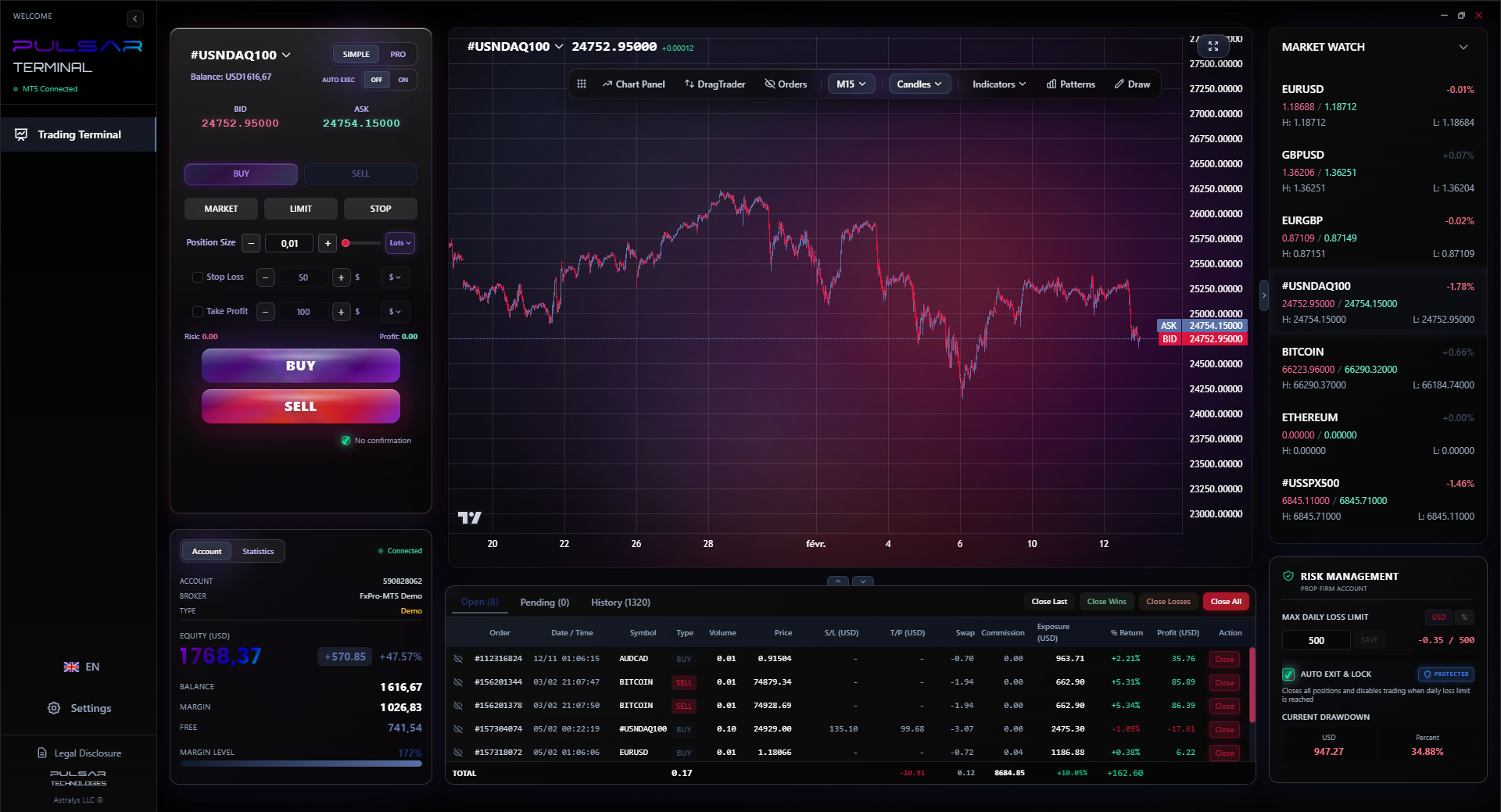
Managing multiple trades based on Heikin Ashi trends is complex, but tools like Pulsar Terminal let you set multi-level take-profits and trailing stops directly on your MT5 chart, automating your exit strategy while you focus on the next setup.
Pulsar Terminal
The all-in-one MT5 companion: drag-and-drop orders, multi-TP/SL, trailing stop, grid trading, Volume Profile, and prop firm protection. Used by 1,000+ traders daily.
“The perfect Heikin Ashi signal is worthless if your position size would wipe out a week's profits on a single stop-loss.”
Trading with Heikin Ashi doesn't change your costs. But because it's a trend-following method, you might hold trades longer, which changes which taxes apply. You must factor this in.
Let's say you use Heikin Ashi on a daily chart for swing trades (delivery). Here’s what you pay:
- STT: 0.1% on both buy and sell. Yes, you pay just to buy.
- Brokerage: Often zero for delivery on discount brokers.
- GST: 18% on all other charges.
- Stamp Duty: Say 0.015% on the buy value.
Now, compare that to an intraday trade you might take based on a 5-minute Heikin Ashi signal:
- STT: 0.025% on the sell side only.
- Brokerage: ~₹20 per executed order.
- Stamp Duty: Lower, at 0.003% on the buy side.

Example: You make a ₹1,00,000 profit on a delivery swing trade. Before you even think about that profit, hundreds of rupees have already been paid in taxes and charges. On an intraday trade with the same profit, the STT is lower, but brokerage is a fixed cost. Your Heikin Ashi strategy needs an edge wide enough to comfortably cover these costs, which are higher than in many other countries. A strategy that generates 100 small, scratchy wins might see all profits erased by charges. Aim for fewer, higher-quality setups.
💡 Winston's Tip
Smoothing price is like smoothing rum. It goes down easier, but the kick is still there. Don't let a clean Heikin Ashi chart make you complacent about the real volatility underneath.
Ready to try it? Don't jump in live. Follow this plan.
Step 1: Paper Trade for a Month. Pick one instrument - start with the Nifty 50 ETF. Switch your chart to Heikin Ashi on the 1-hour timeframe. Add a 20-period EMA. Your only rule: Only consider buys when candles are green and above the EMA. Only consider sells when red and below. Don't even look at other timeframes. Paper trade this for a month. Log every trade, the signal, and the outcome.
Step 2: Define Your Exit. This is harder than entry. Will you exit on the first opposing colour candle? Will you use a trailing stop based on the regular chart's ATR? Decide this before you risk real money. A good start is to exit when the Heikin Ashi candle closes back below the 20 EMA.
Step 3: Integrate Risk Management. This is non-negotiable. Use a position size calculator. Never risk more than 1% of your capital on a single trade. Because Heikin Ashi can lag, your stop-loss might need to be wider than on a regular chart. Factor that in. The last thing you want is a perfect trend signal that stops you out because your stop was too tight, leading to a margin call.
Step 4: Choose the Right Platform. You need a broker with reliable Heikin Ashi charts and low costs. Most Indian platforms have it. For serious charting, many use TradingView for analysis and link it to a broker like Zerodha or Angel One for execution. International brokers like Exness or IC Markets offer it too, but are for forex/international markets, not Indian stocks.
FAQ
Q1Is Heikin Ashi better than regular candlesticks?
Not better, just different. Regular candlesticks show raw price action. Heikin Ashi shows a smoothed, trend-filtered version. Use regular charts to see volatility and exact prices for orders. Use Heikin Ashi to identify and stay with the trend. They are complementary tools.
Q2Can I use Heikin Ashi for forex trading as an Indian trader?
Q3What's the biggest mistake traders make with Heikin Ashi?
Using it on too low a timeframe (like 1-minute) and expecting timely signals. The lag will kill you. The second biggest mistake is placing stop-loss orders based on the Heikin Ashi candle's low/high. Those are averaged prices, not real market prices. Always use the actual price chart for order levels.
Q4Does Heikin Ashi work with options trading?
It can, but be extra careful. Options have extreme volatility and time decay. Using Heikin Ashi on the underlying asset (like Nifty) to gauge trend direction for your options strategy is valid. But applying it directly to the option's price chart is often less effective due to the erratic price movements.
Q5How do I avoid whipsaws in a ranging market with Heikin Ashi?
You don't use it. That's the key. If the regular price chart is moving sideways between clear support and resistance, turn off the Heikin Ashi. It's a trend-following tool. In a range, it will give false signals. Switch to a range-bound strategy instead.
Q6Are there any Indian brokers that don't support Heikin Ashi charts?
It's very rare among mainstream brokers. All major discount and full-service brokers (Zerodha, Upstox, ICICI Direct, etc.) include it in their web and mobile platforms. If a platform doesn't have it, it's probably not meant for technical analysis.
Prof. Winston's Lesson
Key Takeaways:
- ✓Use Heikin Ashi on 1H+ charts for trends, ignore it in ranges.
- ✓Never place SL/TP orders using Heikin Ashi candle prices.
- ✓Factor in 0.1% STT on delivery trades before calculating profit.
- ✓A colour change is a warning, not an automatic trade signal.
- ✓Combine with 1-2 confirmations like RSI or a moving average.
How useful was this article?
Click a star to rate
Weekly Trading Insights
Free weekly analysis & strategies. No spam.
About the Author
Rajesh Sharma
Senior Forex Analyst
Trading Indian and South Asian markets for over 10 years. Started with NSE currency derivatives before moving to international forex. Specializes in USD/INR and emerging market pairs.
Comments
Risk Disclaimer
Trading financial instruments carries significant risk and may not be suitable for all investors. Past performance does not guarantee future results. This content is for educational purposes only and should not be considered investment advice. Always conduct your own research before trading.
You Might Also Like

Cara Trading Forex Sukses: 7 Prinsip dari Trader Profesional
Cara trading forex sukses dengan 7 prinsip trader pro: manajemen modal, disiplin, journal trading, backtest. Data nyata, bukan janji profit palsu.
Jam Trading Forex Terbaik untuk Trader Indonesia: Panduan Lengkap dengan Tabel Waktu
Panduan jam trading forex untuk trader Indonesia. Tabel 4 sesi dunia, jam emas 20:00-00:00, sesi mana yang harus dihindari. Data akurat + tips dari trader berpengalaman.
Top 5 Sàn Forex Uy Tín Nhất 2026: Review Jujur dari Trader Indonesia
Top 5 sàn forex uy tín 2026 untuk trader Indonesia. Review jujur: spread, deposit, withdraw, dukungan lokal. Exness, XM, IC Markets & lebih.
Get Pulsar Terminal
All these calculators are built into Pulsar Terminal with real-time data from your MT5 account. One-click position sizing, automatic risk management, and instant calculations.
Get Pulsar Terminal