


Here's a statistic that should sober you up: SEBI data shows 89% of individual F&O traders lost money in FY 2023-24, with total losses crossing ₹75,000 crore.

Rajesh Sharma
Senior Forex Analyst ·  India
India
☕ 11 min read
What you'll learn:
- 1What 'High Probability' Really Means in India (Hint: It's Not 90%)
- 2Top Strategies That Actually Work (For Indian Markets)
- 3Crushing the Costs: The Indian Tax Eater
- 4Entry and Exit: The Real Game Isn't in the PDF
- 5Tools & Platforms for the Indian Options Trader
- 6Adapting to the New SEBI Rules (2024-2026)
- 7Building Your Own Edge (Beyond the PDF)
Here's a statistic that should sober you up: SEBI data shows 89% of individual F&O traders lost money in FY 2023-24, with total losses crossing ₹75,000 crore. That's the real landscape you're searching for a 'high probability options trading strategies pdf' in. The truth is, most of those free PDFs are generic, US-centric garbage that ignore the brutal realities of Indian markets - SEBI's ever-tightening screws, the STT hike, and upfront premium payments. I've traded through all of it. Let's cut through the noise and talk about what 'high probability' actually means when your brokerage is ₹20 per order and your regulator is actively trying to save you from yourself.
First, let's kill a fantasy. A 'high probability' trade isn't a sure thing. In the options world, it usually refers to a trade structure that has a statistically greater chance of making a small profit, but carries the risk of a large, albeit less likely, loss. Think of it as picking up pennies in front of a steamroller - you just better be damn sure you know when to jump.
In India, 'high probability' gets redefined by our unique costs. That 0.15% STT on the premium (up from 0.10%) and the flat ₹20 brokerage aren't just line items; they're a tax on your probability. A strategy that might be breakeven in a textbook becomes a loser here after costs. So your first filter for any strategy from a PDF should be: Does it have enough premium capture or spread width to comfortably cover ₹20 + STT + GST? If not, it's dead on arrival.

Warning: Many strategies labeled 'high probability' are just selling options naked (like selling a put). While the probability of profit might be 70-80%, the risk is unlimited for puts or huge for calls. With SEBI's new intraday position limits and the elimination of calendar spread margins, the capital required to run these safely has gone up. Don't confuse 'high probability of a small win' with 'low risk'.
I learned this the hard way in 2022. I was selling weekly Bank Nifty puts, collecting ₹50-60 premium, thinking the probability was on my side. One Thursday, the RBI announced something unexpected, and Bank Nifty dropped 800 points in an hour. That 'high probability' trade turned into a loss of ₹18,000 on a single lot. The probabilities didn't fail; my risk management did. The strategy wasn't wrong for the market, but my position size was suicidal. You must use a position size calculator religiously, especially with options.

💡 Winston's Tip
A 'high probability' trade with terrible risk management is a low probability account. Always define your loss before you define your dream.
“89% of individual F&O traders lost money last year. Your first high-probability move is not being one of them.”
Forget complex iron butterflies and condors from those PDFs. In our market, with its specific liquidity in Nifty and Bank Nifty weekly expiries, simplicity and cost-efficiency win. These are the setups I've seen consistently work for disciplined traders.
The Cash-Secured Put (The 'Get Paid to Wait')
This is your foundational high-probability strategy. You sell an out-of-the-money (OTM) put option on a stock or index you wouldn't mind owning. You collect the premium upfront. If the price stays above your strike, you keep the premium. If it gets assigned, you buy the asset at a discount (strike price minus the premium you collected).
Why it works here: It forces discipline. You're defining your maximum risk (the purchase price) upfront and getting paid to be patient. With the new 100% upfront premium rule, you're already putting up capital for the put you sell, so this aligns perfectly. The key is stock selection - only do this on fundamentally strong Nifty 50 stocks, not speculative mid-caps.
The Covered Call (The 'Rental Income')
You own shares of a stock (say, 100 shares of Reliance) and you sell a call option against that holding. You collect the premium, which gives you a buffer on the downside. If the stock stays below the strike, you keep the premium. If it rallies and gets called away, you sell your shares at a profit (strike price) plus you keep the premium.
Indian Context: This is brilliant for sideways or slowly rising markets, which we see often. It turns dead capital in your portfolio into an income generator. Just be ready to let the shares go if the call is exercised. Don't get emotional.
The Vertical Spread (The Defined-Risk Workhorse)
This is where you truly start managing risk. A bull put spread involves selling one OTM put and buying a further OTM put (lower strike). Both have the same expiry. Your maximum profit is the net premium received. Your maximum loss is the difference between the strikes minus the net premium.
Why it's superior now: With SEBI's margin rule changes, defined-risk strategies like this are king. Your broker knows your max loss upfront, so margin requirements are lower and clearer. It's a probability game: you're giving up some potential profit (the width of the spread) to cap your worst-case scenario. This should be your go-to after mastering cash-secured puts.

Example: Nifty is at 22,500. You sell the 22,400 Put for ₹80 and buy the 22,350 Put for ₹40. Net credit = ₹40 (₹2,000 per lot). Max profit = ₹2,000. Max loss = (50-point spread - 40-point credit) * 50 = ₹500 per lot. You've defined everything before you enter.
“In India, your strategy isn't against the market first; it's against the government and the broker.”
Your strategy isn't against the market first; it's against the government and the broker. Let's break down how a 'winning' trade can become a loser.
Assume you put on a Bull Put Spread on Nifty, net credit ₹50 (₹2,500 per lot).
- Brokerage: ₹20 (flat on the sell leg, though some brokers charge on both entry and exit). Let's call it ₹40 for the round trip.
- STT (on premium): 0.15% on the ₹80 premium from the sold option = ₹0.12 per share, or ₹6 for a lot (50 shares).
- Exchange Charge: ~0.0495% on premium = another small fee.
- GST: 18% on brokerage and exchange charges.
- SEBI Charge: ₹10 per crore (negligible for retail).
- Stamp Duty: ~0.003% on buy side.
Before the market moves a tick, you're down about ₹50-60 in costs per lot. Your ₹2,500 credit is now effectively ₹2,440. Your probability just dipped. This is why scalping tiny premiums is a fool's errand in India. You need a strategy that targets wider spreads or higher premiums to make these costs irrelevant. This is also why using a broker with transparent, low costs like Zerodha or Upstox is non-negotiable. Every extra rupee in brokerage is directly stealing from your edge.
A personal rule: I never put on a spread for a net credit of less than 1% of the spread width. If my strikes are 100 points apart, I need at least a 1-point (₹50) credit after estimating costs. Otherwise, the risk/reward is eaten alive by fees.
“In India, your strategy isn't against the market first; it's against the government and the broker.”
Any PDF can draw a pretty diagram of a strategy. None can teach you timing. This is where you live or die.
Entry: The best entries for premium-selling strategies (like puts) are often when the market is overly fearful and volatility (measured by India VIX) is high. You get paid more premium. I use a combination of support/resistance levels and the RSI indicator to find oversold conditions to sell puts, or overbought conditions to sell calls. Don't just sell premium blindly every Monday.
Exit – The Three Rules:
- Profit Target: Take the trade off at 50-70% of max profit. Why wait for expiry to collect the last 30% while taking on gamma risk (the risk of rapid price moves near expiry)? Book the win and recycle capital.
- Stop Loss (Mental or Technical): For a spread, your max loss is defined. But if the underlying price blows past your short strike and is heading to your long strike, sometimes it's better to admit defeat early at a 150-200% of credit received loss, rather than ride it to max loss. This is an art, not a science.
- Time Decay (Theta) Is Your Friend: Start your trades with 30-45 days to expiry? You're wasting time. The sweet spot for decay acceleration is the last 21 days. I often enter 15-21 day spreads. The time decay works hardest for you then.
I once held a credit spread to expiry for 'max profit,' which was an extra ₹800. The night before expiry, global markets crashed. Nifty gapped down open below my spread. That 'max profit' trade turned into a max loss of ₹2,500. Greed for the last rupee cost me ₹3,300. Now I'm out by 3:20 PM on expiry day, no exceptions. This discipline is more valuable than any strategy PDF.
💡 Winston's Tip
The STT isn't a fee; it's a constant reminder that your edge must be sharp enough to survive the government's cut. Build that into your math from trade one.
“Greed for the last rupee on expiry day has turned more max-profit trades into max losses than any market crash.”
Your broker's basic platform isn't enough. You need proper analytics.
- Sensibull: This is the gold standard for Indian options traders. Their strategy builder, probability calculators, and real-time Greeks (Delta, Theta, Vega) are indispensable. It shows you the probability of profit before costs, which you then adjust mentally. It integrates with major brokers.
- Zerodha Kite / Console: Kite for execution, Console for analytics. The P&L graphs and Greeks on Console are decent for a free tool.
- TradingView for Charts: I use TradingView for my technical analysis - drawing support lines, watching for chart patterns - and then execute the derived options strategy on Sensibull/Zerodha.
- The 'Probability of Profit' Trap: Every platform shows this number. It's based on the Black-Scholes model and current volatility. Remember, it's a theoretical snapshot. It doesn't know about SEBI announcements or RBI meetings. Use it as a guide, not a gospel.
Managing multiple lots and partial exits on these platforms can be clunky. This is where having a streamlined workflow is critical, especially when you're managing several spreads at once and need to adjust or close positions quickly as the market moves.
“Greed for the last rupee on expiry day has turned more max-profit trades into max losses than any market crash.”
The regulatory ground has shifted massively. If your 'high probability options trading strategies pdf' is from before 2024, burn it.
- Upfront Premium (Feb 2025): You need the cash to pay for options you buy, upfront. This kills the 'free use' of buying options with unsettled funds. It increases capital requirements for strategies involving long options (like spreads). Ensure your account has the settled cash before entering.
- Larger Contract Sizes (Nov 2024): Index derivatives now have a minimum contract value of ₹15-20 lakhs. This pushes smaller traders into stock options or forces them to use fewer lots. Your position size calculator is now your best friend. You can't just YOLO into 10 lots anymore.
- No Calendar Spread Benefit on Expiry (Feb 2025): This was a popular way to reduce margin. Now, on expiry day, you'll need full margin for your short leg. Plan your exits or rolls before expiry day.
- Intraday Position Limits (2025): For the big players, this caps exposure. For retail, it means liquidity might be affected if large market makers hit their limits. Be aware.
- STT Hike (April 2026): The direct hit to your profitability. Factor it into every single trade calculation from day one.
The game has changed. The reckless, over-leveraged punter is being forced out. This is good for the disciplined trader using high-probability, defined-risk strategies. The volatility from their liquidations might even create better opportunities for us.
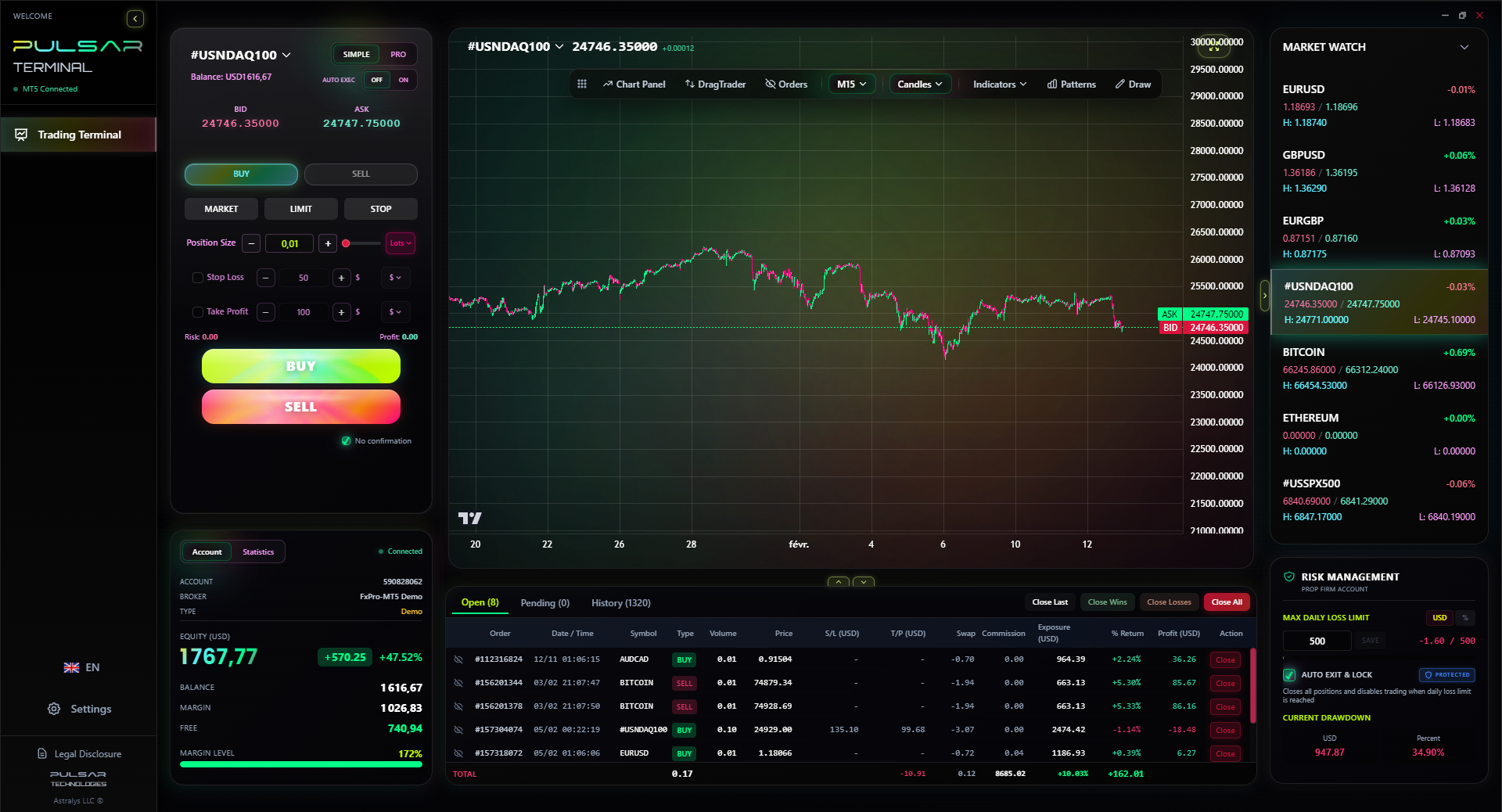
Managing multiple option spreads and executing precise exits is clunky on most platforms, but tools like Pulsar Terminal streamline this with drag-and-drop order management directly on your MT5 chart.
Pulsar Terminal
The all-in-one MT5 companion: drag-and-drop orders, multi-TP/SL, trailing stop, grid trading, Volume Profile, and prop firm protection. Used by 1,000+ traders daily.
“The reckless punter is being forced out. This is good for the disciplined trader.”
Finally, let's talk about the real 'high probability' path: it's you.
- Paper Trade for 3 Months: Use Sensibull's paper trading. Test the cash-secured put and vertical spread strategies on 50 different trades. Log every one. Don't skip this.
- Specialize: Don't trade Nifty, Bank Nifty, and 10 stock options all at once. Master one. I only trade Bank Nifty and Nifty options. I know their rhythms, their typical ranges, and how they react to news.
- Trade Small, Trade Often: Start with 1 lot. The goal is not to make ₹1 lakh this month. The goal is to make 20 trades with a positive expectancy. Prove your process.
- Keep a Journal: Not just 'bought, sold.' Write down: Why did you enter? What was the IV? What was your plan for exit? How did you feel? This is how you find your personal leaks.

Pro Tip: The most high-probability strategy in the world is consistency. A 55% edge, executed 100 times with strict risk management, will crush a 90% edge that you trade once with poor sizing and panic exits.
I spent years searching for the holy grail in PDFs and forums. My edge came when I threw them out, focused on one strategy (bull put spreads), and executed it 200 times in a row, tweaking only my entry timing based on MACD indicator divergences on the hourly chart. The strategy was simple. The discipline was everything. That's what you won't find in any downloadable file.
💡 Winston's Tip
Your best tool isn't a strategy PDF, it's your trading journal. The market tells its secrets to those who listen to their own mistakes.
FAQ
Q1Where can I find a genuine high probability options trading strategies PDF for India?
Frankly, I wouldn't bother. Most are outdated, ignore SEBI's recent rule changes (like upfront premium and higher STT), and are not tailored to Indian cost structures. Better resources are Zerodha Varsity (free, web-based), Sensibull's learning section, and live webinars from reputable Indian educators who discuss current regulations.
Q2What is the safest high probability options strategy for beginners in India?
The Cash-Secured Put on a large-cap index like Nifty 50 or a blue-chip stock you want to own. It's straightforward, defines your maximum risk (the purchase price), and teaches you the core concept of selling premium. Just start with ONE lot. Don't get fancy with spreads until you've done this 20 times successfully in a paper trading account.
Q3How do SEBI's new rules affect my options trading strategy?
They massively increase the cost of being wrong and reduce use. The 100% upfront premium rule means you need more capital. The higher STT directly cuts into profits. The larger contract sizes mean you trade fewer lots. Your strategy must now be more capital-efficient, use defined risk (like spreads), and have a tighter focus on risk management to survive. Strategies relying on heavy use or very short-term, multi-leg setups are much harder now.
Q4Can I use scalping strategies with options in India?
You can, but it's incredibly tough. The flat ₹20 brokerage per order is a huge hurdle. If you're scalping for a ₹50 premium, ₹40 in round-trip brokerage plus STT eats most of it. Successful options scalping strategy here requires very high conviction, excellent timing, and focusing on liquid instruments (Nifty, Bank Nifty) where the bid-ask spread is tight. It's not for beginners.
Q5What is a good probability of profit to target for Indian options?
Aim for trades where your platform (like Sensibull) shows a 65-75% theoretical probability of profit. But remember, that's before costs and black swan events. After accounting for brokerage and taxes, your real-world probability is lower. A trade with a 70% chance of making ₹2000 and a 30% chance of losing ₹5000 has a positive expectancy, but you must be able to withstand a string of losing trades psychologically.
Q6How important are indicators like RSI or MACD for options trading?
Crucial for timing, irrelevant for strategy structure. Use the RSI indicator to identify overbought/oversold conditions to decide when to sell calls or puts. Use MACD for trend confirmation. But the strategy itself - whether it's a spread or a covered call - is based on your market outlook and risk tolerance. The indicator gives you a better entry point, improving your initial probability.
Q7Is selling options really safer than buying options in India?
It's not about 'safer,' it's about different risk profiles. Selling options (like in a cash-secured put) gives you a high probability of a small win, but a low probability of a large loss. Buying options gives you a low probability of a large win, but a high probability of losing the entire premium (now paid upfront). With SEBI's focus on curbing speculation, defined-risk selling strategies (spreads) align better with the new, more disciplined market environment.
Prof. Winston's Lesson
Key Takeaways:
- ✓High probability means >65% win rate AFTER ₹20 brokerage & 0.15% STT.
- ✓Master one defined-risk strategy (like a vertical spread) before adding others.
- ✓Exit at 50-70% max profit. Never hold for the last rupee till expiry.
- ✓Your trading capital must cover 100% of long option premiums upfront (SEBI rule).
- ✓Paper trade for 3 months. Your first 50 trades should be free lessons.
How useful was this article?
Click a star to rate
Weekly Trading Insights
Free weekly analysis & strategies. No spam.
About the Author
Rajesh Sharma
Senior Forex Analyst
Trading Indian and South Asian markets for over 10 years. Started with NSE currency derivatives before moving to international forex. Specializes in USD/INR and emerging market pairs.
Comments
Risk Disclaimer
Trading financial instruments carries significant risk and may not be suitable for all investors. Past performance does not guarantee future results. This content is for educational purposes only and should not be considered investment advice. Always conduct your own research before trading.
You Might Also Like

Cara Trading Forex Sukses: 7 Prinsip dari Trader Profesional
Cara trading forex sukses dengan 7 prinsip trader pro: manajemen modal, disiplin, journal trading, backtest. Data nyata, bukan janji profit palsu.
Jam Trading Forex Terbaik untuk Trader Indonesia: Panduan Lengkap dengan Tabel Waktu
Panduan jam trading forex untuk trader Indonesia. Tabel 4 sesi dunia, jam emas 20:00-00:00, sesi mana yang harus dihindari. Data akurat + tips dari trader berpengalaman.
Top 5 Sàn Forex Uy Tín Nhất 2026: Review Jujur dari Trader Indonesia
Top 5 sàn forex uy tín 2026 untuk trader Indonesia. Review jujur: spread, deposit, withdraw, dukungan lokal. Exness, XM, IC Markets & lebih.
Get Pulsar Terminal
All these calculators are built into Pulsar Terminal with real-time data from your MT5 account. One-click position sizing, automatic risk management, and instant calculations.
Get Pulsar Terminal