


Here's a fact that should sober you up: roughly 80% of retail forex traders lose money.

Olumide Adeyemi
West African Trading Pioneer ·  Nigeria
☕ 8 min read
What you'll learn:

Here's a fact that should sober you up: roughly 80% of retail forex traders lose money. In Nigeria, I'd argue that number is higher, maybe 90%. The reason isn't a lack of intelligence or drive. It's a lack of a proper, structured learning path. Everyone wants to know 'how can I learn forex trading' but they skip the boring fundamentals and jump straight to the Lamborghini ads. This guide is the opposite of that. It's the blueprint I wish I had when I started, one that would have saved me the N450,000 I blew on my first live account.
Your first lesson is unlearning everything you've seen on Instagram. Forex trading is not a side hustle you master in two weeks. It's a skill, like welding or coding, that requires deliberate practice. The core concept is simple: you're speculating on the value of one currency against another, like the US Dollar (USD) against the Naira, or more commonly in forex, the USD against the Euro (EUR/USD).
Your initial goal isn't to make money. It's to not lose money. Sounds depressing, right? But protecting your capital is the single most important skill you'll ever learn. Before you even think about a broker, you need to understand the three pillars: the spread (the broker's cut), the pip (the smallest price move), and use (borrowed money that magnifies both profits and losses).

Warning: Nigerian traders get slaughtered by use. A common offer is 1:500. That means with just N20,000, you can control a N10,000,000 position. A 0.5% move against you wipes out your entire capital. It's a trap for the impatient.
Start with a demo account. Not for a week, but for a minimum of three months. Treat the virtual N500,000 they give you like it's your actual life savings. This is your sandbox to make catastrophic mistakes for free. I spent my first demo month just learning how to place different order types (market, limit, stop) without accidentally buying when I meant to sell.

💡 Winston's Tip
A demo account is for testing your strategy, not your luck. If you're not journaling every demo trade with the same discipline as a live one, you're just playing a video game and learning nothing.

“Your initial goal isn't to make money. It's to not lose money.”
This is the 'classroom' phase. You need a structured curriculum, not random YouTube videos.
Learn the Language of Charts
You must become fluent in reading a price chart. Start with candlestick patterns. What does a long wick at the top of a candle tell you? (Sellers rejected higher prices). Understand support and resistance – these are the floors and ceilings where price tends to bounce. Don't clutter your chart with 10 indicators yet. Master one or two. The RSI indicator can show you if a market is overbought or oversold. The MACD indicator can help spot changes in momentum.
Understand What Moves the Market
For a Nigerian trader, this is critical. The Naira's value is heavily influenced by Central Bank of Nigeria (CBN) policies, oil prices (our major export), and political stability. Globally, you need to watch major economic data: US Non-Farm Payrolls, interest rate decisions from the Federal Reserve and European Central Bank. When the US raises rates, the USD often strengthens. This directly affects pairs like EUR/USD and GBP/USD, which you'll likely trade.
Choose Your Battlefield (Your Strategy)
Are you a scalper, in and out in minutes? A day trader? Or a swing trader holding positions for days? Your personality dictates this. I'm a swing trader. I found scalping strategy too stressful; I'd stare at the screen for hours for tiny gains. My first profitable month came from swing trading, where I held a GBP/USD short for four days based on a clear resistance break, banking 180 pips.

Example: If you buy EUR/USD at 1.0850 and sell at 1.0950, that's a 100 pip move. If your position size was a standard lot (100,000 units), that's a $1,000 profit. But if you got it wrong, that's a $1,000 loss. This is why a position size calculator is non-negotiable.

“use is a trap for the impatient.”
This is where most fail. Demo trading feels like a video game. Real money triggers fear and greed, the two emotions that destroy accounts.
Your first live account should be painfully small. I'm talking N50,000 or less. This is 'tuition fee' money you are 100% prepared to lose. Your sole objective is to experience the psychological pressure, not to get rich.
Choosing a Broker in Nigeria
This is a minefield. You need a broker regulated by a reputable authority (like ASIC or CySEC, though access from Nigeria can be tricky), that offers reliable deposits and withdrawals in Naira. You'll hear names like Exness review, IC Markets review, XM review, and Pepperstone review. Do your own research. Check their average spreads on the pairs you want to trade (like EUR/USD guide), their minimum deposit, and crucially, their withdrawal process and fees. How long does it take to get your money back to your Nigerian bank account?
The Holy Grail: Risk Management
This is it. The secret. The only thing that separates the 10% from the 90%. You must define, in writing, before every trade:
- Risk Per Trade: Never risk more than 1-2% of your account on a single trade. On a N50,000 account, that's N500-N1,000 max.
- Stop-Loss (SL): Every trade gets a stop-loss, no exceptions. It's your ejector seat. Place it at a logical level where your trade idea is proven wrong.
- Take-Profit (TP): Have a target. Don't just pray for infinity.
I learned this the hard way. In 2019, I put 15% of my account on a gold (XAU/USD guide) trade without a stop-loss. A sudden news event moved against me. I watched, frozen, as loss piled upon loss until I got a margin call. I lost N67,500 in 45 minutes. That loss taught me more than any win ever could.
💡 Winston's Tip
Your first three live trades will tell me everything. If you risk 1% on the first, 2% on the second after a win, and 5% on the third after a loss, you're emotionally compromised. Stick to the fixed percentage, no matter what.

“Your losses are your best teachers.”
After a few months, you'll know if chart patterns or economic news resonate with you. That's your starting point for an 'edge' – a slight statistical advantage. Maybe you're good at trading pullbacks during the London session. Double down on that.
But you can't improve what you don't measure. A trading journal is mandatory. Not just 'bought EUR/USD, made money.' You need details:
- Date/Time, Pair, Direction (Buy/Sell)
- Entry Price, Stop-Loss Price, Take-Profit Price
- Position Size (in lots or % risk)
- Reason for Entry: (e.g., "Bounce off daily support, RSI oversold")
- Screenshot of the chart
- P&L in Pips and Naira
- Emotional State: Were you nervous, greedy, confident?
- Lesson Learned
Review this journal weekly. Your losses are your best teachers. Are you consistently getting stopped out just before price reverses? Maybe your stops are too tight. Are you letting winners turn into losers? You need a better exit plan.

Pro Tip: Your strategy isn't the set of rules for entering trades. It's the set of rules for managing them after entry. The exit is everything.

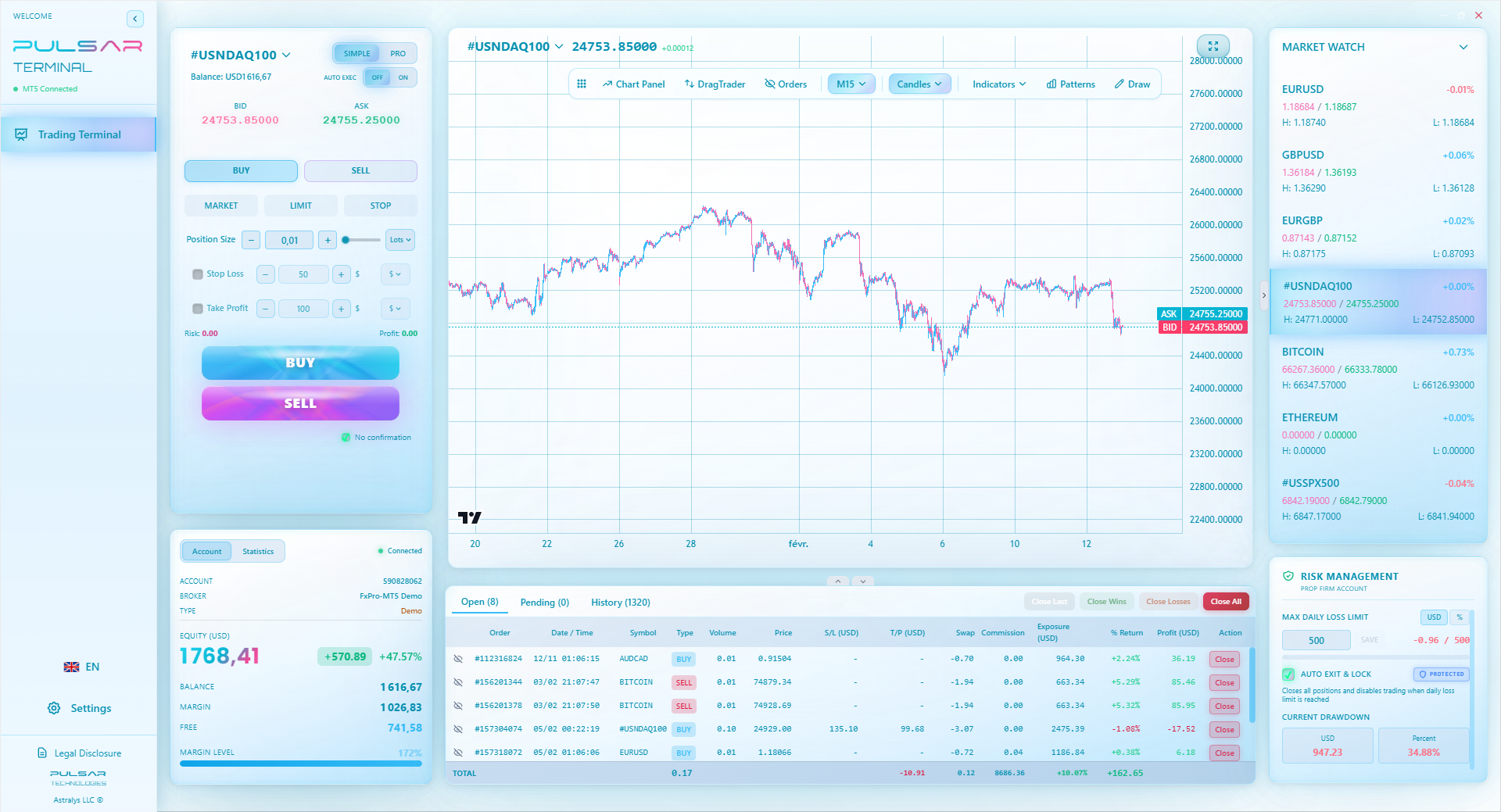
When you're serious about managing trades like a pro, manually moving stop-losses to breakeven or setting multiple take-profit levels on MT5 is a chore. Pulsar Terminal automates all that with one click.
Pulsar Terminal
The all-in-one MT5 companion: drag-and-drop orders, multi-TP/SL, trailing stop, grid trading, Volume Profile, and prop firm protection. Used by 1,000+ traders daily.
“Your losses are your best teachers.”
Once you're consistently not losing for a quarter, you can explore more.
Psychology is King
You'll battle yourself more than the market. You'll break your rules. You'll revenge trade after a loss. You'll move your stop-loss further away, hoping the market turns (it won't). This is normal. Have a daily loss limit (e.g., -3% of account) and a daily profit target. When you hit either, shut down the platform. Go for a walk.
Technical Deep Dive
Explore order flow, market structure, and volume profile. Learn about different session overlaps (Asian, London, New York). The London-New York overlap (1 PM - 4 PM WAT) is often the most volatile.
The Nigerian-Specific Pitfalls
- Power & Internet: A trade can't wait for NEPA to bring light. Invest in a good inverter/solar solution and a stable, backup internet connection (like a 4G router).
- 'Guru' Culture: Ignore the WhatsApp group 'gurus' selling signals. If they were so profitable, why are they selling N5,000 signals? They make money from you, not the market.
- Regulatory Grey Areas: Understand the CBN's stance. Keep your trading capital separate from your essential living funds. Use brokers with clear, legal withdrawal paths.
A pitfall I see constantly? Traders overcomplicate their charts. They add 10 indicators that all say the same thing (lagging price). Keep it stupid simple. Price action, key levels, maybe one or two indicators. That's it.
💡 Winston's Tip
The market doesn't care about your rent, your dreams, or your ego. The moment you trade to 'make back what you lost' or to 'hit a monthly target,' you've handed control over to fear and greed. The plan is the boss.
“It's the hardest way to make easy money you'll ever find.”
Forex trading is a marathon, not a sprint. Your goal in Year 1 is survival. Year 2 is consistency (small, steady gains). Year 3 and beyond is scaling up.
Your learning never stops. The market changes. Read books (I recommend 'Trading in the Zone' by Mark Douglas for psychology). Follow reputable financial news, not hype sites. Engage with serious trading communities where people post charts and analysis, not just P&L brags.
Consider prop firm challenges once you have a solid, documented track record. They offer larger capital but come with strict rules. The path to learning forex trading is a commitment to constant self-improvement and brutal honesty with yourself. It's the hardest way to make easy money you'll ever find.
Finally, always know your 'why'. Are you doing this for supplemental income? For financial freedom? To build a business? When the inevitable losing streak hits (and it will), that 'why' is what keeps you glued to your rules and journal, instead of blowing up your account on a reckless gamble. That's how you graduate from the 90% to the 10%.

FAQ
Q1How long does it take to learn forex trading well enough to be profitable?
Throw out the '30-day masterclass' nonsense. A realistic timeline is 6-12 months of dedicated demo trading and study before going live with significant capital. It takes another 1-2 years of live trading to achieve consistent, psychologically stable profitability. It's a multi-year apprenticeship.
Q2What is the best forex trading strategy for beginners in Nigeria?
There is no single 'best' strategy. However, beginners should start with a simple, rule-based strategy like price action trading around key support and resistance levels on the 4-hour or daily chart. Avoid strategies requiring lightning-fast execution (like scalping) until you've mastered the basics and have ultra-reliable internet/power.
Q3How much money do I need to start forex trading in Nigeria?
You can start a demo account with N0. For a live account, start with an amount you are completely willing to lose, ideally not more than N50,000. This is for learning under real pressure. Never start with money meant for rent, school fees, or business capital. Many international brokers have minimum deposits as low as $10 (approx. N15,000).
Q4Is forex trading legal and regulated in Nigeria?
Trading forex with international brokers is in a regulatory grey area. The Central Bank of Nigeria (CBN) has historically discouraged individuals from engaging in the market due to the high risk of loss and pressure on the Naira. You are responsible for ensuring your broker can legally serve Nigerian clients and that you understand the tax implications. Always prioritize brokers with strong international regulation (like FCA, ASIC).
Q5What's the biggest mistake new Nigerian traders make?
Using excessive use. Brokers offer 1:500 or even 1:1000. This is a tool for professional risk managers, not beginners. It magnifies losses instantly. A 0.2% move against you with 1:500 use wipes out 100% of your margin. Start with 1:10 or 1:20 maximum while learning.
Q6Can I rely on free forex signals from Telegram or WhatsApp?
Absolutely not. This is a surefire path to losses. You don't learn the reasoning, you don't manage the trade, and you have no idea of the signal provider's risk management (if any). You are blindly following someone who is not accountable for your money. Your education is the only reliable signal.
Q7How do I handle the stress and emotions of losing trades?
First, by having a rock-solid risk management rule (like the 1% rule) so no single loss can hurt you. Second, by accepting that losses are a cost of doing business, like a shopkeeper accepts spoilage. Third, by having a trading plan and journal to review objectively, not emotionally. Finally, take breaks after a loss - never 'revenge trade.'
Prof. Winston's Lesson
Key Takeaways:
- ✓Demo trade for 3+ months with full discipline.
- ✓Never risk more than 1-2% of capital per trade.
- ✓A trading journal is non-negotiable for improvement.
- ✓Start live with money you are 100% prepared to lose.
How useful was this article?
Click a star to rate
Weekly Trading Insights
Free weekly analysis & strategies. No spam.
About the Author
Olumide Adeyemi
West African Trading Pioneer
One of Nigeria's most active forex trading educators. 8 years of experience trading from Lagos. Specializes in low-capital strategies and prop firm challenges for African traders.
Comments
Risk Disclaimer
Trading financial instruments carries significant risk and may not be suitable for all investors. Past performance does not guarantee future results. This content is for educational purposes only and should not be considered investment advice. Always conduct your own research before trading.
You Might Also Like

Cara Trading Forex Sukses: 7 Prinsip dari Trader Profesional
Cara trading forex sukses dengan 7 prinsip trader pro: manajemen modal, disiplin, journal trading, backtest. Data nyata, bukan janji profit palsu.
Jam Trading Forex Terbaik untuk Trader Indonesia: Panduan Lengkap dengan Tabel Waktu
Panduan jam trading forex untuk trader Indonesia. Tabel 4 sesi dunia, jam emas 20:00-00:00, sesi mana yang harus dihindari. Data akurat + tips dari trader berpengalaman.
Top 5 Sàn Forex Uy Tín Nhất 2026: Review Jujur dari Trader Indonesia
Top 5 sàn forex uy tín 2026 untuk trader Indonesia. Review jujur: spread, deposit, withdraw, dukungan lokal. Exness, XM, IC Markets & lebih.
Get Pulsar Terminal
All these calculators are built into Pulsar Terminal with real-time data from your MT5 account. One-click position sizing, automatic risk management, and instant calculations.
Get Pulsar Terminal