


I lost R12,000 in a single morning back in 2018 trying to 'play forex' like it was a casino.

David van der Merwe
Emerging Markets Trader ·  South Africa
☕ 10 min read
What you'll learn:
- 1The Legal Game Board: FSCA Rules You Can't Ignore
- 2Real Costs: Spreads, Commissions & The Rands and Cents
- 3Picking Your Broker: The South African Shortlist
- 4The Strategy: This Isn't a Slot Machine
- 5The Psychology of a ZAR Trader
- 6Taxes and The SARS Reality
- 7My Biggest Mistakes (So You Don't Repeat Them)
- 8Getting Started Tomorrow
I lost R12,000 in a single morning back in 2018 trying to 'play forex' like it was a casino. I'd opened a massive position on USD/ZAR with 100:1 use, convinced the Rand would tank. It didn't. It rallied 2%, and my broker's margin call came through before I'd even finished my coffee. That painful lesson taught me that 'playing' is the wrong word entirely. This is a business, governed by strict South African rules. Here’s how you actually do it, legally and profitably, from someone who’s blown up accounts and built them back.
You can't play the game if you don't know the rules, and in South Africa, the Financial Sector Conduct Authority (FSCA) writes them. Trading is legal, but it's a regulated activity. Get this wrong, and you risk your capital with an illegal operator or face SARS knocking.
The biggest rule? use is capped at 30:1 for retail traders on FSCA-regulated accounts. That 500:1 offer from some offshore broker's ‘international entity’? If you're a South African resident trading through them, you're likely outside our regulatory safety net. The FSCA imposed this limit for a reason: to stop idiots like my 2018 self from wiping out an account in minutes. It forces you to use sensible position size calculator.
The Rand and Exchange Control
Here’s a critical local nuance. You, as a South African resident, are generally not allowed to speculate directly against the ZAR with an online broker. Want to buy USD with your Rand to trade? That’s a foreign exchange transaction that must go through an Authorised Dealer (your bank). You use your annual allowances - R1 million single discretionary, R10 million foreign investment - to fund your international trading account. The broker holds your money in USD or EUR. You then trade standard pairs like EUR/USD guide, not ZAR pairs. Trading USD/ZAR on an international platform is a grey area at best. Stick to the clear path.

Warning: Always verify your broker's FSCA license number on the FSCA's public register. If they're not there, your funds aren't protected under South African law. It’s that simple.

💡 Winston's Tip
The 30:1 use cap isn't a limit; it's a governor on your engine preventing a blowout. The fastest traders aren't the ones using the most use, they're the ones who survive the longest.
Forget the ‘from 0.0 pips’ marketing. Let's talk about what you'll actually pay. Your profit is what's left after costs, so this matters more than any indicator.
On a major pair like EUR/USD, the average raw spread among good brokers is around 0.2-0.3 pips. But you often pay a commission on top of that. For example, on a true ECN account, you might see a 0.1 pip spread plus a $3.50 per lot, per side commission. That’s $7 round turn. On a standard lot (100,000 units), that’s R130-ish gone before your trade moves a pip.

Example: You buy 1 standard lot of EUR/USD at 1.0850. Spread is 0.2 pips, commission is $7. Your break-even point isn't 1.0850. It's 1.0850 + 0.0002 + (commission cost in pips). At $7 per $100,000, that's about 0.7 pips. So you need price to hit 1.08527 just to break even.
For local flavor, look at exotic pairs. Want to trade USD/ZAR? Spreads are much wider - think 50-100 pips as standard. At Pepperstone review, I’ve seen it around 5 pips, which is excellent for an exotic, but it’s still 10-20 times the cost of EUR/USD. This is why most pros stick to majors and leave exotics for very specific, longer-term plays. Your scalping strategy will be eaten alive by that spread.
Minimum deposits vary wildly. You can start with $5 at some, but a decent ECN account usually requires $100-$200. Don't start with less than R20,000 total capital. Seriously. With a 30:1 cap, you need buffer to survive drawdowns.
“Your edge isn't a secret indicator. It's discipline and risk management.”
I’ve traded with most of them. Here’s the real deal on who’s operating properly for South Africans.
| Broker | Why They're on the List | The Catch |
|---|---|---|
| IG | Top-tier FSCA regulation, massive global firm. Their proprietary platform is excellent for analysis. | Spreads can be higher than pure ECN brokers. You're paying for the brand and security. |
| Tickmill | FSCA-regulated, brutally low costs. Raw account: ~0.11 pip spread + $3/side commission. | Minimum deposit $100. Platform is standard MT4/MT5. Nothing fancy, just efficient pricing. |
| Exness | Popular locally, FSCA-regulated. Offers raw spreads from 0.0 pips. | Some account types have unusual conditions. Do your homework on their Exness review. |
| XM Group | Strong global presence, FSCA license. Very low minimum deposit ($5). | Spreads on commission-free accounts are wider (0.8 pips+). Better for smaller accounts learning. |
| FP Markets | FSCA-regulated, true ECN pricing. Spreads from 0.0 pips, reliable execution. | Like Tickmill, it’s a no-frills, cost-effective workhorse. |
My main accounts are with Tickmill and FP Markets for cost, and IG when I need deep research. I avoid any ‘broker’ that cold-calls me offering a ‘guaranteed system’. If they have a sales team in Sandton calling randoms, their business model is your deposits, not your success.
So, how do you play forex? You don't. You execute a business plan. Here’s the framework that replaced my gambling.
1. Find Your Edge (It's Not What You Think) Your edge isn't a secret indicator. It's discipline and risk management. My edge is that I risk 1% of my capital per trade, max. I use a 1:1.5 risk-to-reward ratio as a minimum. That means over 100 trades, I can be wrong 40% of the time and still be profitable. The math is your only true friend.
2. Choose Your Timeframe Are you a scalping strategy fiend (5-minute charts) or a swing trading patient type (daily charts)? I started as a scalper, thinking more trades = more money. I was wrong. The spreads and commissions murdered me. I now swing trade, holding positions for days or weeks. It suits the 30:1 use limit and my sanity.
3. Use Tools, Not Crutches I use the MACD indicator on the daily chart for trend direction and momentum. I use the RSI indicator on the 4-hour to spot potential reversals. But I never enter just because an indicator flashes. Price action and key support/resistance levels get the final say. I lost count of the times I bought an RSI ‘oversold’ signal only to watch price plummet another 100 pips.

Pro Tip: Backtest your strategy. Not for 10 trades. For 200+. Use MT5’s strategy tester. If it didn't work in the past, it won't magically work tomorrow. I spent three months backtesting a moving average crossover system only to find it had been unprofitable since 2015.
“Stick to majors where the spread is a fraction of a percent. Exotics are for masochists with deep pockets.”
Trading from South Africa adds unique mental hurdles. You're watching the JSE close, load-shedding schedules, and global markets all at once.
The biggest psychological trap? Chasing losses when you're down in Rands. You see a R10,000 loss and think, 'One big trade on XAU/USD guide can get that back.' That's the fast track to a R50,000 loss. You must think in percentages, not Rands. A 2% loss is a 2% loss, whether it's R1,000 or R100,000.
Another local issue: FOMO on global news. You wake up at 3:30 PM SA time, and the ECB has already caused a 80-pip move in the Euro. The urge to 'jump on the trend' is huge. Don't. The train has left. My rule: if I miss the first 60% of a scheduled news move, I sit out. There will be another opportunity tomorrow. I’ve been stopped out more times chasing news than I care to admit.
Finally, isolate yourself from the 'guru' culture. The WhatsApp groups with ‘100% sure calls’ are poison. Every successful trader I know works alone or in a very small, serious circle. The noise will bankrupt you.
💡 Winston's Tip
Your trading journal is more important than your trading strategy. The strategy tells you what to do. The journal tells you what you actually did, and that's where the real lessons are buried.
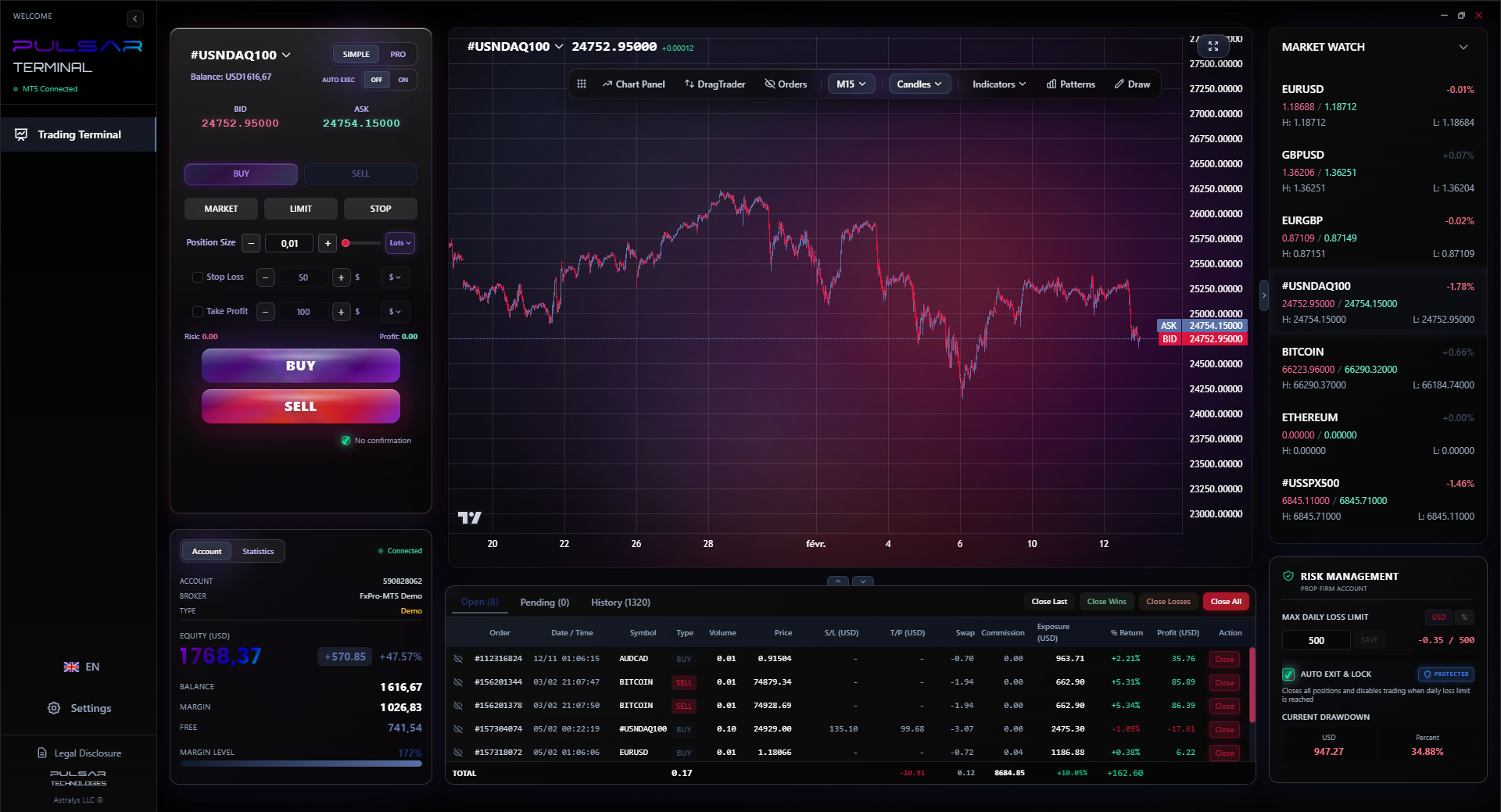
Managing the psychology of multiple trades is easier when your platform lets you set advanced orders like trailing stops and breakeven levels with a single click, directly on your MT5 charts.
Pulsar Terminal
The all-in-one MT5 companion: drag-and-drop orders, multi-TP/SL, trailing stop, grid trading, Volume Profile, and prop firm protection. Used by 1,000+ traders daily.
Let's be blunt: SARS wants its share. Your net trading profits (gains minus losses, minus expenses) are considered taxable income. This applies even if your money is sitting with IC Markets review in Australia. You declare it on your annual tax return.
Keep careful records. Every trade confirmation, every deposit and withdrawal statement, every invoice for trading courses (yes, they can be deductible), your data subscription fees. I use a simple spreadsheet: Date, Pair, Profit/Loss (in ZAR), Running Total.
At the end of the tax year, you convert your total USD profit/loss to ZAR using the average exchange rate for the year (SARS provides this). You add that ZAR amount to your other income. There's no separate 'capital gains' rate for forex trading income for individuals - it's taxed at your marginal income tax rate.
Warning: Do not try to hide trading income in an offshore account. SARS has increasingly sophisticated data-sharing agreements. The penalty for evasion is far worse than the tax bill. I know a trader who got a nasty audit letter because his lifestyle didn't match his declared income. It wasn't pretty.
“How do you play forex in South Africa? You trade it slowly, carefully, legally, and with more respect for risk than for reward.”
I’ll give you the gift of my failures. Memorize these.
Mistake 1: Over-leveraging on ZAR Pairs. In 2019, I put 5% of my account on a USD/ZAR short at 14.85. My analysis was sound (I thought). But a sudden shift in local political sentiment sent it to 15.20 in a day. The 35 pip stop-loss I’d set was a joke. I got margin call and lost R8,000. Exotics are volatile. Use tiny position sizes.
Mistake 2: Not Understanding the Spread definition. I used to trade exotic crosses like EUR/TRY for the ‘big moves.’ The spread was 200 pips. I had to make 200 pips just to break even. I never made a consistent profit. Stick to majors where the spread is a fraction of a percent.
Mistake 3: Trading Around Load-shedding. I entered a trade during Stage 2, confident I’d be online for hours. Eskom escalated to Stage 4. My laptop died, my mobile data was patchy, and I couldn't manage the trade. I lost R3,500 on a trade that would have been a small winner if I’d just been able to adjust my stop. Now, if loadshedding is on the schedule, I either don't trade or I set ultra-wide stops and walk away. No exceptions.
💡 Winston's Tip
If you wouldn't hold the trade through a scheduled load-shedding slot, don't enter it. Eskom is the ultimate stop-loss.
Here’s your action plan, in order.
- Education First: Don't deposit a cent. Read. Understand what a pip definition is, what use really does, what a stop-loss is. Babypips.com is a free starting point.
- Open a Demo Account: Use an FSCA-regulated broker like IG or XM. Demo trade for at least three months. Your goal isn't to make fake money. Your goal is to not lose fake money consistently.
- Develop a Simple Plan: In your demo, test this: Only trade EUR/USD on the 4-hour chart. Use a 20-period moving average to gauge trend. Buy pullbacks in an uptrend, sell rallies in a downtrend. Risk 1% per trade. See if you can follow it for 50 trades.
- Start Small for Real: Deposit the minimum you can afford to lose completely - say, R5,000. Trade micro lots (0.01). Your goal for the first six months is to not blow up the account. Profit is a secondary bonus. If you can preserve R5,000 for six months while executing your plan, you're ready to scale.
- Keep a Journal: Write down every trade, the reason for entry, your emotion, the outcome. Review it weekly. This is how you learn what you actually do, not what you think you do.
How do you play forex in South Africa? You trade it slowly, carefully, legally, and with more respect for risk than for reward. That’s the only way the game is worth playing.
FAQ
Q1Is forex trading legal in South Africa?
Yes, it's completely legal, but it's regulated by the Financial Sector Conduct Authority (FSCA). You must use an FSCA-licensed broker to be protected under South African law. Trading with unregulated offshore entities is risky and may violate exchange control rules.
Q2What is the maximum use I can use?
For retail clients with FSCA-regulated brokers, the maximum use is 30:1. Some brokers offer higher use through their international companies, but using them means you forfeit local regulatory protection. The 30:1 cap is there to protect you from yourself.
Q3How are my forex trading profits taxed?
Your net profit (total gains minus losses and allowable expenses) is considered ordinary taxable income by SARS. You must declare it on your annual tax return, and it's taxed at your marginal income tax rate. You must convert all profits and losses to ZAR using the official average exchange rate for the tax year.
Q4Can I trade the South African Rand (ZAR) online?
It's complicated. South African residents are generally not permitted to speculate directly against the ZAR on an online broker. You fund an international account using your bank and foreign allowances, then trade major pairs like EUR/USD. Trading USD/ZAR on an international platform occupies a regulatory grey area and is best avoided.
Q5What's a realistic amount of money to start with?
While some brokers allow deposits as low as $5, starting with less than R20,000 in total trading capital is extremely difficult with the 30:1 use cap. You need enough buffer to withstand losses without blowing your account. A realistic starter amount for serious learning is between R10,000 and R50,000, trading micro lots (0.01).
Q6What's the biggest mistake new South African traders make?
Two things: 1) Using excessive use, treating forex like a lottery. 2) Trading exotic currency pairs (like USD/ZAR, EUR/TRY) with wide spreads that eat their profits. They chase big moves but don't understand that a 100-pip spread means they start the trade R2,000 in the hole.
Q7Which trading platform is best for beginners?
MetaTrader 4 (MT4) or MetaTrader 5 (MT5) are the industry standards in South Africa. They're stable, have thousands of free indicators, and are supported by almost every broker. Start with MT4/MT5 before exploring any proprietary platforms. Their simplicity is their strength.
Prof. Winston's Lesson
Key Takeaways:
- ✓FSCA's 30:1 use is a protective cage, not a barrier.
- ✓Real cost is spread + commission; calculate your true break-even.
- ✓Trade majors, not ZAR exotics, to avoid spread murder.
- ✓SARS taxes your net profit; keep flawless ZAR records.
- ✓Your first R20k goal is survival, not profit.
How useful was this article?
Click a star to rate
Weekly Trading Insights
Free weekly analysis & strategies. No spam.
About the Author
David van der Merwe
Emerging Markets Trader
Johannesburg-based trader with 11 years in emerging market currencies. Specializes in ZAR pairs, FSCA-regulated trading, and South African market analysis.
Comments
Risk Disclaimer
Trading financial instruments carries significant risk and may not be suitable for all investors. Past performance does not guarantee future results. This content is for educational purposes only and should not be considered investment advice. Always conduct your own research before trading.
You Might Also Like

Cara Trading Forex Sukses: 7 Prinsip dari Trader Profesional
Cara trading forex sukses dengan 7 prinsip trader pro: manajemen modal, disiplin, journal trading, backtest. Data nyata, bukan janji profit palsu.
Jam Trading Forex Terbaik untuk Trader Indonesia: Panduan Lengkap dengan Tabel Waktu
Panduan jam trading forex untuk trader Indonesia. Tabel 4 sesi dunia, jam emas 20:00-00:00, sesi mana yang harus dihindari. Data akurat + tips dari trader berpengalaman.
Top 5 Sàn Forex Uy Tín Nhất 2026: Review Jujur dari Trader Indonesia
Top 5 sàn forex uy tín 2026 untuk trader Indonesia. Review jujur: spread, deposit, withdraw, dukungan lokal. Exness, XM, IC Markets & lebih.
Get Pulsar Terminal
All these calculators are built into Pulsar Terminal with real-time data from your MT5 account. One-click position sizing, automatic risk management, and instant calculations.
Get Pulsar Terminal