


I lost ₦450,000 in two days back in 2016.

Olumide Adeyemi
West African Trading Pioneer ·  Nigeria
☕ 10 min read
What you'll learn:
- 1Forex 101: It's Not Magic, It's Just Buying and Selling
- 2The Legal Stuff: What's Allowed and What Gets You in Trouble
- 3Brokers, Real Costs, and the Naira's Wild Ride
- 4What Actually Moves Prices? (Beyond Oil News)
- 5From Idea to Order: Executing a Trade Step-by-Step
- 6Mistakes I've Made (So You Don't Have To)
- 7Building a Strategy That Lasts More Than 3 Months
I lost ₦450,000 in two days back in 2016. Not on a bad trade, but on pure ignorance of how forex works. I'd deposited with a 'local expert' who promised 100% monthly returns, only to watch my money vanish when his unregulated platform disappeared overnight. That painful lesson taught me what this guide will save you from: you can't trade what you don't understand. The Nigerian forex scene is unique - part opportunity, part minefield - and knowing how it actually functions is your first line of defense.
Let's strip away the mystique. Forex trading is simply speculating on whether one currency will go up or down against another. When you trade EUR/USD, you're betting whether the Euro will strengthen or weaken against the US Dollar. That's it.
In Nigeria, you're already participating in forex every time you check the black market rate for dollars or send money abroad. Trading just formalizes that instinct. The market operates 24 hours a day, five days a week, across major financial centers: London opens, then New York, then Sydney, then Tokyo. This creates constant movement.
The key units are pips and lots. A pip is usually the fourth decimal place in a quote (0.0001). If EUR/USD moves from 1.0850 to 1.0851, that's one pip. A standard lot is 100,000 units of the base currency. Most Nigerians start with micro lots (1,000 units) or mini lots (10,000 units) because risking $100,000 on a single trade is insane for retail traders. Use our position size calculator religiously - it'll save your account.

Warning: Never trust anyone who says forex is 'easy money' or promises guaranteed returns. If it were that easy, banks would have automated it and fired all their traders. It's a skill, like any other.
“Forex trading is legal in Nigeria, but the system around it has quirks that can trip you up.”
Here's where most guides get fuzzy. Let me be blunt: trading forex as an individual Nigerian is legal. Full stop. But the system around it has quirks that can trip you up.
The Regulatory Players
You have two main bodies: the Central Bank of Nigeria (CBN) and the Securities and Exchange Commission (SEC). The CBN controls the official forex market and hates speculation that pressures the Naira. The SEC regulates investments but doesn't currently license retail forex brokers operating within Nigeria. This creates a gray zone: you're allowed to trade, but you'll likely use an international broker regulated abroad (like the UK's FCA or Cyprus's CySEC).
The Tax Man Cometh
This is non-negotiable. Profits from forex trading are subject to Capital Gains Tax at 10%. You must report this to the Federal Inland Revenue Service (FIRS). Keep detailed records of every trade - entry, exit, profit/loss. I learned this the hard way in 2019 when I had to reconstruct a year of trades for an audit. It took three solid weekends.
The Banking Hurdle
Nigerian banks are prohibited from facilitating forex transactions for speculation. This means depositing directly from your Nigerian bank account to an international broker can be problematic. Most traders I know use intermediaries like Wise (formerly TransferWise) or specific payment processors the broker supports. Withdrawal back to your Nigerian account usually works fine, but expect the bank to ask questions about the source of funds.

Pro Tip: Open a separate domiciliary account specifically for trading funds. It makes tracking and tax reporting infinitely easier. And always declare your trading income - the FIRS is getting more sophisticated at tracking forex profits.

💡 Winston's Tip
Your first profit target should always be to move your stop-loss to breakeven. Protecting your capital is job number one. Profits are a bonus.
“Never trust anyone who says forex is 'easy money' or promises guaranteed returns.”
Choosing a broker in Nigeria isn't about who has the flashiest ads on Instagram. It's about who won't disappear with your money and who offers fair costs.
Broker Reality Check
You want a broker regulated by a reputable international authority. I've had good experiences with IC Markets for their raw spreads and Exness for their local payment support. Avoid any 'broker' that's only 'registered' in Nigeria with no offshore regulation - that's a red flag the size of Lagos.
The True Cost of Trading
Your costs come in two forms: the spread and sometimes a commission. The spread is the difference between the buy and sell price. For EUR/USD, a good spread might be 0.6 pips. On a standard lot, that's a $6 cost to enter the trade.
Some accounts offer raw spreads (as low as 0.0 pips) but charge a commission, often around $3 per side per standard lot. Do the math: which is cheaper for your trading style? For scalpers taking dozens of trades a day, the commission model usually wins. For swing traders holding positions for days, the wider spread might be fine. Check our detailed spread definition for a deeper breakdown.
Trading Naira Pairs? Think Twice.
You might see USD/NGN or GBP/NGN offered. Be extremely careful. The CBN's official rate and the parallel market rate can differ wildly. Broker prices often reflect the unofficial market, which is highly volatile. I once shorted USD/NGN based on a CBN policy announcement, only to watch it spike 15% in hours due to black market panic. Lost ₦220,000. The liquidity is thin, and the moves can be brutal. Stick to major pairs like EUR/USD or XAU/USD when you're starting.
“Never trust anyone who says forex is 'easy money' or promises guaranteed returns.”
Nigerian traders obsess over oil prices. Yes, crude matters for the Naira's long-term health, but if you're trading EUR/USD or GBP/JPY, you need to think globally.
The Big Three Drivers
- Central Bank Policy: This is king. When the US Federal Reserve hints at raising interest rates, the dollar typically strengthens. When the European Central Bank is dovish, the Euro weakens. You need to follow their meeting minutes and statements.
- Economic Data: Non-Farm Payrolls (US jobs data), inflation reports (CPI), and GDP growth numbers cause immediate volatility. A strong US jobs report often boosts the dollar. I once got stopped out of a GBP/USD trade 30 seconds before a UK inflation release, only to watch it rocket in my original direction. Now I never hold through major news unless I'm intentionally gambling.
- Geopolitics and Market Sentiment: Wars, elections, trade deals - they all shift capital flows. Risk-on sentiment (when investors are optimistic) pushes money into currencies like the Australian Dollar. Risk-off sentiment sends everyone scrambling for the safe-haven Swiss Franc and Japanese Yen.
The Nigerian Filter
Local events affect you indirectly. A CBN decision to hike interest rates might temporarily strengthen the Naira, but it also signals economic stress that could spook foreign investors from Nigerian assets altogether. Don't trade major pairs based solely on local news unless it's a genuine global shock (like a major oil disruption).

Example: On June 12, 2024, US CPI data came in hotter than expected. EUR/USD was at 1.0800. Within 90 minutes, it dropped to 1.0725 - a 75 pip move. On a standard lot, that's a $750 move. Being on the wrong side of that without a stop-loss is account suicide.
💡 Winston's Tip
If you feel the urge to double your position size after a loss to 'get back to even,' shut down your platform and walk away. That's gambling, not trading.
“The discipline isn't in the analysis; it's in sticking to the plan.”
Let's walk through a real trade I took recently, so you see how forex works in practice.
Step 1: The Analysis (April 2, 2025) I was watching GBP/USD. The MACD indicator showed a bullish crossover on the 4-hour chart, and price was bouncing off a key support level at 1.2550. The RSI indicator was at 35, not yet oversold. My bias was to buy.
Step 2: The Plan I decided my entry would be a break above the minor resistance at 1.2580. Stop-loss: 1.2525 (55 pips below entry). Take-profit: 1.2680 (100 pips above). That's a risk-reward ratio of almost 1:2. I used my position size calculator: with a ₦500,000 account and risking 1% (₦5,000), my position size was 0.9 mini lots.
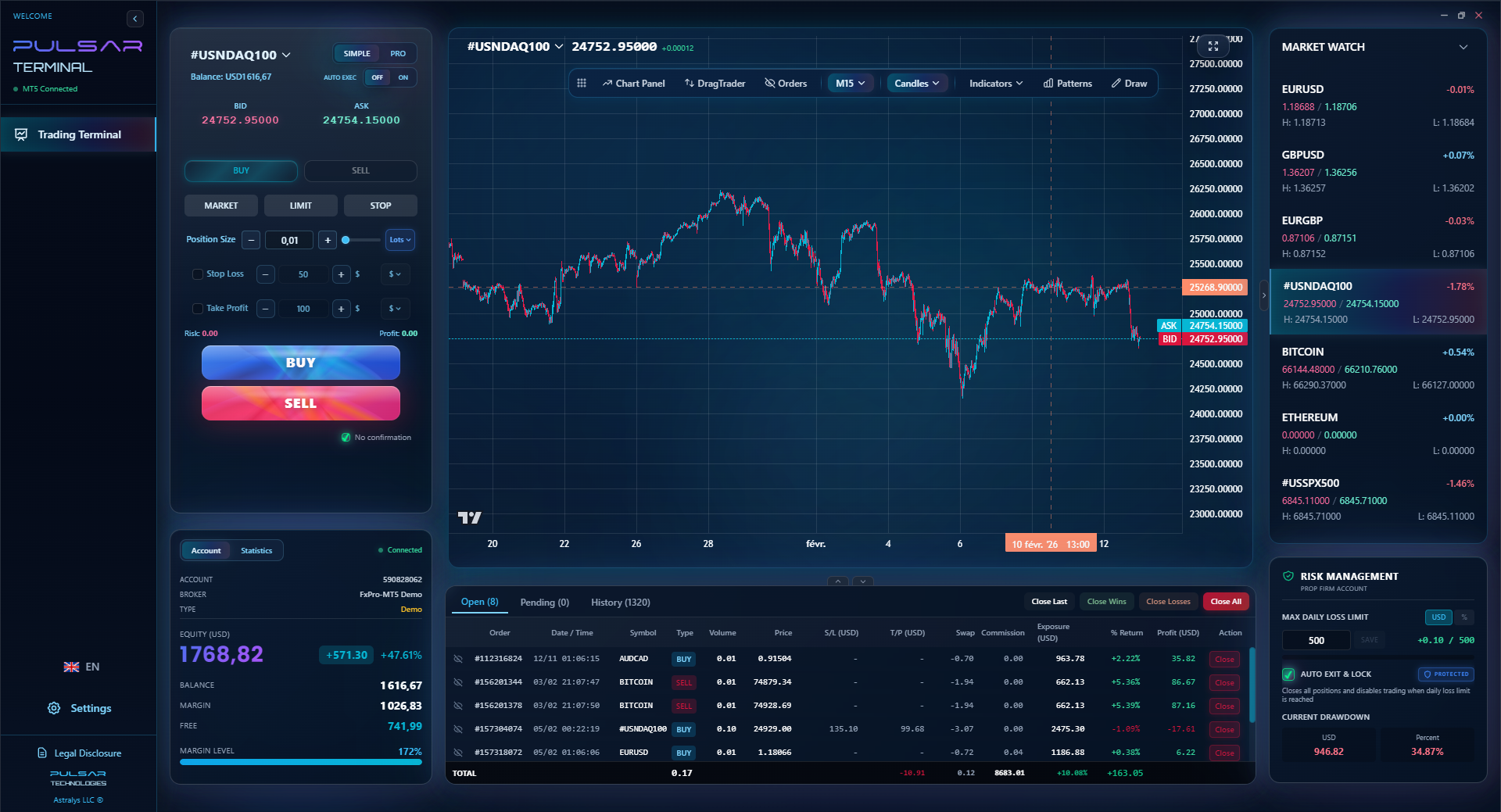
Step 3: The Execution Price hit 1.2581. I clicked buy. Stop-loss and take-profit were set immediately. Never enter a trade without these. This is where tools like Pulsar Terminal shine - you can set this up with one click.
Step 4: The Management Price moved up to 1.2630, then stalled. I moved my stop-loss to breakeven at 1.2581, locking in zero risk. Two days later, price hit my take-profit at 1.2680. Profit: 100 pips x 0.9 lots x $1 per pip (mini lot) = $90, roughly ₦135,000 at the time.
The discipline isn't in the analysis; it's in sticking to the plan. My biggest losses have always come from moving stop-losses out 'just a little more.'
Executing a disciplined trade plan with precise stop-loss and take-profit levels is critical, and Pulsar Terminal automates this directly on your MT5 platform with drag-and-drop ease.
Pulsar Terminal
The all-in-one MT5 companion: drag-and-drop orders, multi-TP/SL, trailing stop, grid trading, Volume Profile, and prop firm protection. Used by 1,000+ traders daily.
“The discipline isn't in the analysis; it's in sticking to the plan.”
We learn more from failure than success. Here are my expensive lessons.
Mistake 1: Overleveraging. In 2017, I used 1:500 use on a $500 account. A 20-pip move against me triggered a margin call. Poof. Account gone in one trade. use is a tool, not a strategy. I rarely use above 1:30 now.
Mistake 2: Trading Without a Stop-Loss. I once bought USD/JPY believing it 'had to bounce.' It didn't. I watched the loss grow from -₦50,000 to -₦250,000, frozen by hope. A stop-loss is an admission you're wrong sometimes. It's your best friend.
Mistake 3: Chasing the 'Holy Grail' System. I spent years and thousands on courses, indicators, and robots promising 90% win rates. They don't exist. Consistent profitability comes from risk management and psychology, not a secret indicator.
Mistake 4: Ignoring Timeframes. Trying to scalp on a 1-minute chart while also holding swing trading positions on the daily will scramble your brain. Pick a style and master it.
Mistake 5: Letting a Winner Turn into a Loser. In 2020, I was up ₦400,000 on a gold trade. Got greedy, removed my take-profit. The market reversed. I closed for a ₦80,000 loss. The pain of that still stings. Always take partial profits.
💡 Winston's Tip
Spend 80% of your time learning risk management and psychology, and 20% on indicators. The best entry system in the world won't save you from poor position sizing.
“Consistent profitability comes from risk management and psychology, not a secret indicator.”
Surviving in forex long-term requires a system, not just lucky guesses.
Start with Your Personality
Are you patient or impulsive? If you can't sit still, maybe scalping fits. If you have a day job, swing trading on higher timeframes (4-hour, daily) is more realistic. Don't fight your nature.
The Core Pillars
- A Clear Edge: This is a repeatable reason to enter a trade. It could be price action at a support level, a specific MACD divergence pattern, or a breakout from consolidation. Mine is a combination of market structure and momentum on the 1-hour chart.
- Iron-Clad Risk Management: Never risk more than 1-2% of your account on a single trade. This is the single most important rule. It means you can survive 20 losing trades in a row and still have capital to fight.
- A Trading Journal: Not optional. Record every trade: screenshot, reason for entry, emotional state, outcome. Review it weekly. My journal showed I had a 70% loss rate on trades entered after 10 PM Lagos time. I was tired and sloppy. I now stop trading at 9 PM.
The Nigerian Edge
You have one: you understand volatility and economic uncertainty intimately. Use that to manage your risk better than a complacent trader in a stable economy. You know that sharp, unexpected moves happen. Plan for them.
Pro Tip: Paper trade for at least three months before risking real money. And when you go live, start with an amount you can afford to lose completely. The first year is for learning, not for getting rich.
FAQ
Q1Is forex trading illegal in Nigeria?
No, it is legal for individuals to trade forex. However, Nigerian banks are restricted from facilitating transactions for speculative trading, so you'll likely use an internationally regulated broker and process deposits through third-party payment systems.
Q2How much money do I need to start forex trading in Nigeria?
You can start with as little as ₦50,000 with some brokers offering micro accounts. However, I recommend at least ₦200,000 - ₦500,000 to properly manage risk and avoid being wiped out by a few small losses. Remember, it's not just the capital, it's the risk per trade (1-2%).
Q3How do I withdraw my forex profits to my Nigerian bank account?
Most international brokers allow withdrawals back to the method you used to deposit. If you deposited via a cryptocurrency or an e-wallet like Skrill, you withdraw to that same wallet, then convert to Naira through a local exchange. Direct bank wire is possible but slower and may attract more scrutiny from your bank.
Q4What is the best time to trade forex in Nigeria?
The most volatile (and opportunity-rich) sessions for major pairs like EUR/USD are the London session (1 PM - 10 PM Nigerian time) and the overlap with New York (3 PM - 5 PM Nigerian time). Avoid the Asian session (late night to early morning Nigerian time) unless you're trading specific Asian pairs.
Q5Do I pay tax on my forex trading profits?
Yes. The Federal Inland Revenue Service (FIRS) treats forex trading profits as capital gains, taxable at 10%. You are legally required to declare this income in your annual tax returns.
Q6Can I trade the Naira (NGN) directly?
Some brokers offer pairs like USD/NGN, but I strongly advise against it for beginners. The market is influenced by parallel rates, CBN policies, and can have extreme volatility and low liquidity, making it very risky. Stick to major liquid pairs when starting.
Q7What's the difference between a demo account and a live account?
A demo account uses virtual money. It's for learning the platform and testing strategies. A live account uses real money and involves real psychology - fear and greed. You will trade differently. Use a demo to learn mechanics, but expect a learning curve when you switch to live.
Prof. Winston's Lesson
Key Takeaways:
- ✓Risk only 1-2% of your capital per trade.
- ✓Always use a stop-loss. No exceptions.
- ✓Forex profits are taxable (10% Capital Gains Tax).
- ✓Choose internationally regulated brokers, not local 'experts'.
- ✓Paper trade for 3 months before using real money.
How useful was this article?
Click a star to rate
Weekly Trading Insights
Free weekly analysis & strategies. No spam.
About the Author
Olumide Adeyemi
West African Trading Pioneer
One of Nigeria's most active forex trading educators. 8 years of experience trading from Lagos. Specializes in low-capital strategies and prop firm challenges for African traders.
Comments
Risk Disclaimer
Trading financial instruments carries significant risk and may not be suitable for all investors. Past performance does not guarantee future results. This content is for educational purposes only and should not be considered investment advice. Always conduct your own research before trading.
You Might Also Like

Cara Trading Forex Sukses: 7 Prinsip dari Trader Profesional
Cara trading forex sukses dengan 7 prinsip trader pro: manajemen modal, disiplin, journal trading, backtest. Data nyata, bukan janji profit palsu.
Jam Trading Forex Terbaik untuk Trader Indonesia: Panduan Lengkap dengan Tabel Waktu
Panduan jam trading forex untuk trader Indonesia. Tabel 4 sesi dunia, jam emas 20:00-00:00, sesi mana yang harus dihindari. Data akurat + tips dari trader berpengalaman.
Top 5 Sàn Forex Uy Tín Nhất 2026: Review Jujur dari Trader Indonesia
Top 5 sàn forex uy tín 2026 untuk trader Indonesia. Review jujur: spread, deposit, withdraw, dukungan lokal. Exness, XM, IC Markets & lebih.
Get Pulsar Terminal
All these calculators are built into Pulsar Terminal with real-time data from your MT5 account. One-click position sizing, automatic risk management, and instant calculations.
Get Pulsar Terminal