


You've seen the ads: 'Trade with 1:1000 use! Turn ₦50,000 into ₦5,000,000!' It sounds too good to be true, right? That's because it is.

Olumide Adeyemi
West African Trading Pioneer ·  Nigeria
☕ 10 min read
What you'll learn:
- 1What Margin Actually Is (It's Not a Fee)
- 2The Core Formula: How to Calculate Margin Step-by-Step
- 3The Nigerian Twist: Account Currency & Naira Conversion
- 4Used Margin, Free Margin & The All-Important Margin Level
- 5The Nigerian use Trap: Why 1:1000 is a Debt Invitation
- 6Practical Margin Management Tips for Nigerian Traders
- 7Final Word: Margin is a Tool, Not a Toy
You've seen the ads: 'Trade with 1:1000 use! Turn ₦50,000 into ₦5,000,000!' It sounds too good to be true, right? That's because it is. For years, I chased those promises, blowing up accounts before I truly understood the engine under the hood: margin calculation. Knowing exactly how is margin calculated in forex isn't just math homework. It's the difference between surviving in this market and becoming another statistic. Let me walk you through the real numbers, the common mistakes we make here in Nigeria, and how to use this knowledge to protect your capital.
First, let's clear up a huge misconception. Margin is not a fee or a cost you pay to your broker. Think of it as a security deposit. When you rent an apartment in Lagos, you pay a deposit to the landlord. That money isn't gone; it's held as collateral in case you damage the property. It's the same with your broker.
When you open a leveraged trade, you're borrowing money from the broker to control a much larger position. The margin is your skin in the game, your proof that you can cover potential losses. The broker 'locks' this portion of your account balance. It's still your money, but you can't use it to open other trades until you close the original position.
This is where many new traders get confused. They see a $50 margin requirement on a trade and think, 'Great, it only costs $50 to make $500!' No. That $50 is your collateral. The real 'cost' is the potential loss, which can be many times that $50. I learned this the hard way early on, treating margin like a cheap entry ticket. I was over-leveraged on five different pairs, my used margin was eating up all my free capital, and one bad move triggered a margin call that wiped me out.

Warning: Never confuse 'margin required' with 'cost of trade.' The cost is your total risk, which is determined by your stop-loss and position size. Margin is just the deposit.
Alright, let's get into the nuts and bolts. How is margin calculated in forex? It boils down to one main formula, but you need to understand the pieces first.
The Basic Formula: Required Margin = (Trade Size / use) × Current Market Price
Or, if your broker states it as a percentage: Required Margin = Trade Size × Current Price × Margin %
They are the same thing. A 1% margin requirement equals 1:100 use.
Let's break it down with a real example from my trading journal. This was a trade on GBP/USD.
The Variables You Need
- Trade Size (Volume): This is in lots. 1 standard lot = 100,000 units of the base currency. I was trading a mini lot, which is 10,000 units.
- use: My broker offered 1:500. I used 1:100 for this trade to be conservative.
- Current Market Price: GBP/USD was trading at 1.2650.
- Account Currency: My account was in USD.
The Calculation
- Step 1: Trade Size in Units = 10,000 (one mini lot)
- Step 2: Notional Value of Trade = 10,000 units × 1.2650 = $12,650 This is the total value of the position I'm controlling.
- Step 3: Required Margin = $12,650 / 100 (my use of 1:100) = $126.50
So, to open that one mini lot trade on GBP/USD, my broker locked $126.50 of my account balance as margin. That left the rest of my balance as 'Free Margin' to either open new trades or absorb losses.

Example: If I had used the maximum 1:500 use, the math changes: $12,650 / 500 = $25.30 in margin. Much less capital tied up, but the risk on the position is identical and now my margin level is far more sensitive to price moves. Dangerous game.

💡 Winston's Tip
Margin is the broker's seatbelt. You can choose not to click it (use low use), but when the market crashes, you'll wish you had.
“High use doesn't increase your profit potential; it increases your risk velocity.”
Here's a critical layer for us: currency conversion. Most international brokers like Exness or XM offer Naira-denominated accounts. This is a game-saver because it avoids hidden conversion fees. But you must know how margin is calculated if your account currency differs from the pair's quote currency.
The rule: Margin is always calculated in the quote currency of the pair you're trading, then converted to your account currency.
Let's say you have a NGN account and want to trade EUR/USD.
- Pair: EUR/USD (Base: EUR, Quote: USD)
- Trade: 0.1 lots (10,000 units)
- Price: 1.0850
- Your use: 1:200
- Notional Value in USD = 10,000 × 1.0850 = $10,850
- Margin in USD = $10,850 / 200 = $54.25
- Now, conversion: If USD/NGN rate is ₦1,400 (roughly the CBN's 2026 projection), your required margin in Naira is: $54.25 × ₦1,400 = ₦75,950
See what happened? The volatility of the USD/NGN rate directly affects your margin requirements. If the Naira weakens, you need more Naira to cover the same dollar margin. I got caught by this in 2023. I had several positions open, the Naira dipped sharply against the dollar overnight, and my margin requirement in Naira terms increased, pushing my margin level down dangerously close to a call. I had to deposit more funds quickly. Always factor in this currency risk.

Pro Tip: If you trade major pairs often, consider a USD account funded via stablecoins (USDT). It removes the Naira volatility from your margin equation. Funding it is the tricky part due to CBN restrictions, but peer-to-peer (P2P) platforms are the common workaround.
Opening one trade is simple. The real test is managing multiple positions. This is where the trio of Used Margin, Free Margin, and Margin Level comes in. They are the dashboard lights for your account's health.
- Used Margin: The sum of all margin locked in your open positions. If you have three trades each requiring $100 margin, your Used Margin is $300.
- Free Margin: Your available trading capital. It's Equity minus Used Margin. Equity = Your Account Balance + Floating Profit/Loss of your open trades.
- Margin Level: The most important number on your screen. (Equity / Used Margin) × 100%.
Let me give you a real, painful example. My account balance was $1,000. I opened two positions:
- Trade 1: Used Margin = $200
- Trade 2: Used Margin = $300
- Total Used Margin = $500
- My Equity was still $1,000 (trades were at breakeven).
- Margin Level = ($1,000 / $500) × 100% = 200%
That's healthy. Then, both trades moved against me. My floating loss hit -$400.
- New Equity = $1,000 - $400 = $600
- Used Margin still = $500
- New Margin Level = ($600 / $500) × 100% = 120%
My broker's margin call level was 100%. I was now 20% away from a disaster. I was out of Free Margin (Equity $600 - Used $500 = only $100 free), so I couldn't average down even if I wanted to (a terrible idea anyway). I had to make a decision: close a losing trade to free up margin or deposit more funds. I chose to close one, took the loss, and survived. This is why monitoring your margin level is non-negotiable. Use a position size calculator religiously to avoid this squeeze.
💡 Winston's Tip
If calculating margin feels complicated, you're trading too big. Simplify your position size until the math is easy and sleep comes naturally.
“Knowing how margin is calculated is the difference between surviving in this market and becoming another statistic.”
Brokers love to advertise insane use to Nigerian traders: 1:500, 1:1000, 'Unlimited.' It's a marketing trap, and I jumped in headfirst. High use doesn't increase your profit potential; it increases your risk velocity. It makes margin requirements tiny, which tempts you to trade sizes far too large for your account.
Let's simulate a common scenario with a ₦100,000 account.
- Broker A: Max use 1:30 (Margin Requirement ~3.33%)
- Broker B: Max use 1:1000 (Margin Requirement 0.1%)
On EUR/USD at 1.0800, for 1 standard lot ($108,000 notional value):
- At 1:30, Required Margin = ~$3,600 (About ₦5 million at ₦1,400/$). IMPOSSIBLE with a ₦100k account. The broker won't let you.
- At 1:1000, Required Margin = $108 (About ₦151,200). The broker allows it.
You've now controlled a ₦5 million position with ₦151k. A mere 10-pip move against you (about 0.09%) on a EUR/USD guide trade would be a $100 loss, wiping out over half your account's Naira value. That's not trading; it's gambling with a stacked deck.
My lesson? I now cap my use at 1:50, even if the broker offers more. I manually set it in my MT5 settings. For volatile pairs like XAU/USD (gold), I drop to 1:20. This forces me to trade sensible sizes. The best scalping strategy in the world won't save you from a 1:1000 use blowout.
Warning: High use is like a powerful sports car. In the hands of a novice on a bad road (volatile market), it's a crash waiting to happen. Your skill and risk management must be in place first.
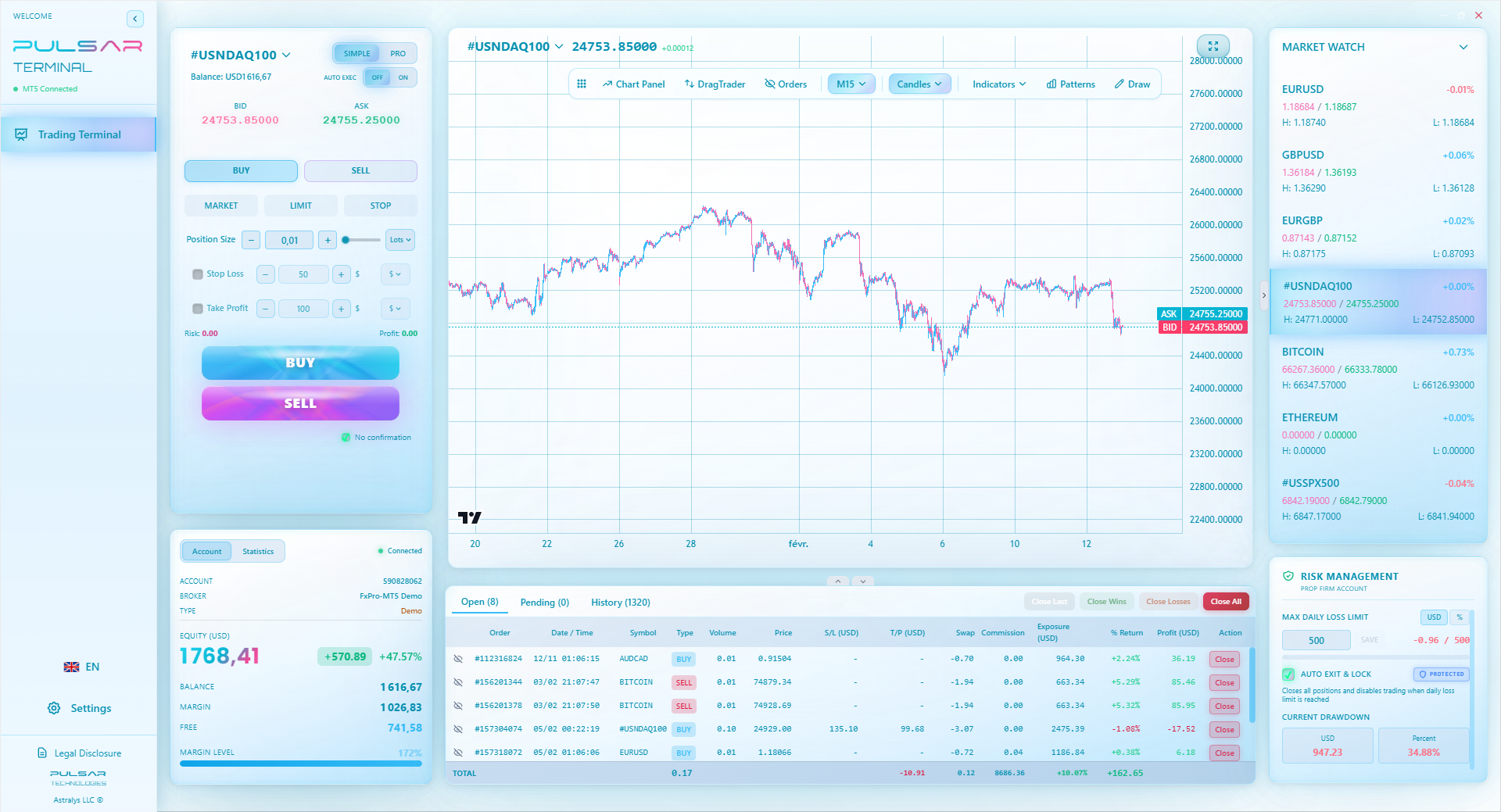
Manually calculating lot sizes for proper margin use is tedious; Pulsar Terminal's drag-and-drop order tools on MT5 let you set risk-based positions instantly, keeping your margin level safe.
Pulsar Terminal
The all-in-one MT5 companion: drag-and-drop orders, multi-TP/SL, trailing stop, grid trading, Volume Profile, and prop firm protection. Used by 1,000+ traders daily.
Theory is good, but what do you actually do? Here are my hard-earned rules.
- Know Your Broker's Specifics: Before funding, check their margin call and stop out levels. Is it 100% and 50%? Or 80% and 20%? This changes your risk dramatically. IC Markets and Pepperstone have clear specs on their sites.
- Use a Calculator, Every Time: Never guess. I have a position size calculator open in another tab for every single trade. Input your account balance, risk percentage (I risk 1% max), stop-loss in pips, and it tells you the correct lot size. This automatically ensures your margin use is sustainable.
- Monitor Margin Level Religiously: I keep my margin level above 500% when I have positions open. If it drops below 200%, I know I'm over-exposed and need to review. This buffer saved me during the CHF SNB shock in 2015.
- Beware of Weekend Gaps: Markets close Friday and reopen Sunday. Major news can cause the price to 'gap' far beyond your stop-loss. Your margin requirement stays the same, but your equity can plummet instantly, triggering a stop out at a terrible price. Either close risky positions before the weekend or ensure your margin level is extremely high (1000%+) to withstand a gap.
- Correlated Pairs Multiply Margin Risk: Opening buys on EUR/USD, GBP/USD, and AUD/USD at the same time? They often move together. You've effectively tripled your position size on the US dollar. Your used margin adds up, and a single USD surge can hit all three trades simultaneously, crushing your margin level. It feels like you're diversified, but you're not.
💡 Winston's Tip
The most profitable trade you'll ever make is the one you don't take because the margin requirement would over-use your account.
“The goal isn't to use the most margin possible. The goal is to use the least amount necessary.”
Understanding how is margin calculated in forex transformed my trading from hopeful guessing to calculated decision-making. It took losing money to respect it.
Margin and use are tools. Used correctly, they allow you to allocate capital efficiently. Used recklessly, they are a fast track to zero. For us in Nigeria, with the added complexity of currency controls and Naira volatility, this knowledge is even more critical.
Start small. Open a demo account and practice the calculations. See how opening multiple trades affects your used margin and margin level. Watch what happens when a trade goes against you. Then, when you go live, start with use no higher than 1:30. It might feel slow, but it's sustainable. This isn't a sprint to a Lamborghini; it's a marathon to build consistent wealth.
Remember, the goal isn't to use the most margin possible. The goal is to use the least amount of margin necessary to execute your trading plan effectively, while keeping the vast majority of your capital safe as Free Margin. That's how you stay in the game long enough to get good at it.
FAQ
Q1What's the difference between margin and use?
They are two sides of the same coin. use is the ratio (e.g., 1:100). Margin is the actual amount of money (the deposit) that ratio requires you to put up. If use is the loan amount, margin is your down payment.
Q2Is 1:500 use illegal for Nigerian traders?
No, it's not illegal. The CBN regulates the official forex market but doesn't set use limits for individuals trading with international brokers. These brokers are often regulated offshore (e.g., CySEC, FSCA) where such high use is permitted. The risk is on you, not illegal.
Q3My broker says 'margin call level 100%.' What does that mean?
It means when your Margin Level (Equity/Used Margin) falls to 100%, your broker will issue a warning. At this point, your Equity equals your Used Margin, meaning you have zero Free Margin left. You must either deposit more funds or close positions immediately to avoid automatic stop-outs.
Q4Can I lose more money than I have in my account?
With a standard retail trading account, generally no. Most reputable brokers have 'Negative Balance Protection,' meaning your loss is capped at your account balance. However, during extreme volatility (like a major news gap), there is a small historical risk. This is why using a stop-loss is absolutely mandatory.
Q5Why did my margin requirement change while my trade was open?
This can happen for two main reasons: 1) Currency Conversion: If you have a NGN account, the USD/NGN rate changed, altering the Naira value of your dollar-denominated margin. 2) Broker Policy: Some brokers increase margin requirements (lower use) for specific pairs over weekends or ahead of major news events to protect against gaps.
Q6What's a good margin level to maintain?
There's no perfect number, but I treat 200% as a yellow light and 500% as a comfortable green zone. A level above 1000% means you're very conservative with your position sizes. Anything hovering near 150% is a red alert; you're one bad move from a margin call.
Q7Should I choose a broker based on who offers the highest use?
Absolutely not. This is the worst criteria to use. Choose a broker based on regulation, reputation, trading costs (spread & commissions), deposit/withdrawal ease for Nigeria, and platform reliability. Then, voluntarily use low use within that broker's platform. High use is a feature you should avoid using.
Prof. Winston's Lesson
Key Takeaways:
- ✓Margin is collateral, not a fee. Remember this.
- ✓Always calculate margin in the pair's quote currency first.
- ✓Maintain a Margin Level above 200% at all times.
- ✓Cap your use at 1:50, even if offered 1:1000.
- ✓Use a position size calculator for every single trade.
How useful was this article?
Click a star to rate
Weekly Trading Insights
Free weekly analysis & strategies. No spam.
About the Author
Olumide Adeyemi
West African Trading Pioneer
One of Nigeria's most active forex trading educators. 8 years of experience trading from Lagos. Specializes in low-capital strategies and prop firm challenges for African traders.
Comments
Risk Disclaimer
Trading financial instruments carries significant risk and may not be suitable for all investors. Past performance does not guarantee future results. This content is for educational purposes only and should not be considered investment advice. Always conduct your own research before trading.
You Might Also Like

Cara Trading Forex Sukses: 7 Prinsip dari Trader Profesional
Cara trading forex sukses dengan 7 prinsip trader pro: manajemen modal, disiplin, journal trading, backtest. Data nyata, bukan janji profit palsu.
Jam Trading Forex Terbaik untuk Trader Indonesia: Panduan Lengkap dengan Tabel Waktu
Panduan jam trading forex untuk trader Indonesia. Tabel 4 sesi dunia, jam emas 20:00-00:00, sesi mana yang harus dihindari. Data akurat + tips dari trader berpengalaman.
Top 5 Sàn Forex Uy Tín Nhất 2026: Review Jujur dari Trader Indonesia
Top 5 sàn forex uy tín 2026 untuk trader Indonesia. Review jujur: spread, deposit, withdraw, dukungan lokal. Exness, XM, IC Markets & lebih.
Get Pulsar Terminal
All these calculators are built into Pulsar Terminal with real-time data from your MT5 account. One-click position sizing, automatic risk management, and instant calculations.
Get Pulsar Terminal