


If you think you can learn forex trading in three months and start buying a Benz, you're about to lose your money.

Olumide Adeyemi
West African Trading Pioneer ·  Nigeria
☕ 11 min read
What you'll learn:
- 1The Three Stages of Learning Forex (And Where Most Nigerians Fail)
- 2The Real Costs of Learning Forex in Naira (Forget the Free YouTube Dream)
- 3Your Trading Style Drives the Timeline
- 4The Nigerian Context: Brokers, use, and Getting Your Money
- 5The Mindset Shift That Actually Works (This Shortened My Journey)
- 6A Realistic 18-Month Learning Plan (Steal This)
- 7The Final Truth: When Will You See Real Money?
If you think you can learn forex trading in three months and start buying a Benz, you're about to lose your money. The biggest lie sold to Nigerian traders is the 'quick riches' timeline. I've been there, I believed it, and I paid for it. In this guide, I'll break down the real, gritty timeline based on my 12-year journey, the actual costs in Naira, and the stages you can't skip if you want to survive this market long-term.
Everyone wants to know how long it takes to learn forex trading, but they're asking the wrong question. It's not about time, it's about stages. You don't 'learn' forex once. You evolve through distinct phases, and most people get stuck between Stage 1 and 2.
Stage 1: The Enthusiastic Beginner (Months 1-6)
This is where you are right now. You're consuming everything: YouTube videos, signals on Telegram, maybe you've even paid for a 'masterclass'. You learn what a pip is, how to place a buy and sell order, and you're fascinated by use. Your main goal is finding the 'holy grail' indicator. I spent my first six months jumping from strategy to strategy, convinced the next one would be the key. I wasn't learning the market; I was collecting shortcuts.

Warning: This stage is dangerous because you might get lucky. I made ₦150,000 in two weeks on a demo account once and thought I was a genius. That false confidence is what funds brokers' offices in Victoria Island.
Stage 2: The Humbled Student (Months 6-18)
Reality hits. Your live account gets a margin call. You realize that emotions - fear, greed, hope - are your real enemy, not the charts. This stage is where you learn to lose. Sounds backwards, right? But it's true. You start to understand risk management, like why risking 1-2% per trade isn't a suggestion, it's a lifeline. You go back to a demo account, not to test get-rich-quick schemes, but to drill one single strategy for hundreds of hours. This is where 80% of aspiring traders quit. The excitement is gone, and the hard work begins.
Stage 3: The Consistent Practitioner (Year 2 and Beyond)
You stop looking for new strategies. You have a written trading plan you actually follow. Your focus shifts from 'making money' to 'executing my plan correctly'. Profits and losses become feedback, not emotional events. This is where you might achieve consistency. Notice I said 'might'. Reaching this stage takes a minimum of 18-24 months of dedicated, focused practice for most people. And 'dedicated' means 15-20 hours a week, not checking your phone occasionally.
My own journey to something resembling consistency took nearly three years. I blew up two small accounts (₦50,000 and ₦100,000) in my first year because I skipped Stage 2. I wanted to be a star, not a student.

💡 Winston's Tip
Stop counting days and start counting trades. Your goal isn't to survive 30 days; it's to execute 100 flawless trades according to your plan, regardless of outcome. That's how you measure progress.
“The biggest lie sold to Nigerian traders is the 'quick riches' timeline.”
Let's talk money. How much does it actually cost to learn forex trading in Nigeria? The online gurus make it seem free, but your time and lost capital are a cost.
The 'Free' Route (The Long, Hard Way) Yes, you can use free resources like BabyPips or broker education. I did this at first. But filtering good info from bad takes forever. You'll waste months, maybe a year, piecing it together yourself. That's a huge opportunity cost. If you value your time at even ₦5,000 an hour, those 'free' 500 hours of research just cost you ₦2.5 million in lost time.
Paid Education & Mentorship This is where it gets real. In Nigeria, you'll see courses from ₦50,000 to over ₦1,000,000. My advice? Be extremely careful.
- ₦50,000 - ₦200,000 Range: Often group classes or online video courses. Some are decent for basics, but many just repackage free information. I paid ₦120,000 for one early on. Got a nice PDF and access to a WhatsApp group full of people asking the same beginner questions. Not worth it.
- ₦300,000+ Range: These promise 'personal mentorship' or 'proprietary strategies'. This is a minefield. I know a guy who paid ₦975,000 to a 'guru' who just taught him a basic scalping strategy you can find online. The real cost was the trust he lost.
The Hidden Cost: Your Trading Capital This is the biggest expense nobody talks about. You will lose money while learning. It's tuition. A realistic budget? Don't risk money you need for bills. Start with capital you are 100% willing to lose. For me, that was ₦75,000 in my third year, after my demo practice. I still lost 40% of it in the first three months live. That ₦30,000 loss was my most valuable education.

Pro Tip: Before spending a kobo on a course, ask for a verifiable track record of the mentor's live trading, not just screenshot profits. If they can't or won't show it, walk away. Invest that money in a better broker like IC Markets or Pepperstone where your execution will be cleaner.
“You start to understand risk management, like why risking 1-2% per trade isn't a suggestion, it's a lifeline.”
How long it takes to learn forex trading depends massively on what kind of trader you want to be. A scalper and a swing trader need different skillsets, and one is much harder to master.
| Trading Style | Time to Basic Competence | Time to Consistency | Why the Difference? |
|---|---|---|---|
| Swing Trading | 9-12 months | 18-30 months | Fewer decisions, more time to analyze. Focus is on patience and broader market structure. Less emotional whipsaw. |
| Day Trading | 12-18 months | 24-36+ months | Fast decisions, needs intense screen time and emotional control. Spreads and commissions eat more into profits. |
| Scalping | 18-24 months | 36+ months | Extremely fast, high pressure. Requires flawless execution, understanding of spreads and order flow. Highest attrition rate. |
I started as a scalper because I wanted action. Big mistake. The speed was overwhelming, and my platform's execution couldn't keep up. I switched to day trading EUR/USD, focusing on London session openings. That shaved months off my learning curve because the pace was manageable. My first consistently profitable six-month period came from swing trading XAU/USD (gold), holding trades for days or weeks. The slower pace let me think.
The lesson? Don't choose the hardest style first. Start with higher timeframes. You'll learn market principles faster with less noise.
“You start to understand risk management, like why risking 1-2% per trade isn't a suggestion, it's a lifeline.”
Our environment adds unique layers to the learning process. You're not just learning charts; you're navigating local realities.
Broker Choice is Critical Many international brokers like Exness, XM, and IC Markets accept Nigerians. But you must check:
- Deposit/Withdrawal: How easy is it to fund with your Nigerian card or bank transfer? How long do withdrawals take? I once waited 11 business days for a payout from a shady broker. Stick with reputable ones.
- NGN Accounts: Some, like HFM, offer Naira-denominated accounts. This removes currency risk on your deposit, but ensure their conversion rates are fair.
The use Trap Brokers here offer crazy use - 1:1000, even 'unlimited'. This is a test, not a gift. As a learner, high use is a poison chalice. It magnifies your mistakes. I used 1:500 on my first live trade. A 10-pip move against me wiped out 25% of my account. The panic was unreal. I now never use more than 1:30, even on my main account. Learning with high use teaches you nothing except how to lose fast.
Market Hours for Nigeria The sweet spot is 1:00 PM to 6:00 PM WAT. This is when London is active and New York comes online. Liquidity is high, spreads are tight. Trying to trade the Asian session (late night for us) as a beginner is frustrating - slow moves, wide spreads. Align your learning schedule with these active hours.
Warning: If a broker is not regulated by a top-tier authority (like UK's FCA, Australia's ASIC, Cyprus's CySEC) and only has a 'local license' from a dubious island, your funds are at much higher risk. Regulation doesn't guarantee safety, but it's a basic filter.
💡 Winston's Tip
The cost of a bad broker is invisible but huge. Slippage and requotes on entries and exits can turn a winning strategy into a loser. Your first 'profit' should be finding a broker with proven, reliable execution.
“Learning isn't just when you're winning. Your deepest lessons come from losses.”
The technical stuff - indicators, patterns - is maybe 30% of the battle. The other 70% is your head. Changing my mindset cut years off my struggle.
From Profit-Focused to Process-Focused Early on, I'd check my P&L every 5 minutes. If I was up, I was happy. Down, I was stressed. My mood was tied to a number. I had to force a change. I made a checklist for every trade: Did I follow my entry rules? Is my stop-loss set? Is my risk 1%? I only judged my day on whether I ticked all boxes, not the profit. This detachment was a game-saver.
Embracing the Journal You must keep a trading journal. Not just 'bought EUR/USD, made money'. I mean a detailed log: screenshot of the chart, reason for entry, emotional state ('felt FOMO after missing earlier move'), outcome, and post-trade analysis. I reviewed mine every Sunday for two years. That's where I saw my repeating mistake: chasing losses after a bad trade. The journal made it undeniable.
Redefining 'Learning' Learning isn't just when you're winning. Your deepest lessons come from losses. That margin call I got in 2018 taught me more about position sizing than any winning streak. I had over-leveraged a gold trade. After that, I built my own position size calculator in a spreadsheet and never entered a trade without it again. The loss was painful, but the lesson was permanent.
This mental shift is what separates those who last from those who vanish. It's boring. It's not glamorous. But it's the only thing that works.
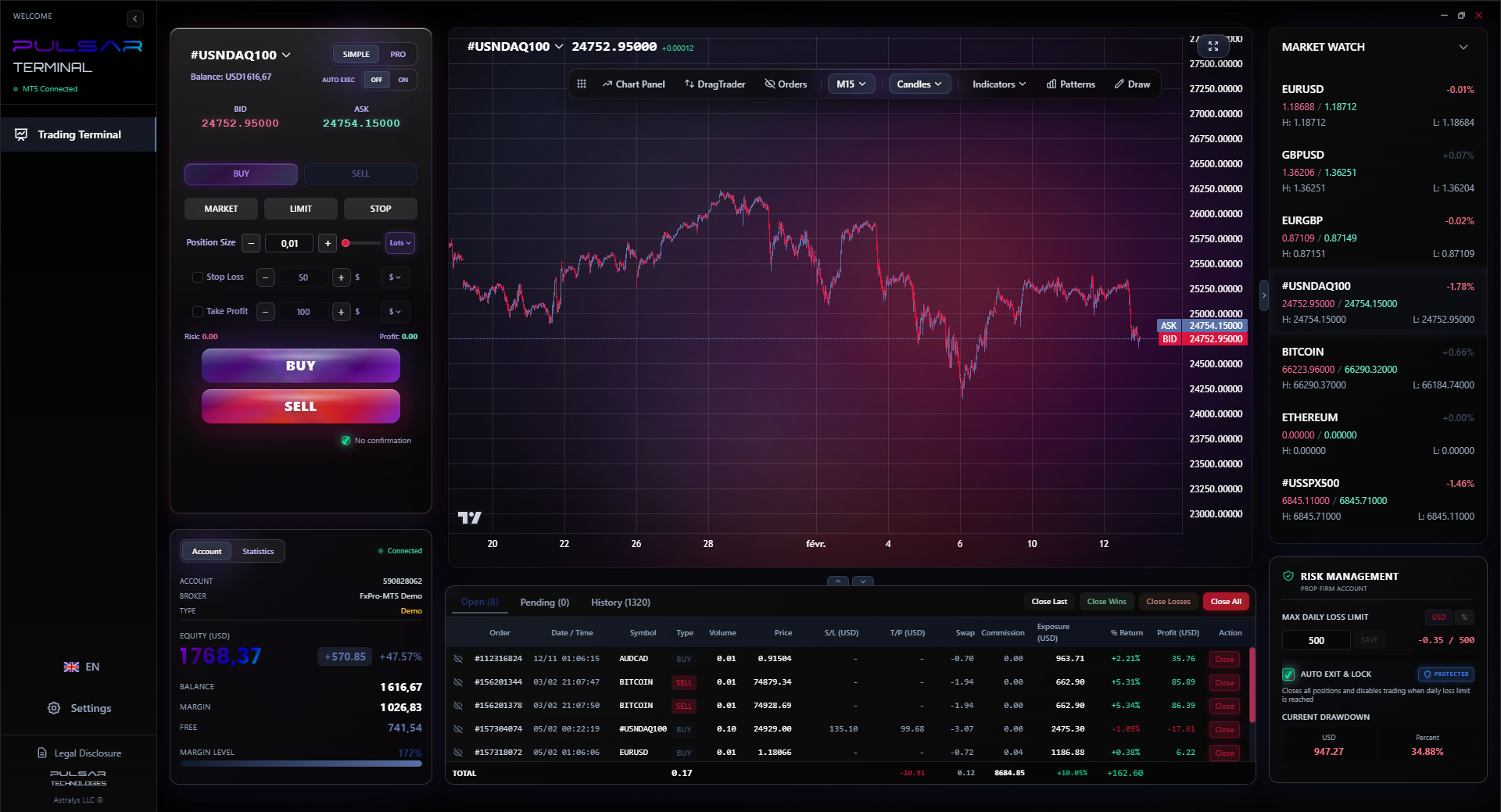
A detailed trading journal is non-negotiable for tracking your progress, and Pulsar Terminal integrates journaling and trade analytics directly into your MT5 workspace.
Pulsar Terminal
The all-in-one MT5 companion: drag-and-drop orders, multi-TP/SL, trailing stop, grid trading, Volume Profile, and prop firm protection. Used by 1,000+ traders daily.
“Learning isn't just when you're winning. Your deepest lessons come from losses.”
Here’s a condensed version of what I wish I’d done from day one. This plan assumes you can commit 10-15 hours per week.
Months 1-3: Foundation & Demo Immersion
- Goal: Understand mechanics, not make money.
- Action: Open a demo account. Learn every function of MT4/MT5. Paper trade with fake money but real seriousness. Master calculating pips, lot sizes, and understanding the spread. Read one solid book on trading psychology. Ignore all signal groups.
Months 4-9: Strategy Development & Backtesting
- Goal: Find and test one simple strategy.
- Action: Pick one major pair (EUR/USD is perfect). Learn one or two indicators deeply, like the RSI or MACD. Don't combine five of them. Define clear, written rules for entries, exits, and stops. Backtest this strategy on 6 months of historical data, trade by trade. Record every result in your journal.
Months 10-15: Live Trading with Micro Lots
- Goal: Execute your plan under real market pressure with tiny risk.
- Action: Fund a live account with the minimum amount - maybe $50 (₦~75,000). Trade the smallest possible lot size (0.01 lots). Your goal is to execute 100 trades following your plan perfectly. The profit/loss is irrelevant. The goal is to hit 100 trades without deviating due to fear or greed. This is the core practice.
Months 16-18: Review, Refine, and Scale
- Goal: Analyze your 100-trade sample and scale up cautiously.
- Action: Analyze your journal. What was your win rate? Your average win vs. average loss? Is your strategy profitable? If yes, you can slightly increase position size. If no, go back to the demo to adjust the strategy. Do not skip this review.
This plan forces discipline. It took me 36 months to stumble through this process. With focus, 18 months is aggressive but possible.
💡 Winston's Tip
Your learning timeline is directly inverse to the number of indicators on your chart. One clean chart with price action teaches you more in a month than five clashing indicators will in a year. Simplify to accelerate.
“Your first year goal should be survival. Your second year goal should be small, consistent growth.”
So, after all that, how long does it take to learn forex trading well enough to make consistent, meaningful money?
Let's be brutally honest. 'Consistent' doesn't mean monthly Lamborghini money. It means your equity curve slowly trends upward over quarters, not weeks. For a dedicated Nigerian trader with a good process, a realistic timeline to reach this point is 2 to 3 years.
I made my first sustainable withdrawal - profit I didn't immediately lose back - in my fourth year. It was $1,200 (about ₦1.8m at the time). It felt monumental not because of the amount, but because I knew exactly how I made it. The process was repeatable.
Your first year goal should be survival. Your second year goal should be small, consistent growth (e.g., 3-5% per month on a small account). Your third year goal is scaling that process. Anyone promising you faster results is selling you a dream, and your capital is the price.
The market will be here tomorrow. The question isn't how fast you can learn, but how long you can stay in the game. Slow down. Learn properly. Your future self with a healthier bank account will thank you for the patience you show today.
Pro Tip: The single best investment you can make isn't in a course or a signal. It's in a strong trading journal tool and a reliable internet connection. Your ability to review and learn from your own actions is what determines your timeline.
FAQ
Q1Can I really learn forex trading in 3 months?
You can learn the basic mechanics in 3 months - like how to place a trade or what a pip is. But learning enough to be consistently profitable? Absolutely not. That timeline is a marketing fantasy that sets you up for major losses. True competency takes years, not months.
Q2What's the fastest way to learn forex trading in Nigeria?
The fastest reliable way is to combine structured education (a reputable course focusing on basics and psychology) with immediate, disciplined demo trading. Then, move to a live account trading only 0.01 lots. There are no shortcuts. Avoiding the high-use, signal-chasing culture common here will actually speed up your real learning.
Q3How much money do I need to start learning forex in Nigeria?
To learn? You need $0. Use a demo account for at least 3-6 months. To start live trading with real, riskable capital? You can start with as little as ₦30,000-₦75,000 with a broker that allows micro lots. This money should be capital you are fully prepared to lose. It's tuition, not investment capital.
Q4Why do most Nigerian forex traders fail?
They fail for the same reasons traders fail everywhere, amplified by local factors: starting with unrealistic get-rich-quick expectations, using dangerously high use, following 'gurus' without verification, poor risk management, and a lack of patience. They try to run before they can crawl.
Q5Is forex trading a good side hustle for Nigerians?
It can be, but not in the way people think. It's not a quick cash side hustle. It's a skilled profession that requires part-time study and practice for years before it might generate side income. Treat it like learning law or coding, not like driving Uber. The initial time investment is massive.
Q6What percentage of forex traders become profitable?
Globally, the often-cited statistic is that around 10-20% of retail traders are profitable long-term. In Nigeria, I suspect the number is even lower due to the prevalence of poor practices and misinformation. This isn't to discourage you, but to highlight that success requires being in the top percentile of discipline and effort.
Q7Should I quit my job to trade forex?
No. Not until you have at least 2-3 years of documented, consistent profitability from a live account that has survived different market conditions (trending, ranging, volatile). Your trading profits should also exceed your job salary for at least 12 consecutive months. Quitting your job to learn is a surefire path to financial and emotional disaster.
Prof. Winston's Lesson
Key Takeaways:
- ✓Consistency takes 2-3 years minimum, not 3 months.
- ✓Risk management skill matters more than entry strategy.
- ✓Trade process, not profits, especially while learning.
- ✓High use is a learning barrier, not a tool.
How useful was this article?
Click a star to rate
Weekly Trading Insights
Free weekly analysis & strategies. No spam.
About the Author
Olumide Adeyemi
West African Trading Pioneer
One of Nigeria's most active forex trading educators. 8 years of experience trading from Lagos. Specializes in low-capital strategies and prop firm challenges for African traders.
Comments
Risk Disclaimer
Trading financial instruments carries significant risk and may not be suitable for all investors. Past performance does not guarantee future results. This content is for educational purposes only and should not be considered investment advice. Always conduct your own research before trading.
You Might Also Like

Cara Trading Forex Sukses: 7 Prinsip dari Trader Profesional
Cara trading forex sukses dengan 7 prinsip trader pro: manajemen modal, disiplin, journal trading, backtest. Data nyata, bukan janji profit palsu.
Jam Trading Forex Terbaik untuk Trader Indonesia: Panduan Lengkap dengan Tabel Waktu
Panduan jam trading forex untuk trader Indonesia. Tabel 4 sesi dunia, jam emas 20:00-00:00, sesi mana yang harus dihindari. Data akurat + tips dari trader berpengalaman.
Top 5 Sàn Forex Uy Tín Nhất 2026: Review Jujur dari Trader Indonesia
Top 5 sàn forex uy tín 2026 untuk trader Indonesia. Review jujur: spread, deposit, withdraw, dukungan lokal. Exness, XM, IC Markets & lebih.
Get Pulsar Terminal
All these calculators are built into Pulsar Terminal with real-time data from your MT5 account. One-click position sizing, automatic risk management, and instant calculations.
Get Pulsar Terminal