


I watched my screen turn red.
James Mitchell
Senior Trading Analyst
☕ 10 min read
What you'll learn:
- 1What Revenge Trading Really Is (It's Not Just Being Stubborn)
- 2The US Regulatory Cushion (And Why It Doesn't Stop You)
- 3Your Revenge Trading Emergency Protocol (Do This NOW)
- 4Position Sizing: The Ultimate Revenge Killer
- 5Managing Forum Toxicity (Forex Factory, etc.)
- 6Building a System That Removes Emotion
- 7The Long Game: Reframing Losses
I watched my screen turn red. A short EUR/USD trade I’d taken based on a clean breakout had just reversed, hitting my stop loss for a $450 loss. My heart started pounding, my face got hot. I felt the market had 'taken' from me. Within 90 seconds, I’d doubled my position size and entered a new trade in the opposite direction, convinced I could outsmart the move. I didn’t even check the economic calendar. Twenty minutes later, I was down another $1,100. That’s revenge trading. It’s not a strategy, it’s a psychological trap that blows up more accounts than any bad indicator. Here’s how to spot it and stop it for good.
Most traders think revenge trading is just getting emotional after a loss. It's deeper than that. It's a neurological hijack. When you take a loss, your brain's reward center (which expected a win) gets a dose of pain instead of dopamine. Your amygdala - the threat detection center - kicks in, treating the loss as a physical threat. Logic gets sidelined. Your goal shifts from 'making a good trade' to 'restoring emotional equilibrium.' You stop seeing price action and start seeing an opponent that needs to be punished.
This is why you'll see traders on forums like Forex Factory posting things like, "The market owes me" or "I'm going to get my money back right now." They're not analyzing; they're seeking emotional relief. The trade is no longer about probability, it's about vengeance. I've been there. After that $1,100 double-loss fiasco, I broke my keyboard. The financial hurt was bad, but the feeling of being out of control was worse.

Warning: Revenge trading often disguises itself as 'conviction.' You'll tell yourself you have a 'strong feeling' or that you 'see something others don't.' That's usually the amygdala talking, not your trading plan.

💡 Winston's Tip
The market doesn't know you exist. It can't take anything from you, and it owes you nothing. Trading against it personally is like getting angry at the rain.
“Revenge trading is a neurological hijack. Your goal shifts from 'making a good trade' to 'restoring emotional equilibrium.'”
Trading in the US comes with a built-in safety net that many traders globally don't have. The CFTC and NFA enforce rules specifically designed to limit catastrophic, emotion-driven blow-ups.
| Rule | What It Is | How It Should Help Curb Revenge |
|---|---|---|
| 50:1 use Cap | Max use for majors like EUR/USD. | Makes it harder to wipe an account in one wild, emotional trade. A $10,000 account can't control $500,000 worth of currency on a whim. |
| FIFO Rule | First-In, First-Out. You must close your oldest position first in a currency pair. | Prevents you from throwing hedges on top of a losing trade in a panic, which can create a complex, emotional mess. |
| $20M Broker Capital | Minimum net capital for a Retail Foreign Exchange Dealer (RFED). | Means your broker is less likely to fail if the market gets chaotic. Your emotional spiral won't be compounded by a broker insolvency. |
Here's the brutal truth, though: these rules protect you from the market and from bad brokers, but they do nothing to protect you from yourself. The 50:1 use limit feels restrictive to some, but I've seen traders revenge-trade their way to a 50% account loss with it. The FIFO rule just changes the method of your revenge - you can't hedge, so you might just double your position size instead. The structure is there, but the psychology is all on you. For a deeper look at how brokers operate under these rules, our Exness review covers an international perspective, while FOREX.com is a major US player.

Pro Tip: Use the US use limits as a psychological anchor. If you find yourself thinking, "If only I had 200:1, I could get back faster," that's a giant red flag. You're not seeking an edge, you're seeking a faster way to self-destruct.
“US use limits protect you from the market, but they do nothing to protect you from yourself.”
You need a physical, non-negotiable routine for the moment after a loss. Thinking won't work - your thinking brain is offline. You need a script.
Step 1: The Hard Stop
When a trade hits your stop loss, your next action is NOT to look for a new entry. It's this: Stand up. Physically push your chair back from your desk. This breaks the physical trance of staring at the charts. I literally have a post-it on my monitor that says "STAND UP."
Step 2: The 15-Minute Mandatory Break
Walk away for 15 minutes. No charts, no Forex Factory threads, no trading YouTube. Go make a coffee, walk around the block, do some push-ups. This allows the amygdala hijack to subside. The chemical surge in your body takes about 10-15 minutes to dissipate. Trying to 'think clearly' before that is like trying to solve a math problem while being yelled at.
Step 3: The Post-Loss Journal Entry
Before you even consider the market again, open your trading journal. Write down three things only:
- The objective reason the trade hit its stop (e.g., "Price rejected the daily resistance I identified").
- The emotional feeling you had when it happened (e.g., "Angry, betrayed, stupid").
- The first revenge thought that popped into your head (e.g., "I should just flip long, it's obviously reversing").
This process objectifies the event. It moves it from an emotional wound to a data point. Only after this ritual can you even glance at the charts to assess if a new, planned setup exists. Most of the time, you'll find the urge to trade is gone. This is how you build the muscle memory of discipline. A good swing trading plan incorporates this kind of emotional spacing between trades.
“US use limits protect you from the market, but they do nothing to protect you from yourself.”
This is the most powerful, mechanical defense you have. Revenge trading's fuel is oversized positions. If your standard risk is 0.5% of your account per trade, a loss stings but doesn't cripple. If you're risking 3%, a loss feels like a crisis, and your brain goes into crisis mode.
Let me give you a real number from my own stupidity. Early on, I had a $15,000 account. My plan said to risk 1% ($150). I took a loss on a GBP/USD trade. The revenge urge hit. I thought, "I'm a good trader, I just need to get back to even." I entered a new trade risking 5% ($750). I lost. In two trades, I was down $900. To get back to breakeven from that point, I'd need to make 6% - requiring a string of successful 1% trades. The hole was dug by emotion, not the market.
Your position size must be so small that a string of losses doesn't trigger an emotional survival response. For most retail traders, that's between 0.5% and 1.5% risk per trade. Use a position size calculator religiously. If you ever override it to input a larger size after a loss, that's the literal definition of revenge trading. It's not a trade, it's a therapy session you're paying for with your capital.

Example:
- Account: $10,000
- Planned Risk: 1% = $100 per trade
- Revenge Risk: 5% = $500 per trade
- After 3 Revenge Losses: Account at $8,500. To recover, you now need a 17.6% return just to get back to $10,000. With your planned 1% risk, that's a mountain of disciplined trades. You turned a bad day into a catastrophic month.
💡 Winston's Tip
Your first loss is usually your cheapest. The trades you take trying to recover it are the expensive ones.
“Your position size must be so small that a string of losses doesn't trigger an emotional survival response.”
Online trading communities are a double-edged sword. They can be great for idea sharing, but they are absolute fuel for revenge trading. Here's why: after a loss, you're vulnerable. You go to a thread on Forex Factory about the pair you just traded. You're looking for confirmation that you were "right" and the market was "wrong."
You'll find it. Someone will post a chart with a fancy indicator showing the reversal was "predictable." Someone else will boast about taking the opposite trade for a big win. This feels like salt in the wound. Now your emotional drive isn't just to recover money, it's to prove you're as smart as that random poster. You're no longer trading the market, you're trading your ego against an internet stranger.
My rule is simple: No forum browsing during trading hours. Period. If I'm analyzing, I use my own charts and my own plan. I might browse for fundamental insights or news interpretation in the evening, but never in the heat of the session. The chatter is noise. The moment you see a post that makes you feel FOMO (fear of missing out) or anger after a loss, you've left the realm of analysis. This is a key part of learning [how to avoid revenge trading forex factory] environments can inadvertently encourage.
Also, beware of the "blown account" confession threads. While sometimes framed as cautionary tales, they can normalize failure and create a subconscious expectation that blowing up is just part of the process. It's not. It's a failure of process, not a rite of passage.
“Your position size must be so small that a string of losses doesn't trigger an emotional survival response.”
The final defense is to systematize everything so there's no room for an emotional decision to enter. This means pre-defining every possible scenario.
Your Trading Plan Must Include:
- Daily Loss Limit: A hard stop for the day. Mine is 3% of my account. Hit it, and the platform is closed. No "one more trade." This is your circuit breaker.
- Maximum Consecutive Losses: For my scalping strategy, if I take two losses in a row, I'm done for that session. It prevents the "just one win" desperation spiral.
- Pre-Marked Charts: All key support/resistance, planned entry zones, and stop levels are drawn before the New York session opens. During the session, I only execute, I don't analyze.
- Automated Where Possible: Use trade management tools that execute parts of your plan automatically. If your strategy uses a trailing stop, having a tool that manages it mechanically removes the temptation to move it too early out of fear.
I use a checklist, printed out, next to my desk. Before every single trade, my finger goes down the list. If I can't check every box, I don't take the trade. This ritual overrides emotion. The goal is to make trading boring. Excitement is the enemy. When you feel a thrill, that's often risk you haven't accounted for. For analyzing trends systematically, tools like the MACD indicator can be part of a rules-based entry filter.
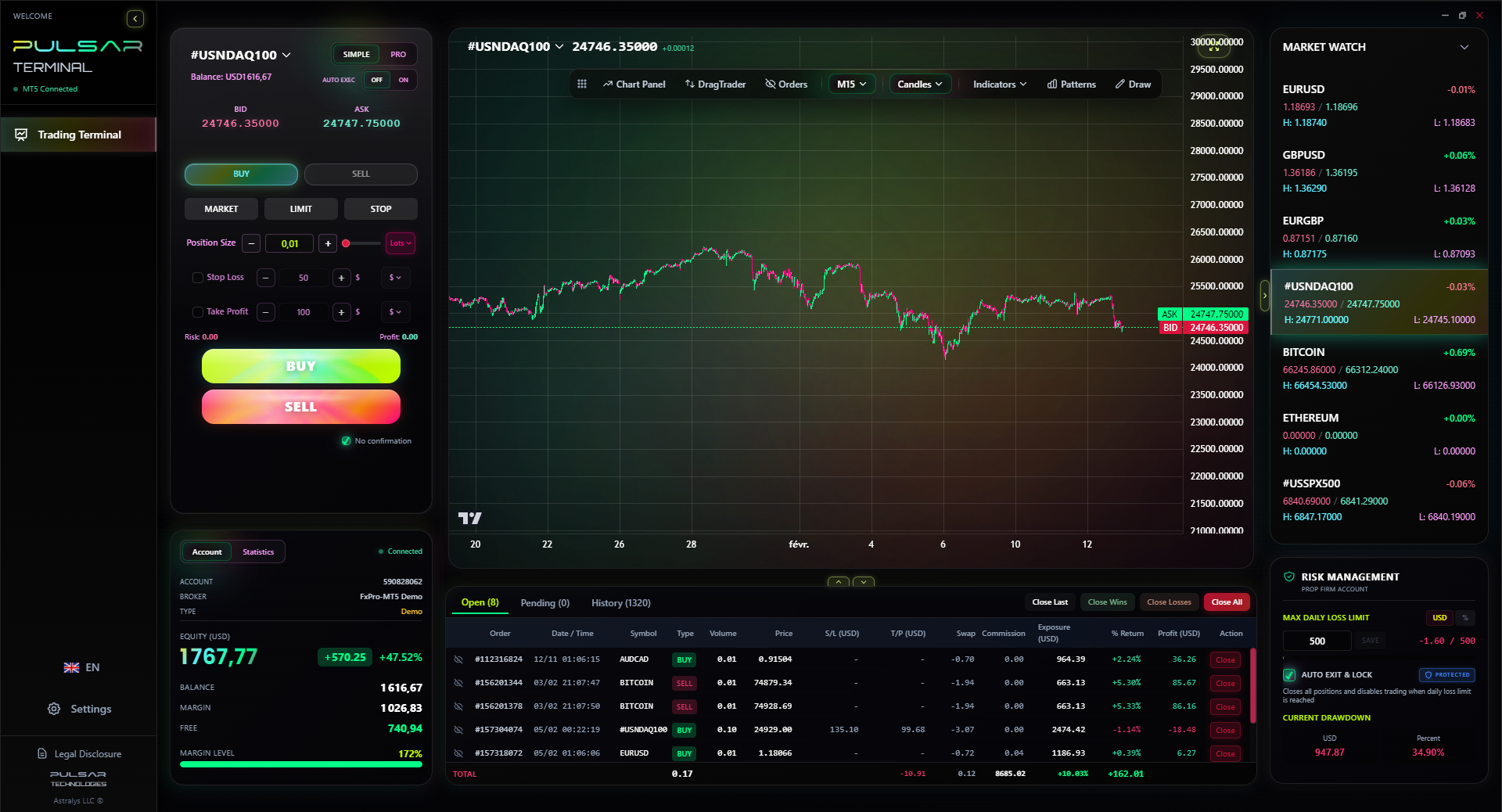
Sticking to a daily loss limit is critical to avoid revenge spirals, and Pulsar Terminal can automate this by capping your session loss directly within MT5.
Pulsar Terminal
The all-in-one MT5 companion: drag-and-drop orders, multi-TP/SL, trailing stop, grid trading, Volume Profile, and prop firm protection. Used by 1,000+ traders daily.
“The loss is the fee you pay the market for the opportunity to be in the game.”
The core of the revenge trading problem is a fundamental misunderstanding of what a loss is. Amateurs see a loss as a failure. Professionals see a loss as a fee.
You pay fees for a service. The loss is the fee you pay the market for the opportunity to be in the game. It's the cost of finding the winning trades. If you have a strategy with a 40% win rate and a 2:1 reward-to-risk, you expect to lose 6 out of every 10 trades. Each of those losses is not a mistake; it's a necessary step in the statistical process.
When you internalize this, the emotional charge around a single loss disappears. Your job is not to be right on every trade. Your job is to execute your plan over a series of 100 trades. One loss is meaningless data. Revenge trading is an attempt to make that single data point meaningful, which destroys the entire statistical model.
I keep a screenshot of my worst losing streak framed. It was 7 losses in a row. It felt awful at the time. But because my position sizing was fixed at 1%, my account only drew down 7%. The next 10 trades had 6 winners. The account made new highs. The losing streak was just noise. Accepting that is the final, and most important, step in learning [how to avoid revenge trading forex factory] discussions often miss. It's not about controlling the market, it's about controlling your reaction to its random outcomes. Even the best setups fail sometimes, which is why understanding tools like RSI indicator divergences is about probability, not certainty.
FAQ
Q1What's the fastest way to stop a revenge trading spiral in the moment?
Physically walk away. Close the platform, get out of your chair, and leave the room for at least 15 minutes. Do not try to 'fix it' or 'get one back.' The physiological arousal needs time to subside before you can think logically again.
Q2Does the US FIFO rule help prevent revenge trading?
Indirectly, but not really. It prevents one specific revenge behavior - hedging a losing trade in panic - but it doesn't address the root emotion. Traders simply find other ways to revenge trade, like increasing position size or jumping into a different, correlated pair without thought. The rule manages a behavior, not the psychology behind it.
Q3I use a prop firm challenge account. Does revenge trading matter more?
Absolutely. Prop firm challenges have strict daily and overall loss limits. One revenge trading session can blow your daily limit, forcing you to stop trading, or worse, blow the entire challenge. The pressure to pass can actually increase the likelihood of revenge trading after a loss. You need iron-clad rules. A tool that automatically enforces your daily max loss can be a lifesaver here.
Q4How do I know if I'm revenge trading or just being confident in my analysis?
Ask yourself: Did I plan this trade before my last loss? Is my position size exactly what my calculator says? Am I entering because I see a fresh, high-probability setup, or because I need to 'fix' my P&L? If the trade idea was born in the minutes after a loss, it's almost always revenge.
Q5Are some trading styles more prone to revenge trading?
Yes. Scalping and high-frequency day trading are major risk factors. The faster the pace, the less time for emotional recovery between trades. Losses come quickly and frequently, which can stack emotional pressure. Swing trading, with its slower pace, naturally builds in more cooling-off time between decisions.
Q6Can a trading journal really help stop revenge trading?
It's the best tool you have, but only if you use it proactively. Don't just log entries and exits. You must log your emotional state and the thoughts you had. Over time, you'll see patterns. You'll see that every time you felt 'angry' or 'rushed,' your next trade was a loser. That objective data is harder to ignore in the heat of the moment.
Prof. Winston's Lesson
Key Takeaways:
- ✓A 3% daily loss limit is your emotional circuit breaker.
- ✓Risk 1% or less per trade to stay logical.
- ✓Walk away for 15 minutes after any loss.
- ✓Log your emotion with every trade entry.
- ✓The market is not your opponent.
How useful was this article?
Click a star to rate
Weekly Trading Insights
Free weekly analysis & strategies. No spam.
About the Author
James Mitchell
Senior Trading Analyst
Based in New York with over 9 years of trading experience. Focuses on major USD pairs, prop firm challenges, and the US regulatory landscape.
Comments
Risk Disclaimer
Trading financial instruments carries significant risk and may not be suitable for all investors. Past performance does not guarantee future results. This content is for educational purposes only and should not be considered investment advice. Always conduct your own research before trading.
You Might Also Like

Cara Trading Forex Sukses: 7 Prinsip dari Trader Profesional
Cara trading forex sukses dengan 7 prinsip trader pro: manajemen modal, disiplin, journal trading, backtest. Data nyata, bukan janji profit palsu.
Jam Trading Forex Terbaik untuk Trader Indonesia: Panduan Lengkap dengan Tabel Waktu
Panduan jam trading forex untuk trader Indonesia. Tabel 4 sesi dunia, jam emas 20:00-00:00, sesi mana yang harus dihindari. Data akurat + tips dari trader berpengalaman.
Top 5 Sàn Forex Uy Tín Nhất 2026: Review Jujur dari Trader Indonesia
Top 5 sàn forex uy tín 2026 untuk trader Indonesia. Review jujur: spread, deposit, withdraw, dukungan lokal. Exness, XM, IC Markets & lebih.
Get Pulsar Terminal
All these calculators are built into Pulsar Terminal with real-time data from your MT5 account. One-click position sizing, automatic risk management, and instant calculations.
Get Pulsar Terminal