


I watched my screen in Lagos, sweat beading on my forehead, as my USD/NGN trade went against me.

Olumide Adeyemi
West African Trading Pioneer ·  Nigeria
☕ 10 min read
What you'll learn:
- 1What Free Margin Actually Is (And Isn't)
- 2The Formula: Breaking It Down Step-by-Step
- 3A Real Nigerian Trading Scenario with Numbers
- 4How use Twists the Knife & The Margin Call
- 5Practical Management for Nigerian Traders
- 6Mistakes I See Every Time (And Made Myself)
- 7Brokers & Tools: What to Look For in Nigeria
I watched my screen in Lagos, sweat beading on my forehead, as my USD/NGN trade went against me. My account balance was ₦500,000, but the platform showed a margin level of 85%. I didn't understand why I couldn't open another position on EUR/USD. The 'Free Margin' figure was blinking red at ₦-42,150. I'd confused equity with balance, and my used margin had eaten up my buffer. That trade ended in a stop-out, costing me ₦187,000. It happened because I never truly learned how to calculate free margin in forex. Let's make sure you don't make that same expensive mistake.
Think of your trading account like your bank account on a tight budget. Your Account Balance is the total cash you deposited. But once you open trades, you lock up some of that cash as a security deposit with your broker. That locked-up cash is your Used Margin.
Free Margin isn't some bonus cash. It's simply what's left over and available to use. It's your Equity (your real-time account value including running profits/losses) minus the Used Margin you've already committed.

Warning: Most new traders in Nigeria look only at their balance. They see ₦200,000 and think they can open another trade worth that much. They forget about the margin already tied up in their open USD/NGN or GBP/USD positions. That's how you get a nasty surprise.
Here’s the brutal truth: if your Free Margin hits zero, you're done. You cannot open any new trades. If your losses keep eating into it and your Margin Level drops too low (often 50%), your broker will start closing your positions automatically to protect themselves. This is the dreaded stop-out. I learned this the hard way with that USD/NGN trade. My equity kept falling, but my used margin stayed the same, squeezing my free margin until it was gone.
Getting this right is the foundation of survival, especially with the volatility we see in pairs involving the Naira. It's more important than any fancy indicator.
Let's strip the mystery out of it. You only need three numbers, and your trading platform gives you two of them.
The Core Formula: Free Margin = Equity – Used Margin
It looks simple, but each part has its own calculation. You need to understand them to know how to calculate free margin in forex correctly.
Equity: Your Real-Time Net Worth
Your Equity is your current account value if you closed all trades right now. Equity = Account Balance + Floating Profit – Floating Loss
If you have a trade in profit, your equity is higher than your balance. If you're in a loss, it's lower. This is the number that matters, not the static balance.
Used Margin: Your Locked-Up Cash
This is the collateral your broker holds. For a single trade, it's roughly: (Trade Size in Units / use) × Current Price
But honestly, you don't need to calculate this manually every time. Your platform's 'Trade' or 'Order' window shows the estimated margin requirement before you click buy or sell. Pay attention to it! For managing multiple positions, always use a position size calculator to keep this under control.

Example: Let's say you're trading with IC Markets.
- Your Account Balance is $1,000 (or roughly ₦1,500,000).
- You buy 0.5 lots of GBP/USD. Your Used Margin for this is $200.
- The trade goes against you by $50. Your Floating Loss is -$50.
- Equity = $1,000 + (-$50) = $950
- Free Margin = $950 (Equity) - $200 (Used Margin) = $750
That $750 is all you have left to open new trades or absorb further losses on your current one. If GBP/USD drops further, your equity falls, and your free margin shrinks even faster.

💡 Winston's Tip
Your Free Margin is your oxygen tank. If you see it dropping fast, you're in dangerous waters. Don't add more trades; start closing some.
“If your Free Margin hits zero, you're done.”
Let's use a real scenario I see all the time. A trader in Abuja wants to trade Gold (XAU/USD) and EUR/USD simultaneously. This is where mistakes compound.
Trader Tunde's Setup:
- Broker: XM
- Account Balance: ₦800,000
- use: 1:100
Trade 1: He buys 0.3 lots of XAU/USD at $2,350. The margin required shows as roughly $705.
- Used Margin after Trade 1: $705
- Equity is still ₦800,000 (no profit/loss yet).
- Free Margin = ₦800,000 - $705 (converted) ≈ ₦792,000
He feels he has plenty left. So he opens Trade 2: Selling 0.5 lots of EUR/USD at 1.0850. The margin required is about $542.50.
Now, his Total Used Margin = $705 + $542.50 = $1,247.50 (approx ₦1,871,250 at $1/₦1500).
His platform now shows:
- Equity: ₦800,000 (trades are flat)
- Used Margin: ₦1,871,250
- Free Margin: ₦800,000 - ₦1,871,250 = ₦-1,071,250
Tunde's account is already in a negative free margin state before any price movement! He can't open this second trade because he doesn't have enough capital for the required margin. The platform should reject it. If it didn't (due to some miscalculation), he'd be in instant deficit.
This is the critical check. Before any new trade, look at your Free Margin. If the new trade's margin requirement is more than your Free Margin, you cannot take the trade. It's not a suggestion; it's arithmetic. For a volatile instrument like Gold, understanding this is key, which is why I always recommend studying a dedicated XAU/USD guide.
use is a double-edged sword, especially for us in Nigeria where the temptation to over-use is high due to smaller starting capitals. High use (like 1:500 offered by some brokers like Exness) reduces your Used Margin per trade, which feels like it increases your Free Margin.
But here's the trap: it also magnifies your floating losses. Your Equity can plummet much faster, wiping out your Free Margin in minutes.
The Domino Effect:
- High use lets you open a bigger position.
- A small move against you creates a large floating loss.
- This loss crashes your Equity.
- Since Free Margin = Equity - Used Margin, your Free Margin evaporates.
- Margin Level (Equity / Used Margin x 100%) plummets.
When your Margin Level hits your broker's threshold (often 100%), you get a Margin Call. This is a warning to deposit more funds or close positions. If you ignore it and the level falls further (to a Stop-Out level, often 50%), the broker starts forcibly closing your positions, starting with the biggest loser.

Pro Tip: Don't wait for the margin call. Set your own, stricter rule. I treat a Margin Level of 150% as my personal 'red alert.' At that point, I'm looking to close or hedge positions, not open new ones. This self-imposed rule saved me during the last major USD spike.
Understanding your broker's specific rules is non-negotiable. Check their policy on margin call and stop-out levels before you deposit a single Naira.
💡 Winston's Tip
Nigerian traders love high use. Remember, it doesn't increase your Free Margin's safety, it just makes the explosion bigger when it goes wrong.
“High use reduces your Used Margin per trade, which feels like it increases your Free Margin. But here's the trap: it also magnifies your floating losses.”
Theory is fine, but how do you manage this daily? Here’s what works in our market.
1. The Pre-Trade Checklist:
- Calculate Required Margin First: Use the broker's calculator. For that planned 0.2 lot EUR/USD trade, is it $400? Good.
- Check Current Free Margin: Is your Free Margin at least 3 times that amount? If the required margin is $400, you should have at least $1,200 in Free Margin. This buffer is for existing trades moving against you.
- If not, don't take the trade. Scale down your lot size.
2. Monitor Like a Hawk: Your Free Margin isn't static. It updates with every tick. When you're in a trade, watch it as closely as the price. If your Free Margin is draining rapidly, your position is too big or moving too far against you.
3. Use Tools to Automate Safety: This is where good trading software pays for itself. A platform that lets you set automatic trailing stops or breakeven orders can protect your equity (and thus your Free Margin) without you staring at the screen. For example, if you're scalping, these tools are essential to lock in tiny profits before they vanish.
4. The Naira & Tax Reality: Remember, your profits are subject to 10% Capital Gains Tax with FIRS. When you calculate your equity and potential profits, factor this in. A ₦1,000,000 profit isn't ₦1,000,000 in usable Free Margin for reinvestment - it's ₦900,000 after tax. Plan your margin usage accordingly.
Finally, your strategy dictates your margin needs. A swing trading position held for days will require margin to be locked up longer, reducing your free margin for other opportunities. Plan your portfolio accordingly.
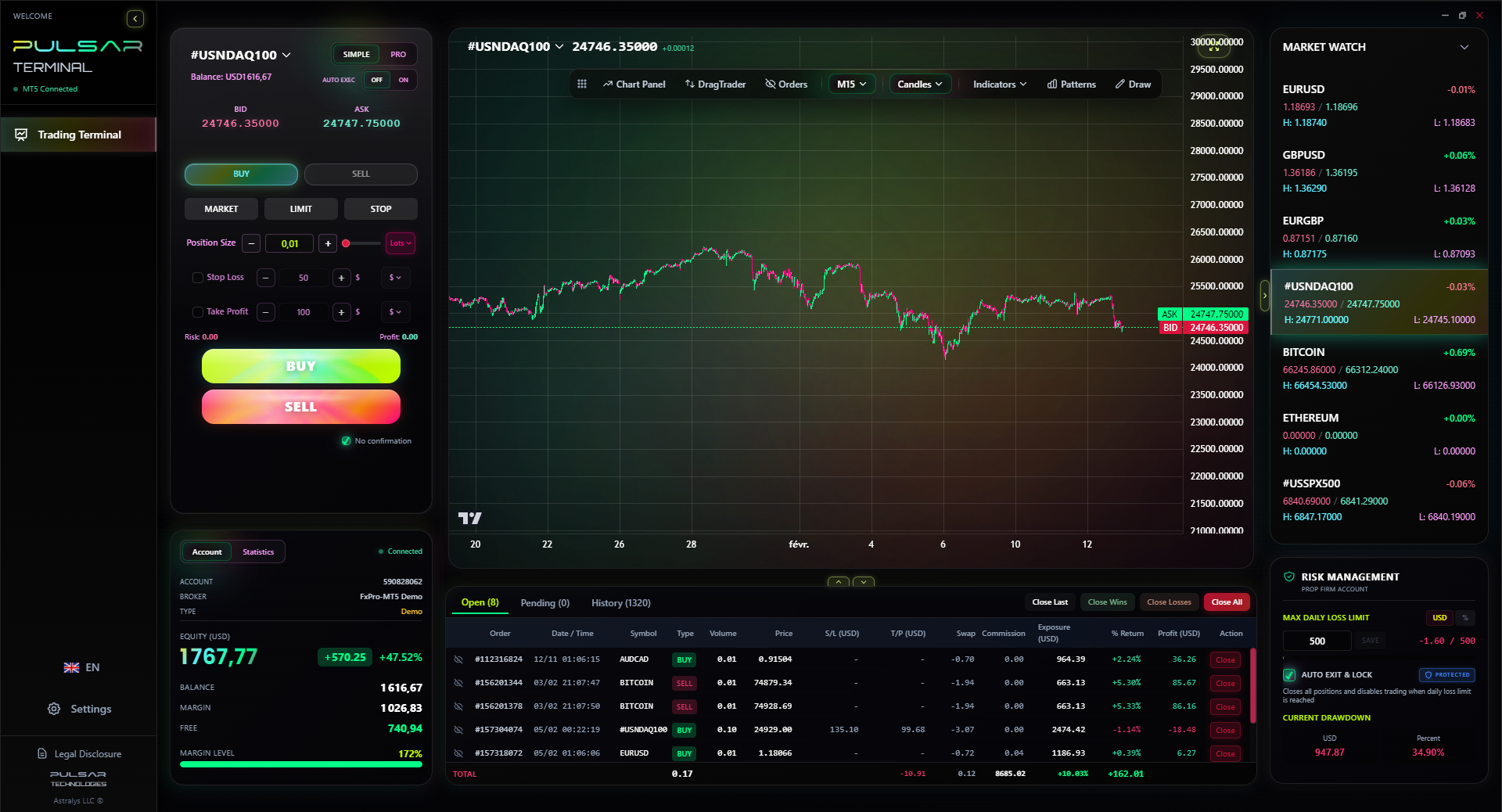
Manually watching your margin level is stressful; Pulsar Terminal can automate stop-loss and breakeven orders on MT5 to protect your equity before a margin call ever becomes a threat.
Pulsar Terminal
The all-in-one MT5 companion: drag-and-drop orders, multi-TP/SL, trailing stop, grid trading, Volume Profile, and prop firm protection. Used by 1,000+ traders daily.
Let me be blunt about where you'll likely mess up.
Mistake 1: Trading Without a Buffer. You have ₦500,000 Free Margin. You see a 'sure' opportunity on USD/JPY that requires ₦480,000 margin. You take it. Now your Free Margin is ₦20,000. Any tiny adverse move in any of your open positions pushes your Equity down, wiping out that ₦20,000 and triggering a margin call. You've left yourself no room for error. I did this in 2019. The trade was actually right, but a sudden spike in the spread on another position caused a momentary loss that triggered a stop-out on the 'sure' trade.
Mistake 2: Ignoring Cross-Margin Effects. You trade GBP/USD and EUR/USD. They often move similarly. If you're long on both and the dollar strengthens, both positions lose money simultaneously. Your Equity drops from two sources, demolishing your Free Margin twice as fast. Diversify your risks, not just your currency pairs.
Mistake 3: Not Accounting for Swaps/Overnight Fees. Your Free Margin is also used to pay or receive swap charges. Holding a position over Wednesday night can incur triple swap. I once had a trade where the swap fee was larger than my expected profit for the day. It slowly eroded my Free Margin over a week, limiting my ability to trade other setups.
Mistake 4: Chasing Losses by Adding to a Losing Position. This is the killer. Your EUR/USD trade is down, eating your Free Margin. To 'average down,' you add another lot. This DOUBLES your Used Margin on this losing trade. If the price continues down, your Equity collapse accelerates exponentially. This single mistake has ended more trading accounts in Nigeria than any other. If a trade is wrong, get out. Don't throw more margin at the problem.
💡 Winston's Tip
Before you blame the broker for a stop-out, check your trades. 99% of the time, the math doesn't lie. You over-committed your margin.
“This single mistake has ended more trading accounts in Nigeria than any other.”
Given the SEC's new rules under the ISA 2025, you need to be extra careful about who you trade with. The platform's interface can make or break your margin management.
Broker Considerations:
- Clear Margin Display: The best brokers like Pepperstone or IC Markets show Equity, Used Margin, Free Margin, and Margin Level prominently, often in bold. If you have to dig for these numbers, find another broker.
- Local Payment Methods: Funding your account affects your balance, the starting point for all margin math. Use brokers with reliable P2P or local bank transfer options to avoid funding delays or losses.
- Regulation: While you might use an international broker, ensure they are reputable. Their risk management systems (which execute margin calls) need to be strong.
Essential Platform Features:
- Real-Time Margin Calculator: Built into the order ticket.
- Detailed Account Summary: A single view of all your key figures.
- Risk Management Tools: The ability to set stop-loss and take-profit orders directly is basic. Advanced tools like trailing stops that move automatically are crucial for protecting equity.
For example, using the MACD indicator or RSI indicator might give you a signal, but without the platform tools to execute and protect the trade based on that signal, you're risking your margin unnecessarily. Your technical analysis and your margin management must work together through the tools your platform provides.
FAQ
Q1What is the difference between free margin and margin level?
Free Margin is an amount (like ₦150,000), the cash available to open new trades. Margin Level is a percentage (like 250%), a health indicator for your account. It's calculated as (Equity / Used Margin) x 100%. A high Margin Level means you have a large buffer; a low one (near 100%) means you're close to a margin call, even if your Free Margin number still looks positive.
Q2Can my free margin ever be negative?
Yes, and it's a serious warning sign. It means your current losses (floating loss) have eaten into the margin you originally posted for your trades. Your Equity has fallen below your Used Margin. Most platforms will not allow this to happen for long; they will start closing positions (a stop-out) immediately to bring your Equity back above your Used Margin.
Q3How does use affect my free margin calculation?
use directly determines your Used Margin. Higher use (e.g., 1:500 vs 1:100) means you need less Used Margin to open the same size trade. This initially leaves you with more Free Margin. However, the trade's risk (potential profit/loss) remains the same. So, a small price move will impact your Equity just as much, causing your Free Margin to fluctuate just as wildly. use changes the starting point of the calculation, not the volatility of the result.
Q4Is free margin the same as usable balance?
, yes. In most trading platforms, 'Free Margin', 'Usable Margin', and 'Available to Trade' mean the same thing: the portion of your Equity that is not currently being used as collateral for open positions. It's the money you can actually deploy right now.
Q5What happens if I get a margin call in Nigeria?
You'll get a notification (email, SMS, pop-up) from your broker stating your Margin Level has fallen below their requirement (e.g., 100%). You have two choices: 1) Deposit more funds immediately to increase your Equity, or 2) Close some losing positions to reduce your Used Margin. If you do nothing, the broker will automatically close positions (a stop-out) once your Margin Level hits an even lower threshold (e.g., 50%). You are still liable for any losses incurred.
Q6Do swap/rollover fees affect free margin?
Absolutely. Swap fees are deducted from (or added to) your account balance daily if you hold a position overnight. This changes your Balance, which in turn affects your Equity, which is a direct component of the Free Margin calculation. A consistently negative swap can slowly drain your Free Margin over time.
Prof. Winston's Lesson
Key Takeaways:
- ✓Free Margin = Equity - Used Margin. Memorize it.
- ✓Always maintain a Free Margin buffer of 3x your next trade's requirement.
- ✓Monitor Margin Level, not just Free Margin. 150% is your personal red alert.
- ✓A 10% Capital Gains Tax applies to profits, reducing your usable margin.
How useful was this article?
Click a star to rate
Weekly Trading Insights
Free weekly analysis & strategies. No spam.
About the Author
Olumide Adeyemi
West African Trading Pioneer
One of Nigeria's most active forex trading educators. 8 years of experience trading from Lagos. Specializes in low-capital strategies and prop firm challenges for African traders.
Comments
Risk Disclaimer
Trading financial instruments carries significant risk and may not be suitable for all investors. Past performance does not guarantee future results. This content is for educational purposes only and should not be considered investment advice. Always conduct your own research before trading.
You Might Also Like

Cara Trading Forex Sukses: 7 Prinsip dari Trader Profesional
Cara trading forex sukses dengan 7 prinsip trader pro: manajemen modal, disiplin, journal trading, backtest. Data nyata, bukan janji profit palsu.
Jam Trading Forex Terbaik untuk Trader Indonesia: Panduan Lengkap dengan Tabel Waktu
Panduan jam trading forex untuk trader Indonesia. Tabel 4 sesi dunia, jam emas 20:00-00:00, sesi mana yang harus dihindari. Data akurat + tips dari trader berpengalaman.
Top 5 Sàn Forex Uy Tín Nhất 2026: Review Jujur dari Trader Indonesia
Top 5 sàn forex uy tín 2026 untuk trader Indonesia. Review jujur: spread, deposit, withdraw, dukungan lokal. Exness, XM, IC Markets & lebih.
Get Pulsar Terminal
All these calculators are built into Pulsar Terminal with real-time data from your MT5 account. One-click position sizing, automatic risk management, and instant calculations.
Get Pulsar Terminal