


Most South African traders blow their accounts not because their strategy is wrong, but because they have no clue how to calculate margin level in forex.

David van der Merwe
Emerging Markets Trader ·  South Africa
☕ 9 min read
What you'll learn:
Most South African traders blow their accounts not because their strategy is wrong, but because they have no clue how to calculate margin level in forex. They treat use like free money from a loan shark, not the dangerous tool it is. I've watched too many 'students' get stopped out because they thought margin was just a suggestion. This isn't theory; it's the math that keeps you in the game. I'll show you the exact calculations, how the FSCA's rules change them, and the brutal mistakes you're probably making right now.
Let's get this straight from the start. When you deposit R10,000 with a broker and they offer you 30:1 use, you haven't magically gotten R300,000 to play with. That use is a credit line, and the margin is your collateral. The broker locks it up to ensure you can cover potential losses. Think of it like a rental deposit on a flat in Sandton – you don't get to spend it, but you need it to secure the deal.
In South Africa, thanks to FSCA rules, retail traders are capped at 30:1 on major pairs. That's a good thing, even if it feels restrictive. I remember chasing 100:1 with an offshore broker years ago. One bad trade on USD/ZAR and I was margin called before I could even check my phone. The use felt powerful until it wasn't. The required margin is the specific rand amount your broker sets aside per trade. Free margin is what's left in your account to open new positions or absorb losses. Get these confused, and you're trading on borrowed time.

Warning: A common mistake is looking at your 'balance' and thinking that's what you can trade with. Your balance is history. Your equity (balance + floating P/L) is your current net worth, and your free margin is your actual buying power. Ignoring this difference is the fastest route to a margin call.
This is the core of it. How to calculate margin level in forex isn't a mystery. It's a simple ratio that tells you how much breathing room you have.
Margin Level = (Equity / Used Margin) × 100
You express it as a percentage. Let's break down what this really means with a South African example.
You start with R20,000 in your account (Equity). You open a position on EUR/USD, and the broker locks up R6,000 as your Used Margin (also called Required Margin).
Margin Level = (20,000 / 6,000) × 100 = 333%
That's healthy. You have plenty of buffer. Now, say that trade goes against you. Your floating loss is R10,000. Your Equity is now R20,000 - R10,000 = R10,000. Your Used Margin is still R6,000 (it doesn't change with P/L).
New Margin Level = (10,000 / 6,000) × 100 = 167%
You're still okay, but the room is shrinking. This number is your single most important metric while you have open trades. Watching your P/L is emotional; watching your margin level is strategic.
Why This Percentage Matters More Than Your P/L
Brokers don't close your trades because you're losing money. They close them because your margin level hits their stop-out threshold. For most FSCA-regulated brokers, that's around 20-50%. If your margin level falls to, say, 30%, the system will automatically start closing your losing positions, biggest loser first, until your level recovers above that threshold. You don't get a choice. It's an automated safety mechanism that feels like a disaster when it hits you.
I learned this the hard way on a swing trading setup. I was down on a GBP/USD trade, but my analysis said it would reverse. I was right, but I never got to see it. My margin level dipped to 28% overnight, and the platform closed the trade at the worst possible price. The reversal happened hours later. My analysis was solid, but my margin management was pathetic.

💡 Winston's Tip
Your margin level is your account's pulse. If you can't quote it right now with your trades open, you're driving blindfolded.
“Brokers don't close your trades because you're losing money. They close them because your margin level hits their stop-out threshold.”
Let's make this concrete with ZAR and a local broker example. You're using an FSCA-regulated broker like XM or IC Markets. You want to buy 1 standard lot (100,000 units) of USD/ZAR. The current rate is R18.50 per $1. Your account use is the max 30:1 for retail.
Step 1: Find the Position Value in ZAR. Position Value = Trade Size × Current Price = 100,000 × 18.50 = R1,850,000
That's the notional value you're controlling.
Step 2: Calculate the Required Margin. Required Margin = Position Value / use = R1,850,000 / 30 = R61,666.67
That R61,666.67 is instantly locked in your account. You cannot use it for anything else.
Step 3: Determine Your Starting Margin Level. Let's say your account equity before this trade was R100,000. You open the trade. Used Margin is now R61,666.67. Starting Margin Level = (100,000 / 61,666.67) × 100 = 162%

Example: That's a tight starting position. A move of just over 3% against you (about 55 cents on USD/ZAR) could wipe out R55,000 of your equity, dropping it to R45,000. Your margin level would then be (45,000 / 61,666.67) × 100 = 73%. You're now dangerously close to a margin call. This is why using a position size calculator isn't optional; it's essential.
Now, what if you had the same R100,000 but only traded 0.5 lots? Required Margin = (50,000 × 18.50) / 30 = R30,833.33 Starting Margin Level = (100,000 / 30,833.33) × 100 = 324%
Massive difference. You can weather a much bigger storm. This is the power of proper position sizing, which is just applied margin management.
The FSCA isn't just some government body putting up red tape. Their rules directly dictate the numbers in your calculations. Ignoring them is like ignoring the weather before a braai.
The 30:1 use Cap: This is the big one for retail traders. It means the denominator in your Required Margin formula can never be larger than 30 for majors like EUR/USD or GBP/USD. It forces you to put up more of your own cash per trade. Before this, brokers offered 100:1, 200:1, even 500:1. It was reckless. The cap protects you from yourself, even if it feels limiting. For volatile pairs or CFDs on things like XAU/USD (gold), the use cap is even lower, like 20:1 or 10:1. Your margin requirement per trade is therefore higher.
Segregated Accounts: This rule doesn't change your calculation, but it changes your safety. Your margin (your money) must be held in a separate bank account from the broker's money. If the broker goes under, your funds are theoretically safer. Always verify your broker's FSP number on the FSCA website. If they're not regulated, your 'margin' might as well be a donation.
The Reality of Offshore Brokers: You'll see ads for brokers offering 1000:1 use. Here's the truth: if you use that use, you are almost guaranteed to blow up. The math becomes unforgiving. A 0.1% move against you wipes out your entire margin. These brokers are counting on you to lose. They're not in the business of you winning with their 'generous' use.
💡 Winston's Tip
The FSCA's 30:1 cap isn't a cage, it's a guardrail on a mountain pass. Be thankful it's there.
“Using maximum use is like driving your car in first gear everywhere – you'll redline the engine and break down.”
After mentoring traders for over a decade, the errors are painfully predictable. Let's fix them.
Mistake 1: Maxing Out use on Every Trade. Just because you can use 30:1 doesn't mean you should. Using maximum use is like driving your car in first gear everywhere – you'll redline the engine and break down. I used to do this, trying to turn R5,000 into R50,000 in a month. I turned it into R500 more times than I care to admit. Treat the maximum as a legal limit, not a target. Start with effective use of 5:1 or 10:1 on your total account.
Mistake 2: Ignoring Margin Level During Drawdowns. Traders stare at their floating loss, praying for a reversal. Be a pro. Stare at your margin level. Have a plan: "If my margin level hits 150%, I will close half my position to free up margin, no questions asked." This is where a tool that manages risk automatically saves you from yourself.
Mistake 3: Not Accounting for Spreads and Swaps. When you calculate if you have enough margin, remember that the spread is a cost you incur immediately. On a volatile pair, a widening spread can use up more margin than you planned. Overnight financing charges (swaps) also slowly eat into your equity, gradually lowering your margin level over time if you hold positions for weeks.
Mistake 4: Adding to a Losing Position Without Checking Margin. This is the account killer. You average down on a losing USD/ZAR trade, doubling your position. You've also doubled your required margin. If the trend continues against you, your margin level will plummet twice as fast. Only add to positions when it's part of a pre-planned strategy and your margin level is strong enough to handle it.

Pro Tip: Your pre-trade checklist must include a margin check. Calculate your worst-case scenario loss (your stop-loss distance) and ask: "If this hit, what would my new margin level be?" If it's below 100%, your position is too big. Full stop.
Theory is useless without action. Here’s how to bake margin management into your daily trading as a South African.
1. Pre-Funding: Choose a broker that offers ZAR accounts to avoid currency conversion fees on your deposits and withdrawals. Fund your account with money you can afford to lose. This is your starting equity.
2. Pre-Trade: Before any trade, use a calculator. Input your account size (equity), your stop-loss in pips, and the pair you're trading. The calculator will tell you the maximum lot size you can trade to risk, say, 2% of your account. This calculated lot size will automatically keep you within safe margin limits. Never, ever guess.
3. During the Trade: Don't just watch the chart. Have your MT4/MT5 'Terminal' window open, showing your Equity, Margin, and Margin Level. Make this your second screen. If you're a scalping with multiple quick trades, this is critical. Your margin level can swing wildly.
4. When Things Go Wrong: Have predefined rules. Mine are simple:
- If Margin Level < 100%: I am in danger. I must close at least one position immediately.
- If Margin Level < 50%: The platform will stop me out soon. I close all non-core positions to avoid the worst prices.
5. Withdrawals: When you're profitable, withdraw your profits regularly. This physically removes excess capital from the leveraged environment. It forces you to rebuild your margin buffer from a smaller base, inherently promoting safer trading.
Managing this manually under pressure is tough. This is where technology becomes a force multiplier. Having a system that can monitor your overall account margin and automatically execute partial closes to protect your level is the difference between surviving a drawdown and getting a margin call email.
💡 Winston's Tip
If your trade idea is so good that you have to use maximum use to make it worthwhile, the idea isn't good enough. Walk away.
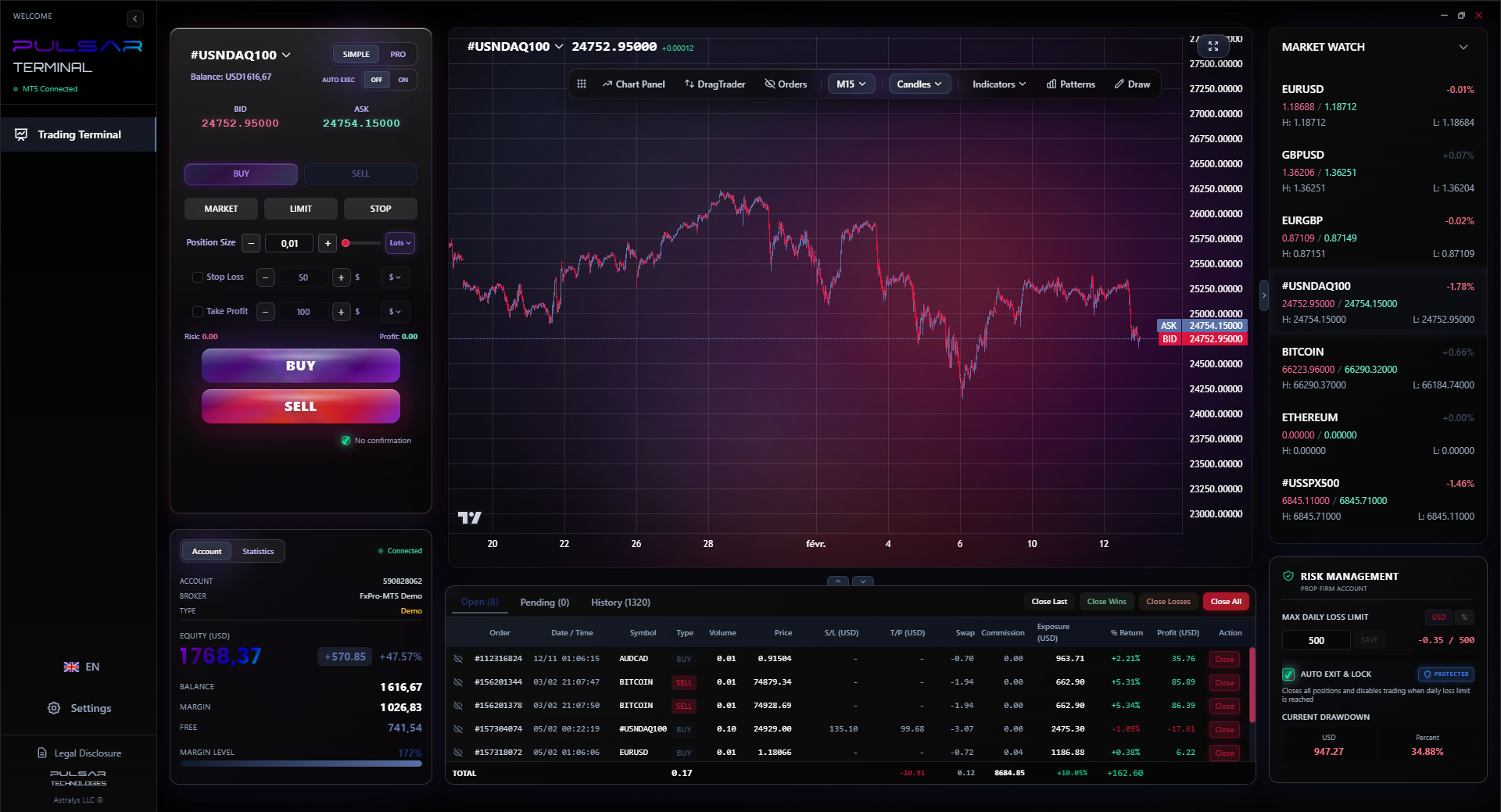
Manually monitoring your margin level during volatile sessions is stressful; Pulsar Terminal can track it and automate partial position closures to protect your account from a margin call.
Pulsar Terminal
The all-in-one MT5 companion: drag-and-drop orders, multi-TP/SL, trailing stop, grid trading, Volume Profile, and prop firm protection. Used by 1,000+ traders daily.
FAQ
Q1What is a good margin level to maintain?
Aim to keep it above 200% at all times when you have open positions. This gives you a substantial buffer against normal market volatility. Below 100%, you are at immediate risk of a margin call. I never let mine dip below 150% without taking action.
Q2How is margin different from use?
use is the multiplier (like 30:1) offered by your broker. Margin is the actual amount of your money (in Rands) that gets locked up as collateral when you use that use. use is the potential; margin is the real cost.
Q3Can I get my margin back?
Yes, but only when you close the trade. The required margin is 'freed up' and returns to your free margin balance. If the trade was profitable, your equity increases by the profit. If it was a loss, your equity decreases.
Q4What happens during a margin call in South Africa?
You'll typically get a warning (an email or pop-up) when your margin level falls to 100%. This is the 'call' to add more funds. If you don't, and the level continues to fall to the broker's 'Stop Out Level' (often 20-50%), they will automatically close your positions, starting with the biggest loser, until your level recovers.
Q5Do all brokers in South Africa have the same margin rules?
No. All FSCA-regulated brokers must adhere to the 30:1 retail use cap. However, their specific stop-out levels (the % where they auto-close trades) can vary, as can their margin requirements on exotic pairs or CFDs. Always read your broker's specific schedule of charges.
Q6How does a ZAR account affect my margin?
It simplifies everything. Your deposit, equity, margin, and P/L are all in Rands. If you use a USD account, your margin requirement is calculated in USD, and your ZAR deposit is converted at the current rate. This adds an extra layer of currency risk to your trading capital.
Prof. Winston's Lesson
Key Takeaways:
- ✓Margin Level = (Equity / Used Margin) x 100. Memorize it.
- ✓Keep your margin level above 200% to sleep at night.
- ✓The FSCA's 30:1 use cap is your friend, not your enemy.
- ✓Always calculate position size before trading; never guess.
How useful was this article?
Click a star to rate
Weekly Trading Insights
Free weekly analysis & strategies. No spam.
About the Author
David van der Merwe
Emerging Markets Trader
Johannesburg-based trader with 11 years in emerging market currencies. Specializes in ZAR pairs, FSCA-regulated trading, and South African market analysis.
Comments
Risk Disclaimer
Trading financial instruments carries significant risk and may not be suitable for all investors. Past performance does not guarantee future results. This content is for educational purposes only and should not be considered investment advice. Always conduct your own research before trading.
You Might Also Like

Cara Trading Forex Sukses: 7 Prinsip dari Trader Profesional
Cara trading forex sukses dengan 7 prinsip trader pro: manajemen modal, disiplin, journal trading, backtest. Data nyata, bukan janji profit palsu.
Jam Trading Forex Terbaik untuk Trader Indonesia: Panduan Lengkap dengan Tabel Waktu
Panduan jam trading forex untuk trader Indonesia. Tabel 4 sesi dunia, jam emas 20:00-00:00, sesi mana yang harus dihindari. Data akurat + tips dari trader berpengalaman.
Top 5 Sàn Forex Uy Tín Nhất 2026: Review Jujur dari Trader Indonesia
Top 5 sàn forex uy tín 2026 untuk trader Indonesia. Review jujur: spread, deposit, withdraw, dukungan lokal. Exness, XM, IC Markets & lebih.
Get Pulsar Terminal
All these calculators are built into Pulsar Terminal with real-time data from your MT5 account. One-click position sizing, automatic risk management, and instant calculations.
Get Pulsar Terminal