


I remember staring at my screen in 2018, watching GBP/JPY.

Olumide Adeyemi
West African Trading Pioneer ·  Nigeria
☕ 10 min read
What you'll learn:
- 1What Is a Pip, Anyway? (It's Not What You Think)
- 2The Basic Pip Value Formula (Stop Using Guesswork)
- 3Why This Math Matters for Nigerian Traders (The Naira Reality)
- 4Practical Steps: Calculating Your Trade Before You Click
- 5Brokers, Platforms, and Automation
- 6Common Pitfalls (And How I've Fallen Into Every One)
- 7Putting It All Together: From Pips to Portfolio
I remember staring at my screen in 2018, watching GBP/JPY. I'd just entered a 2-lot position, convinced it was a sure thing. The market moved 50 pips against me. My stomach dropped, but I told myself, 'It's just 50 pips, it'll come back.' Then I did the math. At that time, with my broker's use, that 50-pip move on GBP/JPY was a loss of over ₦120,000. I hadn't bothered to calculate the pip value before hitting 'buy.' That was the day I learned that in forex, pips aren't just points on a chart. They're the direct line to your bank account, and if you don't know what each one costs, you're trading blind.
Let's get this straight from the start. A pip is the smallest price move a currency pair can make. For most pairs like EUR/USD or GBP/USD, that's 0.0001. If EUR/USD moves from 1.0850 to 1.0851, that's one pip. Simple.
But here's where new traders in Nigeria get tripped up. For pairs with the Japanese Yen (JPY), like USD/JPY or GBP/JPY, the rule changes. A pip is 0.01. So a move from 151.50 to 151.51 is one pip. Forget this distinction, and your risk calculations will be off by a factor of 100. I've seen it happen.
Then there are 'pipettes' or fractional pips. Some brokers quote to the 5th decimal place. That 5th digit is one-tenth of a pip. So a move from 1.08500 to 1.08501 is 0.1 pips. It's for finer measurement, but the core pip value calculation still uses the standard 0.0001 (or 0.01 for JPY).

Warning: Never assume a pip is always 0.0001. Always check if the quote currency is JPY. This is the first checkpoint in learning how to calculate pip value in forex correctly.

💡 Winston's Tip
A pip is just a measurement. The value of that measurement in your local currency is what determines if you eat steak or indomie at the end of the month. Never confuse the two.
The formula isn't complicated, but you have to apply it correctly based on your trade. Let's break it down into the three main scenarios you'll face.
Scenario 1: USD is the Quote Currency (The Easy One)
This is for pairs like EUR/USD, GBP/USD, AUD/USD. The quote currency (the second one) is USD.
Formula: Pip Value = (0.0001 / 1) × Trade Size Since 1 USD = 1 USD, the exchange rate part is just 1. It simplifies to: Pip Value = 0.0001 × Trade Size
Example: You're trading 1 standard lot of EUR/USD. A standard lot is 100,000 units. Pip Value = 0.0001 × 100,000 = $10 So, each pip movement is worth $10. If you're trading a mini lot (10,000 units), it's $1 per pip. A micro lot (1,000 units) is $0.10 per pip.
Scenario 2: JPY is the Quote Currency
This is for pairs like USD/JPY, EUR/JPY, GBP/JPY.
Formula: Pip Value = (0.01 / Current Exchange Rate) × Trade Size
Example: You buy 1 standard lot (100,000 units) of USD/JPY at 151.00. Pip Value = (0.01 / 151.00) × 100,000 Pip Value = (0.000066225) × 100,000 ≈ $6.62 Notice it's not $10. This is the trap.
Scenario 3: The Cross Currency (Where Most Get Lost)
This is for pairs where the quote currency is NOT USD or JPY, like EUR/GBP or AUD/CAD. You need an extra step: the quote currency's rate against the USD.
Formula: Pip Value = (0.0001 / Quote Currency to USD Rate) × Trade Size
Example: You sell 1 standard lot of EUR/GBP at 0.8550. The quote currency is GBP. First, find GBP/USD. Let's say GBP/USD is trading at 1.2650. Pip Value = (0.0001 / 1.2650) × 100,000 Pip Value = (0.00007905) × 100,000 ≈ $7.91 per pip.

Example: Let's make it local. If you're trading a 0.5 lot (50,000 units) of GBP/JPY at 190.50, and GBP/USD is 1.2600, the calculation is: (0.01 / 190.50) x 50,000 = ~$2.62 per pip. In Naira at ₦1,450/$, that's about ₦3,799 per pip move. A 20-pip stop-loss now has a real cost: ₦75,980. That's why you calculate first.
Yes, you can use a position size calculator, but understanding the math behind it stops you from blindly trusting a tool. I use calculators for speed, but I can do the math manually to verify. You should too.
“In forex, pips aren't just points on a chart. They're the direct line to your bank account.”
You're not trading in a vacuum. You're trading with Naira, through a system with unique costs and regulations. Ignoring this context is why many talented Nigerian traders never see consistent profits.
First, the 10% Capital Gains Tax. Let's say you make a 50-pip profit on a 1-lot EUR/USD trade. That's $500 (50 pips x $10). At ₦1,450/$, that's ₦725,000. Your tax liability is ₦72,500. If you didn't know your pip value was $10, you wouldn't accurately forecast your net profit. I learned this the hard way after a big win on XAU/USD – the tax man cometh, and he wants his share calculated correctly.
Second, funding costs. If you're funding via a domiciliary account or a platform like Grey, you have exchange rate spreads to consider. That ₦1,450/$ rate isn't what you'll get. It might be ₦1,470/$ when buying and ₦1,430/$ when selling. This effectively widens your trading costs before you even place a trade.
Third, and most critically, position sizing. Nigerian traders often use high use offered by brokers like Exness or IC Markets to start with small capital. I get it. But high use with incorrect pip value calculation is a bomb. If you think you're risking ₦5,000 but your pip value math is wrong, you might actually be risking ₦25,000. That's a one-way ticket to a margin call.
Here’s a real mistake I made early on with a scalping strategy: I was scalping USD/JPY, thinking my risk was $2 per trade based on old EUR/USD habits. I was actually risking over $6 per trade. I wiped out a week's profits in one bad session because my foundation was faulty.
Turn this knowledge into a non-negotiable pre-trade ritual. Here's my exact checklist.
- Identify the Pair & Lot Size: What are you trading? How many units? (e.g., 0.75 lots of GBP/JPY = 75,000 units).
- Apply the Correct Formula:
- EUR/USD? Use: 0.0001 x Units.
- USD/JPY? Use: (0.01 / USDJPY Price) x Units.
- EUR/GBP? Use: (0.0001 / GBPUSD Price) x Units.
- Convert to Naira: Multiply the dollar pip value by your current USD/NGN rate. Use a conservative rate (like the sell rate from your bank) to account for withdrawal costs.
- Apply to Your Risk: Decide how much in Naira you're willing to lose. Is it ₦10,000? Divide that by your Naira pip value. That tells you how many pips your stop-loss can be.
- Example: Pip value = ₦1,450. Max loss = ₦10,000. Your stop-loss must be within 10,000 / 1,450 ≈ 6.9 pips.
- Check Against Account Balance: Is that potential loss more than 1-2% of your account? If yes, reduce your lot size. Don't move your stop-loss further out to 'make it fit.' That's amateur hour.

Pro Tip: Most platforms show 'profit per pip' in the order window before you place the trade. Use it! But always do a quick mental check. If you're trading GBP/JPY and the platform says $1 per pip on a mini lot, something is wrong. Your formula knowledge is the quality control.
💡 Winston's Tip
If you can't instantly tell me the Naira value of a 10-pip move on your current position, you're not trading. You're gambling with a fancy charting app.
“High use with incorrect pip value calculation is a bomb waiting to detonate your account.”
Where you trade changes the game. Nigerian traders have access to global brokers, but the terms vary wildly.
Account Types Matter:
- Standard/Commission-Free Accounts: Brokers like XM bake their fee into the spread. Your pip value calculation is straightforward, but your breakeven is further away. A 1.5 pip spread on EUR/USD means you're down $15 on a 1-lot trade before you start.
- Raw Spread/ECN Accounts: Brokers like Pepperstone or IC Markets offer spreads from 0.0 pips but charge a commission per lot. Your pip value is pure, but you must subtract the commission cost from your profit (or add to your loss). A $7 commission per round lot is like a 0.7 pip additional cost.
Platform Tools: MT4 and MT5 have a built-in 'Profit Calculator' tool. You input the symbol, volume, and entry/exit prices, and it shows the profit. This is a cross-check. I also keep a simple Excel sheet with the formulas for my favorite pairs. Old school? Maybe. But it saved me when my internet was slow and I needed to calculate fast.
The Prop Firm Angle: If you're pursuing a prop firm challenge, this is non-negotiable. These challenges have strict daily and overall loss limits. A miscalculated pip value can blow your daily limit on one bad trade. I failed my first prop challenge not on analysis, but on poor position sizing derived from lazy pip math.
Automation through tools can help enforce discipline. For instance, setting up a trade with multiple take-profit levels requires knowing the exact value at each level.
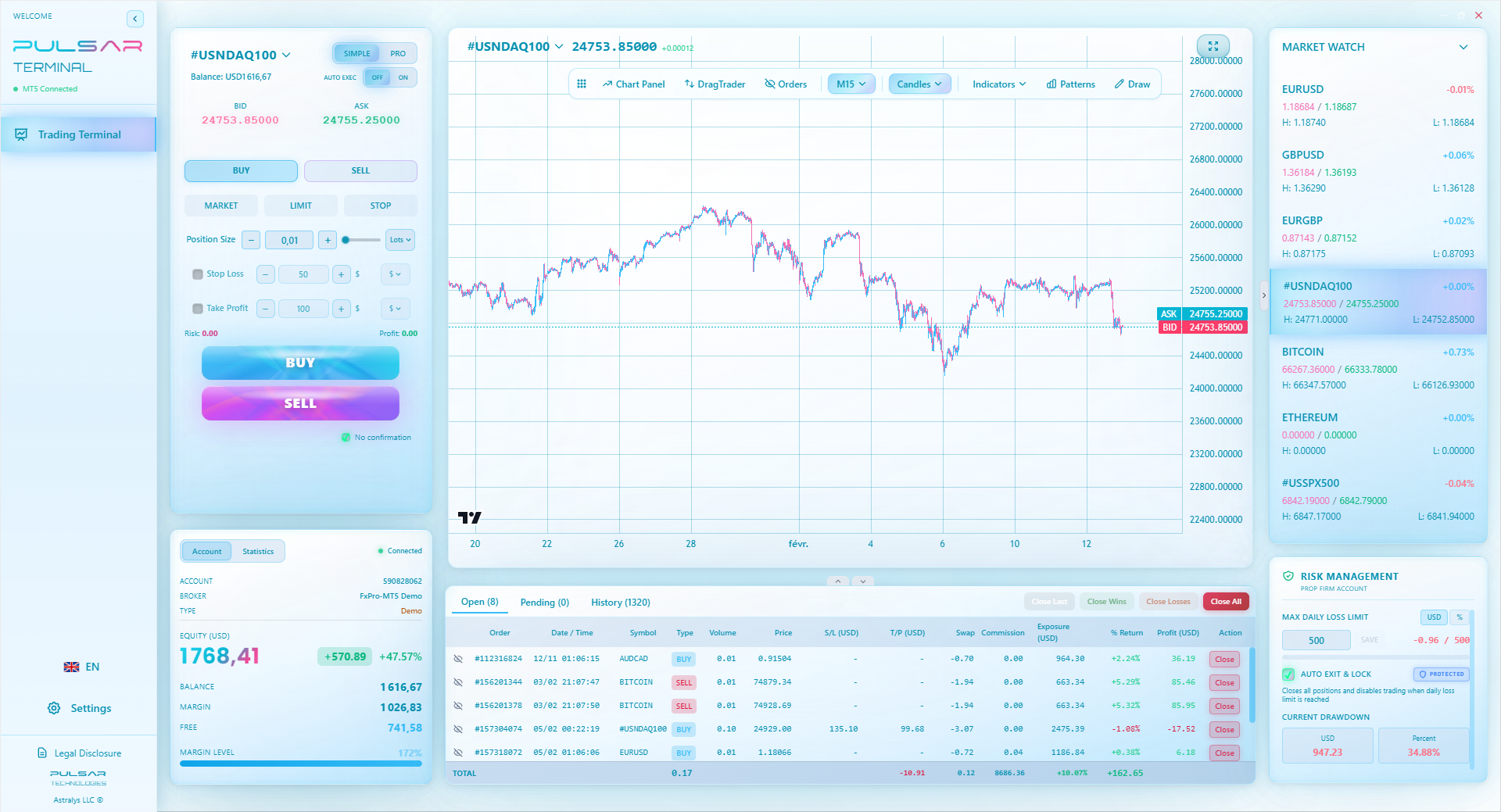
Manually calculating risk for complex multi-take-profit trades is error-prone; Pulsar Terminal automates this by letting you drag and drop orders with pre-calculated partial closures directly on your MT5 chart.
Pulsar Terminal
The all-in-one MT5 companion: drag-and-drop orders, multi-TP/SL, trailing stop, grid trading, Volume Profile, and prop firm protection. Used by 1,000+ traders daily.
Let me save you some pain and lost Naira.
Pitfall 1: Assuming All Pips Are Equal. Trading EUR/GBP like it's EUR/USD. The pip value can be 20-30% different. Always check the quote currency.
Pitfall 2: Ignoring the USD/NGN Fluctuation. Your pip value in dollars is fixed for a given trade size. But its Naira value moves with the exchange rate. A trade you held for a week could have a different Naira profit/loss than planned just from USD/NGN moves. Hedge your mind against this.
Pitfall 3: Mental Calculation Errors with High use. You deposit ₦100,000, get 1:500 use, and suddenly you can control 5 standard lots. The temptation is huge. But 5 lots on EUR/USD is $50 per pip. That's ₦72,500 per pip at ₦1,450/$! Your entire account is gone in under 2 pips. use amplifies pip value errors catastrophically.
Pitfall 4: Not Recalculating for Different Lot Sizes. You're used to trading 0.1 lots. One day you feel confident and go to 1.0 lot. You subconsciously think your risk is similar. It's 10 times greater. This lack of scaling awareness is a portfolio killer.
The antidote? A trading journal. Log every trade: pair, lot size, calculated pip value, stop-loss in pips, and risk in Naira. Review it weekly. The patterns of your mistakes will stare you in the face.
💡 Winston's Tip
Your first calculation before any trade shouldn't be 'where's my profit target?' It should be 'what's my pip value, and where's my stop-loss?' Risk first, reward second. Always.
“Master your pips, and you master the first true skill of this profession.”
Calculating pip value isn't the goal. It's the first, critical step in risk management, which is the only thing that keeps you in the game long enough to get good.
Your process should look like this:
- Analysis: You see a setup on EUR/USD using your MACD indicator and RSI.
- Risk First: You decide, 'I will risk ₦15,000 on this trade, no more.'
- Pip Value: You calculate that for your planned 0.5-lot trade, the pip value is $5, or ₦7,250.
- Stop-Loss: ₦15,000 risk / ₦7,250 per pip = ~2 pips. You look at the chart. Is a 2-pip stop-loss realistic for EUR/USD? No. It's noise. So you go back.
- Adjust Size: You need a 20-pip stop-loss for the trade to breathe. ₦15,000 risk / 20 pips = ₦750 risk per pip allowed. ₦750 per pip / ₦1,450 exchange rate = ~$0.52 pip value needed. To get a $0.52 pip value on EUR/USD, you need a trade size of $0.52 / 0.0001 = 5,200 units, or a 0.05 lot.
- Execute: You place the 0.05 lot trade with a 20-pip stop. Your risk is locked at ₦15,000.
This is the discipline that separates punters from traders. It's boring. It's mechanical. But it's what allows you to survive the inevitable losing streaks and compound your gains over time, whether you're swing trading or scalping. Master your pips, and you master the first true skill of this profession.
FAQ
Q1What is a pip in forex trading?
A pip (percentage in point) is the standard unit for measuring a currency pair's price change. For most pairs (e.g., EUR/USD), it's a 0.0001 move. For JPY pairs (e.g., USD/JPY), it's a 0.01 move. It's the basic building block of profit and loss.
Q2How much is 1 pip in Naira?
There's no single answer. The Naira value of 1 pip depends on the currency pair, your trade size (lots), and the current USD/NGN exchange rate. For example, 1 pip on a 1-lot EUR/USD trade is worth $10. If USD/NGN is 1,450, that pip is worth ₦14,500. You must calculate it for each specific trade.
Q3How do you calculate pip value for Nigerian Naira (NGN) pairs?
You rarely trade Naira directly on major forex platforms. You're usually trading USD-based pairs. So, you first calculate the pip value in US Dollars using the standard formulas, then convert that dollar amount to Naira using the prevailing USD/NGN rate to see your actual profit or loss in your local currency.
Q4Does use affect pip value?
No, and this is a crucial point. use affects how much margin you need to open a position, but it does NOT change the monetary value of a single pip. A 0.1 lot trade has the same pip value whether you use 1:10 or 1:1000 use. use amplifies your gains and losses relative to your margin, not the pip value itself.
Q5What's the difference between pip value and profit?
Pip value is the monetary worth of a one-pip movement for your specific trade size. Profit (or loss) is the pip value multiplied by the number of pips the market has moved in your favor (or against you). You need to know the pip value first to calculate potential profit.
Q6How can I calculate pip value quickly?
Use your trading platform's built-in calculator or a standalone position size calculator. For a quick mental estimate for major USD pairs: 1 standard lot = ~$10/pip, 1 mini lot = ~$1/pip, 1 micro lot = ~$0.10/pip. But always verify with the proper formula, especially for cross and JPY pairs.
Q7Why did my profit in Naira differ from my calculated pip value x pips?
Two main reasons: 1) The USD/NGN exchange rate changed between when you opened and closed the trade, altering the conversion value. 2) You might have traded a pair where the quote currency isn't USD (like EUR/GBP), and the GBP/USD rate also moved, affecting the final USD value before conversion to Naira.
Prof. Winston's Lesson
Key Takeaways:
- ✓A pip on EUR/USD is 0.0001; on USD/JPY it's 0.01. Never forget this.
- ✓1 standard lot on EUR/USD = ~$10 per pip. Use this as your mental anchor.
- ✓Always convert pip value to Naira using a conservative USD/NGN rate.
- ✓Your stop-loss in pips is determined by your risk in Naira divided by your pip value in Naira.
How useful was this article?
Click a star to rate
Weekly Trading Insights
Free weekly analysis & strategies. No spam.
About the Author
Olumide Adeyemi
West African Trading Pioneer
One of Nigeria's most active forex trading educators. 8 years of experience trading from Lagos. Specializes in low-capital strategies and prop firm challenges for African traders.
Comments
Risk Disclaimer
Trading financial instruments carries significant risk and may not be suitable for all investors. Past performance does not guarantee future results. This content is for educational purposes only and should not be considered investment advice. Always conduct your own research before trading.
You Might Also Like

Cara Trading Forex Sukses: 7 Prinsip dari Trader Profesional
Cara trading forex sukses dengan 7 prinsip trader pro: manajemen modal, disiplin, journal trading, backtest. Data nyata, bukan janji profit palsu.
Jam Trading Forex Terbaik untuk Trader Indonesia: Panduan Lengkap dengan Tabel Waktu
Panduan jam trading forex untuk trader Indonesia. Tabel 4 sesi dunia, jam emas 20:00-00:00, sesi mana yang harus dihindari. Data akurat + tips dari trader berpengalaman.
Top 5 Sàn Forex Uy Tín Nhất 2026: Review Jujur dari Trader Indonesia
Top 5 sàn forex uy tín 2026 untuk trader Indonesia. Review jujur: spread, deposit, withdraw, dukungan lokal. Exness, XM, IC Markets & lebih.
Get Pulsar Terminal
All these calculators are built into Pulsar Terminal with real-time data from your MT5 account. One-click position sizing, automatic risk management, and instant calculations.
Get Pulsar Terminal