


Ever closed a forex trade, seen a number on your screen, and wondered, 'Okay, but how much is that actually in my pocket?' If you're trading from India, that simple question has layers - currency conversion, taxes, brokerage, and SEBI's rulebook all come into play.

Rajesh Sharma
Senior Forex Analyst ·  India
India
☕ 10 min read
What you'll learn:
- 1The Basic Math: Pips, Lots, and INR Conversion
- 2India's Regulatory Reality: What You Can Actually Trade
- 3The Real Costs: Brokerage, Taxes, and GST
- 4Step-by-Step Calculation with Real Trade Examples
- 5Tools, Platforms, and Managing Calculations
- 6Common Pitfalls and How to Avoid Them
- 7Putting It All Together: A Profitable Mindset
Ever closed a forex trade, seen a number on your screen, and wondered, 'Okay, but how much is that actually in my pocket?' If you're trading from India, that simple question has layers - currency conversion, taxes, brokerage, and SEBI's rulebook all come into play. I've been there, scratching my head after what looked like a winning trade. Let's break down exactly how to calculate profit in forex trading, from the basic pip math to the final rupee that hits your bank account, with all the India-specific quirks you need to know.
Before we get to taxes and regulations, you've got to nail the core calculation. It's not complicated, but missing a step will throw everything off.
Understanding the Building Blocks
First, what are you actually trading? In India, you're mostly dealing with currency derivatives on exchanges like the NSE. A standard lot size for something like USD/INR futures is 1000 units of the US dollar. That's your starting point.
A pip is just the smallest price move. For USD/INR, since it's usually quoted like 83.4250, one pip is a change of 0.0025. Yeah, it's different from the standard 0.0001 you see with pairs like EUR/USD. Keep that straight.
The Profit Formula (The Simple Version)
Here’s the universal formula:
Profit/Loss = (Exit Price – Entry Price) × Lot Size × Number of Lots
The result is in the quote currency. For USD/INR, that's rupees. For a cross-currency pair like EUR/USD traded on an Indian exchange, the profit would first be in US dollars, then you convert it to INR.

Example: Let's say you buy 1 lot of USD/INR futures at 83.4000 and sell at 83.4500. Profit = (83.4500 - 83.4000) × 1000 × 1 Profit = 0.0500 × 1000 = ₹50 per lot.
That ₹50 is your gross profit. It hasn't met its friends - brokerage, taxes, and GST - yet. We'll get to them.
For cross-currency pairs, there's an extra step. Say you make $15 on an EUR/USD trade. You then convert that $15 to rupees using the day's USD/INR rate. If the rate is 83.45, your gross profit is ₹1,251.75. This is why knowing how to calculate profit in forex trading means keeping an eye on two rates: your trade's P&L and the USD/INR conversion rate.

💡 Winston's Tip
Your first profit calculation for any trade should happen *before* you enter. Know your risk (in rupees), your potential reward (in rupees, net), and the ratio between them. If it's not at least 1:1.5, question the trade.
This is where many new Indian traders get tripped up. You can't just open an account with any international broker and trade GBP/JPY with 500:1 use. The Reserve Bank of India (RBI) and SEBI have a strict playbook under FEMA.
You are legally allowed to trade:
- INR Pairs on Indian Exchanges: USD/INR, EUR/INR, GBP/INR, JPY/INR. These are futures and options contracts on the NSE, BSE, or MSEI.
- Cross-Currency Pairs on Indian Exchanges: EUR/USD, GBP/USD, USD/JPY. These are also exchange-traded derivatives.
What's not allowed? Using the Liberalised Remittance Scheme (LRS) to fund an offshore account for speculative spot forex trading on non-INR pairs. Platforms like Exness, IC Markets, or XM might accept Indian clients, but using them for leveraged spot forex falls in a grey-to-black area legally. The RBI regularly publishes an 'Alert List' of unauthorized platforms. Getting caught can mean penalties and fund seizures.

Warning: I learned this the hard way early on. I funded an international account with a small amount, made a decent profit on some AUD/NZD trades, and then spent weeks stressed about the legal and tax implications during withdrawal. The anxiety wasn't worth the gain. Now I stick to the exchange-traded derivatives for my main book - it's simpler, legal, and sleep-friendly.
The recent RBI circulars (March 2024) stress that these derivatives are for hedging, not pure speculation. While you can take positions up to $10 million without proving an underlying exposure, the regulatory intent is clear. Keep that in mind.
“Your gross profit is a fantasy. Your net profit is reality.”
Your gross profit is a fantasy. Your net profit is reality. Here’s what bites into it in India.
1. Brokerage and Transaction Charges: Your SEBI-registered broker (like Zerodha, Angel One, Upstox) will charge fees. These can be a flat fee per trade or a percentage of turnover. For example, you might pay ₹20 per executed order plus GST on that brokerage. Always check your broker's contract note.
2. The Tax Tango: This is crucial for how to calculate profit in forex trading accurately.
- Income Tax: If you're an active trader, your profits are treated as Business Income. You add them to your total income, and they're taxed at your slab rate (can be 30%+). The good news? You can deduct business expenses - brokerage, data fees, even a part of your internet bill.
- If you're a very occasional trader, you might classify it as Capital Gains. Short-term gains (held less than 12 months) are added to your income. Long-term gains (held more than 12 months) on these derivatives might be tax-free, but this is rare for active forex trading.
3. Goods and Services Tax (GST): GST is levied on the brokerage fee and the transaction charges. The rate is 18%. So, if your brokerage for a trade is ₹100, you pay ₹118 total.
4. Other Levies:
- Commodity Transaction Tax (CTT): Applicable on sale of currency futures. It's 0.01% of the transaction value (only on the sell side).
- Stamp Duty: A tiny state-level charge.

Example with Real Numbers: Let's take that USD/INR trade from earlier. Gross Profit = ₹50.
- Brokerage: ₹20 (flat rate)
- GST on Brokerage (18%): ₹3.6
- CTT (0.01% of Sell Value): Let's say sell value was ₹83,450. CTT = ₹8.35 Total Deductions: ₹20 + ₹3.6 + ₹8.35 = ₹31.95 Net Profit = ₹50 - ₹31.95 = ₹18.05
See how it shrinks? On a small trade, costs eat a huge chunk. This is why a solid position size calculator is non-negotiable - you need to know if a trade is worth it after costs.
Let's walk through two common scenarios: a domestic INR pair and a cross-currency pair.
Example 1: Trading USD/INR Futures
- Trade: Buy 2 lots of USD/INR APR futures at 83.5000. Lot size = 1000 USD.
- Exit: Sell at 83.6000.
- Gross Profit: (83.6000 - 83.5000) × 1000 × 2 = 0.1000 × 2000 = ₹200
- Costs:
- Brokerage: ₹20/order × 2 (buy & sell) = ₹40
- GST on Brokerage (18%): ₹7.2
- CTT (0.01% of Sell Value): Sell value per lot = 83.6000 × 1000 = ₹83,600. For 2 lots = ₹1,67,200. CTT = 0.0001 × 1,67,200 = ₹16.72
- Total Costs = ₹40 + ₹7.2 + ₹16.72 = ₹63.92
- Net Profit: ₹200 - ₹63.92 = ₹136.08
Example 2: Trading EUR/USD (Cross-Currency) on NSE
This has the conversion twist.
- Trade: Sell 1 lot of EUR/USD futures at 1.0850. Lot size = 1000 EUR.
- Exit: Buy to cover at 1.0800.
- USD/INR Rate at time of profit conversion: 83.00
- Gross Profit in USD: (1.0850 - 1.0800) × 1000 × 1 = 0.0050 × 1000 = $50
- Convert to INR: $50 × 83.00 = ₹4,150 (Gross in INR)
- Costs (similar structure, in INR): Let's estimate total brokerage + taxes at ₹70.
- Net Profit: ₹4,150 - ₹70 = ₹4,080
I once messed up the conversion step. I made $200 on a GBP/USD swing trade and celebrated. When I converted it, the USD/INR rate had moved against me by 50 paise, wiping out nearly ₹1,000 of my profit. Lesson learned: for cross-currency trades, your final P&L has two variables - the pair you trade and the USD/INR rate.
💡 Winston's Tip
Treat every tax rupee you set aside as a winning trade. If you make ₹100,000 net, immediately move ₹30,000+ to a separate tax savings account. It's not your money anymore. This discipline prevents a nasty shock in March.
“In India, your forex strategy isn't just competing against the market; it's competing against brokerage, GST, and CTT.”
You can't be doing this math manually for every trade. Thankfully, you don't have to.
Trading Platforms: Indian brokers' platforms (Zerodha Kite, Upstox Pro) show your P&L in real-time. This includes the gross profit/loss. However, they often don't show the net profit after all estimated charges until the contract note is generated at the end of the day. The contract note is your holy grail - it lists the trade price, brokerage, taxes, and net value.
For analysis and charting, many of us use TradingView alongside our broker's platform. But remember, for order execution in India, it must go through your SEBI-registered broker's system.
The Importance of a Trading Journal: This is the single best habit I've adopted. Every trade gets logged with:
- Entry/Exit prices
- Gross P&L
- Charges from the contract note
- Net P&L
- The reason for the trade
Over time, this journal tells you your true profitability, not the glossy gross figures. It shows you if your scalping strategy is actually working after costs, or if you're just making your broker rich.
Using a Calculator: Before entering any trade, especially when you're swing trading larger positions, use a forex calculator. Input your entry, target stop-loss, and lot size. It should tell you your potential profit/loss in rupees and, critically, what that means as a percentage of your capital. Risking more than 1-2% of your capital on a single trade is a fast track to a margin call.
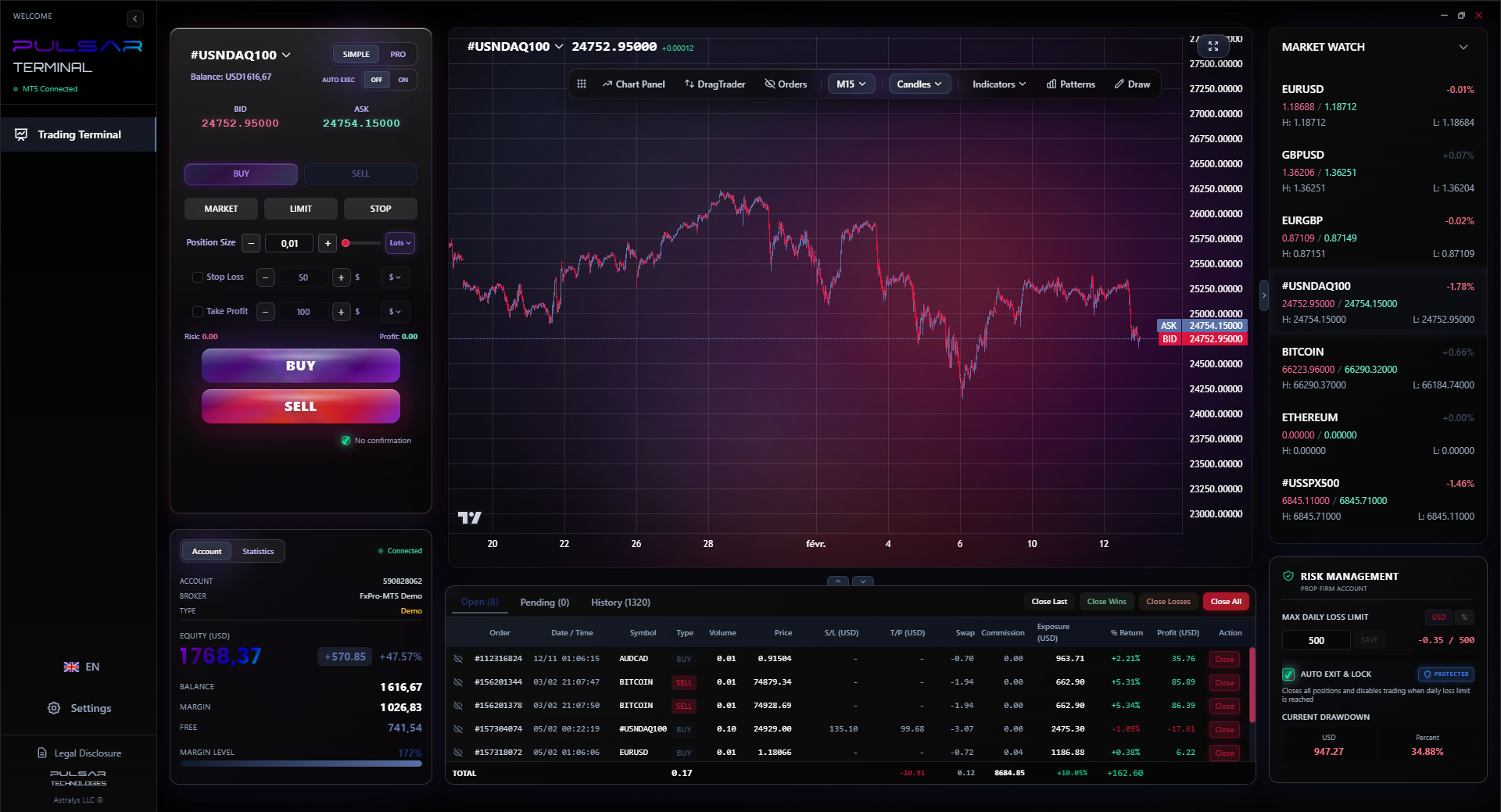
Manually calculating risk and plotting multiple take-profit levels for different lot sizes is tedious; Pulsar Terminal's drag-and-drop order tools and multi-TP/SL brackets automate this directly on your MT5 charts, saving time and reducing errors.
Pulsar Terminal
The all-in-one MT5 companion: drag-and-drop orders, multi-TP/SL, trailing stop, grid trading, Volume Profile, and prop firm protection. Used by 1,000+ traders daily.
Here are the mistakes I've made or seen friends make, so you don't have to.
1. Ignoring the Total Cost of Trading: Focusing only on the pip movement. A 10-pip win on a small lot might actually be a net loss after costs. Know your break-even point.
2. Forgetting About Currency Conversion Risk: As in my earlier story, your cross-currency profit in dollars is at the mercy of USD/INR. If you're holding a profit in USD over several days, you're taking a second, unplanned position on USD/INR.
3. Misunderstanding use: Exchange-traded derivatives have lower use (like 10:1 or 20:1) compared to unregulated offshore spot markets (500:1). This is a good thing! That insane use is how accounts get blown up. The lower use on Indian exchanges forces more sensible position sizing.
4. Not Accounting for Slippage: Your calculated profit assumes you get filled at your exact limit price. In fast markets, especially around news events, you might get slippage - a worse fill. This turns a calculated win into a smaller win or even a loss. I got slippage on a USD/INR trade during an RBI policy announcement once; my target was 83.5500, but I got filled at 83.5475. That 0.0025 difference cost me ₹25 per lot. Not huge, but it adds up.
5. Tax Planning Paralysis: Not keeping records through the year. Come March, you're scrambling through contract notes. Use a simple spreadsheet or a dedicated app from day one. Track your net P&L monthly so you know your estimated tax liability.
“I learned the hard way: a profit in dollars is at the mercy of the USD/INR rate until it's in your bank account.”
Knowing how to calculate profit in forex trading is a technical skill. Turning that into consistent profitability is a mental game.
Trade the Net, Not the Gross: Train yourself to think in terms of net profit after all costs. That ₹50 gross trade that becomes ₹18 net? Maybe it's not worth the risk and screen time. Wait for higher-conviction setups where the net profit potential justifies the effort.
Costs are Your Constant Adversary: Your strategy isn't just competing against the market; it's competing against brokerage, GST, and CTT. This makes high-frequency, low-pip scalping incredibly difficult to sustain legally in India. Strategies that aim for larger moves (like 20-50 pip targets) have a better chance of overcoming the cost hurdle.
Embrace the Regulation: It's easy to see SEBI and RBI rules as limitations. Flip the script. The regulated environment protects you from outright fraud, limits catastrophic use, and provides clarity on taxation. Work within the system. Build your edge through analysis, patience, and rock-solid risk management, not through seeking out illegal use or unregulated products.
Finally, backtest and forward-test any strategy with net profit in mind. If it doesn't show an edge after deducting a realistic estimate for costs, it's not a strategy, it's a hobby. And trading is an expensive hobby to have.
FAQ
Q1Is forex trading legal in India?
Yes, but with strict conditions. You can only trade currency derivatives (futures and options) that include the Indian Rupee (INR) on SEBI-regulated Indian exchanges like the NSE or BSE. Trading non-INR pairs on international platforms using the LRS for speculation is not permitted under FEMA rules.
Q2How much tax will I pay on my forex trading profits?
For active traders, profits are typically taxed as business income at your applicable income tax slab rate (up to 30%+). You can deduct related expenses. There's also an 18% GST on brokerage fees and a 0.01% Commodity Transaction Tax (CTT) on the sell side of futures. Always consult a CA for your specific situation.
Q3What's the difference between a pip in USD/INR and EUR/USD?
A pip in most major pairs (EUR/USD) is 0.0001. In USD/INR, which is quoted to four decimal places (e.g., 83.4250), the minimum tick size is 0.0025. So, a 0.0025 move in USD/INR is equivalent to 1 pip for calculation purposes on Indian exchanges.
Q4Can I use MetaTrader 5 (MT5) in India?
You can use MT5 for charting and analysis. However, for actual execution of trades in the legal Indian forex market (INR pairs), your orders must be placed through your SEBI-registered broker's platform (like Zerodha Kite). Using MT5 to trade on an international broker's server for spot forex is against RBI regulations.
Q5Why is my net profit on the contract note different from what my trading platform showed?
Your trading platform shows the gross profit/loss based on price movement. The contract note deducts all applicable charges - brokerage, GST, CTT, stamp duty - to give you the final net profit or loss that is settled to your account.
Q6What's the minimum amount needed to start forex trading in India?
It depends on the broker and the margin required. For example, trading 1 lot of USD/INR might require an initial margin of around ₹8,000-₹12,000. Some brokers allow you to start with a smaller capital amount, but you must ensure you have enough to meet margin requirements and withstand normal price swings without an immediate margin call.
Q7How do I convert profit from a EUR/USD trade into rupees?
First, calculate your profit in US dollars: (Exit Price - Entry Price) x Lot Size. Then, multiply that dollar amount by the current USD/INR exchange rate. Remember, this conversion rate can change between your trade exit and when the funds are settled, affecting your final rupee amount.
Prof. Winston's Lesson
Key Takeaways:
- ✓Calculate profit in rupees, net of all costs, before entering any trade.
- ✓For cross-currency trades, account for USD/INR conversion risk - it's a second position.
- ✓Legal trading on Indian exchanges has lower use (10-20:1), which protects your capital.
- ✓Maintain a detailed trading journal with net P&L; it's your only source of truth.
How useful was this article?
Click a star to rate
Weekly Trading Insights
Free weekly analysis & strategies. No spam.
About the Author
Rajesh Sharma
Senior Forex Analyst
Trading Indian and South Asian markets for over 10 years. Started with NSE currency derivatives before moving to international forex. Specializes in USD/INR and emerging market pairs.
Comments
Risk Disclaimer
Trading financial instruments carries significant risk and may not be suitable for all investors. Past performance does not guarantee future results. This content is for educational purposes only and should not be considered investment advice. Always conduct your own research before trading.
You Might Also Like

Cara Trading Forex Sukses: 7 Prinsip dari Trader Profesional
Cara trading forex sukses dengan 7 prinsip trader pro: manajemen modal, disiplin, journal trading, backtest. Data nyata, bukan janji profit palsu.
Jam Trading Forex Terbaik untuk Trader Indonesia: Panduan Lengkap dengan Tabel Waktu
Panduan jam trading forex untuk trader Indonesia. Tabel 4 sesi dunia, jam emas 20:00-00:00, sesi mana yang harus dihindari. Data akurat + tips dari trader berpengalaman.
Top 5 Sàn Forex Uy Tín Nhất 2026: Review Jujur dari Trader Indonesia
Top 5 sàn forex uy tín 2026 untuk trader Indonesia. Review jujur: spread, deposit, withdraw, dukungan lokal. Exness, XM, IC Markets & lebih.
Get Pulsar Terminal
All these calculators are built into Pulsar Terminal with real-time data from your MT5 account. One-click position sizing, automatic risk management, and instant calculations.
Get Pulsar Terminal