


Here's a hard truth most trading gurus won't tell you: 90% of people looking for a mentor are looking for a shortcut.

David van der Merwe
Emerging Markets Trader ·  South Africa
☕ 8 min read
What you'll learn:
Here's a hard truth most trading gurus won't tell you: 90% of people looking for a mentor are looking for a shortcut. They want the secret sauce spoon-fed, not the discipline to cook the meal themselves. In South Africa, with our unique market hours, volatile ZAR pairs, and a landscape flooded with 'instant millionaire' schemes, finding a real mentor is like finding a sober person at a shebeen on a Friday night. It's possible, but you need to know where to look and, more importantly, what to avoid. I've paid for mentors, been scammed by mentors, and eventually became one. Let me save you some rand and a lot of heartache.
First, let's kill the fantasy. A mentor is not a signal service. They won't WhatsApp you buy/sell alerts while you sit back. That's a crutch, and it'll break the moment they stop.
A real mentor's job is to build your framework, not fill your pockets with daily trades. They help you develop your own edge, manage your psychology (the biggest battle for any South African trader facing load-shedding-induced volatility), and hold you accountable. They're a coach, not a cheat code.
I learned this the expensive way. Early on, I paid a guy R15,000 for a 'mentorship'. He sent daily Telegram signals on USD/ZAR. I made R8,000 in two weeks following blindly. I felt like a genius. Then, one Friday during a US data dump, he sent a signal to go long. I did, with too much size. The trade went 50 pips against me, he went silent, and I panicked and closed for a R12,000 loss. He blamed 'unforeseen volatility'. I blamed my own stupidity for not having a position size calculator or a risk plan. That was the lesson, just a costly one.

Warning: If a 'mentor' leads with their Lamborghini or promises a specific monthly return (e.g., 'Make 20% per month guaranteed!'), run. That's marketing, not mentoring. In South Africa, the FSCA doesn't regulate mentors, so anyone with a Facebook ad can claim to be one.

💡 Winston's Tip
When evaluating a mentor, ask to see their worst-ever losing trade on a statement. Their reaction and explanation will tell you more than 100 winning trades.
“A real mentor's job is to build your framework, not fill your pockets with daily trades.”
Forget the flashy Instagram ads. The real pros aren't there.
Trading Floors & Prop Firms: This is the gold standard. While pure prop firms are less common in SA than in London or NYC, some trading academies and funded trader programs have physical desks in Johannesburg and Cape Town. Being in a room with other traders, hearing the chatter, seeing the discipline (or lack thereof) is useful. You learn by osmosis. Ask if they offer mentorship as part of their program.
Broker Seminars (The Right Kind): Not the 'get rich quick' free dinners. Reputable international brokers like IC Markets or Pepperstone sometimes host genuine educational workshops with senior analysts. Go, not for the signals, but to network. The person sitting next to you might be a seasoned veteran.
Online Communities (Curated): Broad forums are noise. Look for small, paid Discord groups or forums focused on a specific style, like scalping the J200 during London open. The paid barrier filters out some trolls. Observe who consistently shares logical market analysis, not just P&L screenshots.
Your Own Broker: Sometimes the answer is boring. If you trade with a solid broker like Exness or XM, use their resources. Their senior client managers or analysts often have decades of experience and will give you straight answers if you ask specific, intelligent questions.
“If a 'mentor' leads with their Lamborghini, run. That's marketing, not mentoring.”
You've found a potential candidate. Now, interrogate them. I'm serious.
Demand a Track Record, Not a Story: Ask for a multi-year, auditable track record. MyFfxBook or something similar. It should show consistency, not just one monster year. Anyone can get lucky on a few XAU/USD trades during a crisis.
Ask About Their Worst Loss: If they say they've never had a bad loss, they're lying. I want to hear about the time they blew 30% of their account misreading a EUR/USD breakout and what they learned. Vulnerability equals credibility.
Have a Trial Conversation: Pay for an hour of their time. Ask: 'What's your edge? How do you handle a losing streak? What's your view on the SA 10-year yield right now?' Gauge their passion for markets, not for selling you a package.
Green Lights: They talk more about risk management and psychology than entries. They ask YOU questions about your goals and experience. They encourage you to develop your own system. They're transparent about what their mentorship includes (e.g., weekly review calls, chart analysis, journal feedback).

Pro Tip: Ask them to explain a recent trade they took. Not just 'I went long,' but the full thesis: fundamental catalyst, technical trigger on the 4H chart, where their stop was and why, their profit target rationale. Their thought process is what you're buying.
“If a 'mentor' leads with their Lamborghini, run. That's marketing, not mentoring.”
This is where dreams meet reality. Mentorship isn't cheap, nor should it be if it's valuable.
The Spectrum:
- Free: Usually from a more experienced trader in a community who takes a liking to you. Rare, but it happens. You pay with your attentiveness and effort.
- R1,500 - R5,000 per month: Common for online group mentorship. You get weekly webinars, a Discord channel, and maybe a monthly 1-on-1 review. Hit or miss.
- R10,000 - R30,000+ for a 3-6 month intensive program: This should include significant 1-on-1 time, direct feedback on your trades, and a structured curriculum. This is where you find dedicated coaches.
- Percentage of Profits: Some elite mentors (usually ex-prop shop guys) will work for a cut of your profits for a period. Extreme caution here. Contracts must be watertight.
My Take: I once paid R25,000 for a 3-month program. Was it worth it? Partly. The best R5,000 of that was spent on two sessions where he tore apart my trading journal and showed me my consistent error: moving my stop-loss to breakeven too early on winning trades, which destroyed my risk/reward. The rest was generic content I could find online. The key is the personalized feedback.

Example: If a mentor charges R20,000, that's 20% of a R100,000 account. Ask yourself: Could that R20,000 be better used as trading capital? Only if the mentor can demonstrably improve your performance by more than 20%.
💡 Winston's Tip
If you can't afford a mentor, become one to your past self. Keep a detailed journal and review it weekly as if you were coaching a rookie. You'll be shocked at the patterns you see.
“You pay a mentor for their thought process, not their trade signals.”
You don't hire a personal trainer and then eat burgers every day. Same principle.
Come Prepared: Before you even speak to a mentor, have a trading journal. Have a track record, even if it's losing. Have specific questions. 'How do I trade?' is a bad question. 'My RSI indicator divergences keep failing on the USD/ZAR 1-hour chart, am I misreading the context?' is a great question.
Do the Work: They give you homework - like backtesting a specific MACD indicator crossover on 100 instances - you do it. All of it. I failed here initially. I wanted the answer, not the work. It set me back months.
Accept Brutal Honesty: A good mentor will tell you your trading is reckless, your journal is sloppy, and your ego is writing cheques your account can't cash. Your job is to listen, not defend.
, You Are Responsible: The mentor guides, but your finger is on the mouse. You control the spread definition you accept, you decide to ignore the stop, you face the margin call. Internalizing this is the first step to being ready for a mentor.
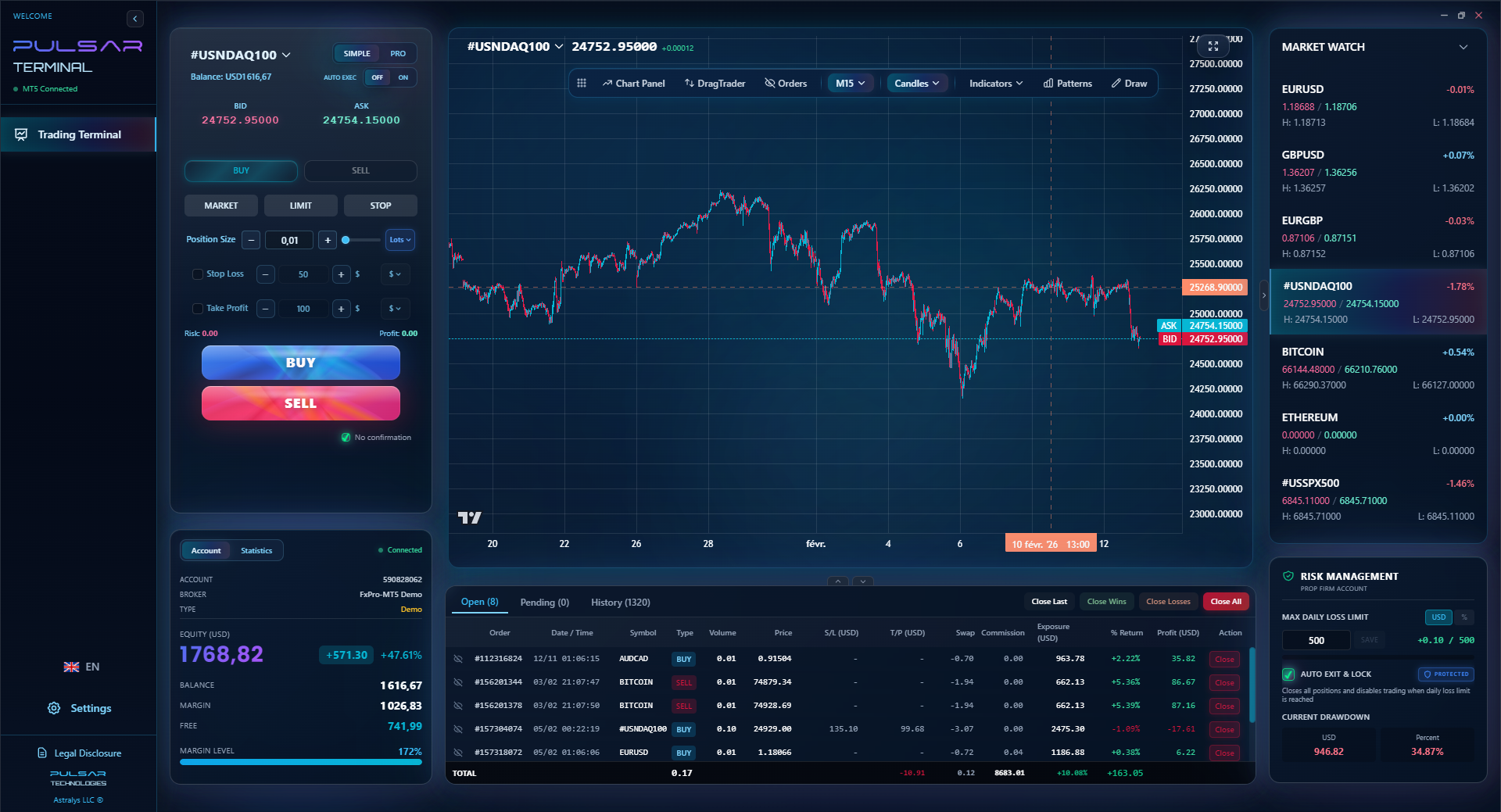
A mentor teaches discipline, but tools like Pulsar Terminal enforce it directly on your MT5 platform with automated trade and risk management.
Pulsar Terminal
The all-in-one MT5 companion: drag-and-drop orders, multi-TP/SL, trailing stop, grid trading, Volume Profile, and prop firm protection. Used by 1,000+ traders daily.
“You pay a mentor for their thought process, not their trade signals.”
Can't find or afford a dedicated human? Build your own 'mentor network'.
The Book Mentor: Pick 5 legendary trading books. Read them. Then re-read them. Take notes. Treat the authors as mentors. I'd take 'Trading in the Zone' by Mark Douglas over 90% of the Instagram gurus any day.
The Market Profile Mentor: Learn to read the market's footprint. Tools that visualize auction market theory, like Volume Profile, can teach you where the big boys are trading. Studying this is like having a silent mentor showing you the real areas of value.
The Journal Mentor: Your trading journal, when reviewed with ruthless honesty, becomes your most accurate mentor. It doesn't lie. It shows you exactly where you're stupid, greedy, or scared. I review mine every Sunday without fail.
The Simulated Mentor: Use a demo account to test specific strategies religiously for 3-6 months. The market's feedback - your P&L - is your mentor. It's merciless and unbiased.
Sometimes, the grind of self-education forges a stronger trader. You learn your lessons in blood, sweat, and virtual drawdowns, but they stick forever.
💡 Winston's Tip
The best mentorship often happens in the trenches. Consider a prop firm challenge. The strict rules (max daily loss, drawdown limits) are a brutal but effective form of mentorship from the market itself.
“Your trading journal, when reviewed with ruthless honesty, becomes your most accurate mentor.”
Trading in South Africa has its own flavour. Your mentor, ideally, should understand this.
They should get that when Eskom hits Stage 6, liquidity can dry up faster than a dam in the Karoo, widening spreads on ZAR pairs. They should understand the impact of SARB MPC announcements, not just the Fed. They should know that trading the J200 Index requires a different lens than the S&P 500.
If your mentor is based in the US and only trades Nasdaq, their advice on timing your swing trading around Johannesburg market hours might be theoretical at best.
Local context matters. It's not everything, but it's a layer. A good mentor will either have this knowledge or have the humility to admit when local factors are outside their wheelhouse and guide you to find that information yourself. The ultimate goal of any mentorship is to make you an independent, resilient trader who can handle any market, whether it's in Sandton or Shanghai.
FAQ
Q1How much should I pay a forex mentor in South Africa?
Anywhere from R1,500 for basic group access to R30,000+ for intensive, personalised programs. Don't focus on the price, focus on the value. A R5,000 mentor who fixes your risk management is worth infinitely more than a R20,000 mentor who just gives you signals. Always start with a single paid session to test the waters.
Q2Are free forex mentorships legit?
Rarely. High-quality knowledge and time are valuable. Free 'mentorships' are almost always lead magnets for selling a costly course or signal service later. Sometimes you'll find genuine help in small community forums, but a structured, committed mentorship for free is like finding a free Ferrari. Be deeply skeptical.
Q3What's the #1 red flag for a scam mentor?
Guaranteed profits or specific monthly returns (e.g., '10% per month'). Trading is probabilistic, not certain. Anyone guaranteeing results is lying. The second biggest red flag is only showing screenshot P&Ls instead of a verifiable, long-term track record on a platform like MyFxBook.
Q4Can I learn everything without a mentor?
Yes, absolutely. It's harder, slower, and often more expensive in terms of losses from mistakes you have to make yourself. Books, a rigorous demo trading period, and deep analysis of your own journal can be a form of self-mentorship. A human mentor accelerates the process by helping you avoid their past mistakes.
Q5Should my mentor be a local South African?
It's beneficial but not essential. A local mentor understands ZAR volatility, SA market hours, and local events. However, a world-class international mentor who understands global macro is far better than a mediocre local one. The key is their proven trading skill and teaching ability, not just their passport.
Q6How long should a mentorship last?
There's no set time. A good mentorship has an objective, like 'develop and consistently execute a profitable trading plan.' This could take 3 months or a year. It should not be an endless subscription. The goal is for you to graduate, not to keep you paying forever.
Prof. Winston's Lesson
Key Takeaways:
- ✓Vet mentors on worst losses, not best wins.
- ✓Expect to pay R1,500-R30,000+ for real value.
- ✓Local SA market knowledge is a bonus, not a must.
- ✓Your preparation dictates 50% of the mentorship's success.
How useful was this article?
Click a star to rate
Weekly Trading Insights
Free weekly analysis & strategies. No spam.
About the Author
David van der Merwe
Emerging Markets Trader
Johannesburg-based trader with 11 years in emerging market currencies. Specializes in ZAR pairs, FSCA-regulated trading, and South African market analysis.
Comments
Risk Disclaimer
Trading financial instruments carries significant risk and may not be suitable for all investors. Past performance does not guarantee future results. This content is for educational purposes only and should not be considered investment advice. Always conduct your own research before trading.
You Might Also Like

Cara Trading Forex Sukses: 7 Prinsip dari Trader Profesional
Cara trading forex sukses dengan 7 prinsip trader pro: manajemen modal, disiplin, journal trading, backtest. Data nyata, bukan janji profit palsu.
Jam Trading Forex Terbaik untuk Trader Indonesia: Panduan Lengkap dengan Tabel Waktu
Panduan jam trading forex untuk trader Indonesia. Tabel 4 sesi dunia, jam emas 20:00-00:00, sesi mana yang harus dihindari. Data akurat + tips dari trader berpengalaman.
Top 5 Sàn Forex Uy Tín Nhất 2026: Review Jujur dari Trader Indonesia
Top 5 sàn forex uy tín 2026 untuk trader Indonesia. Review jujur: spread, deposit, withdraw, dukungan lokal. Exness, XM, IC Markets & lebih.
Get Pulsar Terminal
All these calculators are built into Pulsar Terminal with real-time data from your MT5 account. One-click position sizing, automatic risk management, and instant calculations.
Get Pulsar Terminal