


Here's a fact that should sober you up: globally, between 65% and 82% of retail traders lose money trading CFDs like forex.

Olumide Adeyemi
West African Trading Pioneer ·  Nigeria
☕ 9 min read
What you'll learn:
- 1The Legal Reality Check (It's Not What You Think)
- 2Picking a Broker You Can Actually Survive With
- 3Your First $1,000: A Realistic Action Plan
- 4What to Actually Trade (Strategy Before You Click Buy)
- 5The Nigerian Trader's Mindset: Psychology, Taxes & Getting Paid
- 6The Classic Nigerian Mistakes (And How to Avoid Them)
Here's a fact that should sober you up: globally, between 65% and 82% of retail traders lose money trading CFDs like forex. In Nigeria, that number isn't published, but I'd bet my last Naira it's on the higher end. The dream sold is quick riches; the reality is a complex, high-risk financial skill. If you're wondering how to go into forex trading, you need to start by understanding it's not a side hustle, it's a profession. This guide won't sugarcoat it. I'll walk you through the legal minefield, the broker traps, the taxman's cut, and the only realistic path to not becoming another statistic.
Let's clear the air. Yes, forex trading is legal for you as a Nigerian individual. No, the Central Bank of Nigeria (CBN) isn't going to kick down your door for trading EUR/USD. But that's where the simplicity ends. The online retail space you're entering is what we politely call 'poorly regulated' locally. There's no specific SEC rulebook for your MetaTrader 5 account. This creates a weird freedom: you can sign up with brokers regulated in Cyprus, Seychelles, or Australia. It also creates massive risk, because you're largely on your own.
The real legal headaches are practical. First, the taxman. The Federal Inland Revenue Service (FIRS) wants 10% of your gross trading profits as Capital Gains Tax. I don't care if your broker is in Mauritius; if you're withdrawing profits to a Nigerian bank account, that income is taxable. I learned this the hard way early on, getting a surprisingly polite but firm letter after a good quarter. Second, funding. The CBN explicitly bans using official forex windows to fund trading accounts. Your bank's Naira card might also be blocked for international broker deposits. Your workaround? Cryptocurrency transfers or payment processors like Flutterwave. It's a friction cost you must factor in.

Warning: Thinking of skipping the 10% tax? The FIRS is getting smarter at tracking digital inflows. A tax bill plus penalties can wipe out years of careful trading. Factor it into your profit calculations from day one.
“The CBN isn't going to kick down your door for trading EUR/USD, but the FIRS will happily send you a bill for 10% of your profits.”
This is your first major decision, and most Nigerians get it wrong. They chase flashy bonuses or insane use. You need to chase reliability and fair costs. Since local regulation is thin, a broker's international license is your safety net. Look for ones regulated by the FCA (UK), ASIC (Australia), or CySEC (EU). They have stricter client fund protection rules.
The Minimum Deposit Trap
Brokers advertise "Start with $1!" It's a marketing trick. You can technically start with $5 at a broker like XM or $10 at Exness. But with $1, you're just playing a video game, not learning to trade. One micro-lot (1,000 units) move of 50 pips wipes you out. My blunt advice? Don't even turn on your charts until you have at least $200-$500 dedicated solely to learning. A $100 minimum deposit at a broker like AvaTrade forces a more serious mindset.
use: Your Double-Edged Sword
In Nigeria, you'll see offers of use up to 1:1000 or even 'unlimited'. This is a disaster waiting to happen for a new trader. use amplifies losses as fast as profits. At 1:1000, a 0.1% move against you wipes your account. I once used 1:500 on a gold trade early in my career, convinced I was a genius. A routine $10 volatility spike hit my stop-loss and took out 40% of my capital in seconds. It was a cheap, painful lesson.
Start with a broker that allows you to set your use low, like 1:10 or 1:30. It forces you to focus on good trade size and analysis, not gambling. Use a position size calculator religiously. Your broker's real value isn't high use, it's tight spreads (the cost of trading), fast execution, and reliable withdrawals. Compare the raw spread accounts from brokers like IC Markets or Pepperstone – where the EUR/USD spread can be 0.0 pips plus a small commission – against standard accounts with wider markups.

💡 Winston's Tip
Your first profitable month is your most dangerous. It convinces you you're smarter than the market. Double your risk management, not your position size.
“Starting with $1 in forex is like learning to drive in a Formula 1 car. You'll crash before you leave the pit lane.”
Let's assume you've saved up NGN equivalent of $1,000. Here's exactly what to do with it, step-by-step.
Step 1: The 70/30 Split. Immediately put $700 aside. This is your 'live capital' and you won't touch it for at least 3 months. The remaining $300 is for everything else: broker deposit, educational resources, and your 'demo-to-live' buffer.
Step 2: Demo Account Grind. Deposit $50-$100 with your chosen broker. Then, ignore your live account. Open a demo account with the same broker and trade it exactly as if it were real. Your goal isn't profit; it's consistency. Can you place 20 trades in a row following a simple plan? I want you to track every single trade in a journal. Entry, exit, reason, emotional state. Do this for a minimum of two months. Most people quit after two weeks. Don't be most people.
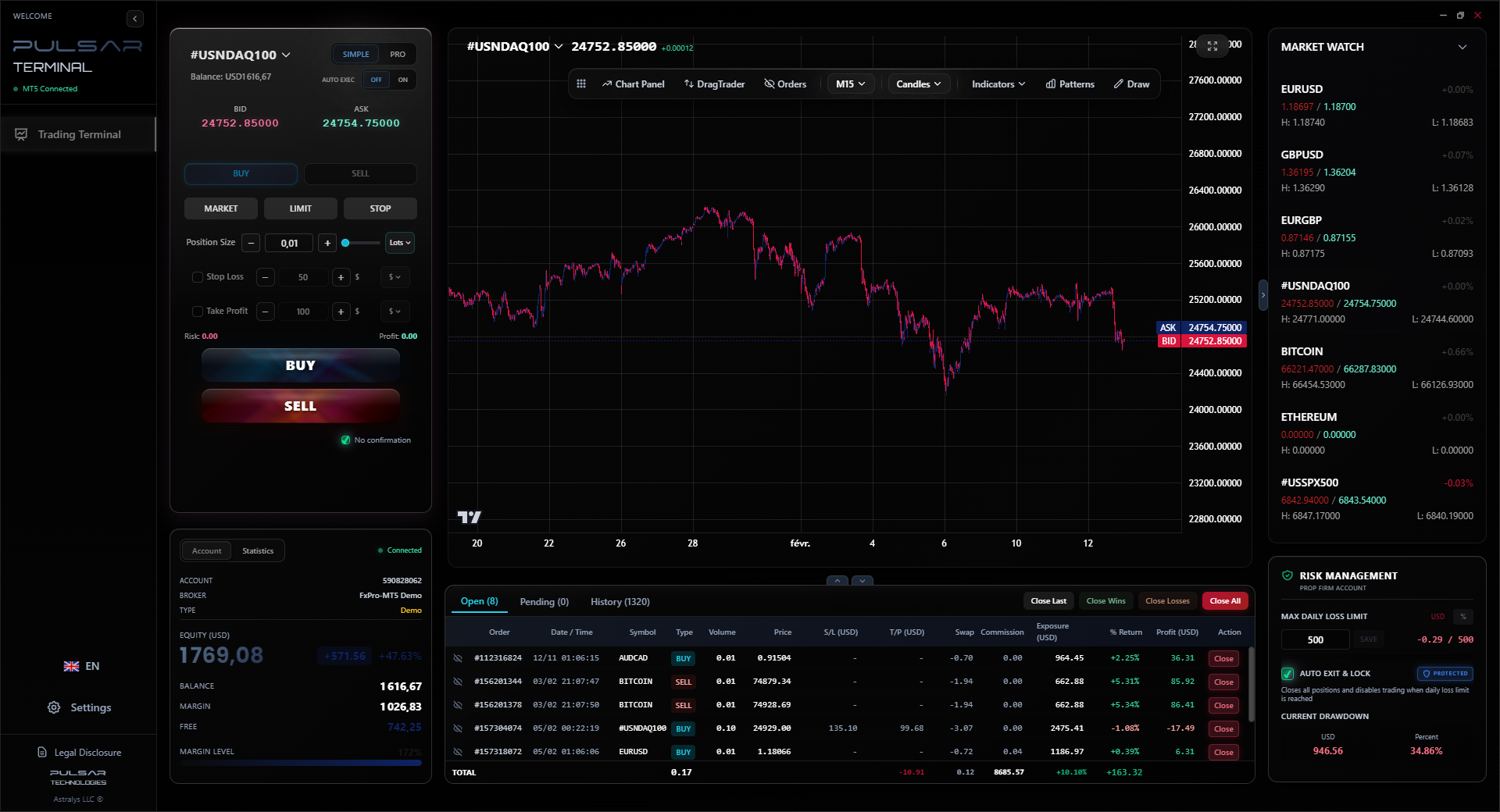
Step 3: The Micro-Lot Launch. After your two-month demo proof, fund your live account with the rest of the $300. Now, you trade only micro lots (0.01). Your $700 is still safe. The goal here is to make your live account statements look identical to your demo journal: disciplined, unemotional. The moment you feel panic or euphoria, stop. This phase is about marrying your strategy to real-world spreads and execution. A tool like Pulsar Terminal can help here, letting you set multi-level take-profits and stop-losses directly on MT5, which removes emotional decisions at critical moments.
Step 4: Scaling Up. Only after 3-6 months of consistent, small-lot profitability do you gradually introduce the $700. Even then, you never risk more than 1-2% of your total capital on a single trade. This is how you learn how to go into forex trading without a spectacular blow-up.
“Your strategy isn't what you think will happen. It's your plan for when you're wrong.”
You have a funded account. Now what? You need a rule-based system, not hunches. Forget the WhatsApp group signals. Develop one simple methodology and beat it to death.
Start with the Majors: EUR/USD, GBP/USD, USD/JPY. They have the tightest spreads and most predictable liquidity. The EUR/USD guide is a mandatory read. It's the most traded pair on earth for a reason. Avoid exotic pairs like USD/NGN or USD/TRY as a beginner; the spreads are wide and moves can be erratic.
Pick One Timeframe: Are you a scalping person (5-minute charts, in and out fast) or a swing trading person (4-hour/daily charts, holding for days)? You must choose. I'm a swing trader by nature. Trying to scalp early on fried my nerves and my account. Find your rhythm.
Use Indicators as Guides, Not Oracles: Learn two or three indicators deeply. The RSI indicator for spotting overbought/oversold conditions, and the MACD indicator for trend momentum. Here's the secret: they often contradict each other. That's the point. It forces you to analyze, not blindly follow. My early mistake was stacking 10 indicators on a chart until it was a rainbow mess. Simplicity wins.
| Your First System (Example) | Rules |
|---|---|
| Pair | EUR/USD only |
| Timeframe | 1-Hour Chart for setup, 15-min for entry |
| Trigger | Price pulls back to a key support level, RSI shows oversold (<30) |
| Confirmation | MACD histogram starts turning upward |
| Risk Management | Stop-loss 20 pips away. Take-profit at 40 pips (2:1 reward/risk). Never risk more than 1% of account. |
Backtest this simple system on 6 months of historical data. See if it would have worked. Tweak it. Then, and only then, try it with a micro lot.
💡 Winston's Tip
If you can't explain your trade setup in one simple sentence ('price bouncing off the daily support with bullish RSI divergence'), you shouldn't take the trade. Complexity hides poor analysis.
“Your strategy isn't what you think will happen. It's your plan for when you're wrong.”
This is where careers are made or destroyed. The Nigerian market has unique psychological pressures. You're trading in dollars while living in Naira. A $500 profit feels like a fortune when converted. This leads to overtrading to 'hit a monthly salary.' Conversely, a $200 loss feels catastrophic. You must internalize that you trade in USD, full stop. Convert to Naira only during withdrawals for living expenses.
The Withdrawal Process: This is your report card. Choose brokers with a proven track record of processing withdrawals to Nigeria within 24-48 hours, like Exness or XM. Use crypto (USDT) for funding and withdrawals to bypass bank issues. When you withdraw, immediately set aside 10% for the FIRS. Open a separate savings account for this. It's not your money.
Handling the Emotional Cycle: You will have a losing streak. It's guaranteed. Your WhatsApp groups will be buzzing with 'can't lose' signals. Your cousin will ask for a loan because he heard you're into forex. This is the noise you must block. The single best thing I ever did was institute a 'mandatory stop' rule: if I have three losing trades in a day, I close the platform and walk away. No exceptions. It prevents revenge trading, which is the fastest route to a margin call.

Pro Tip: Your trading platform is a workplace. Treat it like one. Set specific hours. Dress decently (no pyjamas). Have a pre-trade checklist. This mental separation between 'trading time' and 'life time' is more valuable than any indicator.
“In Nigeria, you trade in USD. You live in Naira. Confusing the two is an emotional disaster.”
I've seen these patterns destroy accounts for a decade. Let's name and shame them.
1. Chasing Bonuses: A broker offers a 100% deposit bonus. It sounds free money, but it always comes with insane trading volume requirements (lots to turnover before you can withdraw). You'll trade huge sizes to hit the target and blow up. Avoid bonuses. Always.
2. Overtrading the Naira Pairs: USD/NGN is not a typical forex pair for retail speculation. The CBN controls it, and the spread can be massive (sometimes 500 pips!). You're not trading, you're gambling against central bank policy. Stick to the global majors.
3. The 'Prop Firm Shortcut': Passing a proprietary trading firm challenge seems like a way to trade with 'house money.' It can be a valid path, but Nigerians often fail the evaluation because they treat it like a lottery ticket, not a job. The daily loss limits are brutal. If you go this route, you need surgical risk management. Tools that automate daily loss protection, like those in Pulsar Terminal, become essential to pass these challenges without a nervous breakdown.
4. Ignoring the True Cost: You see a 2-pip spread, but don't account for swap fees (overnight financing costs) if you hold trades. On a long GBP/USD position, the swap can be negative and eat your profits. Always check the swap rates in your platform's specification window.
💡 Winston's Tip
Keep a 'stupid tax' journal. Every time you break your own rules and lose money, write the amount and reason. Seeing the Naira total grow is the best discipline enforcer you'll ever have.
Managing the strict rules of a prop firm challenge or your own trading plan requires automated tools, which is where a platform like Pulsar Terminal, with its daily loss protection and one-click order templates, becomes a trader's control center.
Pulsar Terminal
The all-in-one MT5 companion: drag-and-drop orders, multi-TP/SL, trailing stop, grid trading, Volume Profile, and prop firm protection. Used by 1,000+ traders daily.
FAQ
Q1Is forex trading illegal in Nigeria?
No, it is not illegal for individuals to trade forex. However, the retail online trading sector is lightly regulated within Nigeria itself. You are legally allowed to trade with internationally regulated brokers. The key legal obligations are paying the 10% Capital Gains Tax on profits and not using CBN official windows to fund your account.
Q2What is the minimum amount to start forex trading in Nigeria?
Technically, you can start with as little as $1 with some brokers. Practically, this is useless for learning. A serious minimum to begin the learning process with real, managed risk is between $200 and $500. This allows you to trade micro lots and survive inevitable early losses without blowing your account.
Q3How do I fund my forex trading account from Nigeria?
Given restrictions on Naira cards for international brokers, the most reliable methods are cryptocurrency transfers (sending USDT to your broker's crypto wallet) or using licensed payment processors like Flutterwave or Paystack that some brokers integrate. Always check your broker's deposit options for 'Nigeria' specifically.
Q4Which forex broker is best for Nigerians?
There's no single 'best.' You need a broker with reliable Naira deposit/withdrawal options, strong international regulation (like ASIC or CySEC), and competitive spreads. Brokers like Exness, XM, and IC Markets are popular choices due to their local payment integrations and service to the Nigerian market. Always read the latest Exness review or XM review for current conditions.
Q5How is forex trading income taxed in Nigeria?
All profits from forex trading are subject to a 10% Capital Gains Tax, administered by the Federal Inland Revenue Service (FIRS). You are responsible for declaring this income and paying the tax. It is calculated on your gross profits, not your net account balance.
Q6Can I make a living from forex trading in Nigeria?
It is possible, but statistically unlikely for most. It requires treating it as a full-time profession for years, not a side hustle. You need significant capital (start with at least $5,000-$10,000 to target meaningful monthly returns), a proven, disciplined strategy, and iron-clad emotional control. Most successful 'full-time' traders have other income sources during their multi-year learning phase.
Q7What is a pip in forex?
A pip is the standard unit for measuring how much a currency pair's price has changed. For most pairs, it's a 0.0001 move. If EUR/USD moves from 1.0850 to 1.0851, it moved 1 pip. Understanding pip definition and value is fundamental to calculating your profit, loss, and position size.
Prof. Winston's Lesson
Key Takeaways:
- ✓Legally trade with global brokers, but always reserve 10% for FIRS tax.
- ✓Start with a minimum of $200, not $1, to learn properly.
- ✓Use use of 1:30 or less while learning the basics.
- ✓Master one major pair (EUR/USD) and one timeframe first.
- ✓Three losing trades in a day means you stop trading immediately.
How useful was this article?
Click a star to rate
Weekly Trading Insights
Free weekly analysis & strategies. No spam.
About the Author
Olumide Adeyemi
West African Trading Pioneer
One of Nigeria's most active forex trading educators. 8 years of experience trading from Lagos. Specializes in low-capital strategies and prop firm challenges for African traders.
Comments
Risk Disclaimer
Trading financial instruments carries significant risk and may not be suitable for all investors. Past performance does not guarantee future results. This content is for educational purposes only and should not be considered investment advice. Always conduct your own research before trading.
You Might Also Like

Cara Trading Forex Sukses: 7 Prinsip dari Trader Profesional
Cara trading forex sukses dengan 7 prinsip trader pro: manajemen modal, disiplin, journal trading, backtest. Data nyata, bukan janji profit palsu.
Jam Trading Forex Terbaik untuk Trader Indonesia: Panduan Lengkap dengan Tabel Waktu
Panduan jam trading forex untuk trader Indonesia. Tabel 4 sesi dunia, jam emas 20:00-00:00, sesi mana yang harus dihindari. Data akurat + tips dari trader berpengalaman.
Top 5 Sàn Forex Uy Tín Nhất 2026: Review Jujur dari Trader Indonesia
Top 5 sàn forex uy tín 2026 untuk trader Indonesia. Review jujur: spread, deposit, withdraw, dukungan lokal. Exness, XM, IC Markets & lebih.
Get Pulsar Terminal
All these calculators are built into Pulsar Terminal with real-time data from your MT5 account. One-click position sizing, automatic risk management, and instant calculations.
Get Pulsar Terminal