


Most traders get the entry completely backwards.

Olumide Adeyemi
West African Trading Pioneer ·  Nigeria
☕ 10 min read
What you'll learn:
- 1Why Your Current Entry System is Probably Broken
- 2The Three-Pillar Entry Framework
- 3Practical Entry Setups for Nigerian Traders
- 4Risk Management: The Non-Negotiable Step Before Entry
- 5Common Entry Traps (And How to Avoid Them)
- 6Putting It All Together: A Trade Journal Example
- 7Final Word: Patience is the Ultimate Edge
Most traders get the entry completely backwards. They spend weeks hunting for the perfect setup, then blow it all by entering at the worst possible price. I've done it myself, more times than I care to admit. The truth is, knowing how to know when to enter a trade in forex isn't about finding a magic signal; it's about having a ruthless system for filtering out noise. In Nigeria, where use is sky-high and the temptation to 'just jump in' is fueled by Naira volatility, getting this wrong is a fast track to a margin call. Let me show you the system that actually works.
Let's be honest. You're likely entering trades based on hope, a gut feeling, or because someone on WhatsApp said 'GBP/NGN is about to blow.' I've been there. In 2019, I saw USD/NGN making what looked like a clear breakout on the daily chart. I didn't wait for a retest, didn't check the volume. I just slammed a buy order at 362.50. Two days later, it retraced back to 358, hitting my stop-loss and taking $400 with it. That was a classic 'FOMO entry' – Fear Of Missing Out.
The Nigerian market environment makes this worse. With brokers like Exness offering insane use (I've seen 1:2000), a tiny move feels like a fortune, pushing you to enter prematurely. You're not just fighting the market; you're fighting your own psychology, amplified by easy credit. The 10% capital gains tax from FIRS? That's the final insult if you're entering sloppy trades. You need a method, not a mood.

Warning: High use is a double-edged sword. A 50-pip move against you on a 1:1000 leveraged position can wipe out a huge chunk of your capital. Always use a position size calculator before you even think about your entry.
Forget complicated strategies with 15 indicators. A reliable entry rests on three simple pillars. If one is missing, you walk away. No exceptions.
Pillar 1: The Higher Timeframe Trend
This is your compass. Never enter a trade on the 15-minute chart without knowing what the daily chart is doing. If the daily trend for EUR/USD is bearish, I'm only looking for sell entries on lower timeframes. Trading against the major trend is like trying to swim upstream in the Lagos lagoon during rainy season – exhausting and usually ending badly. I use the 200-period Exponential Moving Average (EMA) on the daily chart as a quick guide. Price above it? Bias is up. Below it? Bias is down.
Pillar 2: A Clear Price Action Signal
This is your trigger. The trend says 'sell,' now where do I actually click the button? I look for specific patterns at key levels.
- Rejection at Resistance/Support: Price approaches a previous high (resistance), forms a bearish pin bar or engulfing candle, and starts moving down. That's a potential sell entry near the close of that candle.
- Break and Retest: Price breaks below a support level, then rallies back to test that old support (now turned resistance) and gets rejected. The rejection candle is your entry signal.
I got a clean one on XAU/USD (Gold) last quarter. Price broke below $1980 support, rallied back to $1978, and formed a clear bearish engulfing candle on the 4-hour chart. Entered short at $1977. That's a textbook break-and-retest. You can learn more about trading gold in our XAU/USD guide.
Pillar 3: Confluence from a Momentum Indicator
This is your final sanity check. I use the RSI indicator or MACD indicator not to generate signals, but to confirm them. If I have a bearish signal at daily resistance, I want to see the RSI on the 4-hour chart showing overbought (above 70) or starting to curl down. It's about stacking probabilities in your favor.

Pro Tip: Don't use more than one oscillator. RSI or MACD, not both. They often tell you the same thing and will just clutter your chart and confuse you.

💡 Winston's Tip
Your first loss is often your smallest loss. If a trade immediately goes against your entry thesis, don't 'give it room to breathe.' Get out. Protecting capital is rule number one.
“Knowing when to enter a trade isn't about finding a magic signal; it's about having a ruthless system for filtering out noise.”
Theory is fine, but let's get practical with pairs you actually trade. Remember, the spread (the broker's fee) is a direct cost you pay on entry. A 3-pip spread means your trade starts 3 pips in the red.
Setup 1: The Trend Pullback (My Personal Favorite) This is for swing trading. Identify a strong trend on the daily chart. Wait for price to pull back to a dynamic support level (like the 50-period EMA) or a previous resistance-turned-support zone. Look for a price action reversal signal (like a bullish pin bar) as it touches that zone. Example: USD/NGN is in a strong uptrend on the daily. It pulls back to the 50 EMA on the 4-hour chart and forms a hammer candle. Entry is at the close of that hammer. Your stop-loss goes just below the low of the pullback.
Setup 2: The Range Breakout Markets consolidate 70-80% of the time. Draw clear horizontal support and resistance lines. The entry is not on the initial breakout. Fakeouts are rampant. The entry is on the retest. Price breaks above resistance, then comes back down to kiss that same line (now support) and bounces. That bounce is your entry signal.
Local Consideration – Exotic Pairs: Trading GBP/NGN or EUR/NGN? Be warned. Spreads are often massive (50+ pips isn't unusual). A pip definition here means real money. Your entry must account for this huge initial cost. I avoid these unless I'm aiming for a 300+ pip swing and have confirmed the setup on multiple timeframes. For most, sticking with majors like EUR/USD (tight spreads, high liquidity) is smarter. Check our EUR/USD guide for specifics.
Here’s a quick comparison of entry costs on common pairs:
| Currency Pair | Typical Spread (Pips) | Cost on a $10,000 Position |
|---|---|---|
| EUR/USD (e.g., IC Markets) | 0.1 - 0.6 | $1 - $6 |
| GBP/NGN (Local Exotic) | 50 - 150 | $500 - $1500 |
| XAU/USD (Gold) | 20 - 40 | $20 - $40 |
You must decide this BEFORE you see the entry signal. When you're excited about a potential trade, your judgment is compromised.
- Determine Your Risk Per Trade: This is the most important number. Never risk more than 1-2% of your trading capital on a single trade. If your account is ₦500,000, your max risk is ₦5,000 to ₦10,000.
- Place Your Stop-Loss (SL): Your stop-loss is determined by the market structure, not your risk amount. If your entry signal is based on a swing low, your SL goes below that low. Let's say that distance is 25 pips.
- Calculate Your Position Size: Now, use your risk amount and your SL distance to find your position size. If you can risk ₦5,000 and your SL is 25 pips away, each pip can only be worth ₦200. This tells you exactly how many lots or units to trade. Never force a bigger position to make more money; you'll only blow up your account.
I learned this the hard way in 2020. I had a 'can't lose' idea on AUD/USD. I risked 5% of my account. The trade went 22 pips against me and hit my stop. That single loss set me back two months of careful profits. It was a brutal, but necessary, lesson. A margin call is often just one oversized, poorly entered trade away.

Example: Account: $1,000. Risk per trade: 1% = $10. Planned EUR/USD short. SL above entry: 20 pips. Pip value needed: $10 / 20 pips = $0.50 per pip. On a standard lot, 1 pip = $10. So you'd trade 0.05 lots. That's your max position size for this setup.
💡 Winston's Tip
The best entry in the world is worthless without a plan for the exit. Decide your take-profit and stop-loss levels before you enter, and have the discipline to stick to them.
“You must decide your risk BEFORE you see the entry signal. When you're excited about a potential trade, your judgment is compromised.”
The News Spike Trap: CBN makes an announcement, USD/NGN spikes 200 pips in seconds. You chase it. By the time your order fills, the move is over, and it reverses. Avoidance: Don't trade major news events unless you're a seasoned scalping strategy expert with a direct, low-latency connection. Wait for the volatility to settle and look for a retest entry.
The Overtrading Trap: You haven't had a signal in two days, so you take a mediocre setup just to 'be in the market.' This is how you slowly bleed capital. Avoidance: Have a daily/weekly trade limit. Mine is three trades max per week. It forces me to be selective.
The Revenge Trade Trap: You just took a loss. You immediately jump into another trade to win it back, ignoring all your rules. Avoidance: After a loss, walk away. Close the platform. Your job is to protect capital, not your ego.
The 'Broker is Against Me' Trap: Your stop-loss gets hit, then price reverses perfectly. It feels like the broker hunted your stop. Sometimes it's bad luck, sometimes it's slippage. Avoidance: Don't place stops at obvious round numbers. Place them a few pips beyond key swing highs/lows. And use a reputable broker with good execution. I've found brokers like Pepperstone and IC Markets to have reliable order execution, which is critical for precise entries.
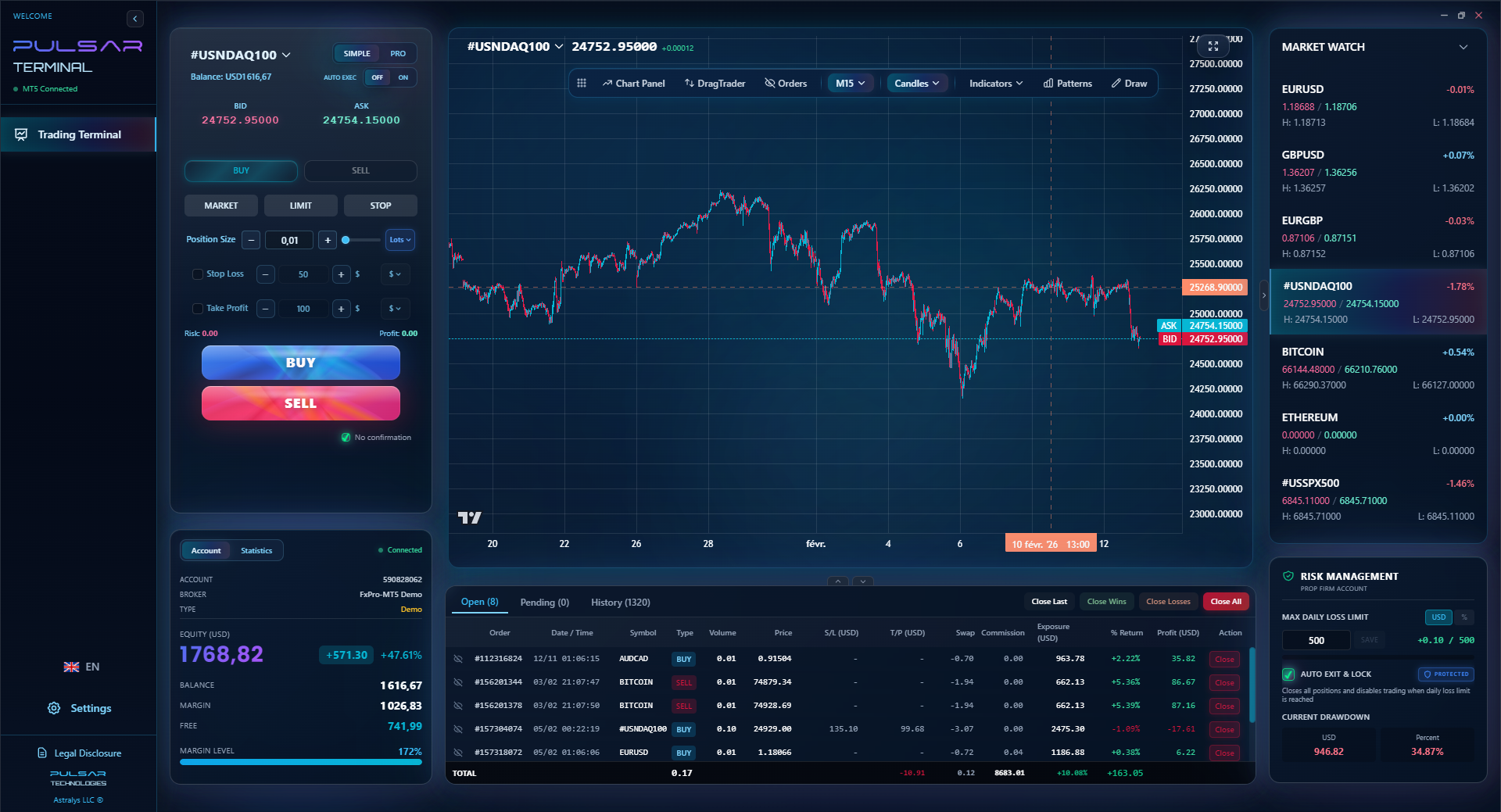
When you've identified a high-probability entry, managing the trade with multiple take-profit levels and a trailing stop is key, and Pulsar Terminal automates this directly on your MT5 platform.
Pulsar Terminal
The all-in-one MT5 companion: drag-and-drop orders, multi-TP/SL, trailing stop, grid trading, Volume Profile, and prop firm protection. Used by 1,000+ traders daily.
Here's a real entry I took recently, documented the way you should.
- Date/Time: April 3, 2024
- Pair: EUR/USD
- Higher Timeframe Trend (Daily): Bearish. Price below 200 EMA.
- Entry Signal (4H Chart): Price approached a clear resistance zone at 1.0850 (previous support). Formed a bearish engulfing candle.
- Confluence: 4H RSI showed bearish divergence (price made a higher high, RSI made a lower high).
- Entry Price: 1.0847 (at the close of the engulfing candle).
- Stop-Loss: 1.0875 (above the recent swing high). Risk: 28 pips.
- Take-Profit: 1.0780 (near next support). Reward: 67 pips.
- Risk/Reward Ratio: 1:2.4 (Good).
- Position Size: Account: $5,000. Risk: 1% = $50. SL distance: 28 pips. Pip value = $50/28 = ~$1.78. Traded 0.18 lots.
- Result: Trade hit take-profit two days later. Profit: $120.60.
Journaling this forces you to justify every decision. Why did you enter there? Why that SL? Over time, you'll see patterns in your winning vs. losing entries. You'll start to see that knowing how to know when to enter a trade in forex is a skill built from reviewing your own data, not just reading articles.
💡 Winston's Tip
If you find yourself constantly tweaking your entry points after the trade is live, your initial plan was weak. Do the work on the chart before you click 'buy' or 'sell.'
“In a market filled with noise, your single biggest advantage is patience. The market will always give you another opportunity.”
In a market filled with noise, FOMO, and get-rich-quick schemes (especially in our Nigerian groups), your single biggest advantage is patience. The market will always give you another opportunity. I've missed perfect setups because I was stuck in traffic on the Third Mainland Bridge. A year later, I can't even remember those trades.
The ones I remember are the impulsive entries I took that burned me. Your job isn't to catch every move. Your job is to catch the high-probability moves that fit your system, manage the risk, and live to trade another day. Pay your 10% to FIRS on consistent profits, not sporadic gambles. Start with a broker that offers realistic conditions for learning, like XM with its low minimum deposit, and build your system one journal entry at a time. The entry is just the first step, but getting it right sets the tone for the entire trade. Now go review your last ten entries. Be brutally honest. That's where the real learning begins.
FAQ
Q1What is the single most important thing to check before entering a forex trade?
The higher timeframe trend. Never enter a trade on a lower timeframe (like 1-hour or 15-min) without knowing the direction of the daily chart. Trading with the trend dramatically increases your odds of success.
Q2How much should I risk on a single forex trade in Nigeria?
Absolutely no more than 1-2% of your total trading capital. On a ₦200,000 account, that's ₦2,000-₦4,000 maximum risk per trade. This protects you from a string of losses wiping you out, especially when using the high use common with brokers here.
Q3Is it better to enter on a market order or a pending order?
For precise, rules-based entries, use a pending limit order. If your system says 'buy if price pulls back to 1.0750 and shows a bullish pin bar,' set a buy limit at 1.0750. This removes emotion and ensures you get your price. Market orders often lead to chasing and worse fills.
Q4How do I handle entering trades around CBN announcements?
Very carefully, or not at all. The volatility is extreme and spreads widen massively. If you must trade news, wait at least 15-30 minutes after the release for the initial spike to settle. Then, look for a technical entry (like a retest of the new level) rather than chasing the initial move.
Q5Why do I keep getting stopped out before the market moves in my direction?
Your stop-loss is probably placed at an obvious level where many other traders have theirs (like a round number). Try placing your stop a few pips beyond a clear swing high or low. Also, ensure your entry isn't too late; entering after a big move has already happened leaves little room for normal retracements.
Q6Can I use use to enter bigger positions with a small account?
You can, but you absolutely shouldn't. use amplifies both profits and losses. Using high use (like 1:500) to enter a large position with a small account means a very small move against you will trigger a margin call. Use use conservatively to control sensible position sizes, not to overextend.
Q7How many entry signals should I act on per day or week?
Quality over quantity. In a good week, I might take 2-3 trades. Some weeks I take zero. Forcing trades leads to overtrading and losses. Set a personal limit (e.g., 3 trades per week) to enforce discipline and wait for only the best setups that meet all your criteria.
Prof. Winston's Lesson
Key Takeaways:
- ✓Always align your entry with the higher timeframe trend.
- ✓Never risk more than 1-2% of your capital on any single trade.
- ✓Use pending orders for precise, emotion-free entries.
- ✓Journal every trade to identify what makes your winning entries work.
How useful was this article?
Click a star to rate
Weekly Trading Insights
Free weekly analysis & strategies. No spam.
About the Author
Olumide Adeyemi
West African Trading Pioneer
One of Nigeria's most active forex trading educators. 8 years of experience trading from Lagos. Specializes in low-capital strategies and prop firm challenges for African traders.
Comments
Risk Disclaimer
Trading financial instruments carries significant risk and may not be suitable for all investors. Past performance does not guarantee future results. This content is for educational purposes only and should not be considered investment advice. Always conduct your own research before trading.
You Might Also Like

Cara Trading Forex Sukses: 7 Prinsip dari Trader Profesional
Cara trading forex sukses dengan 7 prinsip trader pro: manajemen modal, disiplin, journal trading, backtest. Data nyata, bukan janji profit palsu.
Jam Trading Forex Terbaik untuk Trader Indonesia: Panduan Lengkap dengan Tabel Waktu
Panduan jam trading forex untuk trader Indonesia. Tabel 4 sesi dunia, jam emas 20:00-00:00, sesi mana yang harus dihindari. Data akurat + tips dari trader berpengalaman.
Top 5 Sàn Forex Uy Tín Nhất 2026: Review Jujur dari Trader Indonesia
Top 5 sàn forex uy tín 2026 untuk trader Indonesia. Review jujur: spread, deposit, withdraw, dukungan lokal. Exness, XM, IC Markets & lebih.
Get Pulsar Terminal
All these calculators are built into Pulsar Terminal with real-time data from your MT5 account. One-click position sizing, automatic risk management, and instant calculations.
Get Pulsar Terminal